
Most people lose money in the first week of a Meta ads campaign for one reason. They set a budget based on what they feel comfortable spending, not on what the learning phase actually needs. Then Meta cannot gather enough data, the delivery stays unstable, and the cost per result never settles. They blame the creative. They blame the audience. The real problem was the number they typed into the budget box before they pressed publish.
I have spent years running paid social at echoVME Digital, my agency of 500+ brands, and teaching it at Digital Scholar, where more than 1,000 students go through our program every year. The single most common launch mistake I see is a budget that is too small for the result the campaign is optimizing for. The Meta ads learning phase is not a mystery. It is arithmetic. You can do the arithmetic before you spend a single rupee.
This post gives you the exact reverse calculation I use. Work backwards from the cost per result you can accept, multiply by the events Meta needs to exit learning, and you get your launch budget floor. Below that floor, the learning phase is fighting you. At or above it, the learning phase works the way it is supposed to.
You will learn what the Meta ads learning phase really is, the one number Meta actually documents, the Learning-Phase Budget Floor formula that turns your target cost per result into a daily budget, four worked examples with real numbers, how to pick the right optimization event, and what to do when you cannot afford the floor. This is the facebook ads budget math I wish someone had handed me on day one.
- What the Meta ads learning phase actually is
- Why the learning phase is really a budget problem
- The one number Meta documents: about 50 events in 7 days
- The Learning-Phase Budget Floor formula
- Four worked examples across four cost levels
- Picking the right optimization event (event laddering)
- What to do when you cannot afford the floor
- Learning Limited: the trap and how to exit it
- The budget-math checklist before you press publish
- Frequently asked questions
Why listen to me on this
I run echoVME Digital, a performance agency that has managed cumulative ad spend in the hundreds of crores across more than 500 brands. Learning-phase budgeting is not a theory for me. It is a decision I make on live accounts every week, across lead generation, ecommerce, and app installs. I have watched the same Rs 500 daily budget succeed on a Rs 60 landing-page-view campaign and fail completely on a Rs 1,500 purchase campaign, and the only variable that changed was the math behind the number.
At Digital Scholar, our 4-month program puts students on real ad accounts, not screenshots. When a student asks me why their campaign is stuck in Learning Limited, I do not start with the creative. I start with the budget floor. Nine times out of ten, the budget was set too low for the optimization event they chose. Fix the math, and the learning phase sorts itself out. That is what I want to hand you here, the same worksheet I give my Digital Scholar cohorts.
What the Meta ads learning phase actually is
The Meta ads learning phase is the period right after you publish or significantly edit an ad set, during which Meta’s delivery system is still figuring out who to show your ad to and how to get you results at the lowest cost. Performance is unstable during this window because the system is testing, not yet optimizing. It ends when the ad set has gathered enough conversion signal to deliver predictably.
Think of it as the system asking a question. Every time your ad set gets an optimization event, a lead, a purchase, an add to cart, whatever you told it to chase, Meta learns a little more about which people are likely to do that thing cheaply. Early on it has almost no data, so it guesses widely and your cost per result swings. As the events pile up, the guesses narrow and the cost per result settles. That settling is the whole point of the learning phase.
Meta labels each ad set with a delivery status so you can see where it stands. Here is what those states mean in plain language.
| Delivery status | What it means | What you should do |
|---|---|---|
| Learning | The ad set is still gathering data. Results and cost per result are not yet stable. | Do not touch it. Editing resets the phase. Let the events accumulate. |
| Active (learning complete) | The ad set gathered enough events and delivery has stabilised. | Now you can read the numbers and make scaling decisions. |
| Learning Limited | The ad set is unlikely to ever gather enough events to exit learning at the current settings. | This is almost always a budget or event-choice problem. Fix the math. |
The key insight: the learning phase is not something you wait out with patience. It is something you fund. Enough budget for enough events, and it ends. Too little, and it never does.
Why the learning phase is really a budget problem
The learning phase is really a budget problem because exiting it depends on how many optimization events your ad set collects in a fixed window, and the number of events you can collect is capped by how much you spend. Budget buys events. Events end the learning phase. Everything else is downstream of that relationship.
Here is the trap most beginners fall into. They pick a high-value optimization event, a purchase worth thousands of rupees, then fund it with a small daily budget because that is the money they are comfortable risking. But a costly event at a small budget produces very few events per week. The ad set crawls, never reaches the volume it needs, and gets stuck in Learning Limited. The creative might be excellent. The audience might be perfect. The math was wrong before any of that mattered.
This is exactly the mindset shift I teach in the Meta ads objective decision guide. Your objective and optimization event are not just campaign settings, they set the price of a single unit of learning. A cheap event is cheap to learn on. An expensive event is expensive to learn on. If you cannot afford to learn on the expensive event, you have to change something, and the honest way to know that is to do the arithmetic first.
The one number Meta documents: about 50 events in 7 days
Meta documents one concrete threshold for exiting the learning phase: an ad set generally needs to gather around 50 optimization events within roughly 7 days of its last significant edit. That is the guidance published in Meta’s own advertiser help resources, and it is the anchor for every budget calculation in this post. It is a guideline, not a physical law, and Meta can and does adjust it, so treat it as a planning number rather than a promise.
Two words in that sentence matter more than the rest. “Optimization events”, not clicks, not impressions, not reach. The 50 has to be the specific event you optimized the ad set for. If you optimize for purchases, you need about 50 purchases. If you optimize for leads, about 50 leads. And “per ad set”, not per campaign and not per account. Each ad set has to clear its own bar, which is why spreading a small budget across many ad sets is one of the fastest ways to get every one of them stuck.
Once you accept 50-in-7 as your target, the budget question answers itself. If you know what one event costs, you know what 50 events cost, and 50 events is one week of learning. That is the entire formula, and I will build it now.
The Learning-Phase Budget Floor formula
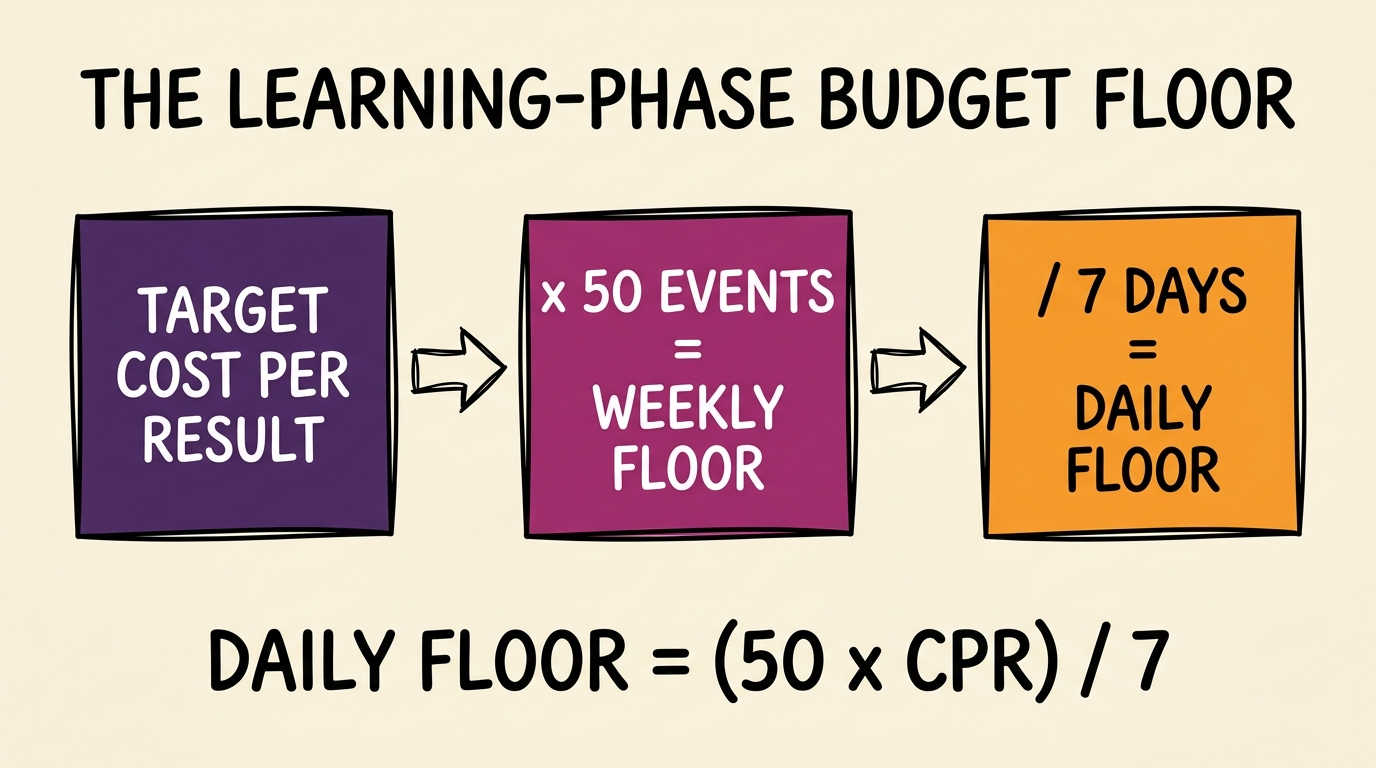
The Learning-Phase Budget Floor is the minimum daily budget an ad set needs to have a realistic chance of exiting the learning phase, and you calculate it by working backwards from your target cost per result. The formula is simple enough to run on your phone before you launch.
This is the named framework I teach at Digital Scholar, and it has exactly three steps.
- Step 1, set your target cost per result. What can you afford to pay for one optimization event and still make the unit economics work? Ground this in your break-even ROAS math, not in a number you hope for.
- Step 2, multiply by 50. That is your weekly budget floor, the money it takes to buy roughly 50 events in a week at your target cost.
- Step 3, divide by 7. That is your daily budget floor, the number that actually goes into the ad set.
Written as one line, the Learning-Phase Budget Floor is:
Daily budget floor = (50 × target cost per result) ÷ 7. Weekly budget floor is simply 50 times your target cost per result. If you cannot commit to that daily number for at least a full week without editing the ad set, you are not ready to launch that event yet.
One rule protects the whole formula. Do not edit the ad set during the week. Every significant edit, a budget change beyond a modest range, a new audience, a swapped optimization event, resets the learning phase and burns the events you already paid for. Fund the floor, then leave it alone. This is the same discipline I stress in our Meta ads creative testing framework, where the whole point is to change one thing at a time and let the system read it cleanly.
Four worked examples across four cost levels
The fastest way to make the formula stick is to run it at four cost levels, from a cheap lead to an expensive purchase. Each row below applies the same Learning-Phase Budget Floor calculation, so you can find the row that looks like your business and read your number straight off the table.
| Target cost per result | Events to exit (Meta guidance) | Weekly budget floor | Daily budget floor | Who this looks like |
|---|---|---|---|---|
| Rs 200 per lead | 50 | Rs 10,000 | Rs 1,429 | Low-friction lead form, broad service |
| Rs 500 per lead | 50 | Rs 25,000 | Rs 3,571 | Mid-ticket coaching, local services |
| Rs 1,000 per result | 50 | Rs 50,000 | Rs 7,143 | Qualified lead or low-ticket ecommerce sale |
| Rs 2,000 per purchase | 50 | Rs 1,00,000 | Rs 14,286 | Higher-AOV ecommerce, considered purchase |
Look at the last row. A brand selling a product with a Rs 2,000 acquisition cost needs roughly Rs 14,286 a day to give the purchase-optimized ad set a fair shot at learning. That is not a number most first-time advertisers expect. When a founder tells me they tried Meta ads with Rs 1,000 a day for a Rs 2,000 purchase and it did not work, I do not need to see the account. The event was seven times more expensive than the daily budget could ever feed. It was mathematically stuck from launch.
At echoVME, this table is the first thing we build for any new performance client before we write a single line of ad copy. We take their break-even cost per result, drop it into the floor formula, and immediately know whether their budget matches their ambition. Often the honest conversation on day one is not about creative at all. It is about whether the budget can fund the event they want, or whether we need to change the event. That is the whole reason the channel and budget decision has to come before the creative decision, never after.
Picking the right optimization event (event laddering)
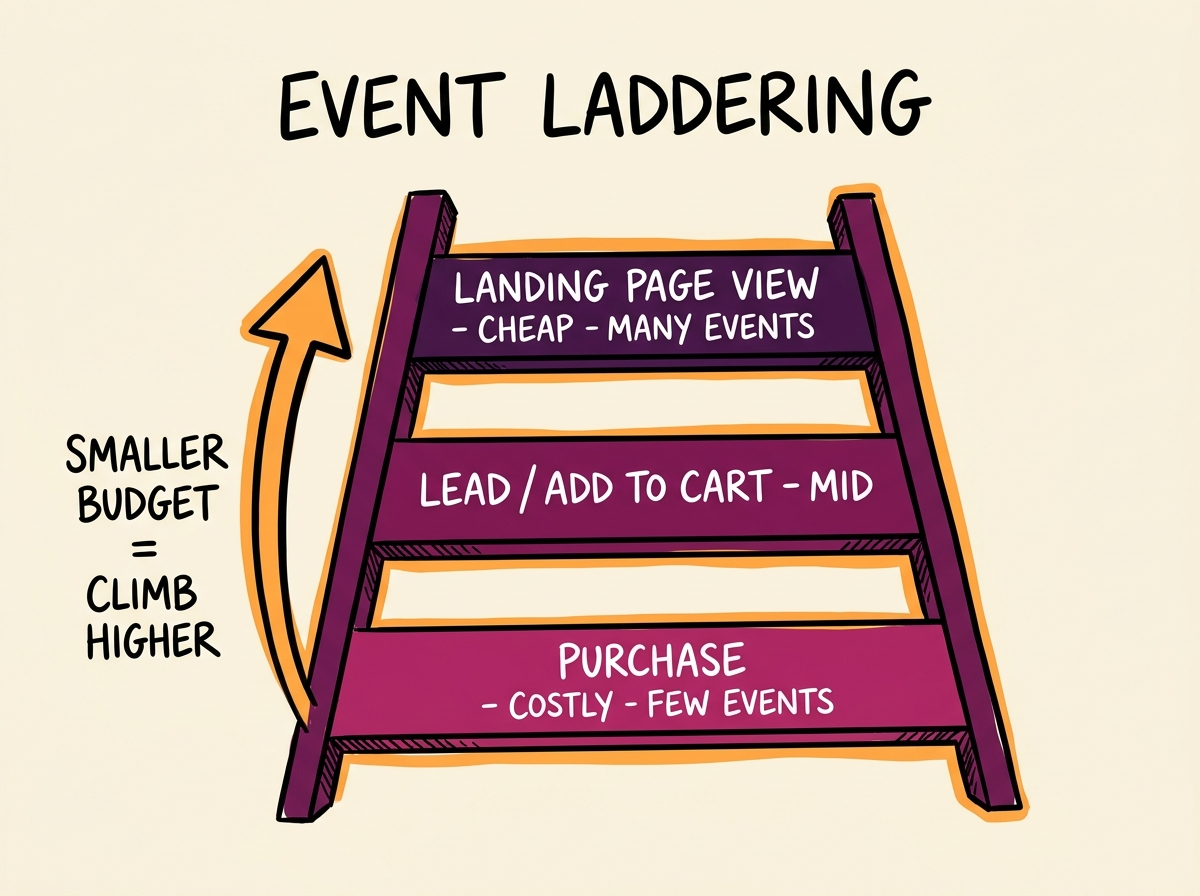
If your budget floor for the ideal event is out of reach, the smartest move is often to optimize for a cheaper event higher up the funnel, gather learning faster, and move down the funnel once you have data and volume. I call this event laddering, and it is the single most useful lever when the budget will not stretch to the purchase-optimized floor.
The logic is straightforward. Events higher in the funnel happen more often and cost less each, so 50 of them is cheaper to buy in a week. A landing page view might cost Rs 40. An add to cart might cost Rs 250. A purchase might cost Rs 2,000. The same daily budget buys wildly different event volumes depending on which one you chase, and event volume is what ends the learning phase.
| Optimization event | Illustrative cost each | Weekly floor for 50 events | When to use it |
|---|---|---|---|
| Landing page view | Rs 40 | Rs 2,000 | Tiny budgets, cold traffic, top of funnel proof of interest |
| Lead / add to cart | Rs 250 | Rs 12,500 | Mid budgets, when you need intent signal without full purchase cost |
| Purchase / qualified lead | Rs 2,000 | Rs 1,00,000 | Larger budgets, when you can fund learning on the money event directly |
Event laddering is one of the first plays we drill into every Digital Scholar cohort, because it keeps beginners live and learning instead of stuck. It is not a permanent compromise. It is a bridge. You launch on the cheaper event to exit learning and prove the funnel converts, then once you have enough purchase data in the account, you graduate the same campaign structure to purchase optimization at a budget you can now justify. This is where your choice of lead destination matters too, because a WhatsApp or instant-form lead behaves differently from a website conversion, something I break down in the Meta lead ads destination matrix.
What to do when you cannot afford the floor
When your budget cannot fund the floor for the event you want, you have three honest moves, and all three are better than launching underfunded and hoping. Do not launch a purchase campaign on a landing-page-view budget and expect purchases to appear. Pick one of these instead.
Move 1: Climb the event ladder
Optimize for a cheaper upstream event so your budget can actually buy 50 of them in a week. This is event laddering from the section above. It is the first move I reach for, because it keeps the campaign live and learning instead of stuck. You give up some precision now to buy stability, and you graduate to the money event once the account has data.
Move 2: Consolidate your ad sets
If you split a small budget across four ad sets, each one gets a quarter of the events and all four stall. Collapse them into one or two ad sets so the budget concentrates and at least one clears the 50-event bar. Broader audiences and fewer ad sets are usually the right answer on small budgets, and campaign-budget optimization lets Meta pool the spend where events are cheapest.
Move 3: Extend the runway, not the daily budget
If you genuinely cannot raise the daily number, accept that learning will take longer than 7 days and give it more calendar time before you judge it. This is the weakest of the three moves because slow learning means unstable delivery for longer, but it is honest. What you must not do is keep editing the ad set out of impatience, because every edit resets the clock and wastes the events you already bought.
Across hundreds of echoVME launches, Move 1 and Move 2 together solve the large majority of underfunded starts. Move 3 is the fallback when the budget is simply fixed. If none of the three feel workable, that is real information: the budget may be too small for paid social to be the right channel yet, and you may get further with organic and retargeting warm audiences first, which is exactly what the custom audience ladder is built for.
Learning Limited: the trap and how to exit it
Learning Limited means Meta has concluded your ad set is unlikely to ever gather the roughly 50 events it needs to exit learning at its current settings, so delivery stays inefficient and your cost per result stays higher than it should. It is not a temporary status you wait out. It is the system telling you the math does not add up, and it will keep telling you until you change something.
The causes are almost always one of a short list: the budget is below the floor for the chosen event, the budget is split across too many ad sets, the audience is too narrow to deliver enough events, or the optimization event is too rare and expensive for the spend. Notice that three of those four are budget-math problems, which is why the Learning-Phase Budget Floor formula prevents most Learning Limited situations before they happen.
To exit Learning Limited, raise the budget to the floor, consolidate ad sets, broaden the audience, or move to a cheaper optimization event, then leave the ad set alone for a full week. Pick the fix that matches the cause, make one change, and resist the urge to keep tweaking. If you diagnose it like this, calmly and by the numbers, Learning Limited stops being a mystery and becomes a checklist. This diagnostic mindset is the same one that separates the confident practitioners from the guessers, which is a theme that runs through our performance marketing interview questions as well.
The budget-math checklist before you press publish
Before you launch any Meta ads campaign, run this five-point checklist. It takes about two minutes and it is the difference between a learning phase that works and a week of wasted spend. This is the exact pre-flight list I have my Digital Scholar students run on every campaign they build.
- Know your target cost per result. Derived from your margins and break-even, not a hopeful guess.
- Calculate the daily floor. (50 × target cost per result) ÷ 7. Write the number down.
- Confirm you can fund the floor for 7 full days without editing the ad set.
- Check your event choice against your budget. If the floor is unaffordable, climb the event ladder before you launch, not after.
- Count your ad sets. On a small budget, one or two ad sets beats four. Concentrate the spend.
If all five pass, launch and do not touch the ad set for a week. If any fail, fix the math first. A campaign built on this checklist starts its learning phase with a real chance of finishing it, and that is the entire game in the first week of any account. Everything I teach about scaling in the how to learn performance marketing guide and inside the Digital Scholar program assumes you cleared this bar first.
Want to run this on real ad accounts, not slides?
Our 4-month program at Digital Scholar puts you on live Meta ad accounts and teaches the budget math, the frameworks, and the AI workflows we use at echoVME Digital across 500+ brands. You leave able to launch, diagnose, and scale a campaign without guessing.
Frequently asked questions
How do I calculate a Facebook ad budget for the learning phase?
Work backwards from your target cost per result. Take the amount you can pay for one optimization event, multiply it by the roughly 50 events Meta says an ad set needs to exit learning, and that is your weekly floor. Divide by 7 for the daily budget. For a Rs 500 lead, that is (50 x 500) divided by 7, which is about Rs 3,571 a day. At echoVME we build this number first for every new account, before creative or targeting.
What is the minimum budget for a Facebook ad campaign?
There is no single minimum. The real minimum is whatever funds about 50 of your chosen optimization event in a week. For a cheap landing page view at Rs 40, that can be as low as Rs 2,000 a week. For a Rs 2,000 purchase, it is closer to Rs 1,00,000 a week. The event you optimize for sets the minimum, not a flat rupee figure, which is why event choice and budget must be decided together.
How do I decide the budget for my Facebook ads?
Start from unit economics, not from a number you are comfortable spending. Use your break-even cost per result as the target, run the Learning-Phase Budget Floor formula, and that gives you the floor for the event you want. If you cannot fund that floor, either climb the event ladder to a cheaper event or consolidate your ad sets so the spend concentrates. Deciding budget without doing this math is the most common reason campaigns stall at Digital Scholar student launches too.
How long does the Facebook ads learning phase last?
Meta’s guidance is that an ad set exits learning once it gathers around 50 optimization events, usually within about 7 days of the last significant edit. If your budget funds those events, roughly a week is normal. If it does not, the phase drags on or the ad set slips into Learning Limited and never truly exits. Time is not the lever. Event volume is, and event volume is bought with budget.
When should I increase my Facebook ad budget?
Wait until the ad set has exited learning and delivery is stable, then scale in modest steps rather than large jumps. A large sudden budget increase can re-trigger the learning phase and undo your stability. At echoVME we typically raise budgets in measured increments on winning ad sets and watch the cost per result hold before the next step. Scale the winners you have proven, do not gamble on unproven ad sets by pouring money in early.
What is a good budget for Facebook ads for a small business?
A good starting budget is one that can fund 50 of a realistically cheap optimization event in a week. For many small businesses that means starting on leads or landing page views rather than purchases, so a floor of Rs 10,000 to Rs 25,000 a week is a sensible entry range depending on your cost per lead. Chasing high-value purchase events on a tiny budget is where small businesses waste money. Start where your budget can actually fund learning.
How does the Facebook ad budget actually work during learning?
Your budget is spent buying auctions, and each result you get is an optimization event that teaches the system who to target. During learning, Meta spends more experimentally to gather that signal, so your cost per result is higher and less stable than it will be later. Once about 50 events land, delivery settles and efficiency improves. So the budget is not just paying for results in week one, it is paying tuition for the learning that makes weeks two onward cheaper.
The learning phase is where most Meta ads budgets quietly leak, and it is also the easiest leak to seal, because it is arithmetic and not art. Decide the cost per result you can afford, fund the 50 events it takes to learn, resist every urge to edit for a week, and the phase does its job. Get this one number right before you launch and half of the problems people spend months chasing simply never appear.
Do the math today. Open your next campaign, write down your target cost per result, run (50 times that number) divided by 7, and set that as your daily floor. If you cannot fund it, climb the event ladder before you press publish, not after you have burned a week. That is the play.