
Here is the honest state of social media in 2026. More than 86% of social media professionals now use AI to write posts, and 59.5% use it specifically for content ideation and trend research. Teams that adopt it report roughly 45% time savings on content creation and a 52% jump in posting consistency. The people ignoring AI are not staying pure. They are just working three times slower than the person next to them.
But here is the trap almost everyone falls into. They open ChatGPT, type “write me 30 Instagram captions”, paste the output, and wonder why engagement drops. At echoVME, we run social media for brands across e-commerce, education, and services, and I run the Digital Scholar accounts myself. I have seen AI turn a two-person social team into a machine that ships 10 times the content. I have also seen it flatten a brand’s voice into grey mush in under a month. The difference is never the tool. It is the system.
This guide is how to use AI for social media marketing the way a practitioner does. Not a tool list. A repeatable loop. You will get the exact six-stage system my team runs at echoVME and Digital Scholar, the tools we actually pay for, the places AI quietly kills your engagement, and a 7-day plan you can copy this week. Every claim here carries a number, because that is the only kind of claim worth trusting.
By the end of this post you will know exactly how to use AI for social media marketing across listening, ideation, creation, scheduling, engagement, and analytics. You will get a named framework (The Social AI Loop), a content-repurposing multiplier that turns one idea into ten posts, a tested tool table, and a copy-paste 7-day plan. This is the AI social media system we teach inside Digital Scholar.
TL;DR:
- AI for social media marketing means using AI across six stages: listening, ideation, creation, scheduling, engagement, and analytics. It does the reps. You keep the voice and the judgment.
- The win in 2026 is speed with a spine. AI can cut content creation time by 45%, but only a human keeps the brand sounding like a brand instead of a template.
- Repurposing is the real unlock. One strong idea becomes 10 posts across formats. That multiplier, not raw generation, is where AI pays for itself.
- The tools worth paying for are few. I use maybe five, not fifty. The table below shows which and why.
- Who this is for: founders, social media managers, and marketing teams in India who want a real workflow, not another listicle. If you post weekly and want AI to make it faster and better, start with The Social AI Loop.
- What is AI for social media marketing in 2026
- Why listen to me on this
- The Social AI Loop (the framework)
- Stage 1: Listen (research and social listening)
- Stage 2: Ideate (hooks, angles, and calendars)
- Stage 3: Create (captions, images, and video)
- Stage 4: Schedule and repurpose
- Stage 5: Engage (comments, DMs, and community)
- Stage 6: Learn (analytics and optimization)
- The Content Repurposing Multiplier
- Where AI quietly kills your engagement
- The AI social media tools I actually pay for
- A 7-day AI social media workflow you can copy
- Frequently asked questions
What is AI for social media marketing in 2026
AI for social media marketing is the practice of using artificial intelligence to do the repetitive, data-heavy parts of running social accounts faster: researching trends, brainstorming hooks, drafting captions, generating images and video, scheduling, replying to comments and DMs, and reading performance data. In 2026 it also means using AI to personalize content at a scale a human team simply cannot match by hand.
Here is what changed, in numbers. Adoption crossed the tipping point: 86% of social media professionals now use AI for writing, and content ideation with AI cuts brainstorming time by an estimated 60% to 83%. Brands running AI-assisted social workflows report 45% time savings on creation, a 38% lift in engagement rates, and 52% better posting consistency. The bar for “just showing up regularly” got much lower, which paradoxically makes standing out much harder.
Read those numbers together and the strategy writes itself. When everyone can produce more, volume stops being an edge. Voice, point of view, and genuine audience understanding become the edge. So AI for social media marketing in 2026 is not “let the robot post for you”. It is using AI to remove the busywork so your team spends its hours on the two things AI cannot fake: original ideas and real relationships. The Digital Scholar social system is built entirely around that split, and it is the same one we teach echoVME clients.
Why listen to me on this
Because I run this every day, at scale, with real budgets on the line. I am the Co-Founder of Digital Scholar, where we train 1,000+ students a year in AI and digital marketing, and the CEO of echoVME Digital, where we have managed over Rs 400 crore in cumulative ad spend across 500+ brands. Social media is not a side hobby for us. It is a core service and, for Digital Scholar, our biggest owned channel.
The Digital Scholar and echoVME accounts you can go check right now are a live experiment in AI-assisted, human-led social media. We use AI to research trends and draft, then a human rewrites for voice, adds a real opinion or a number nobody else has, and ships. That is why the content still sounds like a person and not a prompt. I will hand you the exact same method, stage by stage.
I will also be honest about the failures. In 2025 we tried letting AI write and schedule a full week of captions with only light edits, to save time. Reach held for about three weeks, then engagement rate slid roughly 30% because every post started sounding the same. We went back to human-led editing on every caption and it recovered. That mistake is baked into every rule in this post. I am not selling you AI. I am telling you what it costs to use it lazily.
The Social AI Loop (the framework)
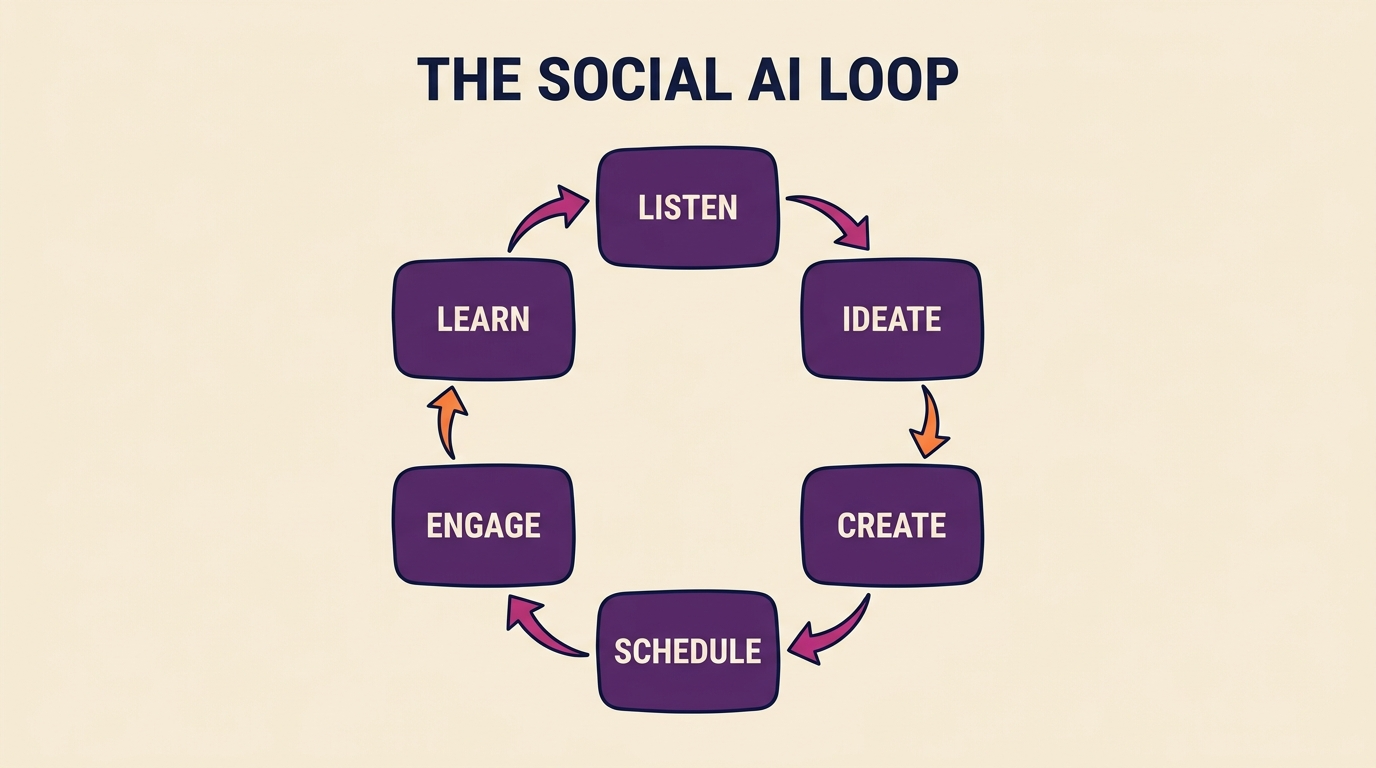
The Social AI Loop is the framework we use at Digital Scholar to decide where AI belongs in social media and where a human must stay in control. It has six stages that run in a loop, not a line, because social media never stops: Listen, Ideate, Create, Schedule, Engage, and Learn. Each stage has a clear split between what AI does and what you own.
The principle that runs through all six stages is the same one behind every system we teach: AI does the reps, you keep the voice. AI can generate 50 caption variations in a minute. It cannot decide which one sounds like your brand, or which one makes a promise you can actually keep. That judgment is yours, every single post.
| Stage | What AI does (the reps) | What you own (the voice and calls) |
|---|---|---|
| 1. Listen | Summarize trends, comments, and competitor posts at scale | Decide which signals actually match your brand and audience |
| 2. Ideate | Generate hooks, angles, and a full content calendar | Pick the ideas worth your brand’s name and point of view |
| 3. Create | Draft captions, images, video scripts, and variations | Rewrite for voice, add the one real story or number |
| 4. Schedule | Slot posts at optimal times, reformat across platforms | Sign off on the mix, timing, and final assets |
| 5. Engage | Draft replies, sort DMs, flag urgent messages | Handle real conversations and complaints as a human |
| 6. Learn | Read analytics, spot patterns, suggest what to double down on | Decide what to change and what to protect |
Stage 1: Listen (research and social listening)
Use AI first to listen, not to talk. Feed it your comment sections, competitor feeds, trending audio lists, and your own last 90 days of posts, then ask it to summarize what your audience actually reacts to. This turns a full day of manual scrolling into about 45 minutes of reading a tight summary, and it is the stage most people skip straight past on their way to generating captions.
My workflow is simple. I export our post performance and paste it into an AI assistant with a clear prompt: group these by format and topic, tell me which hooks pulled the most saves and shares, and flag three content gaps competitors are filling that we are not. The same approach powers our Instagram audit using AI walkthrough, where the tool does the pull and the human reads the story behind the numbers.
Here is the part people get wrong. AI will confidently tell you a trend is hot when it is already dead, because its training data lags. Use it to organize signals, not to source them. The live pulse still comes from you actually being on the platform. At echoVME, our best-performing campaigns almost always start from a comment a human noticed, then AI helped us scale the insight into a week of content.
The key insight: AI is a brilliant research assistant and a terrible trend scout. Let it summarize what you feed it. Do not let it tell you what is trending right now.
Stage 2: Ideate (hooks, angles, and calendars)
Ideation is where AI earns its subscription fee. Give it your positioning, your audience, and one strong topic, and ask for 20 hooks, 10 content angles, and a two-week posting calendar mapped to formats. What used to be a painful planning meeting becomes a 30-minute editing session where you cut the weak 80% and keep the sharp 20%.
The trick is context. A lazy prompt gives you lazy ideas. Before I ask for anything, I tell the assistant what Digital Scholar does, who we serve, our tone, and what we never say. The more specific the brief, the less generic the output, which is exactly the discipline I break down in how to use ChatGPT for digital marketing and how to use Gemini for digital marketing. Both cover the exact prompting patterns that turn a generic assistant into a brand-aware one.
Here is the part you own. AI will happily hand you 20 hooks. Your job is to reject the 16 that sound like every other account. The four that survive are the ones with a real opinion, a specific number, or a story only your brand has. That selection is the whole skill. We drill it constantly at Digital Scholar, because a marketer who can prompt is common, and a marketer who can judge is rare.
Stage 3: Create (captions, images, and video)
Use AI to draft captions, generate images, and script video, then have a human add the parts that make content worth following: a real voice, a defensible opinion, and a specific detail. Creation is the stage where AI helps the most and does the most damage when used lazily, exactly like it does in content marketing and SEO.
For captions, I never publish the first draft. I ask for three versions in our voice, then I rewrite the winner by hand so it sounds like a human wrote it at 11pm because they cared, not like a template. For visuals, AI image tools now produce scroll-stopping graphics in seconds, and the same craft that goes into AI creative for Meta Ads applies directly to organic social. The rule there holds here: a specific brief beats a vague wish every time.
Video is where 2026 changed the most. AI can now turn a blog post into a short-form script, generate captions and voiceover, and suggest B-roll, cutting reel production time by more than half. But the hook still has to come from a human who understands the audience. Is an AI-drafted caption as good as one I write from scratch? Honestly, about 70% as good before editing. The edit is where the other 30% and all the trust live. Do not cheat on the edit. If you want to see how far a well-built AI workflow carries the busywork, I documented how I replaced five hours of daily agency work with Claude routines, and the same discipline applies to content.
Stage 4: Schedule and repurpose
Use AI-powered scheduling tools to slot posts at optimal times and, more importantly, to reformat one piece of content across every platform automatically. This is where consistency stops being a willpower problem. Brands using AI social tools report a 52% improvement in posting consistency, and consistency is what the algorithm rewards most reliably.
The scheduling side is mostly solved. Tools now predict the best posting slots from your own audience data and auto-adjust as behavior shifts. The bigger win is reformatting. A single LinkedIn post can become an Instagram carousel, a reel script, a tweet thread, and a WhatsApp broadcast with AI handling the format conversion while you check the tone. We do exactly this for Digital Scholar, and it is why one strong idea shows up on five channels in the same week instead of dying on one.
One caution from experience. Auto-scheduling makes it dangerously easy to go on autopilot and stop watching. Never fully automate the calendar and walk away. A tone-deaf scheduled post that lands during a crisis or a sensitive news moment can damage a brand more than a week of silence. Keep a human eye on what is queued, especially on the days that matter.
Stage 5: Engage (comments, DMs, and community)
Use AI to triage engagement, not to replace it. AI-powered chatbots can handle common questions instantly, sort your DMs by intent, and flag the messages a human needs to answer, ensuring fast response times while freeing your team for the conversations that actually build loyalty. Used well, this is how a small team keeps up with a growing audience without burning out.
Here is my hard line. Anything that looks like a real relationship, a complaint, a sales question, a genuine thank you, gets a human. AI can draft the reply and speed you up, but a customer can smell a canned bot answer in one sentence, and nothing kills trust faster. For a brand like Digital Scholar, where students often DM before enrolling, a warm human reply is worth more than any automation. We let AI sort and draft, and a person always sends.
The math still favors AI here. A chatbot answering routine questions like course timings or pricing can deflect a large share of repetitive DMs, which at echoVME frees hours of team time every week for real community building. The goal is not to remove humans from conversations. It is to make sure humans only spend their time on the conversations that deserve it.
Stage 6: Learn (analytics and optimization)
Close the loop by feeding your performance data back into AI to find patterns a human would miss. Pull your monthly analytics, hand it to an assistant, and ask it to tell you which formats, topics, and posting times drove the most saves, shares, and profile visits, then what to do more of. This turns a spreadsheet you dread into a clear set of next moves in about 20 minutes.
What AI is genuinely good at here is spotting non-obvious correlations. It might notice that your carousels outperform reels for saves but reels win for reach, so the right move is carousels for depth and reels for discovery. That is a real insight from real data, and it is exactly the kind of thinking we apply across paid and organic, the same way we do in the Meta Ads creative testing framework.
The judgment stays yours. AI will suggest you post more of whatever performed best last month, which can quietly narrow your brand into a one-note account chasing its own tail. You decide what to protect, what to test, and when a dip is noise versus a signal. Data tells you what happened. Only you can decide what it means for the brand you are building.
The Content Repurposing Multiplier
The single highest-return use of AI in social media is repurposing. One strong idea, run through AI, becomes ten pieces of content across formats and platforms in the time it used to take to make one. This is the multiplier that actually justifies the tools, far more than raw caption generation. Here is the exact fan-out we run at Digital Scholar for one core idea.
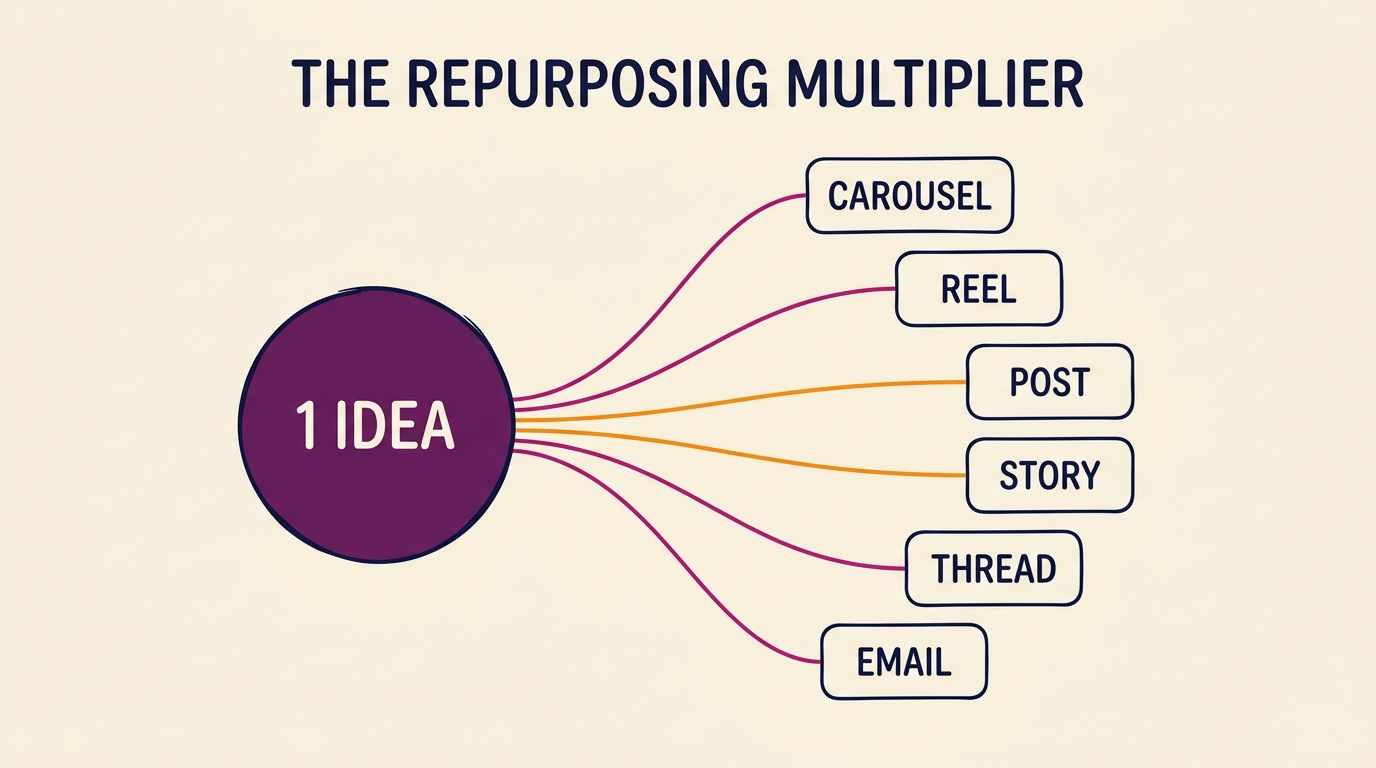
| From one idea, AI helps you make | Platform | Human still adds |
|---|---|---|
| 1. Carousel (5 to 8 slides) | Instagram, LinkedIn | The hook slide and the one real example |
| 2. Reel or short script | Instagram, YouTube | The first-3-second hook and delivery |
| 3. Text post | LinkedIn, X | A specific number or opinion |
| 4. Story sequence | A poll or question that invites replies | |
| 5. Long caption | A personal story from your work | |
| 6. Thread | X | The contrarian take that starts it |
| 7. WhatsApp broadcast | A warm, direct opening line | |
| 8. Email snippet | Newsletter | The one takeaway that matters |
Notice the pattern. AI handles the format conversion, which is pure mechanical work. You add the one human element per piece that makes it worth engaging with. Eight formats, eight small human touches, one afternoon. That is a week of content from a single strong idea, and it is why a lean team at echoVME can out-publish a much larger one that still makes every asset from scratch.
Where AI quietly kills your engagement
AI hurts your social media in three specific ways, and all three are self-inflicted: flattening your brand voice, faking engagement with bots, and trusting hallucinated facts in public. None of these are the platform punishing AI. They are your audience noticing that a human stopped caring.
The first killer is voice collapse. When every caption comes from the same default AI tone, your brand becomes indistinguishable from every other account using the same tool, and follows stall. The second is fake engagement, letting bots reply to everything until your comment section reads like a call center script, which erodes the exact trust social media is supposed to build. The third is hallucination, posting an AI-generated stat or claim that turns out to be wrong, in public, where a screenshot lives forever.
| Task | AI helps | AI hurts if |
|---|---|---|
| Ideation | Generating hooks and angles fast | You post every idea it gives you |
| Captions | First drafts and variations | You publish them unedited in a flat tone |
| Facts and stats | Summarizing sources you provide | You post numbers it made up |
| Engagement | Sorting DMs and drafting replies | A bot handles real conversations |
| Scheduling | Optimal timing and reformatting | You automate and stop watching the queue |
This is exactly the discipline we drill across Digital Scholar and inside every echoVME engagement. AI is a power tool. Power tools are how you build fast and also how you get hurt when you stop paying attention. Respect for the tool is the whole skill, and it is what separates a marketer who scales from one who slowly becomes forgettable.
The AI social media tools I actually pay for
I have tested more than 40 AI social media tools across echoVME and Digital Scholar. I pay for about five. The rest are either features that already live inside tools I own, or novelty that does not survive a month of real use. Here is the short list that earns its keep, by job.
| Tool type | Use it for | My honest verdict |
|---|---|---|
| A general AI assistant (ChatGPT, Gemini, or Claude) | Ideation, hooks, caption drafts, repurposing, analytics reading | The workhorse. One good subscription covers 80% of the work. |
| An AI image tool (nano-banana class or Canva AI) | Scroll-stopping graphics, carousels, thumbnails | Huge time saver. Brief it tightly or it looks generic. |
| An AI video and reel editor | Captions, cuts, voiceover, blog-to-reel scripts | Cut our reel production time by more than half. Worth it if you post reels weekly. |
| An AI-powered scheduler (with listening) | Optimal timing, cross-platform reformatting, social listening | Where consistency becomes automatic. Pick one with real analytics. |
| An engagement and DM assistant | Sorting DMs, drafting replies, routine chatbot answers | Great for triage. Never let it send the important replies. |
Notice what is not on this list: the 30 single-purpose apps promising to auto-run your entire account. I would not pay for those unless you enjoy fixing what they break. The full reasoning is in my guide to the best AI tools for digital marketing. Fewer tools, used with judgment, beats a bloated stack every time. That is true for social media, and it is true for the whole performance marketing tool stack too.
A 7-day AI social media workflow you can copy
Here is a 7-day plan that puts The Social AI Loop into motion without overwhelming you. It assumes you have one AI assistant and one scheduler. That is enough to start. The goal by day 7 is not 100 posts. It is one strong idea turned into a full week of content, plus a system you can repeat every week after.
| Day | Focus | What you do with AI |
|---|---|---|
| Day 1 | Listen | Feed AI your last 90 days plus 3 competitors. Get a summary of what works and 3 gaps. |
| Day 2 | Ideate | Brief AI on your brand. Get 20 hooks and a week’s calendar. Keep the sharp 4 ideas. |
| Day 3 | Create the anchor | Turn one idea into a carousel and a reel script. You write the hooks and add one real story. |
| Day 4 | Repurpose | Fan the anchor into 8 formats with the multiplier. Add one human touch per piece. |
| Day 5 | Schedule | Load the week into your scheduler at optimal times. You sign off on tone and mix. |
| Day 6 | Engage | Set up DM sorting and reply drafts. You answer every real conversation as a human. |
| Day 7 | Learn | Review the week’s data with AI. Decide what to protect and what to test next week. |
Run that loop every week and in a quarter you have a content engine that compounds instead of exhausting you. That is how a brand actually grows on social media, not by posting more, but by posting smarter with a system. It is the same engine behind how we grew the Digital Scholar accounts, and the same one we teach students to run for their own brands and clients, right alongside skills like choosing the right Meta Ads objective and building a Facebook retargeting audience ladder.
Want to run this system end-to-end?
The Digital Scholar 4-month AI and Digital Marketing program teaches the exact AI-assisted, human-led social media workflow in this post, plus performance marketing, content, and AI agents, with live projects. You can visit us at Sapna Trade Centre, 1B, 135, Poonamallee High Road, Purasaiwakkam, Chennai, Tamil Nadu 600084, or call +91 95136 32705 to learn more about the program. With 1,000+ students training with us every year, we offer practical learning through hands-on projects.
Frequently asked questions
How is AI used in social media marketing?
AI is used across six stages of social media marketing: listening and research, content ideation, creation of captions and visuals and video, scheduling and repurposing, engagement through DM and comment triage, and analytics. More than 86% of social professionals now use AI for writing, and teams report about 45% time savings on content creation. The rule that works is simple: AI does the repetitive reps, and a human keeps the brand voice and handles real conversations.
Can AI run my social media on its own?
No, and you should not want it to. AI can draft, schedule, and triage, but it cannot set strategy, judge what fits your brand, build genuine community, or handle a complaint with real care. At echoVME we let AI sort and draft, but a human always sends the important replies and signs off on the calendar. Fully automated accounts flatten into generic feeds that audiences quietly stop following. AI does the reps. You keep the voice.
What is the best AI tool for social media marketing?
There is no single best tool; there is a best stack. You need a strong general AI assistant for ideation and drafting (ChatGPT, Gemini, or Claude), an AI image tool for graphics, an AI video editor if you post reels, an AI scheduler with social listening, and a DM assistant for engagement triage. I have tested 40+ tools and pay for about five. Fewer tools used well beats a bloated stack every time.
Does AI content hurt engagement on social media?
AI content hurts engagement only when it is published unedited in a flat, generic voice. The platforms do not penalize AI for being AI; audiences simply disengage from content that sounds like everyone else. We saw this ourselves in 2025 when lightly edited AI captions dropped our engagement rate about 30% in a few weeks. Human-led editing fixed it. Used to draft and speed you up, AI can lift engagement; used to replace your voice, it kills it.
How much time does AI save on social media content?
Brands using AI social tools report around 45% time savings on content creation and 60% to 83% faster ideation, plus a 52% improvement in posting consistency. The biggest single saving is repurposing: turning one idea into eight or ten formats in an afternoon instead of a week. The saved hours are best reinvested in the two things AI cannot do, original ideas and real audience relationships.
Can AI create Instagram reels and video content?
Yes. In 2026 AI tools can turn a blog post or idea into a short-form script, generate captions and voiceover, suggest B-roll, and auto-cut footage, which cuts reel production time by more than half. But the first-3-second hook and the delivery still need a human who understands the audience. Use AI to remove the editing grind, not to replace the creative judgment that makes a reel stop the scroll. The same craft applies to paid creative, which I cover in the AI creative for Meta Ads guide.
How do I start using AI for social media if I am a beginner?
Start with the 7-day loop in this post: one AI assistant and one scheduler. Use AI to listen and ideate, turn one idea into a week of content with the repurposing multiplier, add one human touch per piece, then schedule and engage as a human. If you want structured, hands-on training with live projects, that is exactly what the Digital Scholar 4-month program is built to teach.
The bigger picture
Social media is not being taken over by robots. It is being rebuilt so that the busywork disappears and the human parts matter more than ever. Everyone now has the same AI tools, which means the tools stop being the advantage. Voice, judgment, and real relationships become the advantage. That is good news if you actually care about the audience you are building.
So here is your one instruction for today: pick a single idea your brand genuinely believes in, run it through The Social AI Loop, and add the one human touch per piece that no prompt can produce. Ship a week of content from it. That is how to use AI for social media marketing in a way that compounds your brand instead of erasing it.
The tools are ready. The system is above. The only thing missing is you actually running it.