Most teams do not have a Meta Ads creative testing problem. They have an idea-generation problem disguised as a testing problem.
They make one ad, change the background colour four times, call those five creatives, and wait for Meta to find a winner. When performance drops, they repeat the same process with a different photograph. That is not creative diversity. It is one idea wearing five shirts.
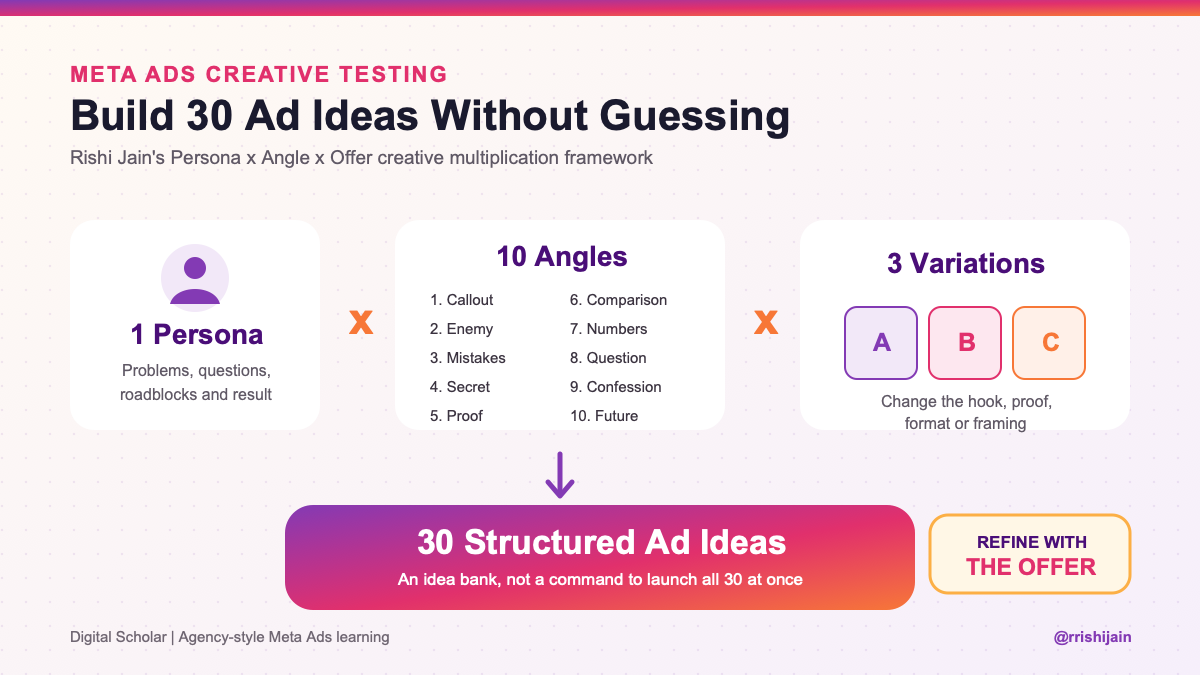
I teach a different system at Digital Scholar. Start with one customer persona. Approach that person through ten distinct arguments. Build three genuine variations of each argument. You now have a bank of 30 ad ideas before a designer opens Canva or an AI image tool generates a pixel.
TL;DR: How does the 30-ad framework work?
- Persona decides who the ad is for. Document the customer’s problems, questions, roadblocks, and desired result in language they use.
- Angle decides the argument. Use ten angles: callout, enemy, mistakes, secret, proof, comparison, numbers, question, confession, and future.
- Offer decides why someone should act now. Combine the core product with relevant bonuses, payment terms, risk reduction, and a clear next step.
- Variation creates a real test. Build three meaningfully different hooks or executions for each angle instead of making cosmetic colour changes.
- Budget decides how many ideas go live. A 30-ad bank gives you options. Launch only the number your budget can evaluate responsibly.
Who this is for: performance marketers, D2C founders, agency teams, and Digital Scholar students who can operate Ads Manager but still struggle to decide what creative to make next.
Build the wider skill stack: place this creative system inside the eight levels of performance marketing, choose channels with the Meta Ads vs Google Ads Fit Matrix, and use the performance marketing tool stack to move from research to reporting.
Why does creative diversity matter in Meta Ads?
Creative diversity gives Meta meaningfully different messages, formats, and visual ideas to match with people. It is not the same as producing more files. In Meta Ads creative testing, the goal is to learn which argument and execution move a business outcome. Meta’s own May 2026 Blueprint training defines creative diversification as varying formats, visuals, and messages, while its Advantage+ creative guidance says the system can tailor variations to individual viewers.
The distinction matters. If all your ads make the same argument, you have not tested the customer’s motivation. You have only tested execution. A red button beating a blue button tells you little about why someone bought. A proof angle beating a fear-based mistake angle tells you something your next campaign can use.
Platform source: Meta Blueprint’s May 2026 creative diversification training and Meta’s Advantage+ creative documentation. The Persona x Angle x Offer method below is the classroom framework I teach at Digital Scholar.
What is the Persona x Angle x Offer framework?
The framework forces every creative brief to answer three questions in order: who are we speaking to, what argument are we making, and what exactly are we asking them to accept? If any one answer is weak, a polished design will not rescue the ad.
| Layer | Decision | Weak input | Useful input |
|---|---|---|---|
| Persona | Who is this for? | Young people | A final-year commerce student in Chennai who has a degree but no portfolio |
| Angle | What argument enters their mind? | Learn digital marketing | Your certificate is not the missing proof. Six live campaign artefacts are. |
| Offer | Why take the next step? | Join now | Four-month live program, portfolio reviews, live campaign work, and a counselling call |
At echoVME Digital, this structure also makes creative reviews easier. Instead of saying, “I do not like this design,” a strategist can say the persona is too broad, the proof is missing, or the offer is unclear. Feedback becomes diagnostic.
Step 1: How do you build a persona that produces better ads?
A useful persona is a decision profile, not a fictional biography. Record the person’s situation, problems, questions, roadblocks, desired result, and exact phrases. Interview data, sales calls, comments, reviews, and search queries beat demographic guesswork.
Use the PQR research sheet
- Problems: What is happening that they want to stop?
- Questions: What must they understand before they trust the next step?
- Roadblocks: What keeps them from acting even when they want the result?
- Desired result: What observable change would make the purchase worthwhile?
For a recent graduate, the problem may be having no proof of work. The question may be whether a four-month program can create a credible portfolio. The roadblock may be course fees or family approval. The result may be six campaign artefacts they can show in an interview.
AI can organize this research, but it cannot replace the conversations. In my MBA class, I tell students to talk to the customer first. If you ask an AI model to invent the persona from nothing, it will usually return polished stereotypes.
Step 2: What are the ten Meta ad creative angles?
An angle is the argument you use to enter the customer’s mind. The product and persona can stay the same while the argument changes. Ten angles give a team a repeatable starting point without pretending that every angle will suit every brand.
| Angle | Question it answers | Example for a recent graduate |
|---|---|---|
| 1. Callout | Is this specifically for me? | Graduated this year but still have no campaign portfolio? |
| 2. Enemy | What shared obstacle is holding me back? | The enemy is collecting certificates without producing work. |
| 3. Mistakes | What am I doing wrong? | Three mistakes that make a marketing resume look identical to 200 others. |
| 4. Secret | What have I not understood yet? | The hiring advantage is not another tool. It is evidence that you used one. |
| 5. Proof | Why should I believe you? | Show a real student portfolio, campaign brief, and interview outcome. |
| 6. Comparison | Which path is better for my situation? | Two years of theory versus four months of live campaign artefacts. |
| 7. Numbers | Can I understand the value quickly? | Four months, six portfolio artefacts, one review every week. |
| 8. Question | What tension do I already feel? | Why do graduates finish marketing courses without one ad they can defend? |
| 9. Confession | Has someone like me faced this? | I had a degree and no proof of work. My first live campaign changed the interview. |
| 10. Future | What could life look like after this? | Imagine entering an interview with results to discuss, not certificates to list. |
Step 3: How do you turn a product into an offer?
A product is the thing being sold. An offer is the complete reason to act, including delivery, bonuses, terms, risk reduction, and the next step. Many ads blamed on weak creative are carrying an offer the market does not find useful.
- Core outcome: what changes for the buyer?
- Mechanism: how will the product produce that change?
- Relevant bonus: what removes a roadblock identified in persona research?
- Payment structure: full payment, EMI, trial, or consultation, where appropriate.
- Risk reduction: transparent terms, preview, audit, sample, or clearly written refund policy.
- Next step: buy, book, apply, message, or download. Pick one.
Do not add ten random bonuses to make a price look larger. A bonus earns its place only if it removes a real roadblock. If students fear interviews, a portfolio review is relevant. Another library of 500 prompts is not.
How do you create 30 ad ideas from one persona?
Choose one researched persona, write one concept for each of the ten angles, then create three meaningful variations per angle. Ten multiplied by three gives you 30 ideas. The variation should change the hook, proof, format, or framing, not only the colour.
| Variation | Callout example | What changed? |
|---|---|---|
| A | Graduated this year but still have no campaign portfolio? | Problem-led question |
| B | Commerce graduates in Chennai: build the six artefacts your resume is missing. | Specific identity and location |
| C | Your degree got you shortlisted. Your campaign proof gets you hired. | Contrast-led statement |
Repeat that process across all ten angles. Store every idea in a testing log with five states: idea, ready, live, iterate, and retire. Record the persona, angle, offer, hook, format, launch date, spend, outcome, and what the team learned. Six months later, you should be able to identify which arguments repeatedly work.
Should all 30 Meta ad ideas go live together?
No. Thirty is the size of the idea bank, not the launch batch. The live batch must match the campaign budget and expected cost per result. If each ad receives too little delivery, the team creates activity without learning.
Start Meta Ads creative testing by ranking ideas on four criteria: research strength, offer clarity, policy safety, and production effort. Choose a small batch that tests genuinely different angles. Keep the objective, conversion location, and offer stable enough to interpret what changed.
Do not declare a winner because one ad has a higher click-through rate after a tiny spend. Judge it against the business outcome selected for that campaign. A lead ad needs lead quality and sales follow-up data, not only cheap form fills. A sales ad needs contribution margin and break-even ROAS, which you can calculate using our break-even ROAS guide.
Where should AI help with Meta ad creative testing?
AI is useful for expanding researched inputs, generating structured variants, adapting sizes, and creating first drafts. It is weak at discovering an unspoken customer truth without data. Give it interviews, reviews, winning ads, brand rules, policy constraints, and the selected angle.
- Feed the model the approved persona research.
- Name one angle and one offer. Do not ask for “viral ad ideas.”
- Request three variants with a stated difference between them.
- Provide a reference for layout, brand colour, product accuracy, and text hierarchy.
- Review every claim, face, hand, logo, price, and policy-sensitive phrase.
- Let a human decide what enters the live testing batch.
Meta’s own Advantage+ creative tools can generate text and image variations, resize assets, animate static images, and personalize combinations. Use those capabilities for execution speed. Keep persona research, positioning, truth, and final approval with the team.
What are the five biggest creative testing mistakes?
The biggest Meta Ads creative testing mistakes happen before the campaign launches. Teams confuse files with ideas, change too many variables, use invented customer language, launch more ads than the budget can evaluate, and fail to record why an ad won or lost.
- Five colours, one argument: cosmetic edits do not create message diversity.
- Everything changes at once: a new persona, offer, format, and landing page make the result impossible to diagnose.
- AI invents the customer: generic personas produce generic hooks.
- Volume outruns budget: too many live ads receive too little evidence.
- No learning log: the team remembers winners but forgets the hypothesis, audience, and context.
Frequently asked questions about Meta Ads creative testing
What is creative testing in Meta Ads?
Creative testing is a structured process for comparing different messages, hooks, formats, proof, and offers against a defined business outcome. A useful test begins with a hypothesis, controls avoidable variables, allocates enough budget to learn, and records what the result changes about the next brief.
How many Meta ad creatives should I test at once?
There is no responsible universal number. Use the number your budget can support while giving each concept a fair opportunity to deliver. The 30-ad framework creates an idea bank. Rank those ideas and launch a smaller batch of distinct angles based on expected cost per result and available test budget.
What is the difference between an angle and a variation?
An angle changes the argument, such as proof versus comparison. A variation changes how one argument is expressed, such as a question hook versus a direct statement. Three colourways of the same layout are executions. They are not three new angles.
Can AI create all 30 ads?
AI can draft 30 concepts and produce many assets, but a human should supply research, approve the offer, check product accuracy, review policies, and select the launch batch. The closer the task gets to customer truth or a regulated claim, the less you should delegate blindly.
How do I know when a creative is fatigued?
Do not use frequency alone. Look for a sustained decline in the business outcome alongside delivery and engagement changes, then compare that pattern with audience size, seasonality, offer changes, landing-page issues, and auction costs. Prepare replacements before the current winner becomes unusable.
Should I test the creative or the offer first?
If the offer is unclear or unattractive, fix it before producing dozens of ads. Creative can communicate value, but it cannot manufacture value. When the offer is credible, test different angles to learn which reason for acting matters most to the persona.
Want to practise this on a live campaign?
The Digital Scholar four-month AI and Digital Marketing program teaches campaign setup, creative research, live testing, and reporting with agency-style review. You will build proof of work, not a folder of copied templates.
Creative testing becomes easier when every ad has a reason to exist. Pick one persona today. Write the ten angles. Build three honest variations of the strongest one. Then let the campaign teach you what to make next.
That is the work. Go build it, and tag @rrishijain when your testing board is ready.
Continue learning: compare performance marketing and digital marketing careers, practise the questions in our performance marketing interview guide, and review how Meta Ads fits into a complete digital marketing course syllabus.