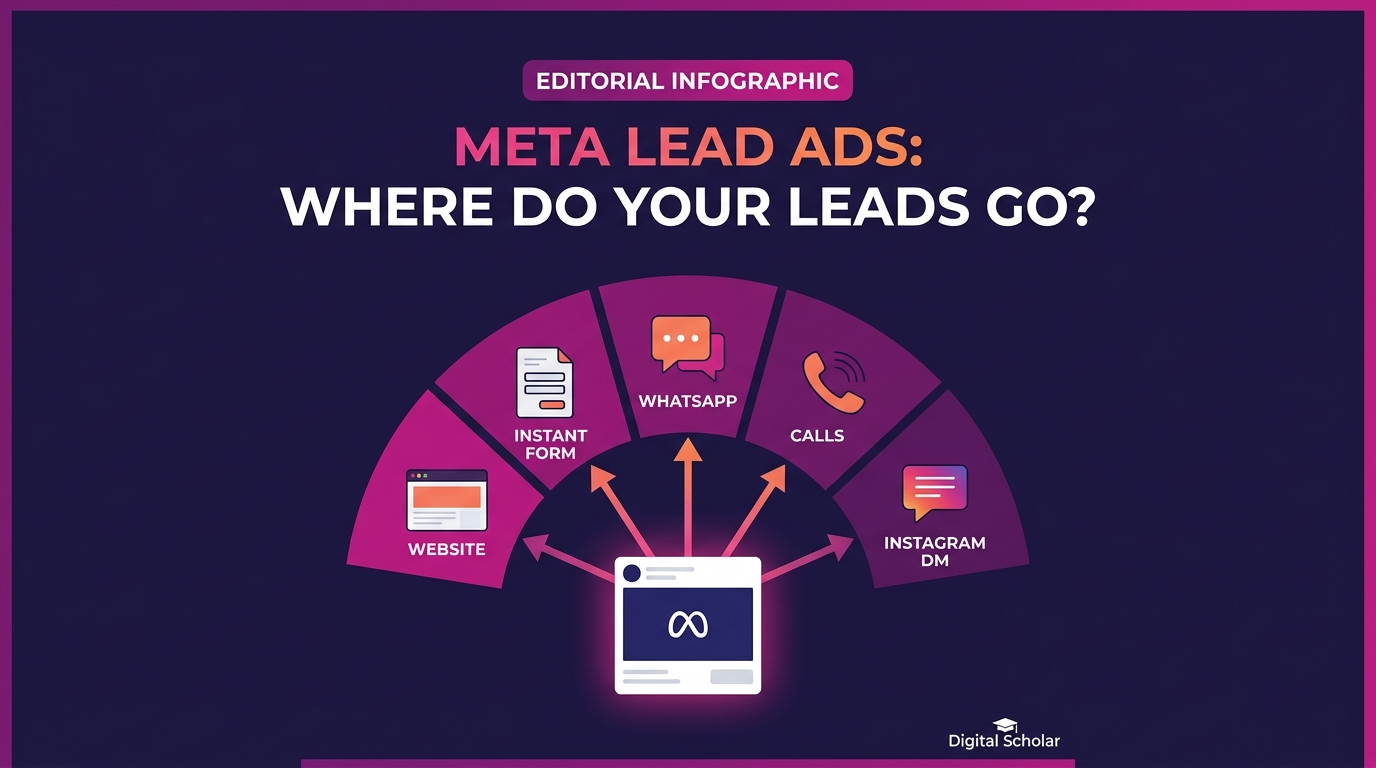
Most brands running Meta lead ads obsess over the creative and ignore the one decision that quietly sets their cost per qualified lead: where the lead actually lands. Website form, Meta instant form, WhatsApp, a phone call, or an Instagram message. Same ad, same budget, five completely different outcomes.
At echoVME Digital we run lead campaigns across coaching, real estate, education, and local services. The pattern repeats every quarter. A team spends three weeks perfecting a hook, then dumps every lead into an instant form because it is the default, and then complains that the leads are junk. The creative was never the problem. The destination was.
This guide is the decision system I teach Digital Scholar students so they stop defaulting and start choosing. It works whether you call them Facebook lead ads or Meta lead ads, because the underlying question is the same for both.
TL;DR: Where should you send Meta lead ads?
- Instant forms win on volume and cost per lead, but lead quality drops because the friction is near zero. Best for top-of-funnel and low-ticket offers.
- Website landing pages filter for intent and let you retarget and track deeply. Best when the offer needs explanation or the ticket size is high.
- WhatsApp wins when the buyer wants a conversation before committing. Best for consideration-heavy, high-trust categories in India.
- Calls win for high-ticket and urgent-intent buyers who convert on a human voice. Best when your sales team can answer inside 5 minutes.
- Instagram DM wins for creator-led and impulse categories where the audience already lives in the app.
- The deciding factors: sales cycle length, trust required, ticket size, and how fast you can follow up. The matrix later in this post turns those four into one recommendation.
Who this is for: D2C founders, local-service owners, agency media buyers, and Digital Scholar students who can build a lead campaign in Ads Manager but keep defaulting the destination instead of choosing it.
Build the wider skill stack: place this destination decision inside the eight levels of performance marketing, decide the channel first with the Meta Ads vs Google Ads Fit Matrix, and feed each destination fresh angles from the Meta Ads creative testing framework.
Why does the lead destination set your cost per qualified lead?
Every lead destination sits somewhere on a friction curve, and friction is not your enemy or your friend. It is a filter you tune. A Meta instant form asks for a tap and pre-fills the name, email, and phone from the user’s profile, so almost anyone completes it. A website landing page asks the person to leave the app, wait for a page to load, and type. Fewer people finish, but the ones who do have shown real intent.
Here is the mistake I see most in Digital Scholar mentorship calls. Teams optimise for cost per lead, the cheapest number on the dashboard, when they should optimise for cost per qualified lead, the only number that pays salaries. A Facebook lead ad that produces leads at Rs 40 each looks like a win next to one producing them at Rs 120. Then the sales team calls both lists. If the cheap list closes at 2 percent and the expensive list closes at 9 percent, the expensive destination was three times more profitable.
Method note: the closing-rate numbers above are illustrative of the pattern we see at echoVME Digital across lead campaigns, not a published benchmark. Your own numbers will differ by category, offer, and sales team. The point is the ratio, not the exact figure. Track your own cost per qualified lead before you trust any destination.
What are the five Meta lead ad destinations?
Meta lets you route a lead ad to more than one place, and each destination changes who raises their hand. The table below compares the five on the factors that actually move profit: friction, typical lead quality, follow-up speed needed, and the situation each one fits.
| Destination | Friction | Typical volume | Typical lead quality | Best fit |
|---|---|---|---|---|
| Meta instant form | Very low | Highest | Lower unless qualified | Low ticket, top of funnel, high-volume goals |
| Website landing page | High | Lower | Higher, self-selected | High ticket, offers that need explanation |
| WhatsApp (click to message) | Medium | Medium | Higher, conversational | Consideration-heavy, high-trust categories |
| Calls | High | Lower | Highest, hot intent | High ticket, urgent, strong sales team |
| Instagram DM | Low | Medium | Varies | Creator-led, impulse, in-app native audiences |
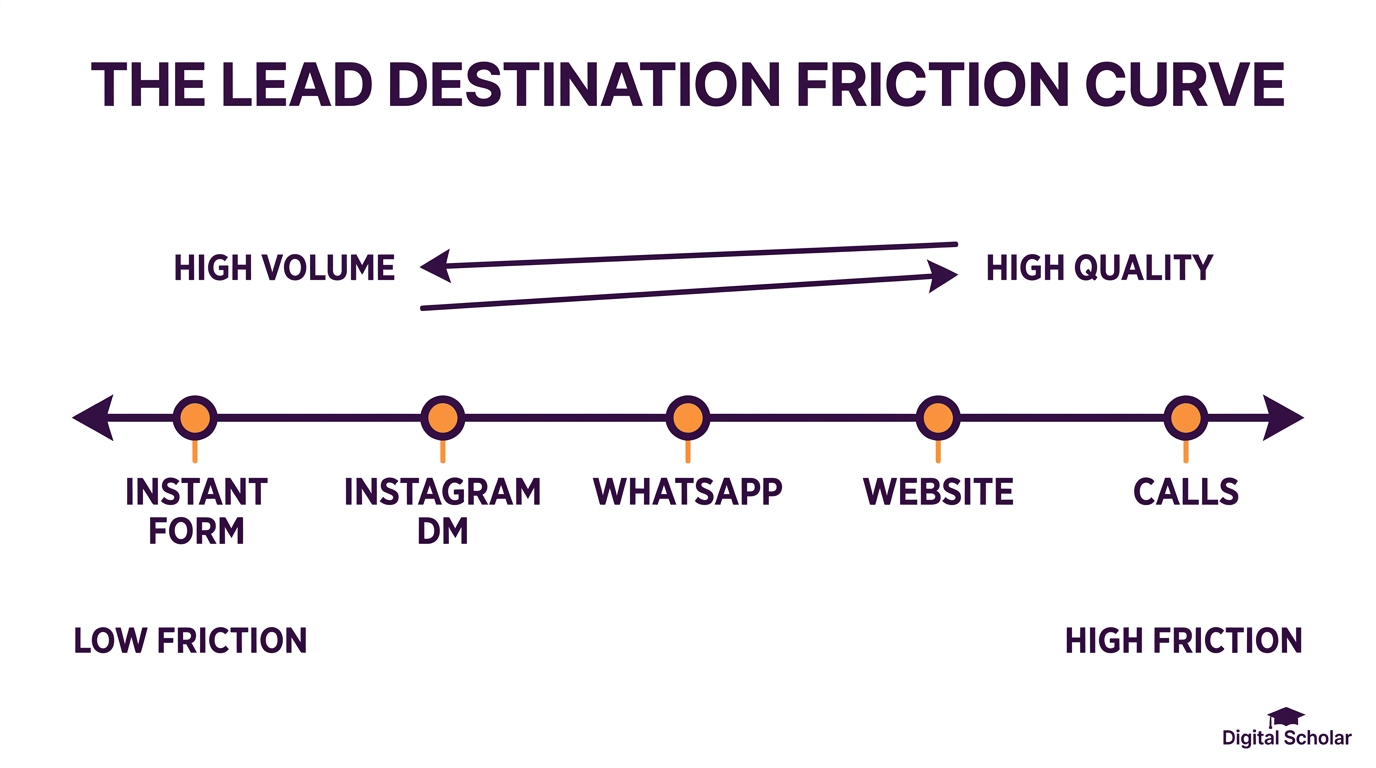
Notice there is no best destination in that table, only best fit. This is the same logic behind choosing between Meta and Google in the first place, which we break down in the Meta Ads vs Google Ads guide for Indian D2C. Channel first, destination second, creative third.
Instant form vs website landing page: which converts better?
This is the fight that decides most campaigns, so it deserves its own section. Both can be right. The instant form keeps the user inside Facebook or Instagram and pre-fills their details, so completion rates are high and cost per lead is low. The website landing page pushes the user out to your own page, where you control the message, the proof, and the tracking.
Pick the instant form when
- The offer is simple and low risk, such as a brochure, a price list, or a free class.
- You need volume fast and your sales team can qualify on the call.
- You want to add two or three custom qualifying questions to raise quality without killing completion.
Pick the website landing page when
- The ticket size is high enough that a few strong leads beat many weak ones.
- The offer needs explanation, social proof, or a video before someone will commit.
- You want full pixel tracking, retargeting pools, and deeper analytics on the page itself.
A practical hybrid I use at echoVME Digital: run the instant form with a “higher intent” preference and add one qualifying question that a tyre-kicker will not bother answering. It keeps most of the volume advantage while filtering out the laziest fills. If the offer is above roughly Rs 50,000 in ticket size, I move to a landing page almost every time, because the cost of a bad lead is a wasted sales conversation, and those are not free.
Whichever you pick, the economics only make sense if you know your break-even. Before you scale any destination, run the numbers with our break-even ROAS guide so you know what a lead is allowed to cost.
When should you send Meta lead ads to WhatsApp?
WhatsApp is the destination India punches above its weight on. When the buyer wants to ask a question before committing, a click-to-WhatsApp ad opens a chat instead of a form, and that conversation is itself the qualification. The person who types “is there an EMI option” is closer to buying than the person who abandoned a form.
Send leads to WhatsApp when your category is consideration-heavy and trust-sensitive: coaching, healthcare, education, real estate, and considered local services. The catch is operational. WhatsApp leads decay fast if nobody replies. At echoVME we treat an unanswered WhatsApp lead the same as a dropped call, because that is what it is. If you cannot staff replies within minutes during ad hours, WhatsApp will quietly waste budget while looking busy.
When do calls beat forms for Meta lead ads?
Call ads route the tap straight to your phone line. They are the highest-friction destination, which is exactly why the leads are the hottest. Nobody dials a number to browse. Send lead ads to calls when the ticket is high, the intent is urgent, and a human voice closes better than any landing page could: emergency services, high-value real estate, premium coaching, and B2B where a conversation is the natural next step.
The non-negotiable is answer rate. A call ad only works if the phone gets answered during the hours the ad runs. I have watched brands pay for call ads, then let calls ring out after 6 pm, and wonder why the channel underperforms. If your team cannot pick up, schedule the ads to your staffed hours. This is the same discipline that separates the Rs 7 LPA hire from the Rs 45 LPA hire in our performance marketing interview questions: knowing that media buying and operations are one system, not two.
When is Instagram DM the right lead destination?
Click-to-message ads that open Instagram Direct work best when your audience already lives in the app and the purchase is impulse-friendly or creator-led. Fashion, beauty, food, local experiences, and personal-brand offers all suit DM because the buyer is one tap from a conversation they were half in already. The message thread also gives you a warm channel to retarget with follow-ups later.
DM is weaker for anything that needs documentation, a quote, or a formal process, because the thread gets messy and hard to hand to a sales CRM. Use it for speed and warmth, not for structured qualification. If you run a personal brand, this is often the highest-return destination you are underusing, and it pairs naturally with the organic content work we cover across the Digital Scholar program.
What is the Lead Destination Decision Matrix?
Here is the framework that removes the guesswork. Score your offer on two axes. First, ticket size and complexity: how much money and explanation does the purchase involve. Second, sales-cycle speed: does the buyer decide fast or slowly. Those two axes point to a starting destination. Treat it as a strong hypothesis, then let your cost per qualified lead confirm or move it.
| Your situation | Ticket and complexity | Buyer decision speed | Start with |
|---|---|---|---|
| Free class, brochure, low-ticket product | Low | Fast | Instant form (add 1 qualifier) |
| Considered service, needs a chat | Medium | Medium | |
| Impulse or creator-led purchase | Low to medium | Fast | Instagram DM |
| High-ticket, needs explanation | High | Slow | Website landing page |
| High-ticket, urgent intent | High | Fast | Calls |
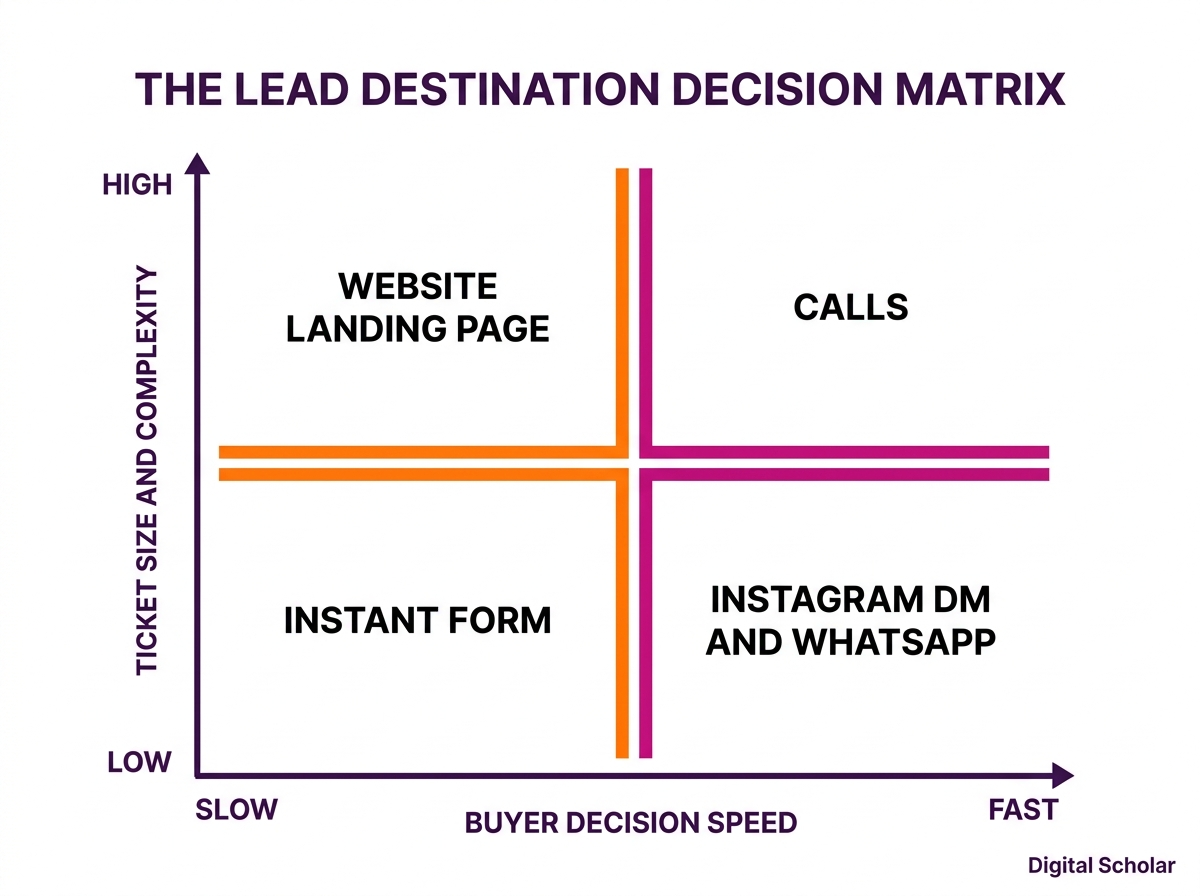
The matrix is a starting point, not a law. Cohort after cohort at Digital Scholar, students want a fixed rule. The honest answer is that the rule gets you to a smart first test, and the data gets you the rest of the way. If your website destination is starving for volume, test the instant form with a qualifier. If your instant form leads are junk, move up the friction curve. The matrix just stops you from starting in the wrong quadrant.
Why does speed-to-lead decide lead quality?
You can pick the perfect destination and still waste it. The single biggest lever on whether a Meta lead converts is how fast you follow up. A lead that fills an instant form is warm for minutes, not days. The longer you wait, the colder and cheaper-feeling the list becomes, and then people blame the destination.
- Wire the leads out of Meta instantly. Use a CRM or automation so leads do not sit in the Ads Manager library unseen. A lead you download once a day is a lead you lost.
- Contact inside 5 minutes where you can. Speed is the cheapest quality upgrade available, and it costs nothing but process.
- Match the follow-up channel to the destination. Call the call leads, message the WhatsApp leads, and do not make a form-filler wait 48 hours for an email.
- Feed outcomes back to Meta. Send qualified-lead and sale events back so the algorithm optimises toward people who actually buy, not just people who fill forms.
This is the operations layer most media buyers skip. Automating that handoff is exactly the kind of routine work we hand to AI now, which I documented in how I replaced five hours of daily agency work with Claude routines. The tooling to build that stack lives in our performance marketing tool stack.
What are the five mistakes that waste lead ad spend?
The biggest lead ad mistakes are decisions made before launch, not tweaks made after. Teams default the destination, chase the cheapest lead, forget to qualify, follow up too slowly, and never feed results back to the algorithm.
- Defaulting to the instant form. It is the easy choice, not always the right one. Choose the destination with the matrix.
- Optimising for cost per lead. Cheap leads that never close are the most expensive leads you can buy.
- No qualifying question. One well-placed question filters tyre-kickers without killing volume.
- Slow follow-up. A brilliant destination with a 24-hour response time performs like a bad one.
- No feedback loop. If you never tell Meta which leads were qualified, you train it to find more of the wrong people.
Frequently asked questions about Meta lead ads
What are lead ads on Facebook?
Facebook lead ads, also called Meta lead ads, are ad formats built to collect contact details directly from an ad. When someone taps, they can open a pre-filled instant form, a website landing page, a WhatsApp chat, a phone call, or an Instagram message, depending on the destination you choose. The destination changes both the volume and the quality of the leads you get.
Are instant forms or website landing pages better for lead ads?
Instant forms win on volume and cost per lead because they are near frictionless. Website landing pages win on lead quality and tracking because the visitor self-selects and you control the page. Use instant forms for low-ticket, high-volume goals and landing pages for high-ticket offers that need explanation. Add a qualifying question to an instant form to get some of both.
How do I download leads from Facebook lead ads?
You can download instant-form leads as a CSV from the Ads Manager or the connected Page, but do not rely on manual downloads. Connect the lead ad to a CRM or an automation tool so every lead is delivered in real time. Speed of follow-up is the biggest driver of lead quality, and a lead sitting in a daily export is usually already cold.
How do I improve Facebook lead ad quality?
Raise friction on purpose. Switch the instant form to a higher-intent preference, add one or two qualifying questions, or move up the friction curve to a landing page, WhatsApp, or calls. Then feed qualified-lead and sale events back to Meta so the algorithm optimises toward buyers. Quality is a destination-and-signal problem far more than a creative problem.
Should I use WhatsApp or an instant form in India?
Use WhatsApp when the buyer wants a conversation before committing, which fits coaching, education, healthcare, and real estate. Use the instant form when you need volume and your sales team qualifies on the call. WhatsApp only works if you can reply within minutes during ad hours, because unanswered chats decay fast.
How fast should I follow up with a Meta lead?
As fast as you realistically can, ideally inside five minutes. Meta leads are warm for minutes, not days, and the response-time gap is often the difference between a destination looking good or bad. Automate the handoff out of Ads Manager and match the follow-up channel to the destination the lead came through.
Is cost per lead a good metric for lead ads?
On its own, no. Cost per lead ignores whether the lead ever qualifies or buys. Track cost per qualified lead, and where possible cost per closed deal, so you compare destinations on profit rather than on the cheapest top-of-funnel number. A destination that looks expensive per lead is often the cheapest per sale.
Want to run lead campaigns on real budgets?
The Digital Scholar four-month AI and Digital Marketing program teaches Meta lead ads end to end: destination selection, qualifying questions, CRM handoff, and reporting, with agency-style reviews from the echoVME team. You build proof of work on live campaigns, not slides.
Stop defaulting your lead destination. Score your offer on ticket size and decision speed, start in the right quadrant, and let cost per qualified lead move you from there. That one decision will do more for your Facebook lead ads than another week spent recolouring the creative.
That is the work. Go build your matrix, and tag @rrishijain when your lead campaign is live.
Continue learning: compare career paths in performance marketing vs digital marketing, see where Meta Ads sits in a full digital marketing course syllabus, and level up your creative with the Persona x Angle x Offer testing framework.