- One question eliminates 80% of performance marketing candidates in the first 15 minutes. It is not about ROAS, creatives, or campaign structure. It is about contribution margin. If the candidate cannot connect ads to business economics, the interview is over.
- These 20 questions are organized by the 8 Levels of Performance Marketing Mastery. A Level 2 fresher gets asked about Meta Pixel installation. A Level 5 Head of Growth gets asked about incrementality testing. Wrong-level questions waste everyone’s time.
- Every question includes what I am testing, the answer I look for, and the red flags that kill the interview. Built from 400+ real interviews at echoVME Digital across Rs 300+ crore in managed ad spend.
Who this is for: Founders hiring their first performance marketer. HR teams screening candidates for growth roles. And candidates preparing for interviews who want to know what hiring managers with real budget authority actually care about. Also useful alongside the performance marketing vs digital marketing salary comparison if you are deciding which track to pursue.
Why Most Performance Marketing Interview Question Lists Are Useless
Most performance marketing interview question lists are useless. Not because the questions are bad. Because they treat every candidate the same.
A fresher applying for a junior role should not be asked about marketing mix modeling. A Senior Head of Growth candidate should not be quizzed on what CPM stands for. When you use the same 50 questions for every interview, you are testing for memory, not for fit.
I have interviewed more than 400 performance marketers over the last decade at echoVME Digital. I have also watched founders hire wrong and then call me 3 months later asking why their ads broke. The pattern is almost always the same: they hired the wrong level. Not the wrong person. The wrong level for their stage of business.
So this post is structured like our agency’s actual interview process at echoVME. Questions organized by the 8-Level Performance Marketing Mastery framework, mapped to what a candidate at each level should be able to answer fluently.
If you are a founder hiring for your first performance marketer, skip to Level 1 and 2. If you are hiring a Head of Growth for a Rs 50 lakh per month operation, skip to Level 5 and 6. If you are a candidate preparing for interviews, read every level. You need to know what the next one expects before you are ready for it.
The 80% Eliminator Question
“What is the contribution margin of your top client’s best-selling product?”
That is the question. No second part. No setup. Just that.
Why This Eliminates 80%
Most performance marketers have never asked this of their clients. They run campaigns, they report ROAS, they optimize CPA. But they have never once asked what ROAS the business actually needs to break even. They do not know the client’s COGS. They do not know the shipping cost per order. They do not know the return rate. They have no idea if 4x ROAS is profitable or bleeding.
A performance marketer who does not know contribution margin is optimizing for the platform’s metric, not the business’s metric. That is the single biggest reason brands spend Rs 40 lakh a month and grow revenue without growing profit.
What the Right Answer Sounds Like
“My top client sells a skincare product at Rs 1,800. COGS is around 35%, shipping and packaging is Rs 180 per order, payment gateway takes 2%, and our return rate is 8%. So contribution margin comes out to around 42%, which means our break-even ROAS is 2.4x. We run with a target of 3.2x to account for overheads. That is the number I optimize against.”
That answer takes 30 seconds. It tells me the candidate has had adult business conversations. They understand ads are a lever, not the goal. They can sit in a boardroom and defend a budget decision to a CFO.
What the Wrong Answer Sounds Like
“I do not handle the finance side, that is the client’s team.” OR “Our ROAS is 4x so we are definitely profitable.” OR “Contribution margin? Like, gross profit?”
When I hear any of these at echoVME, the interview is over. I finish the call politely, thank them, and we move on. This is not a gotcha question. This is the bare minimum for anyone handling more than Rs 5 lakh per month of ad spend.
The 8 Candidate Levels: Match the Questions to the Role
Performance marketing roles in India are not one ladder. They are four ladders stacked on top of each other. Each level has a different set of questions, a different salary band, and a different expectation of business thinking. This maps directly to the 8-Level Stack Framework we use for tool selection at echoVME Digital.
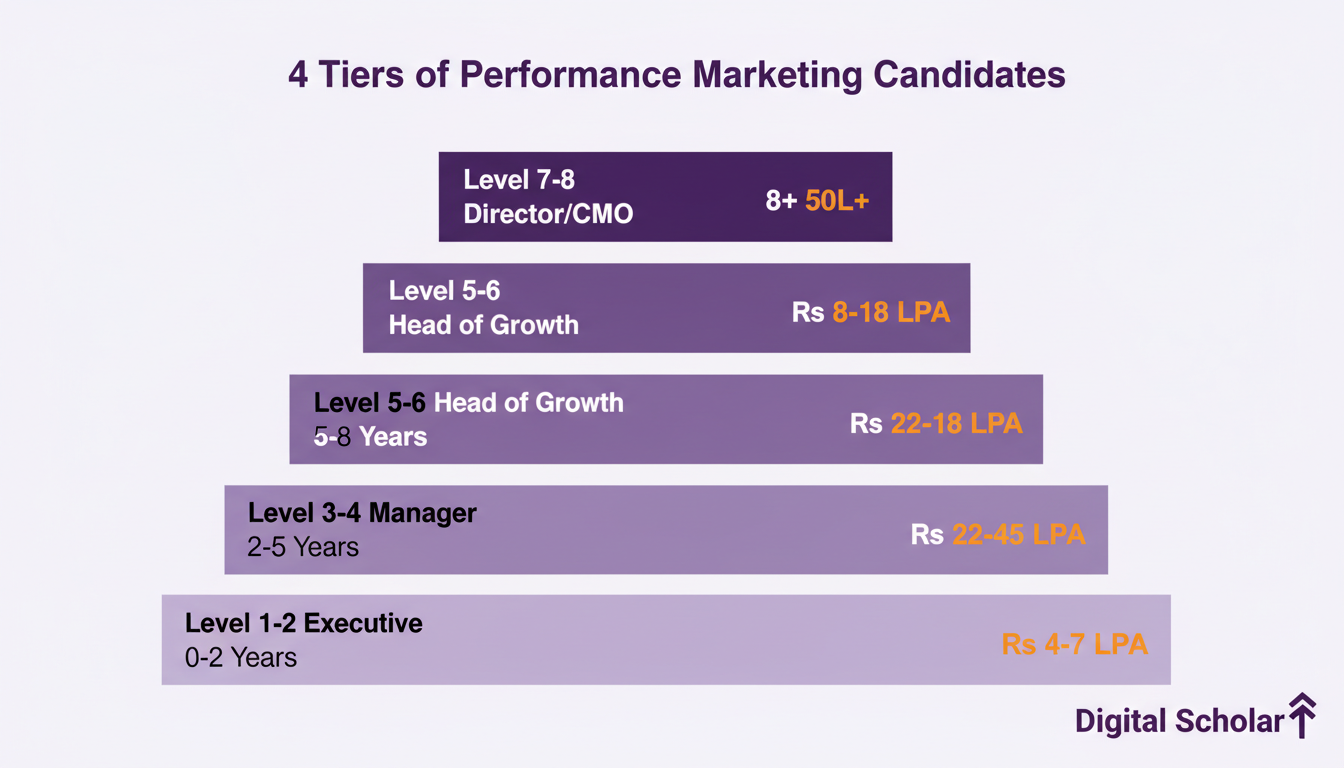
| Candidate Level | Role Title | Experience | Salary Range (India) |
|---|---|---|---|
| Level 1-2 | Executive / Junior Specialist | 0 to 2 years | Rs 4 lakh to Rs 7 lakh per year |
| Level 3-4 | Associate / Manager | 2 to 5 years | Rs 8 lakh to Rs 18 lakh per year |
| Level 5-6 | Senior Manager / Head of Growth | 5 to 8 years | Rs 22 lakh to Rs 45 lakh per year |
| Level 7-8 | Director / VP Growth / CMO | 8+ years | Rs 50 lakh and up |
Interview questions should scale with the level. A Level 2 candidate needs to prove execution fluency. A Level 5 candidate needs to prove strategic thinking. A Level 7 candidate needs to prove they have built systems other people run. Asking the wrong questions for the level wastes everyone’s time.
Level 1-2: Executive / Junior Specialist (0 to 2 Years, Rs 4 to 7 LPA)
At this level, you are hiring for execution fluency. Can they install a pixel correctly? Do they know what CTR means? Can they diagnose why a campaign stopped working? You are not hiring for strategy. You are hiring for hands that will not break things.
Q1. Walk me through how you would install Meta Pixel on a new client’s website and verify it is firing correctly.
What I am testing: Fundamentals of tracking setup. This is non-negotiable for anyone running ads in 2026.
The answer I look for:
- Installs via Google Tag Manager, not directly in site HTML where possible.
- Sets up standard events (PageView, ViewContent, AddToCart, Purchase) plus custom events if needed.
- Verifies via Meta Pixel Helper browser extension.
- Tests events in Events Manager Test Events tab before going live.
- Implements Conversion API (CAPI) for server-side tracking.
- Configures event deduplication between Pixel and CAPI.
- Checks for duplicate pixel installs across subdomains.
- Says “I would install the Shopify plugin” without knowing what it does.
- Does not know what CAPI is.
- Says “I would ask a developer” and cannot describe what they would actually ask for.
Q2. A D2C brand sells a product for Rs 1,500. COGS is 35%, shipping and packaging is Rs 150, payment gateway is 2%. What is the break-even ROAS?
What I am testing: Can they do the math. A performance marketer who cannot calculate break-even ROAS is not a performance marketer.
The answer I look for:
- Revenue is Rs 1,500.
- COGS = 35% of Rs 1,500 = Rs 525.
- Shipping + packaging = Rs 150.
- Payment gateway = 2% of Rs 1,500 = Rs 30.
- Total variable cost before CAC = Rs 705.
- Gross margin = Rs 795 (53%).
- Break-even CAC = Rs 795.
- Break-even ROAS = Rs 1,500 / Rs 795 = 1.89x (roughly 2x).
- Cannot complete the math within 2 minutes.
- Skips any cost component.
- Confuses break-even ROAS with target ROAS.
Q3. Your daily CPA on a Meta campaign has doubled in the last 7 days. Walk me through the first three things you check.
What I am testing: Diagnostic reflex. Can they troubleshoot under pressure without panicking.
The answer I look for:
- Checks frequency first (creative fatigue is the most common cause).
- Looks at CPM trend (market competition or seasonality spike).
- Reviews CTR decline (creative losing relevance).
- Checks audience saturation and reach overlap.
- Looks at landing page or website changes (did conversion rate drop?).
- Considers external events (competitor sale, festival season, news cycle).
- Pulls data before making changes, not after.
- First instinct is “pause the campaign” (panic, not diagnosis).
- Blames “the algorithm” without evidence.
- Cannot name more than 2 diagnostic checks.
Q4. Explain the difference between CTR, CPM, CPC, and CPA. Why does CPM matter if your goal is CPA?
What I am testing: Basic vocabulary fluency plus causal reasoning. You cannot operate at this level without this.
The answer I look for:
- CTR is click-through rate, clicks divided by impressions.
- CPM is cost per 1,000 impressions, the cost of reach.
- CPC is cost per click, typically auto-set by CTR and CPM.
- CPA is cost per action (acquisition), the end-state metric.
- CPM matters because it is the top of the cost stack.
- If CPM doubles, everything downstream gets more expensive.
- High CPM with low CTR is a creative problem.
- Low CPM with high CTR but bad CPA is a landing page or offer problem.
- Hesitates on any definition.
- Cannot articulate why CPM matters when CPA is the goal.
- Treats these as independent metrics instead of a cascade.
Level 3-4: Associate / Manager (2 to 5 Years, Rs 8 to 18 LPA)
At this level, you are hiring for campaign ownership. They will run accounts without supervision, design creative testing frameworks, and explain results to clients. They need to think in systems, not tasks. If you are not sure what tools a candidate at this level should know, check our tools guide first.
Q5. Design the campaign structure for a D2C skincare brand spending Rs 10 lakh per month on Meta. Walk me through your thinking.
What I am testing: Campaign architecture logic. Can they defend choices? Do they have a repeatable framework or a memorized template?
The answer I look for:
- Typically 2 to 4 campaigns running in parallel (not 15, not 1).
- Advantage+ Shopping Campaign running alongside manual sales campaigns.
- Prospecting vs retargeting split (usually 70:30 or 80:20).
- Creative volume target (10 to 15 new creatives per week minimum at this spend).
- Testing methodology (separate ABO campaign for tests, winners moved to CBO).
- Audience segmentation logic (cold, warm, existing customers).
- Scaling methodology (budget laddering, not doubling).
- One-size-fits-all answer with no adaptation logic.
- No mention of creative testing framework.
- Recites a template without explaining why each piece exists.
Q6. Meta reports ROAS of 4x. Google reports ROAS of 5x. The client’s P&L shows MER of 2.8x. What is happening and what do you do?
What I am testing: Attribution literacy. This is the most important diagnostic skill at this level because it affects every decision.
The answer I look for:
- Both platforms are double-counting conversions (same sale claimed by both). iOS 14.5+ signal loss inflates platform-reported ROAS.
- View-through conversions inflate numbers further.
- MER (Marketing Efficiency Ratio) is the only truth because it is P&L-derived.
- Fix: install a third-party attribution layer (Triple Whale for D2C, Hyros or TrackoCity for longer cycles).
- Adjust targets to platform ROAS that maps to desired MER.
- Report MER to the client weekly, not platform ROAS.
- Takes platform-reported ROAS at face value.
- Does not know what MER is.
- Cannot name a single third-party attribution solution.
Q7. When do you use Advantage+ Shopping Campaign versus a manual sales campaign?
What I am testing: Tactical judgment. Can they pick the right tool or do they think one replaces the other?
The answer I look for:
- Advantage+ when the account has 50+ weekly conversions and a deep creative library.
- Manual when targeting specific regional or language audiences (Tamil, Telugu, Kannada, Bengali markets).
- Manual when testing new creative formats or audiences (Advantage+ cannibalizes tests).
- They run in parallel, not as replacements.
- Advantage+ is stronger at scale and retargeting, manual is stronger for specific campaigns.
- Knows when Advantage+ underperforms (narrow niche, low conversion volume, tight regional targeting).
- “Advantage+ is the future, we use it for everything.” “Manual is better because we control it” (binary thinking).
- Cannot name a single scenario where one beats the other clearly.
Q8. How do you decide when a creative is dead and needs to be killed?
What I am testing: Data-driven decision making. Not gut. Not Meta’s “Learning Limited” warning. Real signal reading.
The answer I look for:
- Frequency threshold (typically 2.5 to 3.5 depending on category and audience size).
- CTR decline of 20 to 30% from the creative’s peak.
- CPA climbing above target for 3 to 5 consecutive days.
- Comment quality degrading (spam, complaints, off-topic responses).
- Compare performance against newer creatives in the same ad set, not against its own history alone.
- Kill the creative in the worst ad set first, let it run elsewhere if it is still delivering.
- “When Meta tells me to turn it off.” Cannot cite specific metric thresholds.
- Waits until CPA is 2x target before killing (too late).
Level 5-6: Senior Manager / Head of Growth (5 to 8 Years, Rs 22 to 45 LPA)
At this level, you are hiring for strategic thinking. They will sit in boardrooms, build teams, design attribution stacks, and justify multi-crore budget decisions. Tactical fluency is table stakes. What you are really testing is business thinking. Understanding the difference between performance marketing and digital marketing is assumed at this level. The question is whether they can lead the performance side.
Q9. Design an incrementality test for your brand’s email marketing channel. Walk me through the full methodology.
What I am testing: Experimental rigor. Most senior marketers have never run a proper incrementality test. That is the gap.
The answer I look for:
- Defines incrementality vs A/B testing upfront (A/B is creative testing, incrementality is channel contribution testing).
- Chooses methodology: geo holdout (easier) or audience holdout (more precise).
- Calculates sample size using power analysis (typically needs 2 to 4 weeks of holdout).
- Defines primary metric (incremental revenue, incremental orders).
- Controls for seasonality, competing channels, and external events.
- Quantifies the opportunity cost of the holdout (this is what most people skip).
- Interprets results with confidence intervals, not point estimates.
- Has never run an incrementality test.
- Confuses A/B testing with incrementality.
- Cannot explain sample size logic or statistical significance.
Q10. Your CFO asks you to justify scaling ad spend from Rs 50 lakh to Rs 1 crore per month. What framework do you use?
What I am testing: Business thinking. At this level, you are not selling to marketers. You are selling to CFOs.
The answer I look for:
- Current CAC and LTV:CAC ratio, trending over last 6 months.
- CAC payback period in months (critical for cash flow planning).
- Contribution margin and its sensitivity to higher CAC.
- Channel saturation curves: at what spend does incremental ROAS drop below 1.5x? Expected MER degradation at 2x spend (usually 15 to 25% softer).
- Testing budget carve-out for diversification (typically 10 to 15% of incremental).
- Stress-test against a 2-month underperformance scenario.
- “Current ROAS is strong so we should scale.” Cannot define payback period.
- Does not acknowledge saturation effects.
Q11. When do you use last-click attribution, multi-touch attribution, and marketing mix modeling? When does each break?
What I am testing: Attribution philosophy. A senior performance marketer should know no single model is true, and why each exists.
The answer I look for:
- Last-click for tactical daily optimization (campaign, ad set, creative level).
- Multi-touch for user journey analysis (where does each channel contribute in the funnel).
- Marketing mix modeling for strategic channel allocation, especially with offline spend (TV, OOH, events).
- Triangulate across all three instead of picking one.
- LCA breaks on long sales cycles and brand-building spend.
- MTA breaks with iOS signal loss and walled garden data.
- MMM breaks with low data volume and short history (needs 12+ months usually).
- Has never used MMM, does not know what it is.
- Picks one and dismisses the others.
- Cannot name conditions under which each model fails.
Q12. You have Rs 10 lakh of incremental monthly budget to deploy. Where does it go first and why?
What I am testing: Prioritization under constraint. This tests whether they think in terms of incremental contribution or headline metrics.
The answer I look for:
- Checks saturation in current top channels first (rising CPMs at scale?).
- Calculates incremental ROAS by channel (not average ROAS).
- Splits between retention and acquisition based on CAC:LTV pressure.
- Reserves 10 to 15% for testing (new channels, new audiences, new creative formats).
- Justifies with expected MER impact, not gut or “where ROAS is highest.” Stress-tests the plan against a 30% CPM rise scenario.
- “Put it all on Meta because ROAS is best there.” No mention of saturation or incremental thinking.
- Zero testing allocation.
Level 7-8: Director / VP Growth / CMO (8+ Years, Rs 50 LPA and Up)
At this level, you are hiring for architecture. The candidate should not be running campaigns anymore. They should be building systems that other people run. You are testing whether they can reduce chaos, not add to it.
Q13. Describe a marketing system you built that runs without your daily involvement.
What I am testing: System building. This is the single biggest gap between senior and leadership candidates.
The answer I look for:
- A specific system with measurable business output (not “I built a process”).
- Documented SOPs that onboard new team members in under 2 weeks.
- Automation layer where possible (tools, triggers, dashboards).
- Exception alerts that flag issues without needing the candidate’s review.
- Clear ownership: who runs it day-to-day, who escalates when.
- Review cadence that improves the system without micromanaging.
- The candidate can point to the system still working after they left the role.
- Cannot describe anything beyond “running campaigns well.” Everything still needs their personal sign-off.
- No documentation, no SOPs, no handoff mechanism.
Q14. How do you measure marketing’s contribution to brand equity? Give me metrics, not adjectives.
What I am testing: Brand fluency at a measurable level. Leadership candidates need to speak both languages.
The answer I look for:
- Branded search volume growth (Google Search Console trend).
- Direct traffic trend (proxy for brand recall).
- Unprompted brand mentions on social (Brand24, Meltwater, or manual tracking).
- Share of search against competitors.
- Repeat purchase rate trend (loyalty signal).
- CAC decline over time holding spend constant (brand working).
- Incrementality of non-performance channels (PR, influencer, content).
- Cannot measure beyond platform ROAS.
- Treats brand as “feel-good intangible” so unmeasurable.
- Has never tracked branded search volume.
Q15. How would you integrate AI into a marketing team of 20 people without firing anyone?
What I am testing: Leadership judgment in the AI era. This question separates candidates who think in systems from candidates who think in headlines.
The answer I look for:
- Distinguishes task automation from role automation (automate tasks, upgrade people).
- Identifies the 3 roles that get the most AI leverage first (typically creative ops, research, reporting).
- Designs a skill development plan (prompt engineering, workflow design, data literacy).
- Measures impact in time saved, output volume, and quality consistency.
- Phases the rollout over 30-60-90 days, not a big bang.
- Includes change management: how the team is brought along, not pushed aside.
- “We replace the interns and junior roles with AI.” Vague answer without specific tools or workflows.
- Zero mention of measurement or change management.
Q16. A brand’s customer acquisition cost has plateaued for 6 months despite increasing budget. Diagnose the problem.
What I am testing: Systems-level problem solving. Leadership candidates should diagnose causes, not symptoms.
The answer I look for:
- Builds a diagnostic hierarchy: market, creative, offer, funnel, retention, product.
- Checks category-level CPM trend (is the whole category getting expensive or just this brand?).
- Audits creative velocity (are they making enough new creatives per week?).
- Examines funnel step-by-step (which stage is the drop-off really happening?).
- Considers offer fatigue and repositioning needs.
- Evaluates channel concentration risk (too dependent on Meta only?).
- Looks at retention as a CAC solver (LTV expansion reduces CAC pressure).
4 Questions I Ask at Every Level (Character, Not Skill)
These four do not test skill. They test character, self-awareness, and how the candidate thinks about failure. I have hired people who bombed technical questions but aced these, and they have become some of the best operators at echoVME Digital.
Q17. What is the most expensive mistake you have ever made in ad spend? Tell me in rupees.
What I am testing: Accountability and specificity. A candidate who has never made an expensive mistake has never been trusted with real spend.
The answer I look for:
- Names a specific rupee amount (Rs 5 lakh, Rs 20 lakh, whatever it was).
- Describes what actually happened without blaming others.
- Articulates what they learned from it.
- Explains the system change they made so it does not happen again.
- Shows genuine ownership, not rehearsed humility.
- “I have not really made mistakes.” Blames the team, the client, or the platform.
- Cannot cite a specific amount.
Q18. Tell me about a campaign you killed and later regretted not letting run longer.
What I am testing: Self-awareness and understanding of learning phase dynamics.
The answer I look for:
- A specific campaign with context (what product, what budget, what timeline).
- The signals they misread at the time.
- What they would do differently with the same signals today.
- Shows they have updated their framework based on the learning.
- “I always wait the right amount of time.” Generic answer with no specifics.
- Cannot explain what signals they now read differently.
Q19. What is one belief you held 2 years ago about performance marketing that you now think was wrong?
What I am testing: Intellectual humility and learning velocity. The platforms change every 6 months. Candidates who cannot update their thinking will drift out of relevance fast.
The answer I look for:
- Names a specific belief (e.g., “I used to believe TOF, MOF, BOF structures were always needed”).
- Explains what changed their mind (data, new platform feature, mentor, client experience).
- Describes how it changed their approach today.
- Shows active curiosity, not just responsiveness to new information.
- Cannot name a single updated belief.
- Still running the same playbook from 2021.
- Thinks “everything I believed was right” (no learning loop).
Q20. Your budget gets cut by 50% tomorrow. What is the first thing you do?
What I am testing: Efficiency-first thinking versus volume-first thinking. Tells you everything about how they operate under pressure.
The answer I look for:
- Identifies lowest incremental contribution spend and cuts there first.
- Consolidates around winning creatives and audiences, does not spread thin.
- Protects the top-performing channel.
- Pauses experiments and testing, not proven winners.
- Communicates the implications to stakeholders (lower volume, higher efficiency).
- Uses the cut as a forcing function for efficiency gains they had postponed.
- “Pause everything until I can think.” Across-the-board 50% cuts (no prioritization).
- Panic reaction with no framework.
Universal Red Flags: What Kills an Interview Regardless of Level
These are the patterns that tell me the candidate is not ready, regardless of how well they answered individual questions. I have started tracking these at echoVME because they predict failure 6 months into the role with uncomfortable accuracy.
- Name-drops tools they have never actually used deeply (says “we use Hyros” but cannot explain how it maps conversions)
- Cannot produce a single specific number from their past work (no CPAs, ROAS figures, spend amounts, date ranges)
- Blames “the algorithm” or “iOS updates” for failures without explaining their own diagnostic process
- Talks about “best practices” but cannot articulate why those practices work
- No documentation, spreadsheets, briefs, or templates they can reference from past work
- Says “it depends” to everything without then explaining what it depends on
- Uses jargon (CBO, ABO, PPA, MER, CAPI) without being able to define each clearly
- Cannot describe their own worst failure or what they learned from it
- Has never questioned a client’s request or pushed back on a brief
- Thinks the job is “running ads” not “growing the business”
- At senior levels: has never run a proper incrementality test
- At any level: cannot answer the contribution margin question
How We Actually Hire at echoVME Digital
A quick look at the process we run at echoVME Digital, because the questions themselves are only half the hiring equation. The order matters. The interventions matter. The things we deliberately skip matter.
The echoVME Hiring Process, End to End
- Resume review (10 minutes): We scan for specific numbers and named results. Tenure and brand names are secondary. A 2-year stint with named campaign results beats a 5-year stint at a famous agency with vague “managed campaigns for X brand.”
- Contribution margin filter call (15 minutes): The 80% eliminator question, upfront. If they cannot answer, we end the call politely. Saves everyone hours.
- Take-home assignment (2 hours of candidate time): Real anonymized data from a past echoVME client. We ask them to audit the account and recommend 3 changes. We want to see how they think, not what they memorized.
- Strategic discussion (60 minutes): We walk through their assignment together. We pressure-test their thinking. We ask “what if” questions to see how they adapt.
- Cross-functional interview (30 minutes): Creative team, content team, account management. The candidate has to work with all of them, so all of them get a voice.
What We Deliberately Ignore
- MBA credentials (we have hired brilliant marketers with BCom degrees and mediocre ones with IIM MBAs)
- Certifications (Meta Blueprint, Google Skillshop certificates tell us nothing)
- Big agency names on the resume (name recognition is not skill)
- Number of “accounts managed” (a candidate who managed 15 accounts badly looks better than one who managed 3 well, in interviews only, not in reality)
- Years of experience (a focused 3-year career beats a scattered 8-year one)
What Actually Predicts Success
After 400+ interviews and a decade of data at echoVME Digital on who made it and who did not, three things predict success more reliably than anything else:
Specific numbers in casual conversation. The candidate who says “we brought CAC from Rs 1,800 to Rs 1,200 over 11 weeks by redoing the retargeting stack” is nearly always stronger than the candidate who says “I drove significant improvements in CAC.”
Comfort with saying I do not know. Intellectual honesty beats false confidence every time. Our best hires at echoVME are the ones who asked us hard questions during the interview, not the ones who had all the answers.
Curiosity above credential. The candidates who asked us how we run our internal stack, who read our blog before the call, who came with questions about how we structure client work: those are the hires who compound. The ones who just want to “understand the role” rarely do.
Want to Build the Skills That Pass These Questions?
The Digital Scholar 4-month program does not just teach tools. It teaches the business thinking behind every campaign decision. 1,000+ students trained per year. Rs 300+ crore in managed ad spend behind every framework. The same 8-Level Mastery framework that structures these interview questions structures the entire curriculum.
Explore the ProgramThe Closing Thought
Interview questions are not a quiz. They are a diagnostic.
A good hiring process does not test what the candidate memorized. It tests how they think under pressure, whether they can connect ads to business outcomes, and whether their reflexes will protect your budget or burn it.
If you are a founder interviewing performance marketers for the first time, use the questions at your level. Do not over-interview. Do not test a Level 2 candidate with Level 5 incrementality questions. And do not test a Level 7 candidate by asking them to define CPM.
If you are a candidate preparing for interviews, the uncomfortable truth is this: depth cannot be faked at Level 5 and above. The people who pass are the ones who have done the work. The ones who have made the expensive mistakes. The ones who can talk about contribution margin without flinching.
Follow along on Instagram: @rrishijain.