
Here is the uncomfortable truth about SEO in 2026. In early 2026, 68% of Google searches in the US ended without a single click. On mobile that number is 77%. AI Overviews now show up on roughly 48% of tracked queries, and when one appears, organic click-through rate drops 61%. The old game of “rank number one and collect the traffic” is quietly dying.
Most marketers reacted to this by panicking or by dumping 400 AI-written articles onto their blog in a weekend. Both are wrong. At echoVME, we manage SEO for brands across e-commerce, education, and services, and I run the SEO for Digital Scholar myself. I have watched AI make a good SEO team roughly three times faster, and I have watched it torch a site’s rankings inside six months when used lazily.
This guide is how to use AI for SEO the way a practitioner does. Not a tool list. A system. You will get the exact five-layer stack my team uses, the tools we actually pay for, the places where AI quietly tanks your rankings, and a 30-day workflow you can copy this week. Every claim here comes with a number, because that is the only kind of claim worth making.
By the end of this post you will know exactly how to use AI for SEO across research, content, on-page, technical, and answer engines. You will get a named framework (The 5-Layer AI SEO Stack), a Citation-Worthiness Checklist for the AI Overview era, a tested tool table, and a copy-paste 30-day plan. This is the AI SEO playbook we teach inside Digital Scholar.
TL;DR:
- AI for SEO means using AI as an assistant across five layers: keyword and topic research, content creation, on-page optimization, technical SEO, and answer-engine optimization (AEO). It does the reps. You make the calls.
- The 2026 shift is from ranking to being cited. With AI Overviews on ~48% of queries and a 61% CTR drop when they appear, the new win is becoming the source AI pulls from, not just position one.
- AI-assisted, human-led is the only model that survives. Mass-published, unedited AI content ranks for about six months, then tanks. We have watched it happen.
- The tools worth paying for are few. I use maybe five consistently, not fifty. The table below shows which and why.
- Who this is for: marketers, founders, and SEO teams in India who want a real workflow, not a listicle. If you already run content and want AI to make it faster and more citable, start with the 5-Layer Stack.
- What is AI SEO, and what actually changed in 2026
- Why listen to me on this
- The 5-Layer AI SEO Stack (the framework)
- Layer 1: AI for keyword and topic research
- Layer 2: AI for content creation (the right way)
- Layer 3: AI for on-page optimization
- Layer 4: AI for technical SEO and audits
- Layer 5: AI for answer engines (AEO and GEO)
- The Citation-Worthiness Checklist
- Where AI quietly tanks your SEO
- The AI SEO tools I actually pay for
- A 30-day AI SEO workflow you can copy
- Frequently asked questions
What is AI SEO, and what actually changed in 2026
AI SEO is the practice of using artificial intelligence to do the repetitive, data-heavy parts of search optimization faster: keyword research, content drafting, on-page checks, technical audits, and rank tracking. In 2026 it also means optimizing your content so it gets cited inside AI answers like Google AI Overviews, ChatGPT, and Perplexity, not only ranked in blue links.
Here is what changed, in numbers. Zero-click search hit 68% of US Google searches in early 2026, up from about 60% in 2024. AI Overviews appeared on roughly 48% of tracked queries in February 2026, up 58% year over year. Publisher referral traffic from Google fell 38% year over year. And AI Mode answers refer traffic at a rate of only 1.6% to 2.5%, compared to 17% to 19% for a traditional search result.
Read those numbers together and the strategy writes itself. Search is not sending you the visitor the way it used to. So AI SEO in 2026 is a two-front job. Front one is still classic SEO, because Google’s index is still where AI Overviews and AI Mode pull most of their sources from. Front two is answer-engine optimization, which is making sure that when the machine summarizes the answer, it summarizes yours and links back to you. Digital Scholar’s whole content system is built around this dual model.
Why listen to me on this
Because I run this every day, not in theory. I am the Co-Founder of Digital Scholar, where we train 1,000+ students a year in AI and digital marketing, and the CEO of echoVME Digital, where we have managed over Rs 400 crore in cumulative ad spend across 500+ brands. SEO is one of the disciplines I have to keep working, at scale, with a real team and real budgets on the line.
The Digital Scholar blog you are reading right now is a live experiment in AI-assisted, human-led SEO. We use AI to research and draft, then a human edits every line, adds a framework or a number nobody else has, and ships. That is why these posts get cited and pulled into AI answers instead of sitting on page four. I will show you the exact same method.
I will also be honest about the failures. We tried a phase in 2025 where we let AI write full drafts with light editing to move faster. Rankings on those pages held for a few months, then slid. We rewrote them by hand with real echoVME data and they recovered. That mistake is baked into every rule in this post. I am not selling you AI SEO. I am telling you what it costs to do it wrong.
The 5-Layer AI SEO Stack (the framework)
The 5-Layer AI SEO Stack is the framework we use at Digital Scholar to decide where AI belongs in the SEO process and where it does not. Each layer has a clear split: what AI does, and what a human must own. Get the split wrong and you get generic content that Google ignores. Get it right and one person does the work of three.
The principle that runs through all five layers is simple: AI does the reps, you make the calls. AI can generate 50 keyword clusters in a minute. It cannot decide which cluster is worth your brand’s authority. That decision is yours, every time.
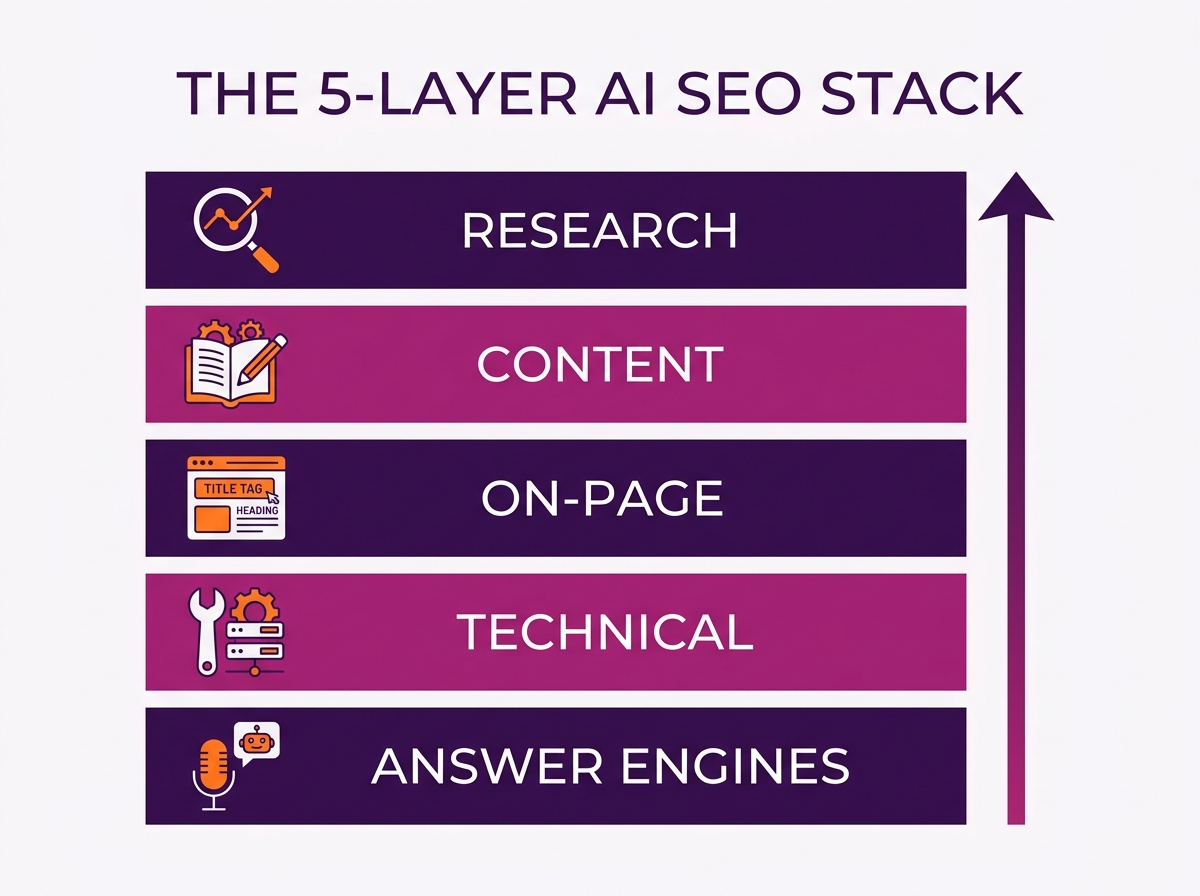
| Layer | What AI does (the reps) | What you own (the calls) |
|---|---|---|
| 1. Research | Cluster keywords, surface questions, summarize competitor gaps | Pick the topics worth your authority and intent match |
| 2. Content | Outlines, first drafts, rewrites, variations | Experience, opinions, original data, the final edit |
| 3. On-page | Titles, meta descriptions, alt text, internal-link suggestions | Brand voice, promises you can keep, the actual click bait vs truth line |
| 4. Technical | Crawl audits, schema drafts, log-file patterns, redirect maps | Which fixes matter, priority order, sign-off on live changes |
| 5. Answer engines | Answer-shaped rewrites, FAQ drafting, entity checks | The unique claim only you can defend, so the AI cites you |
Layer 1: AI for keyword and topic research
AI is at its best in research. Use it to cluster hundreds of keywords by search intent, surface the real questions people ask, and summarize what the top-ranking pages already cover so you can find the gap. This turns a two-day research slog into about 90 minutes of focused work.
My workflow is simple. I pull raw keyword and question data from a proper SEO tool, then I paste it into an AI assistant and ask it to group by intent, flag the transactional terms, and tell me which clusters a mid-authority site can realistically win. I do the same thing you can do with any assistant. If you want the tool-by-tool version, I broke down how I run this inside ChatGPT for digital marketing and Gemini for digital marketing.
Here is the part people skip. AI will happily hand you 200 keywords. Your job is to reject 180 of them. At echoVME, the biggest ranking wins in the last year came from choosing fewer, tighter topics we could genuinely own, not from chasing volume. The AI does not know your brand’s authority ceiling. You do.
The key insight: AI multiplies your research speed, but it also multiplies the temptation to chase every keyword. Speed without selection just produces more mediocre content, faster.
Layer 2: AI for content creation (the right way)
Use AI to build outlines, write first drafts, and produce rewrites, then have a human add the parts that make content worth ranking: real experience, a defensible opinion, original data, and a hard edit. Content marketing is the layer where AI helps the most and does the most damage when used lazily.
Let me be blunt. If you use AI to write your entire blog post from start to finish and hit publish, your content will rank for about six months, then tank. We tested this. Google’s helpful-content signals and the AI Overview citation logic both reward the things AI cannot fake: first-hand experience, specific numbers, and a point of view. A post that summarizes what everyone already said is exactly what the AI Overview replaces, not cites.
So here is the play. Let AI draft the skeleton and the boring connective sentences. Then you add the echoVME campaign story, the Digital Scholar cohort result, the number nobody else has. Every post on this blog carries at least one thing you cannot find anywhere else, which is the same rule we teach in the online digital marketing course. That single rule is why our content gets pulled into AI answers.
Is the AI-drafted section as good as a section I write from scratch? Honestly, about 70% as good before editing. The edit is where the other 30% and all the trust live. Do not cheat on the edit. If you want to see how far a well-built AI workflow can carry the busywork, I documented how I replaced five hours of daily agency work with Claude routines, and the same discipline applies to content.
Layer 3: AI for on-page optimization
On-page is where AI saves the most tedious hours. Use it to draft title tags and meta descriptions that fit the character limits, write keyword-rich image alt text, suggest internal links, and check that every heading answers a real question. These are mechanical tasks with clear rules, which is exactly what AI is good at.
My rule for meta descriptions: I ask AI for five options under 155 characters, each written to earn a click even when an AI Overview sits above the result. Then I pick the one that makes a promise the page actually keeps. The gap between a clickbait meta and the real content is where bounce rate and lost trust come from, so the human check matters. The same AI-assisted, human-led method powers work like our Instagram audit using AI walkthrough, where the tool does the pull and the human reads the story.
Internal linking is the underrated on-page win. AI can scan your content library and suggest which older posts should link to a new one and vice versa. On the Digital Scholar blog, tight internal linking between related posts, like connecting a guide on the best AI tools for digital marketing to specific tool walkthroughs, is a big part of how the whole cluster ranks together instead of individually.
Layer 4: AI for technical SEO and audits
For technical SEO, use AI to read crawl reports, spot patterns in log files, draft structured-data schema, and build redirect maps during migrations. It compresses a task that used to need a specialist and a full day into a guided session where you review the output instead of generating it from scratch.
The highest-leverage technical use in 2026 is schema markup. Article, FAQ, HowTo, and Breadcrumb schema help both Google and answer engines understand exactly what your page is. AI can draft valid JSON-LD in seconds. Your job is to check that the schema describes what is actually on the page, because schema that lies gets ignored or penalized.
A word of caution from experience. AI is confident and often wrong on technical specifics. It will invent a canonical rule or a robots directive that sounds right and is not. Treat every technical suggestion as a draft to verify, never a fix to deploy blind. On live sites where a wrong directive can deindex a whole section, the human sign-off is not optional. If you are still building your technical foundation, our breakdown of the performance marketing tool stack covers the analytics and tracking side that feeds good SEO decisions.
Layer 5: AI for answer engines (AEO and GEO)
Answer-engine optimization (AEO), sometimes called generative engine optimization (GEO), is optimizing your content so AI systems like Google AI Overviews, ChatGPT, and Perplexity cite it when they build an answer. This is the layer that separates 2026 SEO from 2022 SEO, and it is the one most sites are ignoring.
Here is why it matters in numbers. When an AI Overview appears, organic CTR drops 61%, and the top result loses about 58% of its clicks. Ranking number one is worth far less than it was. But the AI Overview lists sources, and being one of those cited sources puts your brand in front of the user even when they never click a blue link. The goal flips from “rank first” to “be the source the machine trusts.”
How do you use AI to win here? Ask your assistant to rewrite each section so the first 40 to 60 words directly answer the heading question, the way an AI Overview would quote it. Have it draft a real FAQ block. Have it check that your key entities, your brand, your product, your author, are named clearly and consistently so the machine can connect them. We build every Digital Scholar post this way, which is why I treat the assistant guides like Claude AI for digital marketing as core reading, not side content.
The Citation-Worthiness Checklist
Being cited by an AI answer is not luck. It is a set of on-page conditions you can engineer. This is the Citation-Worthiness Checklist we run on every Digital Scholar post before it ships. If a page fails three or more of these, it is background noise to an answer engine.
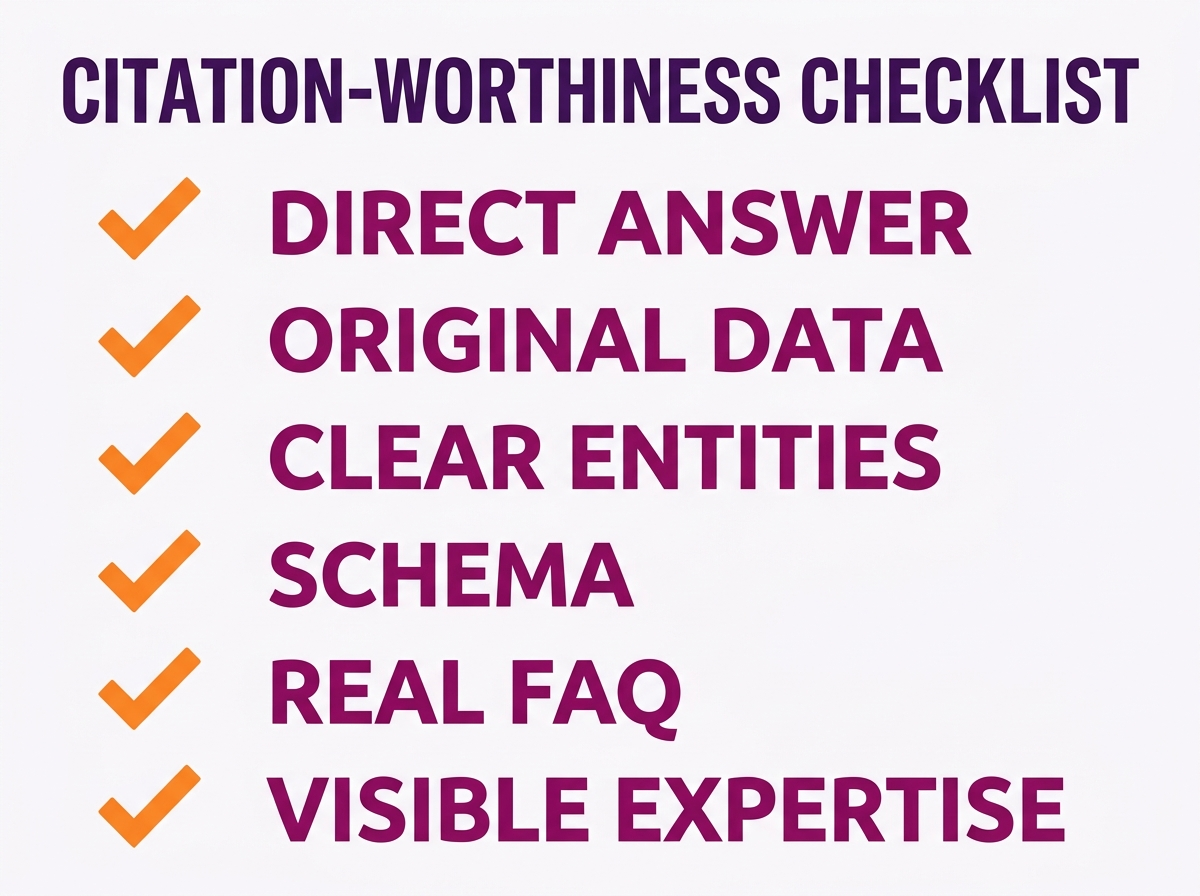
| Check | What it means | Why the machine rewards it |
|---|---|---|
| 1. Direct answer up top | First 40 to 60 words after each heading answer the question | AI Overviews quote answer-shaped passages, not intros |
| 2. One original data point | A stat or result only your page has | Unique data is what gets cited over a summary |
| 3. Clear entities | Brand, product, and author named consistently | The model needs to connect who is making the claim |
| 4. Structured data | Valid Article, FAQ, and Breadcrumb schema | Schema removes ambiguity about what the page is |
| 5. Real FAQ block | 6 to 10 genuine questions with tight answers | FAQs map directly to how people query AI |
| 6. Visible expertise | Named author with real credentials on the page | Experience and authorship signal trust to both Google and AI |
Notice that AI can help you hit five of these six, but check number two, the original data point, is entirely on you. That is the moat. Every other site can prompt an assistant. Only you have your echoVME numbers, your Digital Scholar results, your tested opinion.
Where AI quietly tanks your SEO
AI hurts your SEO in three specific ways, and all three are self-inflicted: mass-publishing thin content, trusting hallucinated facts, and letting every page sound identical. None of these are Google punishing AI. They are Google doing exactly what it always did, faster.
The first killer is volume without value. A weekend of 400 unedited AI articles feels like progress and is actually a slow deindexing event. The second is hallucination. AI states wrong facts with total confidence, and a single invented statistic that a reader catches destroys the trust you spent years building. The third is sameness. If your content reads like every other AI page, there is nothing for a human to remember or an AI to prefer.
| Task | AI helps | AI hurts if |
|---|---|---|
| Keyword research | Clustering and intent grouping | You chase every keyword it suggests |
| Drafting | Outlines and first passes | You publish the draft unedited |
| Facts and stats | Summarizing sources you provide | You trust numbers it generated alone |
| Meta and titles | Fast options within limits | You pick clickbait the page cannot back up |
| Technical fixes | Drafting schema and audits | You deploy directives without checking |
This is exactly the discipline we drill in the performance marketing training and across Digital Scholar. AI is a power tool. Power tools are how you build a house fast and also how you lose a finger. Respect for the tool is the whole skill.
The AI SEO tools I actually pay for
I have tested more than 40 AI SEO tools across echoVME and Digital Scholar. I pay for maybe five. The rest are either features that already live inside tools I own, or novelty that does not survive a month of real use. Here is the short list that earns its keep, by job.
| Tool type | Use it for | My honest verdict |
|---|---|---|
| A serious SEO suite (Semrush or Ahrefs) | Real keyword volume, difficulty, competitor gaps, rank tracking | Non-negotiable. AI assistants guess volume, these measure it. |
| A general AI assistant (ChatGPT, Gemini, or Claude) | Clustering, drafting, rewrites, schema, AEO answer-shaping | The workhorse. One good subscription covers 80% of the work. |
| A content optimizer (Surfer or Frase) | On-page scoring against what already ranks | Worth it if you publish weekly. A score went 42 to 78 and rankings moved in 6 to 8 weeks. |
| A technical crawler (Screaming Frog) | Site audits, redirect maps, schema validation at scale | Old-school and irreplaceable. Pair it with AI to read the output. |
| An AEO tracker (AI visibility monitor) | Seeing whether ChatGPT and Perplexity cite you | Emerging category, still rough, but the only way to measure Layer 5. |
Notice what is not on this list: the 30 single-purpose AI writers promising to auto-generate ranking articles. I would not pay for those unless you enjoy rewriting everything they produce. The full reasoning is in my guide to the AI tools I actually use across marketing. Fewer tools, used properly, beats a bloated stack every time.
A 30-day AI SEO workflow you can copy
Here is a 30-day plan that puts the 5-Layer Stack into motion without overwhelming you. It assumes you have one SEO suite and one AI assistant. That is enough to start. The goal by day 30 is not 400 articles. It is 4 genuinely citable ones and a system you can repeat.
| Week | Focus | What you do with AI |
|---|---|---|
| Week 1 | Research and selection | Cluster keywords, pick 4 topics you can own, map intent. Reject the rest. |
| Week 2 | Create with your data | AI drafts outlines and first passes. You add echoVME-style numbers and one original point per post. |
| Week 3 | Optimize and structure | AI drafts titles, metas, alt text, FAQ, and schema. You run the Citation-Worthiness Checklist. |
| Week 4 | Publish, link, and measure | Ship 4 posts, wire internal links, then track rankings and AI citations. Refine, do not restart. |
Run that loop every month and in a quarter you have a compounding library of 12 citable pages, each reinforcing the others. That is how topical authority is actually built. It is the same engine behind how we grew the Digital Scholar blog, from career guides like the scope of digital marketing in India to buyer guides like how to choose a digital marketing course, and the same one we teach students to run for their own brands and clients.
Want to run this system end-to-end?
The Digital Scholar 4-month AI and Digital Marketing program teaches the exact AI-assisted, human-led SEO workflow in this post, plus performance marketing, content, and AI agents, with live projects. 1,000+ students a year train with us.
Frequently asked questions
Is AI good for SEO?
Yes, when used as an assistant, not an autopilot. AI is excellent at the repetitive parts of SEO: keyword clustering, drafting, on-page checks, schema, and reporting. It becomes bad for SEO the moment you let it publish unedited or trust its facts blind. At echoVME and Digital Scholar, AI made our SEO work roughly three times faster, but every page still passes a human edit before it ships.
Can AI do SEO on its own?
No. AI can handle specific tasks like structure, research, and drafting, but it cannot set strategy, judge search intent for your business, weigh priorities, or own results. It also cannot supply original experience or data, which is exactly what gets content ranked and cited in 2026. AI does the reps. A human makes the calls. That split is the whole method in this post.
Will AI replace SEO?
AI will automate parts of SEO, but it will not remove the need for SEO professionals. Someone still has to understand the audience, decide what a site should own, verify claims, improve the real experience, and measure whether the work helps the business. What is changing is the job, not its existence. The SEOs who thrive are the ones who direct AI instead of competing with it.
Does Google penalize AI-generated content?
Google does not penalize content for being AI-generated. It penalizes unhelpful, low-quality content regardless of how it was made. The risk with AI is that it makes it easy to mass-produce thin, generic pages fast. We tested lightly edited AI drafts in 2025; they ranked for a few months, then slid, and recovered only after we rewrote them by hand with real data. Quality and originality are the actual signals.
What is answer engine optimization (AEO)?
AEO is optimizing your content so AI systems like Google AI Overviews, ChatGPT, and Perplexity cite it when they generate an answer. With AI Overviews on roughly 48% of queries and organic CTR dropping 61% when they appear, being the cited source matters as much as ranking first. You win at AEO with answer-shaped passages, clear entities, structured data, real FAQs, and original data only your brand has.
Which AI tool is best for SEO?
There is no single best tool; there is a best stack. You need a real SEO suite for data (Semrush or Ahrefs), a strong general AI assistant for drafting and optimization (ChatGPT, Gemini, or Claude), a content optimizer if you publish often (Surfer or Frase), and a technical crawler (Screaming Frog). I have tested 40+ tools and pay for about five. Fewer tools used well beats a bloated stack.
How do I start using AI for SEO if I am a beginner?
Start with the 30-day loop in this post: one SEO suite, one AI assistant, four topics you can genuinely own. Use AI to research and draft, then add your own experience and one original number per post, then run the Citation-Worthiness Checklist before publishing. If you want structured, hands-on training with live projects, that is exactly what the Digital Scholar 4-month program is built to teach.
The bigger picture
Search is not dying. It is being rebuilt around AI answers, and the brands that show up inside those answers will own the next decade of demand. Everyone now has access to the same AI tools, which means the tools stop being the advantage. Judgment, experience, and original data become the advantage. That is good news if you actually know your craft.
So here is your one instruction for today: pick a single topic your brand genuinely deserves to own, draft it with AI, then spend the real time adding the one number and the one opinion nobody else can. Run it through the Citation-Worthiness Checklist and ship it. That is how to use AI for SEO in a way that compounds instead of decays.
The tools are ready. The method is above. The only thing missing is you actually doing it.