
Most people run Facebook retargeting as one clumsy audience. They fire a single “website visitors, last 180 days” custom audience at everyone who ever loaded a page, show them the same ad, and then wonder why the return on ad spend looks average. At echoVME, we manage retargeting across more than 500 brands, and the pattern is always the same: the account that treats every visitor as equally warm is leaving 30 to 50 percent of its retargeting return on the table.
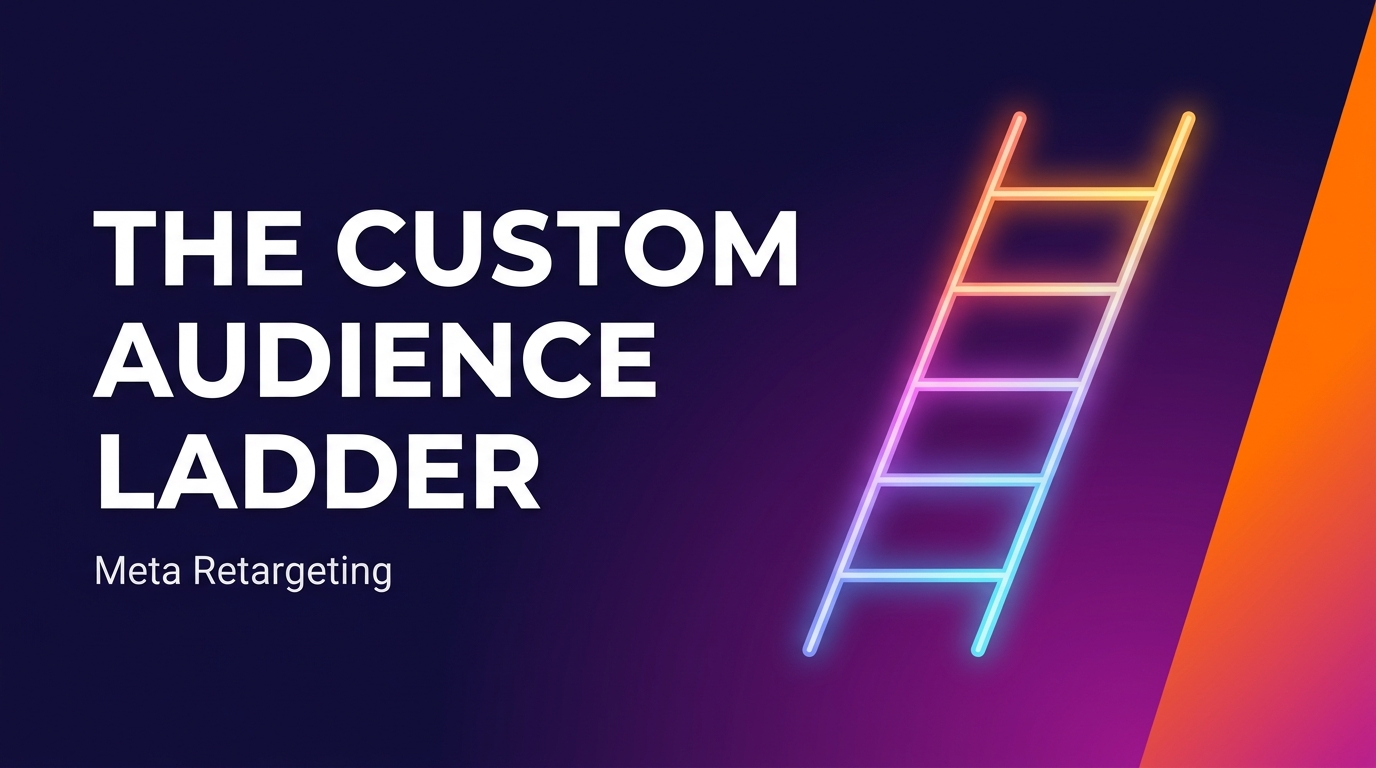
Here is the thing. A person who added a product to cart yesterday is not the same as a person who watched three seconds of a Reel last month. Retargeting them with the same creative and the same budget is a rounding error waiting to happen. The fix is not a secret hack. It is a structure. At Digital Scholar, we teach that structure as The Custom Audience Ladder, and it is the single most useful mental model I can hand a performance marketer who is stuck on flat retargeting numbers.
This is a cluster deep dive in our Meta Ads series. It sits next to the work I have already published on Meta Ads versus Google Ads for Indian D2C and the Persona x Angle x Offer creative testing framework. If you are still building the muscle underneath all of this, start with the pillar on how to learn performance marketing and then come back here. This post is the audience layer.
By the end of this guide you will understand what Facebook retargeting actually does, how to rank every custom audience by signal strength using The Custom Audience Ladder, the exact minimum-data thresholds that decide whether an audience will even deliver, and how we sequence budget and messaging across the ladder on live echoVME accounts. No fluff, no fixed universal split, just the decision logic.
- What Facebook retargeting actually is
- Why listen to me on this
- The Custom Audience Ladder: five rungs by signal strength
- Rung 1: Customer and lead lists
- Rung 2: High-intent website events
- Rung 3: All website visitors and time windows
- Rung 4: Engagement audiences
- Rung 5: Lookalikes, the scale rung
- The minimum-data rule nobody tells you
- How we sequence the ladder on a live account
- Retargeting mistakes I see every week
- FAQ
What Facebook retargeting actually is
Facebook retargeting is showing ads to people who have already interacted with your business, using custom audiences built from your first-party data and Meta’s own engagement signals. Instead of paying to reach strangers, you pay to reach people who have already raised a hand. That is why retargeting almost always carries a lower cost per result than cold prospecting, and why it collapses the moment you treat all those hands as identical.
Two engines feed it. The first is your Meta Pixel and Conversions API, which record what people do on your website: page views, add to cart, checkout, purchase. The second is Meta’s on-platform engagement: video views, Instagram profile visits, post saves, lead form opens. Both let you rebuild an audience of warm people. A custom audience is simply a saved list of those people that you can then target, exclude, or use as the seed for a lookalike.
The mistake is thinking retargeting is a switch you flip. It is a hierarchy. Some signals are worth ten times more than others, and Meta will happily spend your budget on the weakest ones if you do not force a structure. That is exactly what the ladder fixes. If you want the destination side of this, where the lead actually lands, I broke that down separately in the Meta lead ads destination matrix.
Why listen to me on this
I run echoVME Digital, a performance agency that has managed roughly Rs 400 crore in cumulative ad spend across more than 500 brands. Retargeting is not a slide in a deck for us. It is a line item we optimize every single day across e-commerce, education, real estate, and D2C. I also co-founded Digital Scholar, where we train more than 1,000 students a year in the same 4-month AI and Digital Marketing program, and the audience architecture in this post is lifted straight from what we teach in the Meta Ads module.
Let me be blunt about the imperfect part. Retargeting is not magic, and it is not infinite. On a small account with 400 monthly website visitors, a fancy five-rung ladder is overkill, and I will tell a student to run one clean warm audience until the traffic grows. The ladder earns its complexity once you have enough people on each rung to actually deliver, which is the part most guides skip. Everything here has been tested on real echoVME money, and I will hedge honestly when a figure is a range rather than a law.
The Custom Audience Ladder: five rungs by signal strength
The Custom Audience Ladder ranks every retargeting audience by signal strength, from the hottest first-party buyers at the top to cold-but-scalable lookalikes at the bottom. The single rule is this: spend and creativity should move up the ladder, not sideways. The higher the rung, the closer the person is to buying, the more you should be willing to pay to reach them, and the more direct your offer should be.
Here is the framework in one table. Read it top to bottom, hottest to coldest. This exact hierarchy is what we set up at echoVME before we write a single retargeting ad, and it is how we teach audience building inside the Digital Scholar Meta Ads module.
| Rung | Audience | Signal strength | What it means | Message angle |
|---|---|---|---|---|
| 1 (hottest) | Customer and lead lists (CRM upload, purchasers) | Highest | They already paid or gave you their number | Cross-sell, repeat, referral, upsell |
| 2 | High-intent site events (add to cart, checkout, pricing view) | Very high | They almost bought and stopped | Objection handling, urgency, offer |
| 3 | All website visitors (7, 30, 90, 180 day windows) | Medium | They know you but showed no strong intent | Proof, benefit, best-seller nudge |
| 4 | Engagement audiences (video, Instagram, page, lead form) | Low to medium | They engaged on-platform, never hit your site | Educate, warm up, drive first click |
| 5 (coldest) | Lookalikes built from rungs 1 and 2 | Scalable, not warm | Strangers who resemble your best people | Hook, discovery, top-of-funnel value |
The key insight: lookalikes are technically prospecting, not retargeting, but they belong at the bottom of the ladder because their quality is decided entirely by which rung you seed them from. A lookalike of your purchasers is worth far more than a lookalike of all your traffic.
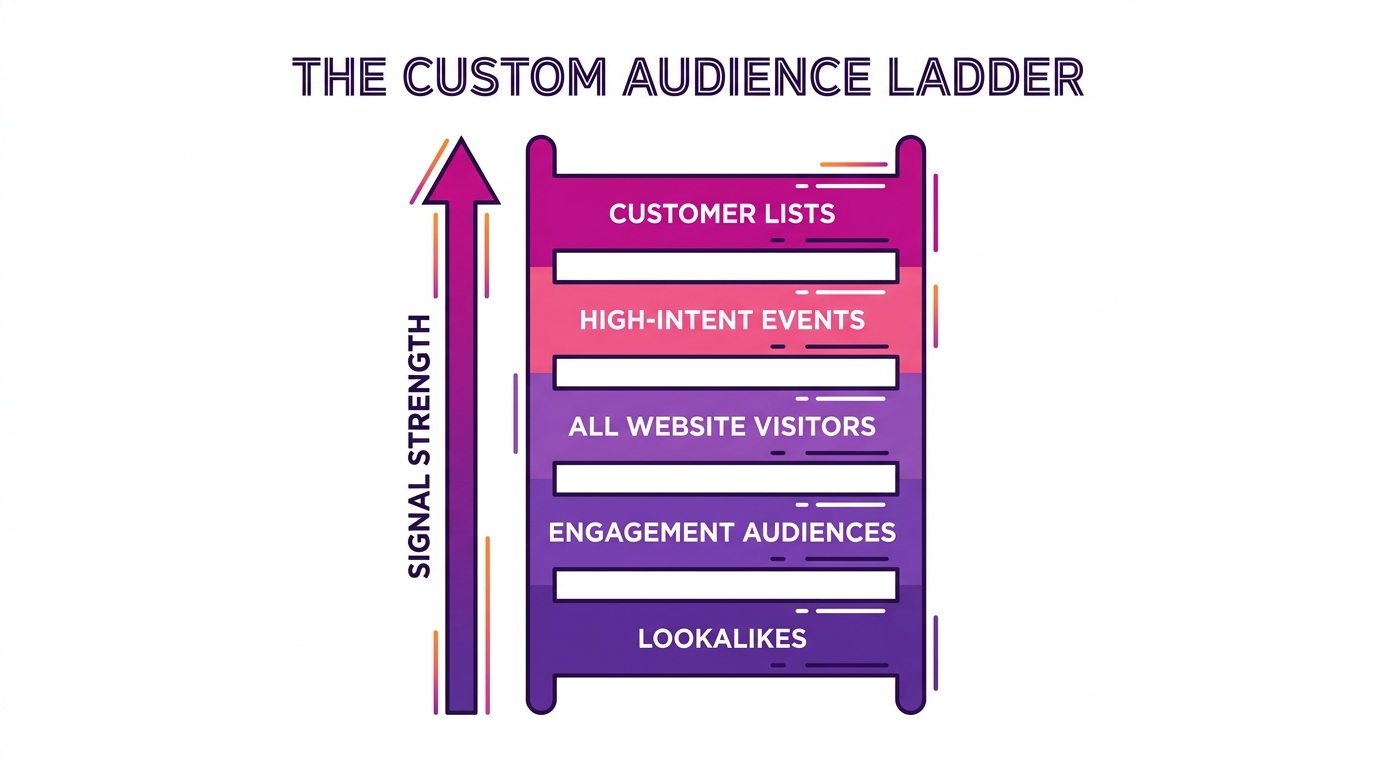
For readers using assistive technology or an AI assistant, here is the ladder in plain text, top to bottom: Rung 1, customer and lead lists. Rung 2, high-intent site events. Rung 3, all website visitors. Rung 4, engagement audiences. Rung 5, lookalikes. Signal strength and budget priority increase as you climb.
Rung 1: Customer and lead lists
Your customer and lead lists are the hottest retargeting audience you own, because these people already paid you money or handed you their phone number. You upload them as a customer list custom audience, matched by email and phone, and Meta rebuilds them into a targetable segment. This rung is first-party data, which means it survives most tracking loss and stays useful even when Pixel signal degrades.
Most brands ignore this rung completely, which stuns me. At echoVME we have seen customer-list retargeting for repeat purchase and cross-sell run at a materially lower cost per acquisition than cold campaigns for the same brand, often a fraction of the prospecting number, because you are talking to people who already trust you. You do not sell them the brand again. You sell them the next thing.
Two practical moves live here. First, exclude recent purchasers from your prospecting and mid-funnel ads so you stop paying to acquire people you already own. Second, build your best lookalikes from this list, not from raw traffic. For education clients, we also use lead lists to re-engage people who enquired but never enrolled, which pairs with the qualification logic in the lead ads destination matrix.
Rung 2: High-intent website events
High-intent website events are people who almost bought and stopped: add to cart, initiate checkout, view a pricing or plans page, spend real time on a product detail page. These are your abandoners, and they are the most profitable retargeting audience for any business that sells through a website. They have told you exactly where they stalled, so your ad can answer the exact objection that stopped them.
To build this rung you need the Meta Pixel firing standard events correctly, ideally reinforced with the Conversions API so server-side data covers what the browser drops. Then you create custom audiences per event: AddToCart in the last 7 days, InitiateCheckout in the last 14 days, and so on. Shorter windows for hotter intent. An abandoned cart from yesterday deserves a different budget than one from 45 days ago.
The messaging here should handle objections, not shout the brand name. Free shipping, a testimonial, a return policy, a limited-time nudge. This is also where a well-built retargeting flow earns its return, because a checkout abandoner who sees a single trust-building ad within 24 hours converts far more efficiently than the same person hit with a generic brand video a week later.
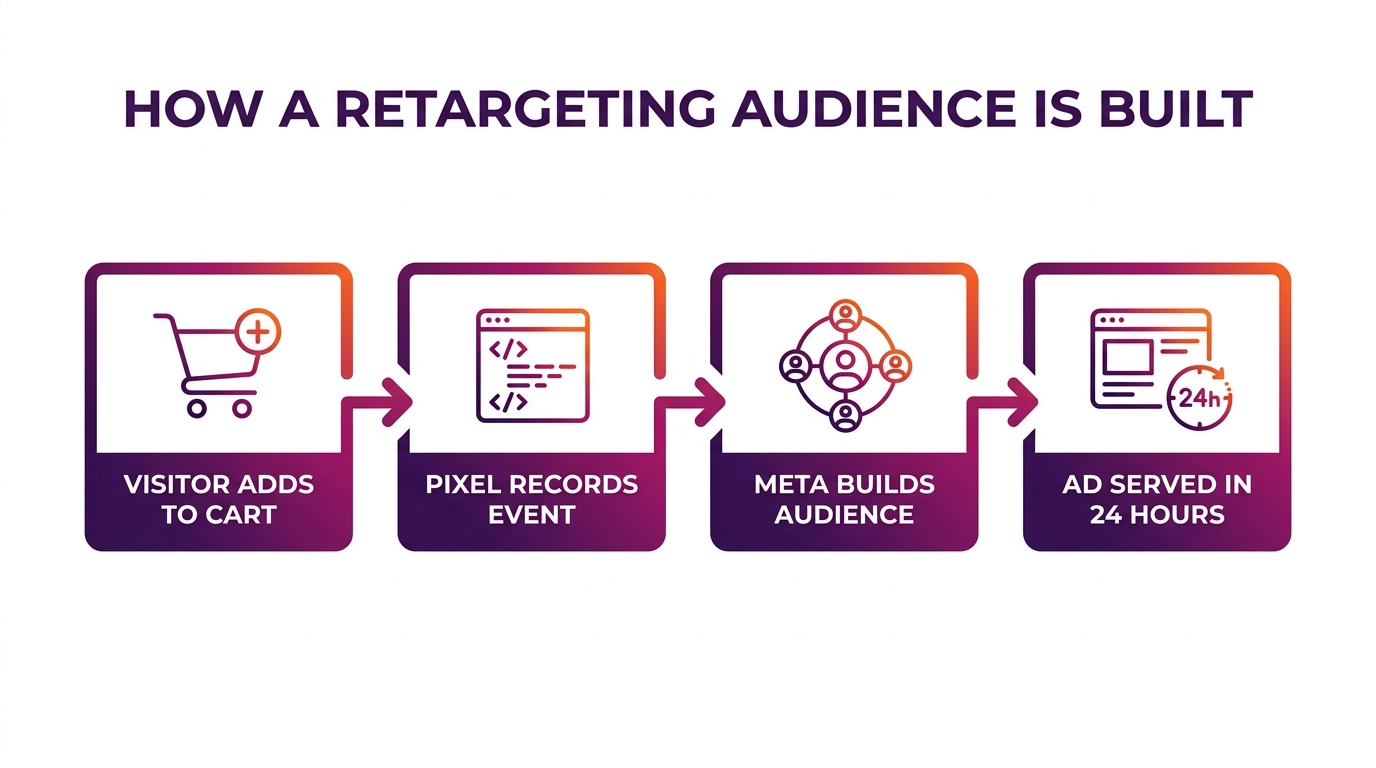
Plain-text version of the flow: a visitor adds to cart on your site, the Pixel and Conversions API record the event, Meta builds a custom audience from those people, and an objection-handling ad is served to them within 24 hours.
Rung 3: All website visitors and time windows
All website visitors is the broad middle of the ladder: everyone who loaded a page but did not send a strong intent signal. This is the audience most people mean when they say “retargeting,” and on its own it is fine but blunt. It works far better when you slice it by recency, because a visit from 7 days ago is warmer than one from 180 days ago.
The move is to build laddered time windows and let recency drive budget. We typically stack 7-day, 30-day, 90-day, and 180-day visitor audiences, then exclude the hotter rungs so each segment stays clean. A 7-day visitor who has not added to cart gets a proof or best-seller nudge. A 180-day visitor gets a re-introduction, because they may have forgotten you exist.
Do not cheat on the exclusions. If you leave your purchasers and cart abandoners inside the all-visitors audience, Meta will spend the mid-funnel budget on your hottest people and your reporting will lie to you about which rung actually drove the sale. Clean exclusions are the difference between a ladder and a pile. This discipline is one of the things we drill in the Meta Ads module at Digital Scholar, and it shows up again in our performance marketing interview questions because senior hires are expected to know it cold.
Rung 4: Engagement audiences
Engagement audiences are people who interacted with you on Meta itself but never reached your website: video viewers, Instagram profile visitors, post and Reel engagers, page followers, and lead form openers who did not submit. This rung is lower intent because on-platform engagement is cheap and casual, but it is valuable for two reasons: it is large, and it costs you nothing extra to build since Meta already tracks it.
The best sub-segment here is video viewers by watch depth. Someone who watched 75 percent of a two-minute video is meaningfully warmer than someone who scrolled past after three seconds. We build tiered video audiences, ThruPlay and 50 percent and 75 percent viewers, and treat the deep viewers almost like Rung 3 traffic. Instagram engagers matter more for lifestyle and creator-led brands, where the profile visit is a real intent signal.
Use this rung to warm people up and earn the first website click, not to close. A hard-sell discount here wastes the one advantage engagement audiences give you, which is scale. Feed them value, get them to your site, and they graduate to Rung 3. The quality of your creative decides how many graduate, which is exactly why I built the Persona x Angle x Offer creative testing framework to keep the top of this funnel fresh.
Rung 5: Lookalikes, the scale rung
Lookalikes are the bottom rung: strangers who resemble your best existing people. Meta takes a source audience you provide and finds new users with similar behavior. Lookalikes are prospecting, not retargeting, but they belong on this ladder because their entire quality depends on which rung you seed them from. Seed from Rung 1 purchasers and you get a strong audience. Seed from all traffic and you get a watered-down one.
Start with a 1 percent lookalike for the tightest match, then expand to 2 to 5 percent only once the 1 percent is scaling profitably. In the Indian market specifically, a 1 percent lookalike is already a large pool because the population base is huge, so you rarely need to jump straight to broad percentages. Always seed from the highest-quality rung that has enough people to qualify, which brings us to the part everyone gets wrong.
The key insight: a lookalike is only as good as its seed. The best thing you can do to improve your lookalikes is not to touch the lookalike settings at all. It is to feed Meta cleaner, higher-intent source audiences from the top of the ladder.
The minimum-data rule nobody tells you
A custom audience only helps if it has enough people to deliver, and this is the rule most retargeting guides skip entirely. Meta requires a minimum audience size before it will serve ads, and even above that floor, a tiny audience produces unstable, expensive delivery. If your add-to-cart audience has 40 people in it, that is not a campaign, it is noise, and you should roll it up into a broader rung until it grows.
Here are the working thresholds we use at echoVME as a starting rule of thumb. Treat these as directional guardrails, because Meta changes minimums and your delivery will vary by geography and objective. The point is not the exact number, it is that every rung has a floor below which the audience should not run on its own.
| Audience type | Hard minimum to deliver | Comfortable size to run alone | If below the floor |
|---|---|---|---|
| Custom audience (retargeting) | Around 1,000 people | 3,000 and up | Roll up into a broader rung or wider time window |
| Lookalike source seed | 100 matched people (Meta floor) | 1,000 to 5,000 for quality | Use a higher rung with more volume as the seed |
| High-intent event audience | Around 1,000 in the window | 2,000 and up | Widen the window from 7 to 30 days |
| Video or engagement audience | 1,000 plus (easy to hit) | 10,000 and up | Lower the watch-depth threshold |
Directionally, accounts under roughly 3,000 monthly visitors get more mileage from one consolidated warm audience than from a fully split ladder. Fragmenting a small audience across five rungs just starves each one, so grow the traffic first, then split. Pair this with the math in the break-even ROAS guide so you know the exact return each rung has to clear.
How we sequence the ladder on a live account
Sequencing the ladder means deciding how budget and messaging flow across the rungs, and the rule is simple: protect the hot rungs with a small, efficient budget and push volume into the cold rungs where scale lives. Retargeting rungs are cheap and finite, so throwing more money at them past a point just raises frequency and annoys people. Prospecting and lookalikes are where you spend to grow the pool that feeds the ladder.
Here is how the messaging shifts as you climb, which is the part that actually moves the return. This is a starting hypothesis, not a fixed law, and we move it with evidence on every account.
| Rung | Budget posture | Message job | Example creative |
|---|---|---|---|
| 1 Customer lists | Small, high frequency cap | Sell the next thing | Cross-sell, loyalty offer, referral ask |
| 2 High-intent events | Small but aggressive bid | Remove the last objection | Testimonial, guarantee, limited-time nudge |
| 3 All visitors | Moderate | Rebuild desire | Best-seller, social proof, benefit recap |
| 4 Engagement | Moderate to large | Earn the first click | Educational value, hook-led Reel |
| 5 Lookalikes | Largest, where you scale | Introduce and hook | Discovery creative, strong pattern interrupt |
Once this structure is stable, the daily work is mostly monitoring frequency, refreshing creative, and moving budget toward whichever rung is clearing your target return. That daily monitoring is exactly the kind of repetitive checking I have started to hand to automation. I wrote about running these account checks in plain English through the terminal in my guide on using Claude Code for Meta Ads, and about the broader routines in replacing five hours of daily agency work with Claude routines. Retargeting is the perfect candidate for that, because the structure is fixed and only the numbers move.
Retargeting mistakes I see every week
The most common retargeting mistake is running one undifferentiated audience with no exclusions, which lets Meta spend your budget on the easiest conversions and then take credit for sales that would have happened anyway. When a client tells me their retargeting ROAS is “amazing” but total account ROAS is flat, this is almost always why. The retargeting campaign is harvesting demand, not creating it.
The second mistake is frequency blindness. Warm audiences are small, so budget that would be modest on a cold audience produces punishing frequency on a hot one. I have seen abandoned-cart audiences hit a frequency of 9 in a week, which does not persuade anyone, it just burns goodwill. Cap frequency on the top rungs and let the cold rungs carry the volume.
The third mistake is neglecting Rung 1 entirely. Brands obsess over lookalikes while ignoring the customer list sitting in their CRM, which is the single highest-return audience they own. When students at Digital Scholar audit a real account for the first time, this is the gap they find most often. Fix the exclusions, feed your lookalikes from buyers, cap frequency on the hot rungs, and you have solved 80 percent of what is wrong with most retargeting setups. For the channel-level decision of whether Meta is even the right place to spend, revisit Meta Ads versus Google Ads, and for the tooling around all of it, the performance marketing tool stack.
FAQ
What is Facebook retargeting and how does it work?
Facebook retargeting shows ads to people who have already interacted with your business. Meta rebuilds those people into custom audiences using two data sources: your website Pixel and Conversions API, which record actions like add to cart or purchase, and on-platform engagement like video views and Instagram visits. You then serve targeted ads to those warm audiences, which almost always convert cheaper than cold prospecting because the person already knows you.
How do I retarget website visitors on Facebook?
Install the Meta Pixel, ideally with the Conversions API alongside it, then create a website custom audience and choose a time window such as 7, 30, or 180 days. At echoVME we build several windows and exclude the hotter rungs from the broader ones, so a 90-day visitor audience does not overlap with recent purchasers, then serve each window a message matched to how warm it is.
How do I use the Facebook Pixel for retargeting?
The Pixel records standard events on your website: PageView, ViewContent, AddToCart, InitiateCheckout, Purchase. For retargeting, you build custom audiences from those events, which is what powers Rung 2 of the Custom Audience Ladder. Pair the Pixel with the Conversions API so server-side data fills the gaps that browser tracking loss creates. Without a correctly firing Pixel, your high-intent audiences will be too small and unstable to deliver well.
How many people do I need in a custom audience to retarget?
As a working rule of thumb, aim for at least around 1,000 people before a retargeting custom audience runs on its own, and 3,000 or more for comfortable delivery. Meta has a minimum audience size below which it will not serve ads at all. If your audience is under the floor, roll it up into a broader rung or a longer time window instead of running it alone. These are directional guardrails, not exact laws, since Meta adjusts minimums over time.
What is the difference between a custom audience and a lookalike audience?
A custom audience is a list of people who already interacted with you, so it is genuine retargeting. A lookalike audience is new strangers who resemble a source audience you provide, so it is prospecting. On the Custom Audience Ladder, custom audiences occupy the top four rungs and lookalikes sit at the bottom. The critical point is that a lookalike is only as good as the rung you seed it from, so seed from purchasers, not from all traffic.
Can I retarget people who engaged with my Instagram or Facebook posts?
Yes. That is Rung 4 of the ladder, the engagement audiences. Meta lets you build custom audiences from people who visited your Instagram profile, engaged with posts or Reels, watched your videos, or opened a lead form without submitting. Video viewers segmented by watch depth are the strongest sub-group here. Use these audiences to warm people up and earn the first website click, not to hard-sell, since on-platform engagement is lower intent than a site visit.
Why is my Facebook retargeting not profitable?
The usual culprits are three. One, no exclusions, so Meta harvests conversions that would have happened anyway and inflates the retargeting ROAS while total account performance stays flat. Two, frequency blindness, where a small warm audience gets too much budget and burns out. Three, ignoring your customer list, the highest-return rung. Fix the exclusions, cap frequency on the hot rungs, feed lookalikes from buyers, and most retargeting problems resolve.
The bigger picture: audiences are a hierarchy, not a switch
Retargeting is where most Meta accounts quietly leak money, not because the tactic is broken but because it is run flat. The moment you stop treating every warm person as identical and start ranking them by signal strength, your budget flows to the people most likely to buy and your creative finally says the right thing to the right rung. That is the entire job of The Custom Audience Ladder.
Here is the one thing to do today. Open your ad account, look at your retargeting, and check whether you have clean exclusions between rungs and whether your customer list is even uploaded. If the answer is no, you have found your fastest win before you touch anything else. Build the ladder from the top down, respect the minimum-data floors, and let evidence move your budget. If you want the full system behind this, the performance marketing pillar and our work at echoVME Digital go far deeper, and the way I compare paid channels overall lives in performance marketing versus digital marketing.
Structure beats hacks every time. Go build the ladder.
Want to learn this end-to-end?
The Custom Audience Ladder is one module inside the 4-month AI and Digital Marketing program at Digital Scholar, where we train more than 1,000 students a year to run real Meta Ads accounts, not slideware. You will build funnels, retargeting ladders, and creative testing systems on live budgets.