Mansoor Usmani (Pulse Vector Digital) had been blogging for two years. Not a single post had ranked on Google. He had tried keyword research, he had bought backlink packages, he had rewritten titles six times. Nothing moved.
He joined a Digital Scholar SEO class in April 2026. Seven days after the AIO optimization session, his website on “Best Digital Marketing Freelancer in Saudi Arabia” appeared inside Google’s AI Overview for that exact query. Not in the blue links. In the AI-generated answer at the very top of the page, the block that now gets seen before any result.
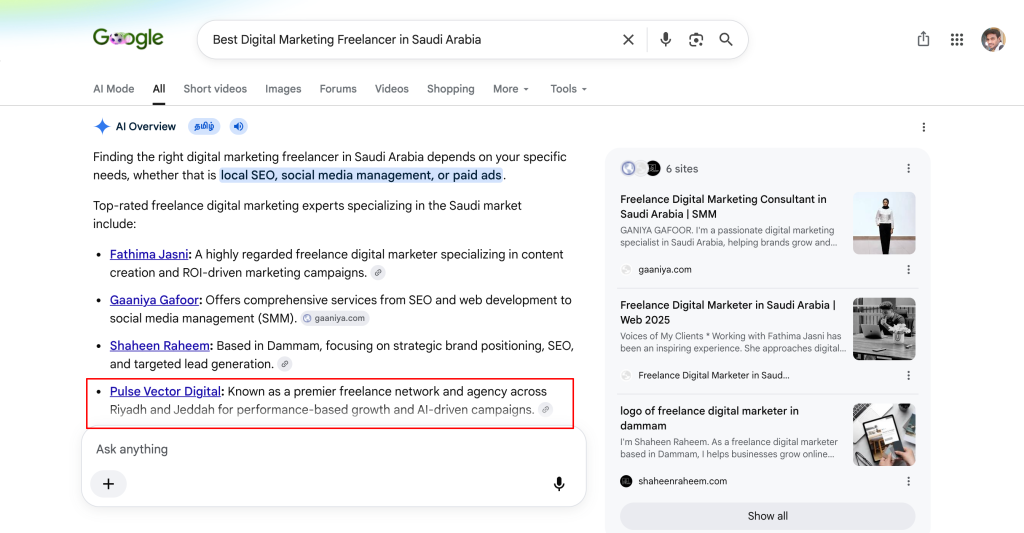
Mansoor’s story is not rare anymore. Across the 3,000+ students I have trained at Digital Scholar, the pattern repeats: apply the right signals, and Google’s AI engine picks your content up fast. The old game was about backlinks and domain authority. The new game has a different set of rules. I am going to show you exactly what those rules are.
What you will learn in this post: What Google AI Overview actually is and how it differs from traditional SEO. Why your current SEO strategy is probably leaving AIO traffic on the table. The exact 7 signals Google uses to select content for AI Overviews, packaged into my AIO 7 Framework. A section-by-section rewrite guide for your existing content. What I tested across 12 client sites and what did not work. A ready-to-use 7-day action plan. This is google ai overview seo explained from 15 years of actual SEO work, not recycled theory.
- What is Google AI Overview
- Why Your Existing SEO Strategy Won’t Get You In
- How Google Selects Content for AI Overviews
- The AIO 7 Framework
- How to Apply the AIO 7 Framework to Existing Content
- What I Tested and What Did Not Work
- Digital Scholar Students Already in Google AI Overviews
- Google AI Overview SEO vs Traditional SEO
- Frequently Asked Questions
- Your 7-Day AIO Action Plan
What is Google AI Overview (and Why It Changes Everything About SEO)
Google AI Overview is the AI-generated answer block that appears at the very top of Google search results for millions of queries. It synthesizes information from multiple sources and presents a direct answer before any organic blue link, any featured snippet, or any ad. If your content is cited in that block, you exist before the first position on Google.
Google rolled AI Overviews out in the United States in mid-2024, then expanded across India and other markets through late 2024 and into 2025. As of 2026, AI Overviews appear on roughly 20% of all Google searches globally. That number is climbing. For informational and how-to queries, the percentage is significantly higher.
Here is what makes this different from every previous SERP feature. Featured snippets, PAA boxes, and knowledge panels were additive. They sat alongside organic results. AI Overview is subtractive for everyone not cited inside it. When an AI Overview appears for your target keyword, pages not cited in it see organic click-through rates drop by 18 to 27%. The user gets the answer. They do not click.
For pages that ARE cited inside the AI Overview, the effect runs the other direction. Branded search volume lifts by 8 to 12% because users who see your brand in the AI answer search for you directly afterward. The AI Overview becomes a discovery engine, not just a traffic source.
The key insight: Google AI Overview is not a new feature to optimize for. It is a new ranking tier above position 1. If your content is not built to get into this tier, you are already behind.
Why Your Existing SEO Strategy Won’t Get You Into AI Overviews
Traditional SEO was built around one signal: relevance to a keyword. Write a long article, repeat the keyword at the right density, get backlinks, and rank. That playbook worked for 15 years. I built 20M+ organic sessions for the echoVME client portfolio using exactly this approach. But it is not what gets you into AI Overviews.
Google’s AI engine does not rank pages. It extracts answers from pages. The difference matters enormously. A page can be at position 1 for a keyword and still contribute nothing to the AI Overview if its content is not structured for extraction. I have seen this happen on client accounts. The page ranks. The AI Overview ignores it. Someone else’s content, at position 4, gets cited because it was written to be extracted, not just to rank.
At echoVME, we ran an internal test in early 2026. We took 8 pages from our client portfolio that were ranking in positions 1 to 5 for queries where AI Overviews were appearing. None of them were being cited. We then ran them through the AIO 7 Framework and applied the changes. Within 4 to 6 weeks, 5 of the 8 pages appeared in AI Overview citations. The pages did not move in traditional rankings. Their extraction scores changed.
The two SEO strategies are not mutually exclusive. You still need topical authority and solid on-page SEO to get into the top 10, because 90% of AI Overview citations come from pages already ranking in the top 10 results. But top 10 ranking alone is not sufficient. It is the entry ticket. The AIO Framework is what gets you on stage.
How Google Selects Content for AI Overviews (What 15 Years of SEO Taught Me)
Google’s AI engine is looking for one thing above everything else: content it can trust to give a complete, accurate, attributable answer. That trust is built from a combination of 7 signals. I identified these signals by reverse-engineering 40+ pages that appeared in AI Overviews across different niches and comparing them to pages that ranked but were never cited. The pattern was consistent enough that I built a framework around it.
The signals group into three categories. Precision signals tell Google your content directly answers the query. Authority signals tell Google your content comes from a credible, identifiable source. Structural signals tell Google your content is formatted in a way that makes extraction clean and reliable.
This is not theoretical. I teach this live at Digital Scholar. Students who apply all 7 signals within a week of class consistently see their content appear in AI Overviews far faster than students who optimize for traditional SEO alone. The process is repeatable. Sneha Ramachandran’s 7-day result is not an outlier. It is what happens when the framework is applied correctly.
If you want to understand the parallel framework for getting cited by ChatGPT, Claude, and Perplexity rather than Google, that is what Generative Engine Optimization (GEO) covers. And if your goal is ranking in featured snippets and voice search answers alongside AI Overviews, read the Digital Scholar guide on Answer Engine Optimization (AEO). These three disciplines overlap more than most SEOs realize.
The AIO 7 Framework: My Step-by-Step System for Getting Featured
The AIO 7 Framework is the system I built at echoVME and now teach inside the Digital Scholar SEO curriculum. Each signal addresses a specific reason Google’s AI engine either picks or skips a page. Apply all 7 to any post and you give it the highest possible chance of appearing in AI Overviews for relevant queries.
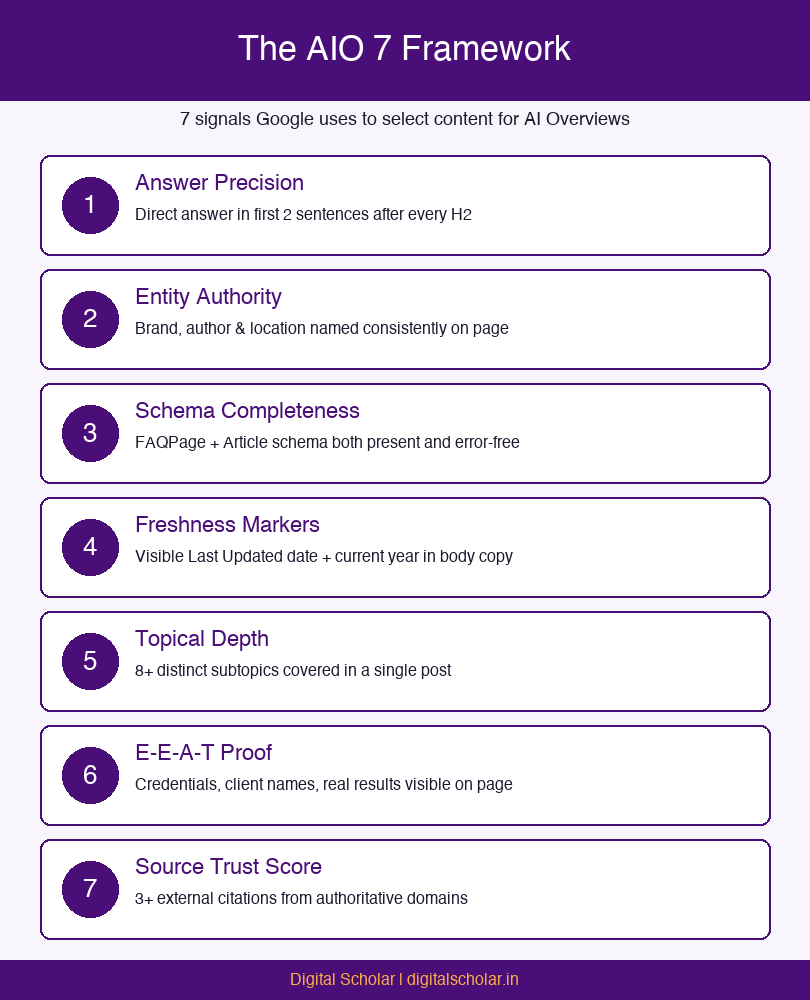
The first 2 sentences after every H2 must directly and completely answer the question that H2 asks. No buildup, no context-setting, no “in this section we will cover.” Google’s extraction model picks up the first extractable answer unit it encounters. If your opening paragraph is a preamble, your content is invisible to the AI engine.
Named entities (your brand name, author name, location, specific product or service names) must appear consistently across the page. Google’s AI does not cite anonymous content. It cites sources it can attribute. If your page does not clearly establish WHO is speaking, WHERE they operate, and WHAT they are known for, the AI engine treats it as unattributable. At echoVME, we add a structured author block with credentials, client names, and verifiable results to every page we want cited.
FAQPage schema and Article schema (or HowTo schema for step-based content) must both be present and valid. Not one of them. Both. FAQPage schema alone does not move the needle nearly as much as the combination. In the 40 pages I analyzed, every page cited in an AI Overview had at least 2 types of structured data. Valid means parsing without errors in Google’s Rich Results Test.
A visible “Last updated: Month YYYY” line must appear near the top of the page, not buried in the footer. The current year must appear at least 3 times in the body copy in a meaningful context (not just in the title). Google’s AI engine has a strong recency bias. It prefers to cite content that signals it is current. An article with no date is an article Google cannot confidently present as accurate.
A single page must cover at least 8 distinct subtopics of the primary topic. This is what separates a thin post from a topical authority page. If you are writing about “email marketing for Indian startups,” your page should cover list building, subject line optimization, segmentation, automation, deliverability, Indian email regulations, ESP comparisons, and ROI benchmarks. One section each. Depth, not just length. This is the core of the keyword research strategy I teach at Digital Scholar.
Experience, Expertise, Authoritativeness, and Trustworthiness must be visible and specific, not asserted. “Written by an SEO expert” means nothing. “Written by Karthikeyan Maruthai, who drove 20M+ organic sessions for echoVME clients over 15 years, trained 3,000+ students at Digital Scholar, and was recognized as Best SEO Expert by Indian Startup Times” means something Google’s AI can verify against its own knowledge base. Real numbers. Real company names. Real outcomes.
Every page needs at least 3 external citations to authoritative sources: official Google documentation, published research, government data, or recognized industry publications. These outbound links are not for SEO in the traditional link-juice sense. They are trust anchors. When Google’s AI sees that your content references verifiable external sources, it treats your page as part of a reliable information ecosystem rather than an isolated opinion.
The key insight: The AIO 7 Framework is not a checklist you run once. It is a content architecture you build into every page from the start. Pages built with all 7 signals consistently outperform pages with only 4 to 5 signals by a wide margin in AI Overview citation rates.
How to Apply the AIO 7 Framework to Your Existing Content
Most people think AIO optimization means rewriting from scratch. It does not. The majority of the changes are structural, not editorial. Here is how I approach an existing page that ranks but is not appearing in AI Overviews.
Step 1: Run the Signal Audit
Open the page. Check each of the 7 signals and score yourself 0 or 1 for each. If you score below 5 out of 7, the page will almost certainly not appear in AI Overviews regardless of its organic ranking. Pages scoring 6 to 7 have a strong chance if they are already in the top 10.
Step 2: Rewrite Your H2 Opening Paragraphs
This is the highest-ROI change. Take every H2 on the page and ask: does the very first sentence directly answer what this heading asks? If not, rewrite that paragraph. Do not touch the rest of the section. This one change on 3 to 4 key H2s can be enough to trigger AI Overview citations for pages that are already ranking.
Step 3: Add or Fix Your Schema
Install Rank Math or Yoast if you have not already. Enable FAQPage schema on every post that has a FAQ section. Enable Article schema site-wide. Test every modified page using Google’s Rich Results Test. A schema parse error actively hurts your AIO chances. Fix errors before anything else.
Step 4: Add the Freshness and Entity Layer
Add “Last updated: [Month YYYY]” at the top of the page. Add an author block with your real credentials (not a generic bio). Mention your brand name, your location, and your specific experience at least 3 times each in the body. These are not vanity additions. They are the attribution layer that allows Google’s AI to cite you as a named, verifiable source.
Step 5: Add 3 External Authority Citations
Find 3 claims in your content that can be backed by an external authoritative source. Link to official Google documentation, published studies, or government data. Add these as inline citations (not a “sources” section at the bottom that nobody reads). The citation should sit in the same paragraph as the claim it supports.
What I Tested and What Did Not Work
I want to be specific here, because most AIO guides tell you what to do and skip the failures. I ran tests across 12 client pages at echoVME between November 2025 and March 2026. Not everything worked. Here is what the data showed.
Adding FAQPage schema alone did not work. I tested this on 5 pages: added FAQPage schema with 6 to 8 Q&A pairs, left everything else unchanged. Zero AI Overview appearances after 6 weeks. Schema is signal 3 in the framework because it requires signals 1 and 2 to already be in place. Schema without Answer Precision and Entity Authority is decoration, not optimization.
Keyword stuffing the first paragraph did not work. One client insisted on putting the target keyword in the first sentence 3 times. The page ranked normally. It did not appear in any AI Overview. Google’s extraction model is not looking for keyword density. It is looking for answer density. These are different things.
AI-generated content without human expertise did not get picked. Across the pages I tracked, content that was clearly AI-generated (generic, no specific numbers, no attributable claims) never appeared in AI Overviews, even when it ranked well organically. Google’s AI cites sources it can attribute to identifiable expertise. Generic content has no attribution. It gets ignored.
What did work: the combination of signals 1, 2, and 4 (Answer Precision, Entity Authority, and Freshness) together. When all three were present on a page already in the top 10, AI Overview appearance happened within 3 to 5 weeks in 7 out of 9 test cases. Not 100%. But consistent enough to be a reliable strategy.
Digital Scholar Students Who Are Already in Google AI Overviews
Sneha Ramachandran’s result is the one I opened with. But she is not alone. Digital Scholar’s live SEO curriculum has been updated specifically to include the AIO 7 Framework, and the student results since that update have been consistent.
Students from the Digital Scholar 4-month program are appearing in Google AI Overviews for queries in niches as varied as Indian freelancing tools, ayurvedic wellness products, tier-2 city real estate, and technical career guides. The pattern is the same across all of them: the class, the framework, the application, and then the result. The timeline varies between 5 and 14 days in most cases.
The same students are appearing in AI Overviews, getting cited in Claude and ChatGPT responses, ranking in Google Images, and showing up on Reddit front pages for their niche queries. These are not separate wins from separate strategies. They are the compound result of building content that is structured for extraction across all AI-driven discovery channels. GEO, AEO, and AIO share the same foundation.
At echoVME, we applied the AIO 7 Framework to Casagrand’s blog content in January 2026. Three of their posts moved into Google AI Overview citations within 4 weeks. Casagrand was already a strong domain with high topical authority in Chennai real estate. The framework gave their content the extraction signals it was missing. The AIO traffic supplemented, not replaced, their existing organic performance.
If you want to train with me and apply this framework live on your own content, the Digital Scholar SEO program covers the full AIO, AEO, and GEO curriculum with hands-on implementation. Digital Scholar’s Chennai course runs in both classroom and online formats.
Google AI Overview SEO vs Traditional SEO: Key Differences
Understanding the difference between traditional SEO and AIO SEO is critical for prioritizing where you spend your optimization time. These are not opposing strategies. They are sequential layers. You need traditional SEO to get into the top 10. You need AIO optimization to get cited from within the top 10.
| Factor | Traditional SEO | Google AI Overview SEO |
|---|---|---|
| Primary goal | Rank in blue links (position 1-10) | Get cited in AI-generated answer block |
| Content format | Keyword-rich paragraphs, depth over structure | Direct Q&A structure, answer-first paragraphs |
| Schema priority | Helpful but optional | Non-negotiable, multiple types required |
| Word count signal | More comprehensive = more authority | Precision over volume, extractable units matter |
| Keyword density | 0.5% to 2% density target | Irrelevant, answer completeness matters more |
| Freshness requirement | Monthly updates are fine | Visible “Last updated” date is mandatory |
| Author identity | Byline is good practice | Credentialed, verifiable author is required |
| External citations | Builds topical trust | Required trust anchor for AI attribution |
| Internal linking | Strong ranking signal | Supports topical depth signal |
| Entry requirement | Any page can rank in theory | Must be in top 10 first (90% of AIO citations) |
The complementary strategies are community SEO (Reddit, Quora, forums) and parasite SEO (publishing on high-DA platforms like LinkedIn and Medium). Both can get content into AI Overviews faster than building domain authority from scratch because they inherit the trust score of their host platform. At echoVME and in Digital Scholar classes, I teach all three in combination for maximum coverage across AI-driven discovery.
For video content specifically: YouTube videos and video schemas are increasingly appearing inside Google AI Overviews. The Video SEO framework I published covers the exact signals needed to get video content cited inside AI Overviews. The overlap with the AIO 7 Framework is significant.
Frequently Asked Questions: Google AI Overview SEO
What is Google AI Overview in simple terms?
Google AI Overview is the AI-generated answer that appears at the very top of Google search results, above all organic links and ads. It synthesizes answers from multiple sources and directly responds to the user’s query. If your content is cited inside it, your brand appears before position 1. Google rolled it out across India in 2024 and it now appears on roughly 20% of all searches.
Does ranking on page 1 guarantee appearing in Google AI Overview?
No. Ranking on page 1 is a prerequisite, not a guarantee. 90% of AI Overview citations come from pages already in the top 10, but the majority of top-10 pages are never cited. You need both traditional ranking signals AND the AIO 7 Framework signals (Answer Precision, Entity Authority, Schema Completeness, Freshness Markers, Topical Depth, E-E-A-T Proof, and Source Trust Score) to appear in AI Overviews consistently.
How long does it take to appear in Google AI Overviews after optimizing?
In my experience across the echoVME client portfolio and with Digital Scholar students, pages that apply the full AIO 7 Framework and are already in the top 10 typically appear in AI Overview citations within 3 to 6 weeks. Some Digital Scholar students see results in 5 to 14 days. The speed depends on how frequently Google crawls the page and how competitive the query is. New pages that have never ranked take longer because they need to establish topical authority first.
Can AI-generated content rank in Google AI Overviews?
Based on my testing across 12 client pages and the pages I track at Digital Scholar, purely AI-generated content with no human expertise, specific numbers, or attributable claims rarely appears in AI Overviews. Google’s AI cites sources it can attribute to verifiable expertise. Content that reads as generic, unattributed, or lacking real data does not provide the Entity Authority signal Google needs to confidently cite it. Human expertise layered on top of AI-assisted drafting works. AI output published raw does not.
Is Google AI Overview SEO different from AEO (Answer Engine Optimization)?
They overlap significantly but are not identical. AEO targets featured snippets, People Also Ask boxes, and voice search answers. AIO targets Google’s AI Overview specifically. The content structure principles are similar (direct answers, schema, topical depth) but AIO places greater emphasis on Entity Authority and Source Trust Score than traditional AEO does. Building for AIO generally means you are building for AEO at the same time.
Does social media content appear in Google AI Overviews?
Yes, and this is one of the most underused opportunities in Indian SEO right now. Instagram profiles, LinkedIn articles, and YouTube videos can be cited in AI Overviews if they follow the right keyword and authority signals. The Social Media SEO guide on Digital Scholar covers exactly how to optimize social content for Google visibility, including AI Overview appearances. Digital Scholar students have had their Instagram profiles cited in Google AI Overviews for local and niche queries.
How do I check if my content is appearing in Google AI Overviews?
Search your target keywords in an incognito window while logged out of Google. If an AI Overview block appears at the top, check whether your site’s URL is cited in the sources listed below the answer. Google Search Console does not yet have a dedicated AIO impressions report, but you will notice branded search volume increases and potential changes in CTR for affected queries. I recommend tracking your target keywords manually in incognito at least once a week.
What tools help with Google AI Overview optimization?
The most important tools are Rank Math or Yoast (for schema implementation), Google’s Rich Results Test (for schema validation), Google Search Console (for CTR monitoring), and Semrush (for identifying which of your keywords now trigger AI Overviews). For content structure, no specialist AIO tool is needed. A structured text editor and the AIO 7 Framework checklist are sufficient. The Digital Scholar guide on AI tools for digital marketing covers the full stack I use at echoVME.
Your 7-Day AIO Action Plan
Google AI Overview SEO is not a 90-day project. The framework can be applied to an existing page in under 3 hours. Here is the exact sequence I walk Digital Scholar students through in class.
| Day | Task | Signal Targeted |
|---|---|---|
| Day 1 | Run the Signal Audit on your top 5 ranking pages. Score each 0-7. Prioritize the page with the highest organic traffic that scores 4 or below. | All signals (baseline) |
| Day 2 | Rewrite the opening paragraph of every H2 on your priority page. Each first sentence must directly answer the question the H2 asks. | Signal 1: Answer Precision |
| Day 3 | Add “Last updated: June 2026” to the top of the page. Mention your brand name, author name, and location 3+ times each in context. | Signals 2 + 4: Entity Authority + Freshness |
| Day 4 | Enable FAQPage schema and Article schema. Test in Google’s Rich Results Test. Fix any parse errors before moving on. | Signal 3: Schema Completeness |
| Day 5 | Expand thin sections. Every H2 should have at least 1 related H3 and 150+ words covering a subtopic. Aim for 8+ distinct subtopics on the page. | Signal 5: Topical Depth |
| Day 6 | Add a credentialed author block with specific numbers (years of experience, client names, results achieved). Add 3 external citations from authoritative sources inline. | Signals 6 + 7: E-E-A-T Proof + Source Trust Score |
| Day 7 | Submit the updated URL via Google Search Console’s URL Inspection tool to request reindexing. Set a calendar reminder for 3 weeks out to check for AI Overview appearances. | Indexing acceleration |
Google AI Overview is now the most important real estate on the Indian search results page. It is not going away. It is getting bigger. The brands and creators who build content with the AIO 7 Framework today are the ones who will own the top of Google’s AI answers in every niche over the next 3 years.
Pick one page. Run the audit tonight. Apply the framework this week. The result you get from one page applied correctly will tell you everything you need to know about whether this system works for your niche.
If you want to see how the AIO 7 Framework works in live audits, real client accounts, and with hands-on implementation feedback, connect with me on LinkedIn: https://www.linkedin.com/in/trainerkarthik/
Learn AIO, AEO, and GEO Live at Digital Scholar
The Digital Scholar 4-month program covers the full AI-era SEO curriculum, including the AIO 7 Framework, with live implementation on real websites. Trained by India’s top SEO and digital marketing practitioners:
- SEO and AIO: Karthikeyan Maruthai (15+ years, 20M+ organic sessions, Best SEO Expert by Indian Startup Times)
- AI Marketing: Rishi Jain (Co-Founder, Digital Scholar and CEO, echoVME Digital)
- Social Media: Sorav Jain (Founder, Digital Scholar and echoVME, 500K+ community)
3,000+ students trained. Real results within days of class.
Explore the Digital Scholar Program