
What is Parasite SEO and How to Do It: The Practitioner’s 2026 Guide
Three years ago, I published a LinkedIn article titled “Top Rated 10 Digital Marketing Agencies in India.” I spent two hours writing it. I built zero backlinks to it. I did not tell my email list. I did not run any ads. I simply published it on LinkedIn with one internal link to echoVME Digital‘s website and watched it climb past websites that had been building domain authority for years. Within three days, that article was ranking on Google’s first page for “digital marketing agency in india.” It still ranks today.
I have been doing SEO for 15 years. I have ranked 10,000+ keywords across Indian markets, driven 20M+ organic sessions for the echoVME client portfolio, and audited hundreds of websites at Digital Scholar. And I will tell you honestly: that LinkedIn article took less effort than most blog posts we have written, and it ranked faster than anything on a brand-new client website would have.
That is parasite SEO. In this guide, I am going to break down exactly what it is, which platforms to use, and the 5-Stage Parasite SEO Execution System I teach to 3,000+ students at Digital Scholar. No theory. No recycled advice. This is what I have tested, what has worked, and what has failed across real campaigns at echoVME.
In this guide, you will learn what parasite SEO is and why it still works in 2026, the Parasite Platform Authority Matrix (which platforms to use for which keywords), the exact 5-stage execution system from Digital Scholar’s SEO curriculum, platform-specific playbooks for LinkedIn, Medium, Quora, and Reddit, and the honest mistakes that get parasite content deindexed. If you want to rank fast without waiting 12 months for your domain to build authority, this is the guide for you.
- TL;DR Summary
- What is Parasite SEO?
- Why Parasite SEO Works in 2026
- The Parasite Platform Authority Matrix
- Who Should Use Parasite SEO
- How to Find the Right Keywords
- The 5-Stage Parasite SEO Execution System
- LinkedIn Articles Playbook
- Medium Playbook
- Quora Playbook
- Reddit Playbook
- What I Tested and What Did Not Work
- Digital Scholar Student Results
- Parasite SEO vs Building Your Own Site
- Common Mistakes to Avoid
- Frequently Asked Questions
TL;DR Summary
Parasite SEO is publishing content on established, high-authority third-party platforms (DA 87-98) so your content ranks in Google faster than it would on your own new or low-authority website. You borrow the platform’s domain authority instead of building it from scratch.
- Top platforms by DA: LinkedIn (DA 98), Medium (DA 95), Substack (DA 91), Reddit (DA 91), Quora (DA 87)
- Time to first ranking: 2 to 14 days on most platforms vs. 3 to 12 months on a brand-new site
- Best use cases: New websites, local businesses, freelancers, affiliate marketers, content creators
- The signal a keyword is parasite-ready: Quora, Reddit, or Medium already appears in the top 10 Google results for it
- The risk: Platform policy changes can remove your content. Use parasite SEO as a bridge while your own site builds authority
Who this is for: SEO professionals and business owners who want faster search visibility without waiting 6 to 12 months for their own domain to build enough authority to compete. Equally effective for B2B service positioning (LinkedIn focus) and B2C local business queries (Medium, Quora, Reddit).
What is Parasite SEO?
Parasite SEO is the practice of publishing content on established, high-authority websites (platforms with DA 70 to 100) so that your content ranks in Google search results using the host platform’s domain authority rather than your own.
The term “parasite” comes from the biological relationship where one organism attaches to a host for survival. In SEO terms, your content (the parasite) attaches to LinkedIn or Medium or Quora (the host) and benefits from the host’s authority. Done correctly, the host also benefits: it receives quality content that keeps users on the platform.
Here is the practical reality. When you launch a new website or work on a client site with DA under 20, you are competing against sites that have been publishing quality content for years. Google has no reason to trust your new domain over an established competitor. It takes most sites 6 to 12 months of consistent publishing to build enough authority to rank for even moderately competitive keywords in India.
Parasite SEO solves that problem. Instead of waiting for your domain to earn trust, you publish on a domain that Google already trusts deeply. Your content inherits that trust immediately.
At Digital Scholar, I teach parasite SEO as a bridge strategy, not a replacement for building your own content. Students in the live SEO bootcamp learn to run both simultaneously: parasite content generates visibility and inbound traffic in weeks, while their own site builds the authority that compounds over months and years. The 3,000+ professionals trained at Digital Scholar understand this distinction from day one.
Why Parasite SEO Works in 2026
Google ranks pages, not domains. But domain authority is a genuine ranking signal. When your page lives on a platform with DA 95, Google’s crawlers trust it faster, index it faster, and give it ranking consideration that a page on a DA 15 blog would not receive for months.
Three mechanisms make parasite SEO work:
- Domain authority inheritance. The host platform’s years of link building, editorial standards, and Google trust transfer partially to every page published on it. Your Medium article benefits from Medium’s DA 95, not just its own zero-link profile.
- Existing indexation pipelines. LinkedIn, Medium, Quora, and Reddit are crawled by Google multiple times per day. A new article on these platforms typically appears in Google’s index within 24 to 72 hours. A new page on a DA 15 blog with no inbound links may take 2 to 4 weeks to get indexed at all.
- Platform engagement signals. When a LinkedIn article gets 50 reactions and 10 comments, or a Quora answer gets 200 upvotes, those are engagement signals that search engines notice. This accelerates ranking without any traditional link-building effort.
Google’s Helpful Content guidelines have made parasite SEO more sustainable in 2026, not less. Platforms like Medium and Quora actively remove thin, spammy content because their reputation depends on quality. This means the parasite SEO content that survives and ranks is the content that would have ranked anywhere: genuinely useful, well-structured, and specific.
The key insight: Parasite SEO works because Google trusts certain platforms far more than most websites will ever be trusted in their first two years. Instead of fighting against that trust asymmetry, you publish inside it.
The Parasite Platform Authority Matrix
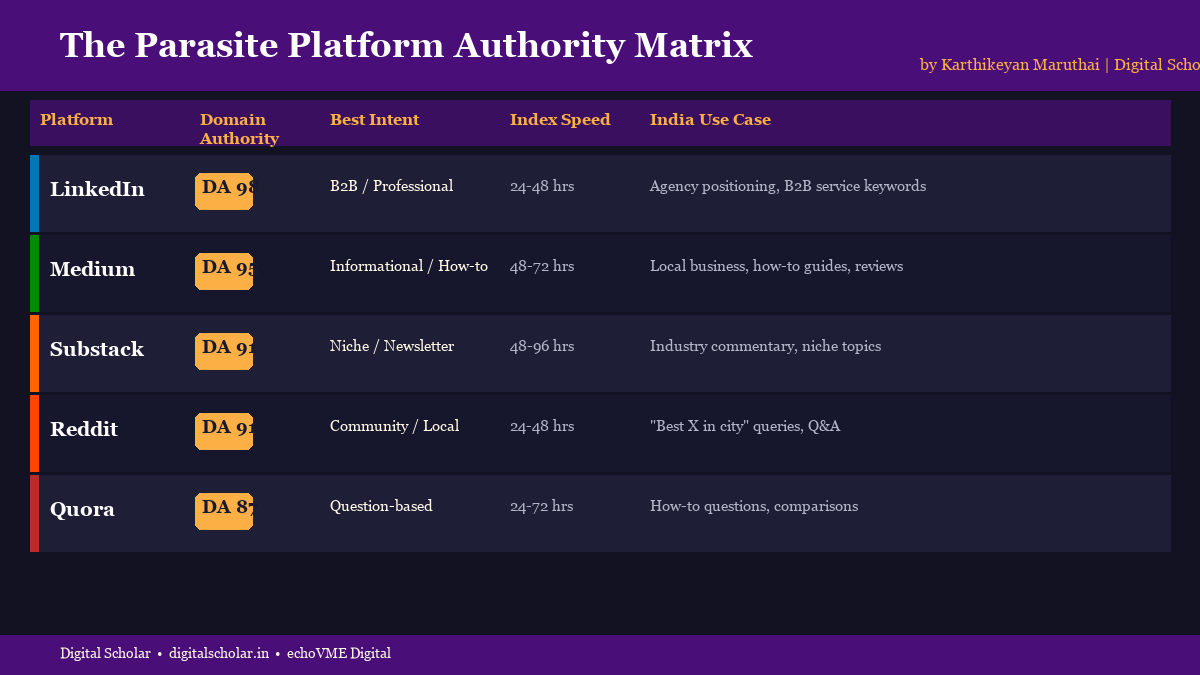
Not all platforms are equal. The right platform depends on the keyword intent, your target audience, and how quickly you need results. Here is the matrix I use at Digital Scholar when teaching parasite SEO strategy:
| Platform | Domain Authority | Best Intent Type | Ideal Content Length | Index Speed | India Use Case |
|---|---|---|---|---|---|
| LinkedIn Articles | DA 98 | Informational, B2B, professional services | 800-2,000 words | 24-48 hours | Agency positioning, B2B service keywords |
| Medium | DA 95 | Informational, how-to, local business | 1,000-3,000 words | 48-72 hours | Local search, how-to guides, product reviews |
| Substack | DA 91 | Niche informational, newsletter audiences | 800-2,500 words | 48-96 hours | Industry commentary, niche positioning |
| DA 91 | Community queries, local recommendations | 400-1,200 words | 24-48 hours | “Best [X] in [city]” queries, community Q&A | |
| Quora | DA 87 | Question-based, comparison, beginner | 300-1,000 words per answer | 24-72 hours | How-to questions, product/service comparisons |
The pattern I see across the 500+ brands in the echoVME portfolio: B2B and professional service businesses get the fastest ROI from LinkedIn. Local and consumer-facing businesses do better with Reddit (for local intent queries) and Quora (for how-to and comparison queries). Medium works well across both, but indexation is slightly slower.
Who Should Use Parasite SEO
Parasite SEO is not a tactic for every situation. Here is where it delivers outsized returns:
- New websites with DA under 20. Your own domain cannot compete for meaningful keywords yet. Parasite SEO gets you traffic and brand impressions while your site builds authority. I tell every new Digital Scholar student: start building parasite content on day one. Do not wait for your site to “earn” rankings first.
- Local businesses. A Google Business Profile is essential but not sufficient. A Quora answer or Reddit post targeting “best [service type] in [Chennai neighbourhood]” can rank on page 1 within a week. At echoVME, we have used this approach for clients in the food and beauty categories across Chennai.
- Freelancers and independent consultants. A LinkedIn article that ranks for your primary service keyword brings inbound enquiries from Google without any ad spend. My own LinkedIn article for “digital marketing agency in india” has generated referrals to echoVME directly from people who found it via Google search, not LinkedIn itself.
- Affiliate marketers. Medium and Quora articles targeting commercial intent keywords (comparison queries, product recommendations) can rank and convert without the months of authority-building that an affiliate blog requires.
- Content creators entering a new niche. Before your YouTube channel or blog has enough authority, parasite SEO establishes credibility in the niche and generates search traffic.
At Digital Scholar, the question I get most from newer practitioners is: “My site has been live for six months and I am not ranking for anything. What do I do?” Parasite SEO is consistently the most practical answer. It generates proof of concept rankings while the own-site authority-building continues in the background. The keyword research fundamentals you learn first at Digital Scholar directly feed into finding the right targets for parasite content. For freelance digital marketers in Chennai, parasite SEO is especially powerful because it lets you show clients fast results on competitive local keywords without needing a high-authority client site.
How to Find the Right Keywords for Parasite SEO
Not every keyword is a good parasite SEO target. The right keywords are the ones where Google has already decided that platform content belongs in the results. Here is how to identify them.
The Platform Presence Signal
Search your target keyword in incognito mode. Count how many of the top 10 results come from Quora, Reddit, Medium, LinkedIn, or Substack. If 2 or more appear in the top 10, Google has already mapped this keyword to platform content. That is your green light.
If zero platform results appear in the top 10 for a keyword, that keyword’s SERP is dominated by authoritative standalone websites and trying to rank via parasite SEO will be an uphill battle. Look for a different keyword or a longer-tail variant of the same topic.
Keyword Research in Semrush India Database
Pull keyword data using the India (in) database in Semrush. Filter for:
- Monthly search volume: above 200/month (lower volume keywords are not worth the effort for parasite placement)
- Keyword difficulty: under 60 (parasite SEO helps with authority, but extremely high-KD keywords need more than a single platform article)
- Intent type: informational or commercial (transactional keywords where Google wants to show product pages are poor parasite SEO targets)
Use the “Also rank for” report in Semrush for any competitor Quora or Reddit page you find in step 1. One good Quora URL can reveal 15 to 20 related parasite-ready keywords in a single pull. This is one of the fastest keyword research techniques I teach in the Digital Scholar live SEO class.
The Parasite SEO Keyword Qualification Checklist
Before investing time writing content for any keyword, run it through this qualification filter. I use this exact checklist at echoVME before recommending parasite SEO targets to clients:
| Qualification Check | Pass Condition | If It Fails |
|---|---|---|
| Platform presence in top 10 | 2 or more results from Quora, Reddit, Medium, LinkedIn in top 10 | Skip this keyword. Try a longer-tail variant. |
| Monthly search volume | Above 200/month (India database) | Volume too low. Not worth the effort. |
| Keyword difficulty (KD) | Under 60 in Semrush India | Too competitive. Consider long-tail variant with same intent. |
| Search intent | Informational, question-based, or local (not transactional) | Transactional intent rarely ranks via platform content. Skip. |
| Platform-intent match | Platform already appearing matches the intent type | Choose a different platform from the Authority Matrix. |
| Content gap | Existing platform results are outdated (pre-2024) or low quality | High-quality recent answers exist. Write something significantly better or target a different angle. |
In the Digital Scholar live SEO bootcamp, students run this checklist on 20 to 30 seed keywords in the first session. Typically, 8 to 12 of those pass all six checks and become the parasite SEO campaign’s initial targets.
The Local Business Keyword Pattern
For local businesses in India, the keyword pattern that consistently has platform results in the top 10 is: “best [service] in [city or neighbourhood]”. Search for “best cafe in T Nagar” or “best physiotherapist in Andheri” and you will almost always see at least one Reddit or Quora result in the top 5. These are your entry points.
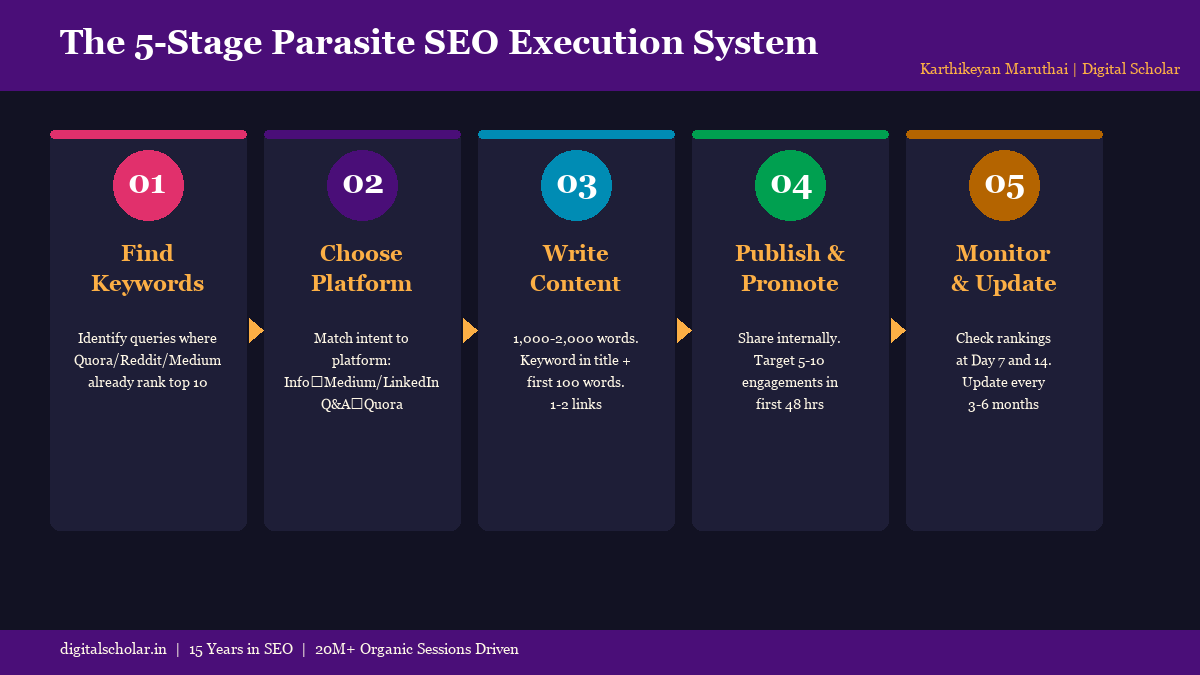
The 5-Stage Parasite SEO Execution System
This is the framework I have built from 15 years of testing what works in Indian search results. I teach this exact sequence at Digital Scholar’s live SEO bootcamp. Every stage matters. Skip one and the campaign underperforms.
Stage 1: Find Keywords Where Third-Party Platforms Already Rank
Start with the platform presence signal described above. Identify 10 to 20 keywords where Quora, Reddit, Medium, or LinkedIn already appear in the top 10 Google results. These are your validated targets.
At echoVME, before we recommend parasite SEO to a client, we run a keyword qualification pass across 25 to 30 seed keywords relevant to their business. Typically 8 to 12 of those qualify based on the platform presence signal. That is enough to run a meaningful campaign with one or two pieces per platform.
Stage 2: Match the Keyword to the Right Platform
Platform selection is not about which platform has the highest DA. It is about which platform Google already ranks for that specific keyword intent.
- Informational intent (“what is”, “how to”, “guide to”) → Medium or LinkedIn Articles
- Question-based intent (“which is best”, “should I”, “is it worth it”) → Quora
- Community or local intent (“best in Chennai”, “recommend a”, “anyone used”) → Reddit (find the right subreddit first)
- Professional service positioning (agency, consultant, B2B service keywords) → LinkedIn Articles exclusively
The mistake I see consistently in the Digital Scholar community: choosing Medium for every keyword because “it has the highest DA after LinkedIn.” Wrong. A Quora answer ranks faster for question-based queries because Google’s algorithm has trained on Quora’s Q&A structure for that intent type. Use the right platform for the right intent, every time.
Stage 3: Write SEO-Optimized Content for That Platform
The content on the host platform must be genuinely useful. Google’s Helpful Content guidelines apply even when the content lives on Medium or Quora. Thin content or link-stuffed content gets deindexed from the host platform, and you lose your ranking entirely.
Write to this checklist:
- Exact-match keyword in the title
- Keyword in the first 100 words of the content
- H2 and H3 structure where the platform allows it (Medium and LinkedIn both support heading tags)
- 1 to 2 contextual links back to your own site, placed where they are genuinely the most helpful resource
- 1,000 to 2,000 words for Medium and LinkedIn articles
- 400 to 800 words for Quora answers
- Match community norms on Reddit (some subreddits penalize long posts)
For on-page structure within the article itself, apply the same principles you would use for your own site. The on-page SEO fundamentals that work on your own domain work inside a Medium or LinkedIn article too: clear heading hierarchy, direct answers early, and specific data points throughout.
Stage 4: Publish and Generate Engagement Signals
Publishing alone is not enough. You need early engagement signals to accelerate indexation and improve ranking velocity.
- Share the published article on your LinkedIn profile (for LinkedIn articles, the platform’s own algorithm amplifies this automatically)
- Share in 2 to 3 relevant WhatsApp or Telegram communities where your content is genuinely useful to members
- Aim for 5 to 10 meaningful engagements (reactions, comments) within the first 48 hours
- Do not buy fake engagement. Platform algorithms detect velocity spikes from low-quality accounts and may suppress your content
At echoVME, when we run parasite SEO campaigns for clients, we brief the client’s internal team to share the article within their organization first. That generates 8 to 12 organic engagements within 24 hours, which is enough to signal genuine interest to Google’s crawlers without triggering spam filters.
Stage 5: Monitor, Update, and Compound
Check rankings 7 to 14 days after publishing using Google Search Console or incognito search. If the article is indexed but not appearing in the top 20 for the target keyword, two approaches help:
- Add more specific details and update the post. Platforms like Medium show an “updated” timestamp, which functions as a freshness signal to Google
- Build one contextual link from your own website or another piece of parasite content to the published article
Update all parasite content every 3 to 6 months. If the content goes stale, the host platform reduces its internal circulation, which indirectly reduces crawl frequency and erodes ranking position. This is a step that most Digital Scholar students learn the hard way: the ranking you earned is not a permanent fixture. You maintain it the same way you earned it, with current, useful content.
LinkedIn Articles Playbook
LinkedIn is the highest-DA platform available to anyone with a free account. My own article “Top Rated 10 Digital Marketing Agencies in India” ranks on Google’s first page for “digital marketing agency in india” to this day. I wrote it in two hours, published from my personal LinkedIn profile with one link to echoVME, and it has generated direct inbound enquiries from people who found it via Google, not LinkedIn.
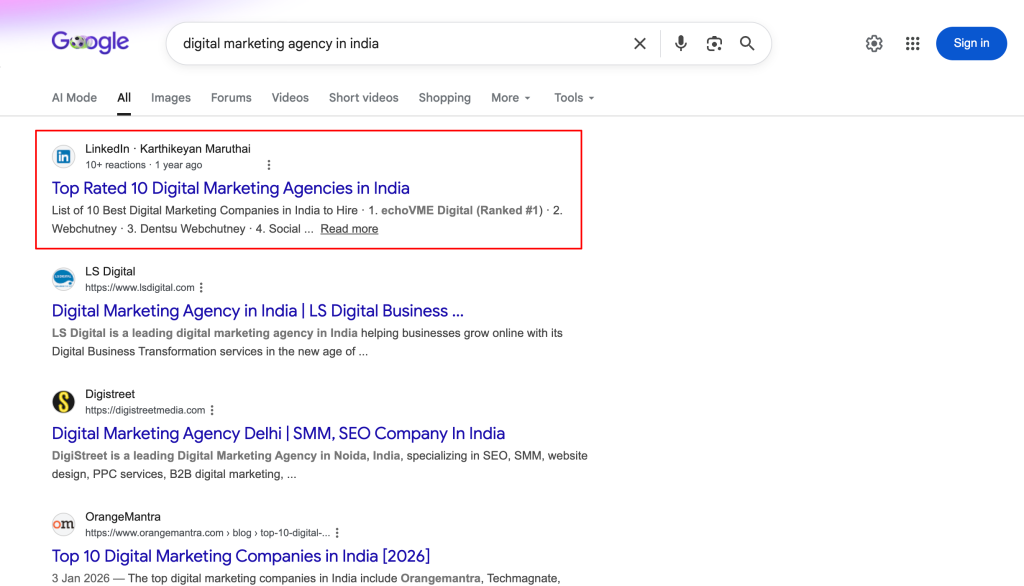
LinkedIn Articles work best for B2B and professional service keywords. If you are positioning yourself as a consultant, agency owner, or industry expert, LinkedIn gives you the highest-authority parasite SEO placement in that category. I recommend LinkedIn Articles as the first parasite SEO channel for every Digital Scholar student who runs a service-based business or works at an agency like echoVME.
Key execution notes for LinkedIn:
- Publish from your personal profile, not a company page. Personal profiles have higher engagement rates and LinkedIn’s algorithm favours them
- Use “LinkedIn Article” (the long-form writing feature), not a standard post. Only Articles are indexed by Google as standalone pages
- Structure with H2 headings. LinkedIn’s Article editor supports heading tags and Google reads them
- Add your target keyword to the article title and the subtitle field
- Include one link to your company site or a relevant resource. Keep it contextual
Medium Playbook
Medium works best for informational and how-to content. In the Digital Scholar live class, I show students a Medium article targeting “best cafe in Kilpauk” that was ranking on Google’s first page within a week of publication. That is a local business SEO use case that most small business owners in Chennai have not discovered yet.
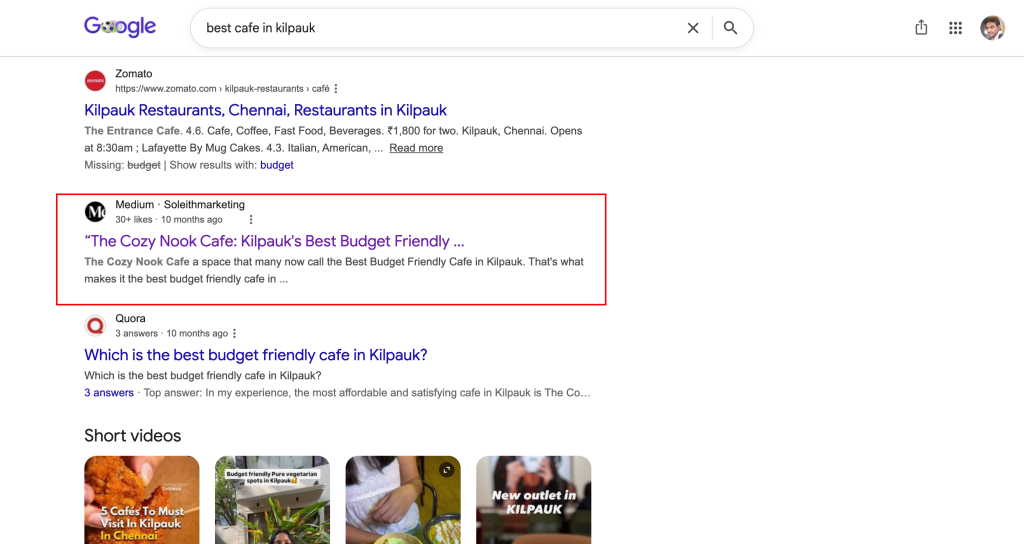
The key advantage of Medium: its domain authority is consistent across all content categories. A Medium article about fitness ranks with the same host authority as one about digital marketing. This makes Medium the most versatile parasite SEO platform.
Key execution notes for Medium:
- Publish into a relevant Medium Publication (Medium’s version of a topic category) to get additional distribution. A standalone Medium article has less reach than one published under a Publication with an existing audience
- Use the canonical URL feature if you are republishing content from your own site. This tells Google your site is the original source
- Avoid Medium’s paywall for parasite SEO content. Content behind the paywall is not indexed by Google
- Add tags (Medium allows up to 5). Use exact-match keyword variations
Quora Playbook
Quora’s strength is question-based keywords. For any keyword phrase starting with “how”, “what”, “which”, or “is it worth”, Quora answers frequently appear in Google’s top 10. A well-structured answer, with a direct answer in the first two sentences, can rank within days of publication.
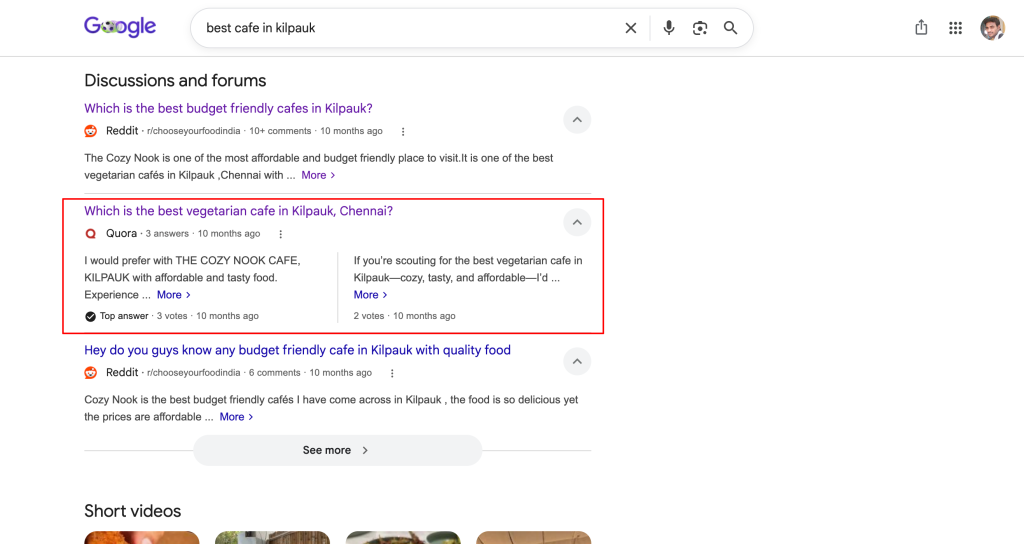
The Quora strategy I teach at Digital Scholar: find an existing high-traffic Quora question with 50 or more answers. Write a new answer that is more structured, more specific, and includes current data from 2025 or 2026. Poorly structured answers from 2019 cannot compete with a well-written 2026 answer that directly addresses the question with verified data. Google re-ranks Quora threads frequently as new quality answers are added.
Key execution notes for Quora:
- Your first sentence must directly answer the question. Do not build up to the answer over three paragraphs
- Use bullet points for listicle answers. Quora bullet lists render cleanly in Google’s featured snippets
- Add one link in the body of your answer, pointed to a genuinely relevant resource on your site
- A Quora profile with 50 or more followers and previous upvoted answers performs better than a brand-new profile. Build the profile before launching a parasite campaign
Reddit Playbook
Reddit is where the Indian SEO community is most underinvested. I have seen Digital Scholar students test parasite content on subreddits including r/digitalmedia, r/SEO, r/Chennai, and r/india, and rank for long-tail queries within 2 to 3 days. The India-specific subreddits are particularly underexploited for local business queries.
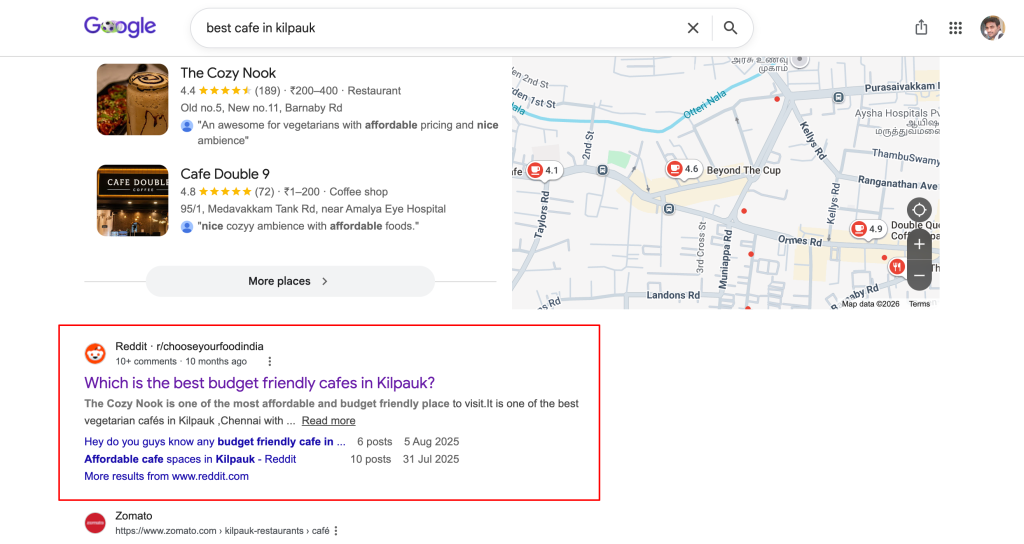
Reddit’s hard rule: never make your post look like a promotion. It must read as a genuine community contribution. Add real value, answer questions that real community members are asking, and include your link only when it is the most helpful resource you can share in that context. Reddit moderators ban accounts that self-promote aggressively, and a banned account loses all its ranking content in a single action.
Key execution notes for Reddit:
- Spend 2 to 3 weeks participating in the subreddit genuinely before posting content with links. Build karma and community standing first
- Check the subreddit’s rules for external links before posting. Many subreddits restrict or ban external links entirely
- Reddit posts with no links sometimes rank better because they stay up longer (no moderation removal risk)
- Local subreddits (r/Chennai, r/Bangalore, r/Mumbai) have less competition and higher relevance for local service business queries
What I Tested and What Did Not Work
I want to be transparent about this. Not every parasite SEO experiment I have run at echoVME has delivered the results I expected. Here is what failed, so you do not repeat the same mistakes.
Thin content on Medium with multiple links. I published a 380-word article on Medium for a client in the B2B software space. It included 3 external links in the body. Medium’s internal algorithm reduced distribution within 48 hours. Google indexed it but never ranked it for any meaningful position. The lesson: content under 700 words rarely survives on Medium. Write as if you are writing for your own site.
Targeting keywords with no existing platform presence. I published a detailed Quora answer targeting a B2B SaaS keyword in the Indian market. The answer was well-written and specific. It did not rank. When I checked the SERP, there were zero Quora, Reddit, or Medium results in the top 20. Google had decided this keyword belongs to SaaS vendor and comparison sites only. Quora had no established presence there. The lesson: always verify the platform presence signal before investing time in the content.
Buying parasite SEO services from third-party agencies. I tested this for an echoVME internal experiment. The service promised “DA 90+ site placements.” What they delivered were sponsored posts on sites with strong overall DA but weak topical authority in our niche. Rankings appeared briefly, then dropped within 3 to 4 weeks. The lesson: organic parasite SEO on genuine platforms (LinkedIn, Medium, Quora, Reddit) consistently outperforms paid placements on obscure high-DA sites.
Publishing the same article on multiple platforms simultaneously. I published identical content on Medium and Substack for a test. I teach the same concept in the AI tools for digital marketing module at Digital Scholar: every tool works best when deployed for its specific purpose, not copy-pasted across every available channel. Google picked one as the canonical source and suppressed the other. Rankings for the suppressed version dropped to zero within two weeks. The lesson: each parasite piece should target a different keyword. One article, one platform, one keyword.
Digital Scholar Student Results from Parasite SEO
At Digital Scholar, I added parasite SEO as a live workshop module in the SEO bootcamp in 2025. The results from the 3,000+ students trained since then have been faster than I expected.
One student from the December 2025 Digital Scholar cohort published a LinkedIn article targeting a competitive professional services keyword in Chennai. She followed the 5-Stage system exactly as taught. The article ranked on page 1 within 4 days. She went from zero search visibility to receiving inbound enquiries from Google, without a single rupee spent on ads. She brought the screenshot to the next live class.
Another Digital Scholar student used the Reddit approach for a client running a local restaurant in Bangalore. He posted a well-structured answer in r/bangalore answering the question “where to eat authentic South Indian food in Indiranagar?” His post ranked in the top 5 for that long-tail local query within one week. The restaurant owner was calling him before the week was out.
Students at Digital Scholar have also tested parasite SEO specifically for Answer Engine Optimization purposes: publishing on Quora and Medium increases the probability of appearing in Google’s AI Overview and getting cited by AI assistants like Claude and ChatGPT. If you want to understand the connection between parasite SEO and Generative Engine Optimization, the underlying principle is the same: appear on platforms that AI systems already reference heavily.
Not every student who applies the framework sees these results immediately. The ones who struggle are almost always skipping Stage 1 (keyword validation) and publishing on platforms where Google has no existing presence for their target keyword. Execution consistency makes the difference, not the technique itself.
Parasite SEO vs Building Your Own Site
The question I get from every Digital Scholar student who learns parasite SEO for the first time: “Should I just do this instead of building my own site?” The honest answer is no. But understanding when to use each approach is what separates practitioners from beginners.
| Factor | Parasite SEO | Building Your Own Site |
|---|---|---|
| Time to first ranking | 2-14 days | 3-12 months |
| Startup cost | Free (LinkedIn, Medium, Quora, Reddit) | Domain + hosting + ongoing content cost |
| Authority needed | None (borrows host platform’s DA) | Must be built from zero |
| Control over content | Low (platform owns it, can remove it) | Full control, permanent ownership |
| Long-term compounding value | Medium (rankings depend on platform staying authoritative) | High (authority compounds with every new post) |
| Scalability | Limited per platform per account | Unlimited as domain grows |
| Risk profile | Platform policy changes, account bans | Algorithm updates, content devaluation |
| Best for | Early-stage visibility, bridge strategy | Long-term topical authority |
My recommendation after 15 years in SEO and 500+ echoVME client campaigns (including major brands like Casagrand, Naturals, and The Hindu): start parasite SEO in the first week of a new site launch. The digital marketing professionals in India who are commanding the highest salaries are the ones who can show clients fast results alongside long-term strategy. Parasite SEO is one of the fastest ways to demonstrate that value. Run it alongside your own content strategy. When your domain’s DA reaches 30 to 40, gradually shift your content investment to your own site. The parasite pieces you published earlier continue sending referral traffic and can be used to link back to your growing content library. The two strategies are not competitors. They compound on each other.
Common Mistakes That Kill Parasite SEO Rankings
- Treating parasite SEO as a replacement for your own content strategy. It is a bridge, not a destination. Digital Scholar students who abandon their own site entirely for parasite content end up with no durable asset to show for their SEO work.
- Over-linking in a single article. One to two contextual links per article is the maximum. More than that reads as spam to both the platform’s moderation system and Google’s link quality assessments. I have seen accounts get flagged on Medium and LinkedIn for adding 4 or more external links to a single article.
- Publishing duplicate content across multiple platforms. If you publish the same article on Medium and LinkedIn and Substack, Google picks one as the canonical source and ignores the rest. Each parasite piece must target a different keyword from the start.
- Ignoring platform-specific community guidelines. LinkedIn has policies on self-promotion and external links. Reddit bans accounts aggressively for perceived self-promotion. Medium can unpublish articles that violate its content standards. Know the rules of the platform before you publish.
- Not monitoring for deindexation. If your article stops appearing in Google Search Console impressions after 30 days, it may have been deindexed by the host platform. Check regularly. If deindexed, diagnose why (thin content, policy violation, account trust) before republishing.
- Skipping the keyword validation step. Publishing on a high-DA platform without verifying platform presence in the SERP is the most common mistake I see in the Digital Scholar community. The platform does not guarantee the ranking. The keyword’s SERP composition determines whether parasite SEO is viable for that specific query.
The key insight: Parasite SEO is a precision tactic, not a spray-and-pray approach. The difference between a Digital Scholar student who ranks in 4 days and one who gets no results is almost always the keyword validation step. Validate first. Then execute.
Frequently Asked Questions About Parasite SEO
Is parasite SEO black hat or white hat?
Parasite SEO is white hat when you publish genuinely useful content on legitimate platforms like LinkedIn, Medium, Quora, and Reddit. It becomes grey hat or black hat when you buy sponsored posts disguised as organic content, publish thin content designed purely for link placement, or violate the platform’s terms of service. The 5-Stage system taught at Digital Scholar is fully compliant with Google’s Helpful Content guidelines and each platform’s publishing terms.
Can parasite SEO hurt my main website?
Parasite SEO does not hurt your main website if done correctly. The 1 to 2 contextual links from your parasite content to your own site are generally positive signals. The risk comes from over-linking (which can look manipulative) or publishing low-quality content that damages your brand reputation. Quality parasite content that ranks well for its target keyword reinforces your authority in that topic, which benefits your own site’s topical authority too.
Which platform is best for parasite SEO in India?
It depends on your keyword intent. LinkedIn (DA 98) is best for B2B and professional service keywords. Medium (DA 95) is most versatile for informational and local content. Quora (DA 87) is best for question-based queries. Reddit (DA 91) is underexploited for local intent queries in Indian cities. Most echoVME campaigns use LinkedIn and Quora as primary platforms, with Medium as a secondary channel.
How long does parasite SEO take to rank?
On LinkedIn and Reddit, indexation happens within 24 to 48 hours. Ranking positions typically stabilize within 7 to 14 days. On Medium and Quora, expect 48 to 96 hours for indexation and up to 3 weeks for ranking to settle. These timelines assume the keyword passes the platform presence signal validation. Keywords without existing platform presence in the SERP may never rank regardless of how quickly they are indexed.
Do I need to build backlinks to my parasite content?
Rarely. The host platform’s existing domain authority usually provides enough ranking power for low-to-medium competition keywords (KD under 55). For higher competition keywords, adding one or two contextual links from your own site to the parasite article can provide an additional boost. Avoid building spammy or low-quality links to parasite content. If the platform detects an unusual inbound link pattern, it may reduce the content’s internal circulation.
What happens if the host platform removes my content?
You lose the ranking. This is the primary risk of parasite SEO. To mitigate it: keep a local copy of all parasite content, follow each platform’s content guidelines strictly, and build your own site’s content in parallel so you are not entirely dependent on platform placements. At Digital Scholar, I teach students to treat parasite content as a 12 to 18 month bridge strategy, after which your own site’s authority should be strong enough to rank independently.
Can I use parasite SEO for local businesses in India?
Yes, and it is one of the most underused local SEO tactics in India. A Medium article or Reddit post targeting “best [service] in [city]” keywords ranks quickly because Google already surfaces platform content for local recommendation queries. I have demonstrated this live in Digital Scholar classes using real examples like a cafe in Kilpauk and digital marketing services in Chennai.
Does Google penalize parasite SEO?
Google’s Site Reputation Abuse policy (updated in 2024-2025) targets websites that host third-party content designed to manipulate rankings, not individual users publishing on open platforms like LinkedIn or Medium. Publishing a useful LinkedIn article or Quora answer is not penalized by Google. The risk is at the platform level (the platform removing your content), not at the Google penalty level, as long as your content is genuinely helpful and not stuffed with manipulative links.
How many links should I include in a parasite SEO article?
One to two contextual links per article, maximum. Both links should go to genuinely relevant resources. Placing them where they are the most natural and helpful to the reader. Link stuffing (3 or more links pointing to your own site in a single article) is the most common reason parasite content gets flagged or removed by platform moderation teams. Quality over quantity, in links as in everything else.
Students at the Digital Marketing Course in Chennai at Digital Scholar practice parasite SEO with real LinkedIn and Medium accounts during the course.
Want to Rank Faster? Learn SEO the Way Practitioners Do.
Digital Scholar’s live SEO program covers keyword research, on-page SEO, parasite SEO, AEO, AIO, and GEO from practitioners who do this work every day across 500+ brands. Learn SEO from Karthikeyan Maruthai, AI from Rishi Jain, and Social Media from Sorav Jain. India’s only institute where you learn directly from the actual practitioners behind some of India’s biggest organic growth stories.
For digital marketing consultants in India, parasite SEO combined with a strong own-site content strategy is the most defensible positioning play available right now. Build the bridge with parasite content. Build the destination with your own domain.Parasite SEO is not a shortcut and it is not a replacement for building real authority. It is a precision tactic that works when you validate the keyword correctly, choose the right platform for the intent, and write genuinely useful content that earns its ranking. I have used it for my own LinkedIn positioning. echoVME has used it for client campaigns. Digital Scholar students have used it to rank within days of learning the system. The pattern is consistent: validate first, execute with quality, and maintain over time.
If you want to see how parasite SEO integrates with the full SEO strategy framework I use across echoVME campaigns and Digital Scholar student projects, connect with me on LinkedIn: https://www.linkedin.com/in/trainerkarthik/