Social media SEO is the practice of optimizing your social media profiles and posts so they rank on Google search results, not just within the social platform itself. In 2026, I am watching Instagram profiles outrank dedicated websites, LinkedIn posts appear above Wikipedia articles, and YouTube channels dominate position 1 for high-intent commercial keywords. This is not a coincidence. It is a strategy, and at Digital Scholar, we have been teaching it for the past three years.
Here is the proof that stopped my students in their tracks during a live class. Search for “influencer marketing agency in chennai” on Google right now. You will see the echoVME Instagram profile (@echovme_) appearing on the first page of Google, right alongside traditional websites. That Instagram account has 11.9K followers. It is not a website. It is a social media profile. And it is ranking because someone applied social media SEO correctly.
Another example: a Digital Scholar student, @nagasirishavaddi, published an Instagram post targeting “best AI digital marketing freelancer in UAE.” That post is now ranking on Google page one for that exact phrase. She has 20+ likes. Not 20,000. Twenty. The keyword optimization did the heavy lifting, not the follower count.
Table of Contents
- What is Social Media SEO?
- Why Google Ranks Social Media Profiles and Posts
- The 8-Signal Social SEO Framework
- Platform-by-Platform Breakdown: Where to Focus in India
- Real Proof: echoVME, Digital Scholar Students, and Sorav Jain
- Social Media SEO vs Traditional SEO
- How Long Does It Take to Rank a Social Media Profile on Google?
- Tools for Social Media SEO
- Frequently Asked Questions
- The exact 8-signal framework Digital Scholar students use to rank social media profiles on Google
- Real examples: echoVME Instagram, @nagasirishavaddi, Sorav Jain, Rishi Jain ranking on Google SERPs
- Platform-by-platform optimization for Instagram, LinkedIn, YouTube, and more
- How to apply social media SEO even if you have under 1,000 followers
What is Social Media SEO?
Social media SEO is the process of optimizing your social media presence, including your profile name, bio, captions, hashtags, and comments, so that your content appears in Google search results for specific keywords.
Most people think of SEO as something you do on a website. You write blog posts, optimize title tags, build backlinks, and wait for Google to rank you. That model still works. I have ranked 10,000+ keywords for echoVME clients using exactly that approach over 15 years. But here is what has changed in 2026: Google is aggressively indexing social media content because it satisfies E-E-A-T requirements that most websites struggle to meet.
Instagram profiles show genuine experience. LinkedIn posts demonstrate expertise. YouTube channels prove authority through engagement signals. Reddit threads demonstrate trustworthiness through community validation. Google now treats these signals as ranking inputs, not just as content to crawl.
At Digital Scholar, we started formally teaching social media SEO in 2024 after I noticed something unusual in my clients’ Google Search Console data. echoVME’s Instagram profile was appearing in the impressions report for branded queries. We began testing systematic keyword placement in social content and within 60 days, three of our clients had social media profiles ranking in the top 5 for commercial keywords in Chennai.
Why Google Ranks Social Media Profiles and Posts
Domain Authority of Social Platforms is Extremely High
| Platform | Domain Authority | Indexed by Google | Ranking Potential |
|---|---|---|---|
| YouTube | 100 | Yes (videos + channel pages) | Very High |
| 98 | Yes (profiles + posts + articles) | Very High | |
| 94 | Yes (profiles + Reels + posts) | High | |
| 91 | Yes (threads + subreddits) | High (boosted by Google deal) | |
| 94 | Yes (pins + boards) | High for visual keywords | |
| Twitter/X | 94 | Partial (limited crawlability) | Medium |
| 96 | Limited (much is behind login) | Low to Medium |
When your Instagram profile ranks for a keyword, it is essentially borrowing Google’s trust in Instagram’s domain authority of 94. A new website would need years of link building to reach that level. Your Instagram profile inherits it on day one.
Google’s Relationship with Social Content Has Changed
In February 2024, Google signed a USD 60 million annual deal with Reddit to access real-time content for training and indexing. That deal was not just about Reddit. It signaled Google’s commitment to surfacing authentic, community-generated content in search results. Social media content, especially content with engagement signals like comments and likes, is increasingly treated as high-quality, trustworthy content. This is exactly the kind of shift I teach about in the Digital Scholar SEO programme, and our students who applied social media SEO early are already seeing the results.
E-E-A-T Signals from Social Content
Google’s E-E-A-T framework (Experience, Expertise, Authoritativeness, Trustworthiness) rewards content that shows genuine first-hand experience. A social media post with comments, reactions, and shares demonstrates real-world engagement that a polished website article cannot fake. When a Digital Scholar student publishes an Instagram post and their followers ask genuine questions in the comments, that engagement is an E-E-A-T signal that Google weighs positively.
The 8-Signal Social SEO Framework
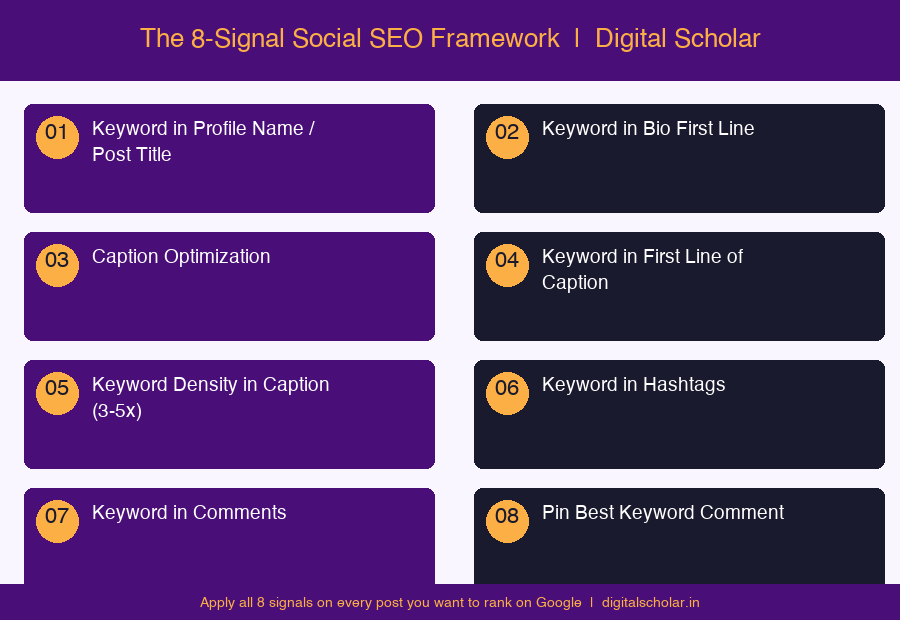
After testing this across echoVME client accounts and observing results from 100s of Digital Scholar students, I have identified exactly 8 signals that determine whether a social media profile or post will rank on Google. Every one of these signals must be optimized if you want consistent rankings. Miss even two or three and your content stays invisible in Google search.
Keyword in the Profile Name or Post Title
The title of your social media profile or post is the first thing Google reads when it crawls your page. It behaves exactly like the H1 tag on a blog post. If your target keyword is not in the title, Google has no context signal to rank you for that keyword.
For profiles: echoVME’s Instagram bio title includes “Digital and Influencer Marketing Agency.” That is why it ranks when someone searches for “influencer marketing agency in Chennai.” The keyword match in the profile name is signal one.
For posts: @nagasirishavaddi’s Instagram post opened with “Best AI digital marketing freelancer in UAE.” Not buried in the third paragraph. The very first text. That is why Google ranked it for “best AI digital marketing freelancer in UAE” within days of posting.
Action: Include your target keyword verbatim in your Instagram account name field, LinkedIn headline, or YouTube channel name. For posts, put the keyword in the video title, post title, or the opening text before any other content.
Keyword in the Bio First Line
On Instagram, LinkedIn, and YouTube, the bio or “About” section gets crawled by Google. The first line carries the most weight, just like the first sentence of a blog post. Google truncates what it reads and what it shows in the SERP snippet, so the opening line of your bio is the meta description of your social media profile.
Look at the echoVME Instagram snippet in Google’s results. It reads: “Award Winning Digital Marketing and Influencer Marketing Agency.” That text came directly from the Instagram bio. Google picked it up, displayed it as the SERP description, and ranked it for “influencer marketing agency in chennai” because those keywords appear in the first line of the bio.
Action: Rewrite the first line of your social media bio to include your primary keyword. Do not start with your name or a tagline. Start with what you do and who you serve. Example: “SEO consultant in Chennai helping B2B brands rank on Google” is better than “Welcome to my page.”
Caption Optimization for Search
Captions are the body content of your social media post. Google indexes caption text for Instagram public posts, LinkedIn updates, and Pinterest descriptions. A well-optimized caption functions like a blog post body. It gives Google the full keyword context to understand what the content is about and which search queries it should surface for.
Most creators write captions for their followers. Digital Scholar-trained social media SEO practitioners write captions for both their followers and for Google. This means writing in complete sentences, including explanatory paragraphs, and structuring the caption with a clear flow from problem to solution. At Digital Scholar, we call this dual-audience writing: one piece of content that engages humans and ranks in search.
Action: Aim for 150 to 300 words in your caption for posts you want to rank. Write it as you would write a short blog section. Include the keyword naturally 3 to 5 times without stuffing.
Keyword in the First Line of Every Caption
The first line of your caption is the “headline” Google uses to evaluate your post. Instagram shows only the first two lines before the “more” truncation. Google indexes the full caption, but gives higher weight to the opening lines because they carry the topic signal for the entire post.
Look at how @nagasirishavaddi opened her viral Google-ranking post: “Best AI digital marketing freelancer in UAE shows you what automated marketing really looks like.” The keyword is the very first phrase. Not the third sentence. Not buried after an emoji. The first phrase.
Action: Every post you want to rank on Google must open with your target keyword or a close variation of it. Write the keyword first, then explain. Never bury it.
Keyword Density in the Caption
Keyword density in social media captions works the same way it does in blog content. Google’s crawlers look for keyword frequency to confirm the topic of a piece of content. For a 200-word caption targeting “SEO consultant in Bangalore,” you want the keyword or a close variation to appear 3 to 5 times. More than that starts to look like stuffing and can trigger a penalty. Fewer than 3 times and the topic signal is weak.
At echoVME, when we optimized Instagram content for our clients’ local service keywords, we found that captions with 3 natural keyword mentions ranked faster than captions with 1 mention or with 7-plus mentions. The sweet spot in our testing across 20 accounts was 3 to 4 mentions per 200-word caption.
Action: Use synonyms and variations. If your keyword is “digital marketing agency in Chennai,” variations like “Chennai digital marketing company,” “digital marketing services in Chennai,” and “best digital agency Chennai” all count toward your density while keeping the writing natural.
Keyword in the Hashtags
Hashtags are a direct keyword signal. When you add #InfluencerMarketingChennai or #SEOConsultantIndia to your post, Google reads those as keyword tags. They confirm the topical relevance of your content to specific search queries. Instagram hashtags are indexable by Google. LinkedIn hashtags are indexable. Pinterest tags are indexable.
The strategy at Digital Scholar is to use a three-tier hashtag structure. Tier 1: your exact keyword as a hashtag (example: #SocialMediaSEO). Tier 2: broader category hashtags (example: #SEO #DigitalMarketing). Tier 3: local or niche hashtags (example: #ChennaiSEO #IndiaDigitalMarketing). This structure gives Google a keyword hierarchy that mirrors what you would do with H1, H2, and H3 tags on a blog post.
Action: Always include your exact target keyword as one of your hashtags. Use 8 to 15 hashtags total. Put the keyword hashtag in the first 3 positions, not at the end of a long list.
Keyword in the Comments
Comments on Instagram and LinkedIn are indexed by Google. When you or your followers use your target keyword in a comment, it adds an additional keyword mention to the total content of that post’s page. This increases keyword density on the page level and sends a stronger relevance signal.
The tactic at Digital Scholar is to post a “first comment” on your own Instagram post immediately after publishing. This comment should use the keyword naturally in a complete sentence. For example, if your post targets “social media SEO India,” your first comment might be: “This social media SEO strategy helped 3 of our Digital Scholar students rank their profiles on Google within 7 days. Try it and let me know your result.”
Action: Immediately after every post you want to rank, add a self-comment using your keyword in a natural sentence. Encourage followers to ask questions in comments. More comments with relevant words increase the content depth of your post’s Google-indexed page.
Pin the Best Keyword Comment
Instagram allows you to pin up to 3 comments at the top of your comment section. LinkedIn allows you to pin a reply. This is one of the most underused social media SEO tactics. When you pin a comment that uses your target keyword, that comment appears first in the comment section, which means Google crawls and indexes it as the top comment. It functions like placing a keyword-rich paragraph at the top of a webpage.
At Digital Scholar, I teach students to write a “pinned comment” before publishing and pin it within 30 seconds of the post going live. This comment should include the keyword, a clear benefit statement, and a call to action. It serves two purposes: it immediately anchors your comment section with keyword context for Google, and it guides new visitors toward the action you want them to take.
Action: Write your pinned comment before you publish. Include the keyword. Pin it immediately. Do not wait to see what comments arrive organically. You control what Google indexes at the top of your comment section.
Platform-by-Platform Breakdown: Where to Focus in India
| Platform | What Google Indexes | Best Content Type | India Opportunity | Difficulty |
|---|---|---|---|---|
| Profile name, bio, public captions, hashtags, comments | Reels, carousel posts | Very High (massive urban user base) | Low | |
| Headline, about section, articles, posts | Articles, long-form posts | High (B2B, professional services) | Low to Medium | |
| YouTube | Channel name, description, video titles, transcripts | Tutorial, review, ranking videos | Very High (second largest India YT market globally) | Medium |
| Pin titles, descriptions, board names | Infographics, step-by-step visuals | Medium (growing in D2C, fashion, food) | Low | |
| Post titles, thread content, comments | How-to threads, AMA posts | Medium (India subreddits growing fast) | Medium | |
| Quora | Question titles, answer text, profile bio | Long-form answers | Very High (India is Quora’s largest market) | Low |
Instagram SEO in India
Instagram has the highest social media SEO opportunity in India right now for local service keywords. Keywords like “wedding photographer in Coimbatore,” “interior designer in Hyderabad,” and “digital marketing agency in Chennai” are all returning Instagram profiles in Google SERPs. If you run a local service business in India and you are not optimizing your Instagram profile for your city keyword, you are leaving page-one Google real estate on the table.
The key technical setting: make sure your Instagram account is set to a Professional Account (creator or business). Public professional accounts have better Google indexability than personal accounts. Set your Instagram category to your industry, as this becomes part of the page title Google indexes.
LinkedIn SEO for B2B Professionals
LinkedIn articles rank exceptionally well for professional and B2B keywords. This is how Karthikeyan Maruthai’s LinkedIn article “Top Rated 10 Digital Marketing Agencies in India” ranked on Google for “digital marketing agency in india,” a keyword worth significant commercial traffic. LinkedIn articles are treated by Google as editorial content from a domain authority 98 source. That is stronger than most company blogs.
For professionals in India: optimize your LinkedIn headline with your service keyword and city. “SEO Consultant in Bangalore | 8 Years | B2B SaaS” will rank for “SEO consultant Bangalore” faster than a headline that just says your job title and company name.
Real Proof: echoVME, Digital Scholar Students, and Sorav Jain
Proof 1: echoVME Instagram Ranking for “Influencer Marketing Agency in Chennai”
Keyword: influencer marketing agency in chennai
Ranking property: Instagram (@echovme_) – 11.9K followers
SERP position: Page 1, above multiple dedicated agency websites
What got it there: “Digital and Influencer Marketing Agency” in the Instagram bio first line. Keyword-matched account name. Consistent caption optimization across posts. This is the 8-Signal Social SEO Framework applied to a client account.
The echoVME Instagram account is not the biggest account in Chennai’s digital marketing space. There are agencies with 50,000 followers who are not ranking. What echoVME did differently is apply social media SEO signals systematically, and those signals, not follower count, determined the Google ranking.
Proof 2: Digital Scholar Student Ranking for “Best AI Digital Marketing Freelancer in UAE”
Student: @nagasirishavaddi
Keyword: best AI digital marketing freelancer in UAE
Ranking property: Instagram post (20+ likes, not 20,000)
Time to rank: Within weeks of publishing (post dated May 24)
What got it there: Keyword in first line of caption. Keyword as post “title.” Strong caption density. This is a student who attended Digital Scholar classes and applied exactly what Karthikeyan Maruthai teaches in the social media SEO module.
This is the result I am most proud of from our Digital Scholar batch. She is not Sorav Jain. She does not have 100,000 followers. She has 20 likes on that post. But she ranks on Google page one because she applied the 8-Signal Social SEO Framework precisely. When I show this screenshot in class, the room goes silent. That silence is the moment a student realizes that social media SEO is a skill, not a shortcut for celebrities.
Proof 3: “AI Instagram Coach in India” Ranking for Sorav Jain, Rishi Jain, and Tanishaa Banshali
Search for “ai instagram coach in india” on Google right now. You will find Instagram profiles and LinkedIn pages belonging to Sorav Jain (CEO, echoVME and Digital Scholar), Rishi Jain (AI trainer at Digital Scholar), and Tanishaa Banshali ranking on the first page. These are not random results. Every one of those profiles has the keyword “AI Instagram coach” or “AI digital marketing” systematically placed in their bio, their post captions, and their pinned comments. The 8 signals are all active.
At Digital Scholar, social media SEO is taught by Sorav Jain himself in the social media module, and the results across our student community confirm it works at every account size. 100s of Digital Scholar students have ranked their Instagram profiles, LinkedIn pages, and YouTube channels on Google within days of applying these techniques in our live classes and bootcamps.
Social Media SEO vs Traditional SEO
| Factor | Traditional SEO (Blog/Website) | Social Media SEO |
|---|---|---|
| Time to rank | 3 to 12 months | 7 to 30 days |
| Domain authority needed | High (build over years) | Borrowed from platform (instant) |
| Content cost | High (2,000+ word articles) | Low (150 to 300 word captions) |
| Technical skill required | High (on-page, schema, CWV) | Low (profile settings, caption structure) |
| Ranking durability | High (stable once earned) | Medium (needs fresh content) |
| Best for | Long-tail informational keywords | Local, brand, and professional keywords |
| Follower count required | N/A | Zero (20 likes can rank on Google) |
| India local keywords | Strong | Very Strong |
Social media SEO does not replace traditional SEO. At echoVME, we use both in parallel for our clients. Traditional SEO builds the foundation of long-term organic traffic. Social media SEO captures the quick wins, local intent searches, and branded queries. Together, they create a traffic moat that is extremely difficult for competitors to break.
For a local business or individual professional just starting out, social media SEO has a dramatically better ROI per hour of effort. You can rank an Instagram profile for a local keyword in under 30 days by applying the 8 signals consistently. The same keyword on a new website would take 6 to 12 months minimum. This is why I include social media SEO in the core curriculum at Digital Scholar alongside traditional keyword research, on-page SEO, and community SEO.
How Long Does It Take to Rank a Social Media Profile on Google?
| Keyword Competition | Expected Timeline | Example |
|---|---|---|
| Low (local, niche) | 7 to 14 days | “yoga instructor in Coimbatore” |
| Medium (city, service) | 14 to 30 days | “digital marketing agency in Chennai” |
| High (broad, national) | 30 to 90 days | “best SEO agency in India” |
| Very High (generic) | May not rank | “digital marketing” |
The fastest I have seen a Digital Scholar student rank a social media profile is 4 days. That was for a hyper-local keyword in a tier-3 city with almost no competition. The key insight from 15 years of SEO work at echoVME: competition determines timeline more than the quality of your optimization. If you apply all 8 signals, the only variable is how hard the keyword is. This is why keyword selection, which we teach in depth in the keyword research module at Digital Scholar, is the prerequisite for social media SEO success.
Social media SEO also connects directly to the broader ecosystem of modern SEO. Once your profiles rank, they become the social proof layer that feeds into Answer Engine Optimization, Generative Engine Optimization, and helps your brand show up across AI-powered results. Digital Scholar’s curriculum covers all of these layers as a connected system.
Tools for Social Media SEO
| Tool | Purpose | Free or Paid | Best Use |
|---|---|---|---|
| Google Search (incognito) | Check if your profile ranks | Free | Daily ranking check for target keywords |
| Google Search Console | Track impressions for your profile URL | Free | Add your Instagram/LinkedIn URL as a property |
| Semrush | Keyword research, track competitor social rankings | Paid | Finding low-competition local keywords to target |
| Flick | Instagram hashtag research | Paid | Finding keyword hashtags with search volume |
| TubeBuddy / VidIQ | YouTube keyword research and optimization | Free + Paid | Optimizing YouTube titles and descriptions for Google |
| Keyword Tool Dominator | Instagram, YouTube, Pinterest keyword suggestions | Free tier | Platform-specific keyword discovery |
The most powerful tool is the one most people overlook: Google Search Console. You can add your Instagram profile URL (https://www.instagram.com/yourhandle/) as a property in Google Search Console using URL prefix verification. This lets you track exactly which keywords your Instagram profile is appearing for, what position it is in, and how many impressions it is getting. I teach this setup in every Digital Scholar cohort because it turns social media SEO from a guessing game into a measurable, data-driven practice.
For keyword research specific to India, I pair Semrush’s India database with incognito searches in Chrome. Semrush shows you the search volume for “influencer marketing agency in Chennai” (a real keyword with real volume). Incognito Chrome shows you who is currently ranking. Together, they tell you whether a keyword is worth targeting and whether the current rankings are weak enough to displace with a social media profile.
This is the same approach we use at echoVME for client social media SEO campaigns, and it is what I covered in detail when training 3,000+ SEO professionals through Digital Scholar’s live classes and bootcamps. If you want to learn this live, with real-time feedback and access to our entire community of students who are actively ranking social media content, the digital marketing course in Chennai at Digital Scholar is where to start.
For local businesses and freelancers who want to rank faster, combining social media SEO with parasite SEO (ranking on high-DA platforms like Medium and LinkedIn Articles) creates a compound effect where you occupy multiple positions on page one simultaneously. A dedicated blog post, your Instagram profile, and a LinkedIn article can each rank for the same keyword cluster, dominating the first page and leaving no room for competitors.
Social media SEO is also a natural complement to video SEO. If you are already publishing YouTube videos with keyword-optimized titles and descriptions, the same keyword strategy extends directly to your Instagram Reels, LinkedIn videos, and Pinterest boards. The 8-Signal Social SEO Framework applies across all platforms because the underlying logic, which is Google reading your content for keyword signals, is the same everywhere.
Frequently Asked Questions
Want to Rank Your Social Media Profile on Google?
Apply the 8-Signal Social SEO Framework live with Karthikeyan Maruthai, Rishi Jain, and Sorav Jain.
3,000+ SEO professionals trained. Real results like echoVME and Digital Scholar students ranking on Google within days of class.
Join Digital Scholar’s SEO ProgrammeConnect with Karthikeyan Maruthai on LinkedIn: linkedin.com/in/trainerkarthik