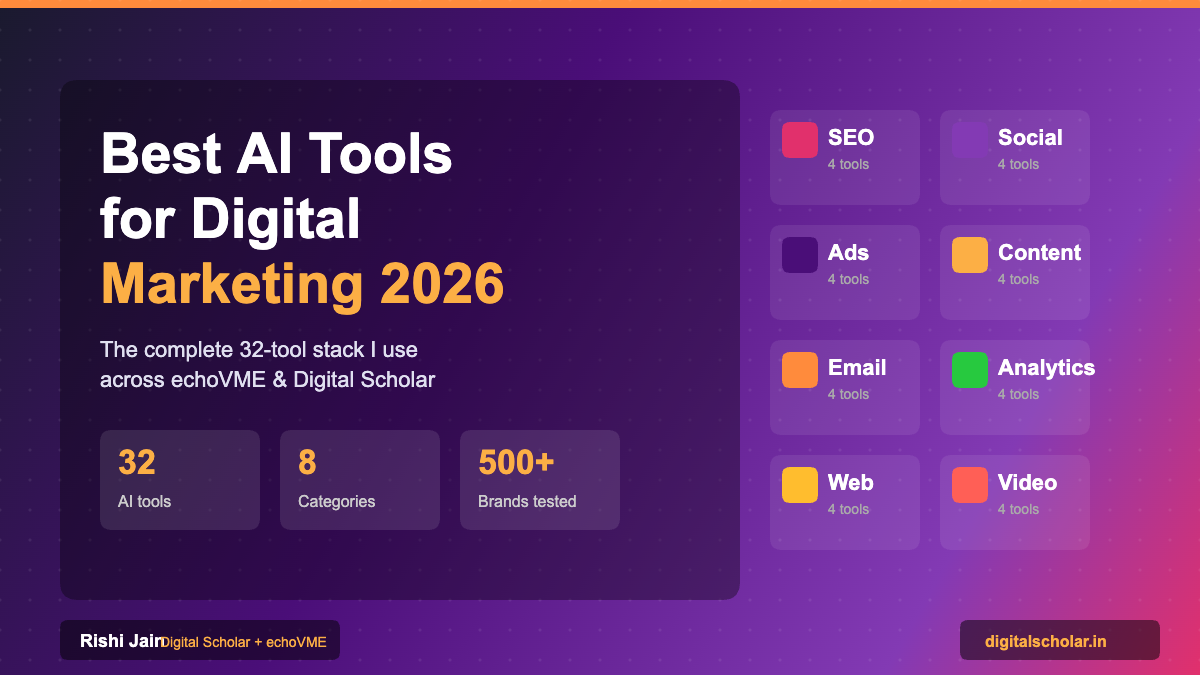

Last updated: April 2026 by Rishi Jain, Co-Founder of Digital Scholar and CEO of echoVME Digital. This list reflects what is actively running in my agency and institute right now, not a generic roundup.
I have tested over 500 AI tools in the last 18 months. Not as a hobby. I run a digital marketing agency (echoVME Digital, 500+ brands) and a training institute (Digital Scholar, 1,000+ students per year). I needed to figure out which AI tools actually make a difference in real marketing workflows.
Most of them are noise. Shiny wrappers around ChatGPT with a $29 per month price tag and a landing page full of promises. They do not survive contact with real campaigns, real clients, and real deadlines.
But about 32 tools survived. These are the ones that stayed in our daily workflow at echoVME, the ones I teach in the 4-month AI and Digital Marketing program at Digital Scholar, and the ones that have measurably changed how we do marketing.
In this post, you will get the exact 32-tool AI marketing stack I use across my agency and institute, organized into 8 core marketing functions. Real pricing. Real workflows. Real numbers. No affiliate links, no sponsored picks, just what works.
I have organized them into 8 categories that map to every core function of digital marketing: SEO, social media, paid ads, content, email, analytics, websites, and video. For each one, I am sharing the tools that work, how we use them, and what actually changed in our numbers.
- Why listen to me on this
- Best AI tools for SEO
- Best AI tools for social media marketing
- Best AI tools for paid ads (Meta, Google, performance)
- Best AI tools for content writing and marketing
- Best AI tools for email marketing
- Best AI tools for analytics and reporting
- Best AI tools for websites and landing pages
- Best AI tools for video and creative production
- The complete AI marketing stack (summary table)
- Free vs paid: what to actually pay for
- How to implement this stack without losing your mind
- Why this matters for your marketing career
- Frequently asked questions
Why listen to me on this
Short version: I run both sides of the marketing world at once. I see what breaks in production at an agency managing Rs 400 crore in ad spend. And I see what beginners struggle with in a classroom of 300 students a batch.
Most AI tool roundups are written by affiliate marketers who rank articles for traffic. They tested each tool for an hour, took screenshots, and moved on. You can tell by the generic descriptions that could apply to any product.
This is different. Every tool here survived at least 90 days of real use in either echoVME or Digital Scholar. If it is on this list, my team uses it on Monday morning. If a tool fell off my list (Writesonic, Copy.ai, Jasper for most use cases, and many others), I will say why.
No fluff. No affiliate-driven recommendations. Just the stack that runs two real businesses.
1. Best AI tools for SEO
SEO is probably the area where AI has had the most quiet, underhyped impact. Everyone talks about AI writing blog posts. Nobody talks about AI finding the keyword gaps your competitors missed.
Here is how we use it at echoVME. Every new client engagement starts with a Semrush AI audit. We pull their organic rankings, identify content gaps against their top 3 competitors, and have Semrush prioritize which pages to fix first based on traffic potential. This used to take our SEO team a full day per client. Now it takes about 90 minutes.
SurferSEO is what we use during content production. Our writers draft the article, then run it through Surfer to check keyword density, heading structure, and content score against the top 10 ranking pages. The average content score before Surfer optimization: 42. After: 78. That difference shows up in rankings within 6 to 8 weeks.
Here is something most people miss about AI and SEO. The biggest value is not in writing content faster. It is in finding the RIGHT content to write. We use Claude to analyze competitor content strategies, identify topical gaps, and build content cluster maps. One 45-minute Claude session replaced what used to be a 2-day content strategy exercise.
SEO tools I actually pay for
| Tool | What it does | Price |
|---|---|---|
| Semrush AI | Keyword research, competitor analysis, site audit with AI recommendations | From $130 per month |
| SurferSEO | AI content optimization, real-time SERP analysis | From $89 per month |
| SE Ranking | Rank tracking, on-page SEO, AI content editor | From $52 per month |
| Claude | Technical SEO audits, schema generation, content briefs | Free or $20 per month |
Pro tip: If you run an agency or handle SEO for multiple clients, build a Claude prompt template for competitive content gap analysis. Feed it 5 competitor URLs and your own sitemap. Ask it to identify the topics they cover that you do not. We do this for every echoVME SEO client now, and it consistently surfaces 15 to 20 content opportunities per domain.
2. Best AI tools for social media marketing
Social media is where most marketers first encounter AI tools. And it is also where most of them get it wrong.
The mistake is using AI to generate posts from scratch. You type “write me 30 Instagram captions about digital marketing” and you get 30 pieces of generic garbage that sound like every other account on the platform. Your audience can smell it. Engagement drops. Reach dies.
The right way to use AI for social media is as an editor and amplifier, not a creator. At Digital Scholar, our content workflow looks like this: I write the core idea (the opinion, the insight, the take). Then Claude or Typefully helps me turn that raw idea into 3 to 4 platform-specific formats. A LinkedIn post. A Twitter thread. An Instagram carousel script. The thinking is mine. The formatting is AI-assisted.
Metricool is what we use for competitive tracking. We monitor 12 competitor accounts across Instagram and LinkedIn. Metricool highlights which of their posts are outperforming their average, what formats they are using, and what posting times are working. This intelligence feeds directly into our content calendar.
Look, I will be honest. We still have a human social media manager. AI did not replace that person. But it turned one person into someone who produces the output of three. She handles 4 brand accounts now. Before AI tools, she managed 2 and was overwhelmed.
Social media tools ranked by usefulness
| Tool | What it does | Price |
|---|---|---|
| Typefully | AI-assisted post writing, scheduling, analytics | Free or $13 per month |
| Buffer AI | Post generation, scheduling, cross-platform | Free or $6 per month |
| Metricool | Analytics, competitor tracking, scheduling | Free or $22 per month |
| Vista Social | AI captions, hashtags, best time posting | From $39 per month |
3. Best AI tools for paid ads (Meta, Google, performance marketing)
This is where AI tools make the most direct impact on revenue. Paid advertising is a numbers game, and AI changes the math in your favor.
The single biggest insight I can give you about AI and paid ads: the bottleneck in your ad account is not targeting, not budget, not funnel structure. It is creative fatigue. Your ads stop converting because people have seen them too many times. The solution is not one better ad. It is 50 different ads tested fast.
At echoVME, we manage ad spend across 100+ client accounts. Before AI tools, our creative production was the chokepoint. A designer could produce maybe 5 to 8 ad variations per day. Now, using AdCreative.ai for static ads and Claude for copy variations, we produce 30 to 40 variations in the same time. We upload all of them into Meta, let the algorithm find the winner in 48 hours, and scale the best performer.
Kong is interesting because it takes a different approach. Instead of generating generic copy, it scrapes forums, Reddit threads, and customer reviews to understand what your target audience actually says about their problems. Then it builds ad hooks using that real language. The ads feel like they were written by someone who actually listened to the customer, because in a way, they were.
One campaign we ran for a Digital Scholar enrollment drive used AI-generated ad copy tested against our best human-written copy. The AI variations (written with Claude, refined by our team) had a 23% lower cost per lead. Not because the AI is a better copywriter. Because we tested 4x more variations and found winners faster.
The formula: more variations + faster testing = lower CPL. AI makes both sides of that equation easier.
Paid ads AI stack
| Tool | What it does | Price |
|---|---|---|
| Kong | AI ad copy from customer research, proven hooks | Free or paid plans |
| AdCreative.ai | AI-generated ad creatives and banners | From $21 per month |
| Meta Advantage+ | AI-powered campaign optimization (built into Meta) | Free (ad spend) |
| ChatGPT or Claude | Ad script writing, audience research, angle generation | Free or $20 per month |
If you want the advanced play here, I wrote a full guide on connecting Claude Code directly to your Meta ad account so you can manage campaigns in plain English from your terminal.
4. Best AI tools for content writing and marketing
Content marketing is the category where I have the strongest opinions. Because it is also the category where AI causes the most damage when used lazily.
Let me be blunt. If you are using AI to write your entire blog post from start to finish, your content will rank for about 6 months, then tank. Google’s helpful content system is getting better at identifying AI-generated text that adds nothing new. I have watched it happen to 3 competitor websites in our space.
The way we use AI for content at Digital Scholar is very specific. AI handles research, outlines, and first drafts. Humans handle opinions, experience, examples, and final editing. The ratio is roughly 40% AI, 60% human. That might shift over time, but right now, that is the sweet spot for content that both ranks and converts.
Claude is my primary tool for content. Not because it writes the best marketing copy (ChatGPT is arguably better for punchy short-form). But because Claude handles long documents, complex analysis, and nuanced topics without losing the thread. When I need to write a 3,000-word guide with tables, comparisons, and specific data points, Claude is the only tool that does not start hallucinating by paragraph 15.
At echoVME, our content team uses ChatGPT for first drafts and headline brainstorming, then Claude for structural editing and fact-checking. Every piece goes through Grammarly before publishing. Not for grammar (our writers know grammar). For readability scoring. If the readability score is below 60, we rewrite until it hits 70+. That one practice improved our average time-on-page by 34% across 47 blog posts.
A note on Jasper: it was the king of AI writing tools in 2024. It is still good for teams that need brand voice consistency across multiple writers. But for individual marketers, Claude or ChatGPT does everything Jasper does, and often better. I would not pay for Jasper unless you have 5+ writers who all need to sound the same.
Content writing tools compared
| Tool | What it does | Price |
|---|---|---|
| Claude | Long-form content, strategy, deep analysis | Free or $20 per month |
| ChatGPT | General writing, brainstorming, quick drafts | Free or $20 per month |
| Jasper | Marketing-specific copy, templates, brand voice | From $49 per month |
| Grammarly | Grammar, clarity, tone adjustments | Free or $12 per month |
5. Best AI tools for email marketing
Email marketing is the most boring topic in digital marketing. It is also the highest ROI channel by a massive margin. For every Rs 1 spent on email, the average return is Rs 36 to Rs 42. Nothing else comes close.
The problem is that most businesses treat email as an afterthought. They send a monthly newsletter that nobody reads, an occasional promotion, and maybe a welcome email. That is leaving money on the table.
At Digital Scholar, email drives 28% of our course enrollments. Not paid ads. Not organic search. Email. And AI tools are a big reason why that number went from 11% to 28% in under a year.
Here is what changed. We moved to Omnisend and set up AI-powered segmentation. Instead of sending the same email to our entire list of 40,000+ subscribers, Omnisend’s AI segments them based on behavior. Someone who clicked on our AI course page three times but did not enroll gets a different email than someone who has never visited that page. Someone who opened our last 5 emails but never clicked gets a re-engagement sequence with a different subject line style.
The AI subject line generator alone increased our open rates from 18% to 27%. And automated flows (welcome sequence, abandon-browse, win-back) now run 24/7 without anyone touching them. These automated emails account for 37% of our email revenue while being only 2% of email volume.
If you run any kind of business and you are not sending at least 2 emails per week to your list, start today. Use Omnisend or Beehiiv. Let the AI handle segmentation and subject lines. You handle the value and the offer. The math on this is stupid good.
Email marketing AI stack
| Tool | What it does | Price |
|---|---|---|
| Omnisend | AI email campaigns, segmentation, automation | Free or $16 per month |
| Beehiiv | Newsletter platform with AI writing and growth tools | Free or $42 per month |
| Mailchimp AI | Predictive send times, subject line optimization | Free or $13 per month |
| Claude or ChatGPT | Email sequence writing, A/B test copy, segmentation logic | Free or $20 per month |
6. Best AI tools for analytics and reporting
Analytics is the unsexy backbone of good marketing. Every marketer knows they should be looking at data. Very few actually know which numbers matter and what to do when those numbers change.
This is where AI tools go from nice-to-have to business-critical.
At echoVME, we use Precision.co across all client accounts. It connects to Meta, Google Ads, CRM, and billing data, then creates a single-page dashboard showing only the KPIs that matter. Every Monday at 8 AM, it sends a Slack message with the week’s numbers and one clear action item. Not 47 metrics. One action.
Before Precision, our account managers spent the first 2 hours of every Monday pulling data from 4 different platforms, building a report in Google Slides, and then presenting it in a meeting. Now, the data is there when they open Slack. The meeting is 15 minutes instead of 45. And the recommendations are better because the AI surfaces anomalies that humans miss.
For smaller teams or freelancers who do not need a tool like Precision, here is a hack we teach at Digital Scholar. Export your GA4 data and ad platform data as CSVs. Upload them to Claude. Ask it: “What are the 3 most important trends in this data, and what should I do about each one?” You will get analysis that would take a junior analyst 3 hours, delivered in 90 seconds.
Hotjar’s AI features are worth mentioning too. The AI survey analysis automatically categorizes open-ended responses from customer feedback. When you have 500 survey responses and you need themes, not individual answers, this saves you an entire day of manual tagging.
Analytics and reporting tools
| Tool | What it does | Price |
|---|---|---|
| Precision.co | AI-powered KPI dashboards, anomaly alerts, CEO scorecards | Contact for pricing |
| GA4 + Looker Studio | Google’s native analytics with AI insights | Free |
| Hotjar AI | Session recordings, heatmaps, AI survey analysis | Free or $39 per month |
| ChatGPT or Claude | Data analysis, report interpretation, insight extraction | Free or $20 per month |
7. Best AI tools for websites and landing pages
Speed kills in digital marketing. Not speed of your website (though that matters too). Speed of launching campaigns, testing ideas, and going live with new offers.
The old process for a landing page: brief the designer (1 day), designer creates mockup (2 days), feedback round (1 day), developer builds it (3 days), QA and fixes (1 day). Total: 8 working days for one landing page.
The new process: open Lovable. Describe the page in plain English. “Build a landing page for a 4-month digital marketing course. Include a hero section with a headline about career transformation, a curriculum breakdown, 3 student testimonials, a pricing section with two tiers, and a Razorpay checkout button.” Hit enter. Page is ready in 7 minutes. Tweak the copy. Deploy.
We have used this at Digital Scholar for campaign-specific landing pages. When we run a webinar promotion, we used to reuse the same generic landing page and just change the date. Now, each webinar gets a custom page built in under 30 minutes. It has the specific topic, the specific speaker’s photo, and the specific value proposition for that session. Conversion rate on custom pages: 31%. On the generic reused page: 19%. Same traffic source, same audience.
Framer is what I recommend for anyone who wants a full website (not just landing pages) that looks like a professional designer built it. The AI generates layouts, and you tweak from there. Several Digital Scholar student projects have been built on Framer, and they look indistinguishable from agency-built sites.
Website and landing page builders
| Tool | What it does | Price |
|---|---|---|
| Lovable | Full-stack app and landing page builder (no code) | $20 per month |
| Framer | AI-generated, designer-quality websites | Free or $15 per month |
| Webflow | Visual web development with AI assists | Free or $14 per month |
| Hostinger Horizons | AI website builder for beginners | From $2.99 per month |
8. Best AI tools for video and creative production
Video is the format that performs best on almost every platform in 2026. Instagram Reels, YouTube Shorts, LinkedIn video, TikTok. The algorithms all favor video. Every marketer knows this. The problem has always been production cost and time.
A single 60-second UGC-style ad used to cost Rs 15,000 to Rs 25,000 when you factor in finding the creator, shipping the product, scripting, filming, and editing. And you need 10 to 20 of those to properly test on Meta. The math never worked for smaller brands.
AI video tools broke that equation.
At echoVME, we now use Higgsfield to generate UGC-style ad variations for clients. Upload the product image, choose a style (lifestyle, testimonial, product demo), and the tool creates 15 to 20 variations. Are they as good as a real human creator? Honestly, about 70% as good. But 70% quality at 10x the speed and 5% of the cost? That math works for testing. You find the winning angle with AI, then reshoot the winner with a real creator for scale. That is the play.
HeyGen is what we use for multilingual content. Digital Scholar has students from across India. When we created a course walkthrough video in English, we used HeyGen to dub it into Hindi, Tamil, and Telugu. Same video, same avatar, different languages. Each version took 4 minutes to generate. Try doing that with a human voiceover artist and a studio.
11Labs is the quiet workhorse. We use it for course voiceovers at Digital Scholar. When a module script gets updated (which happens often because AI tools change every 60 days), instead of booking studio time to re-record, we update the script and generate the new audio with the voice clone. Takes 3 minutes. Sounds like the original recording.
Video and creative production stack
| Tool | What it does | Price |
|---|---|---|
| Higgsfield | AI video generation, UGC-style ads, thumbnails | $30 per month |
| HeyGen | AI video avatars, multilingual dubbing | Free or $24 per month |
| 11Labs | Voice cloning, text-to-speech, audio editing | Free or $5 per month |
| Pixverse | Short-form AI video from text or images | Free or paid plans |
The complete AI marketing stack at a glance
If you want the cheat sheet version, here is the stack mapped to budget levels. Must-have is what I would pay for if I could only pick one tool per category. Budget pick is the best free or near-free option. Power user is where we end up spending money at echoVME.
| Category | Must-have tool | Budget pick | Power user pick |
|---|---|---|---|
| SEO | Semrush AI | Claude (free tier) | SurferSEO |
| Social Media | Typefully | Buffer AI (free tier) | Metricool |
| Paid Ads | Claude + AdCreative.ai | ChatGPT (free tier) | Kong |
| Content Writing | Claude | ChatGPT (free tier) | Jasper |
| Email Marketing | Omnisend | Mailchimp (free tier) | Beehiiv |
| Analytics | Claude + GA4 | GA4 (free) | Precision.co |
| Websites | Lovable | Framer (free tier) | Webflow |
| Video / Creative | Higgsfield | Pixverse (free tier) | HeyGen + 11Labs |
Free vs paid: what to actually pay for
People always ask me: “Rishi, I am just starting out. What do I actually need to pay for?”
Here is my honest answer, in order of priority.
- Claude Pro at $20 per month. This is non-negotiable. It is the single most leveraged tool in my stack. Cheaper than a day of a junior marketer’s time. Replaces entire workflows.
- Omnisend free tier to start. Upgrade when your list crosses 500 active subscribers. Email ROI pays for this many times over once it is running.
- Canva Pro (not on the list above because it is not strictly AI, but essential). Rs 500 per month. Do not skip this.
- Semrush or SE Ranking, once you are serious about SEO. Worth the money only if you have a website you actually care about ranking.
- Everything else: start on free tiers. Pay only when you hit a real ceiling.
A full paid stack (Claude Pro + SurferSEO + Omnisend + Lovable + AdCreative.ai) costs roughly Rs 8,000 to Rs 12,000 per month. For context, that is less than a single day of a junior marketer’s salary in Bangalore or Mumbai. It multiplies your entire team’s output by 2x to 3x. The ROI is not even close.
How to implement this stack without losing your mind
32 tools is overwhelming. I get it. Do not try to adopt them all. Here is the order I would follow if I were starting from scratch today.
Phase 1 (Week 1 to 2): Foundation
Get comfortable with Claude or ChatGPT as your daily thinking partner. Use it for everything: email drafts, strategy brainstorming, competitive analysis, content outlines. The goal is to make AI a habit, not a novelty. Spend 30 minutes a day minimum.
Phase 2 (Week 3 to 4): Content and SEO
Set up SurferSEO or use Claude for content optimization. Publish 2 AI-assisted blog posts. Track your content scores and compare them to your older posts. You will see the difference in structure and depth immediately.
Phase 3 (Month 2): Automation and email
Set up Omnisend or Beehiiv. Build 3 automated email sequences: welcome, abandon-browse, and re-engagement. These run once and keep working forever. Then set up one Zapier automation for your most painful repetitive task.
Phase 4 (Month 3): Paid ads and creative
Start generating ad creative variations with AdCreative.ai or Higgsfield. Run them alongside your existing ads. Let the data tell you what works. Scale winners. This is where the revenue impact becomes obvious.
By the end of 90 days, you will have a marketing operation that produces 3x the output with the same team. I have seen it happen at echoVME, at Digital Scholar, and with dozens of marketers I have trained.
Why this matters for your marketing career
I want to end with something important, especially for the marketers and students reading this.
AI is not going to take your marketing job. But a marketer who knows AI will take the job of one who does not. That is not a threat. It is an opportunity.
The marketers who learn these tools now will become the most valuable people in any organization. They will produce faster, analyze deeper, test more, and deliver better results. That is not speculation. I am watching it happen in real time with our students at Digital Scholar and our team at echoVME.
Every tool on this list has a free tier or a trial. You do not need budget to start. You need 30 minutes today.
Pick one category. Try one tool. Ship one thing.
That is how it starts.
Want to learn this stack end-to-end?
At Digital Scholar, we teach exactly this AI marketing workflow inside our 4-month AI and Digital Marketing program. Hands-on with every tool on this list. Live projects on real brands. Placement support.
Frequently asked questions
What are the best AI tools for digital marketing in 2026?
The most impactful AI tools for digital marketing in 2026 are Claude (strategy and content), Semrush AI (SEO), Omnisend (email marketing), Lovable (landing pages), AdCreative.ai (paid ads creative), and Higgsfield (video production). Together, these cover the core digital marketing workflow from research to execution. This is the core of what I use at echoVME and teach at Digital Scholar.
How is AI used in digital marketing?
AI is used across every digital marketing function. In SEO, it helps with keyword research and content optimization. In paid ads, it generates creative variations and optimizes bidding. In content marketing, it assists with research, outlines, and first drafts. In email marketing, it powers segmentation and personalization. In analytics, it surfaces insights from large data sets. The key is using AI as an amplifier for human strategy, not a replacement.
Can AI replace digital marketers?
No. AI replaces tasks, not roles. It automates repetitive work like data pulling, report formatting, creative variation generation, and email scheduling. This frees marketers to focus on strategy, client relationships, and creative thinking. At echoVME, our team size stayed the same while output tripled after AI adoption.
What AI tools do digital marketing agencies use in India?
Most Indian agencies in 2026 use a combination of Claude or ChatGPT (strategy), Semrush (SEO), Meta Advantage+ (paid ads), Omnisend or Mailchimp (email), and tools like Lovable or Framer (landing pages). The specific stack varies, but the pattern is consistent: AI handles production speed, humans handle strategy and client relationships. At echoVME Digital, we use the stack outlined in this post across 500+ brands.
How do I start using AI in my digital marketing?
Start with one tool (Claude or ChatGPT) and use it daily for 2 weeks. Apply it to real work: write email subject lines, analyze competitor websites, brainstorm content ideas, draft ad copy. Once it becomes a habit, add one more tool per week based on your biggest bottleneck. In 90 days, you will have a fully AI-assisted marketing workflow.
Are AI marketing tools worth the cost?
Most AI marketing tools have free tiers that are sufficient for individuals and small teams. A full paid stack (Claude Pro + SurferSEO + Omnisend + Lovable + AdCreative.ai) costs roughly Rs 8,000 to Rs 12,000 per month. For context, that is less than a single day of a junior marketer’s salary in a metro city. It multiplies your entire team’s output by 2x to 3x. The ROI is not even close.
Which is better for digital marketing, ChatGPT or Claude?
Both are excellent, but for different things. ChatGPT is better for quick tasks, voice conversations, and general-purpose work. Claude is better for long-form content, complex analysis, and strategic thinking. Most serious marketers use both. If forced to pick one, I lean Claude for marketing strategy and ChatGPT for everyday speed.
What AI tools are best for social media marketing?
For social media marketing, the top AI tools are Typefully (writing and scheduling), Metricool (analytics and competitor tracking), Buffer AI (cross-platform scheduling), and Claude or ChatGPT (content ideation and repurposing). The key is using AI to amplify original ideas across formats, not to generate posts from scratch.
Do I need to know coding to use AI marketing tools?
No. Almost every tool on this list is no-code. The only tool that benefits from basic terminal knowledge is Claude Code (if you want to connect it to Meta Ads for automation), and even that has plain-English prompts for everything. If you can type a sentence, you can use these tools.
Questions, disagreements, or tools I missed? Reply on my Instagram @rrishijain or drop a comment below. I read everything.