
In a recent Digital Scholar class, I did something live that stopped the room. I opened ChatGPT and typed “Best SEO Expert for Therapists in India.” The first result was one of our own students, Niveditha Pallempati. She had completed her Digital Scholar training just months earlier. She had not run a single paid ad. She had not acquired hundreds of backlinks. She had done something more deliberate: she had built a concentrated, structured digital presence in a niche that most SEO practitioners overlook entirely. Reddit discussions mentioned her by name. Her LinkedIn reinforced her specialty. Her content answered therapy-specific SEO questions with direct, factual claims. ChatGPT found all of those signals, synthesized them, and placed her first. Twenty-two phones came out across the classroom simultaneously.
That is GEO. And if you are publishing content in India right now without understanding it, you are invisible to a fast-growing segment of your target audience that has already moved from Google to AI.
In this guide, you will learn: what GEO (Generative Engine Optimization) is and how it differs from SEO and AEO, how ChatGPT, Claude, and Perplexity decide what to cite, the CITE Framework that Karthikeyan Maruthai developed for getting cited by AI, why GEO is a faster opportunity in India than anywhere else right now, and real Digital Scholar student results showing exactly what AI citation looks like in practice. By the end, you will have a clear, executable GEO strategy you can start today.
TL;DR: GEO (Generative Engine Optimization) is the practice of structuring your content and digital presence so AI tools like ChatGPT, Claude, Perplexity, and Gemini cite your brand, name, or content when answering relevant questions. It is not a replacement for SEO. It is the next layer on top of it. In India, Perplexity grew 640% year-on-year and ChatGPT is the 2nd most-used platform among Indian professionals. The brands and individuals winning in 2026 will be those who got into AI citations before their competitors. The CITE Framework (Claim, Information, Trust, Entity) is the structured approach I use at echoVME Digital to build AI-citation-ready content for clients and teach Digital Scholar students. Who this is for: Indian bloggers, SEO practitioners, digital marketing professionals, and business owners who want to stay visible as search behavior shifts from Google to AI.
- What is GEO? The 60-Second Explanation
- GEO vs SEO vs AEO: The Difference That Changes How You Write
- How ChatGPT, Claude, and Perplexity Decide What to Cite
- Why GEO is a Bigger Opportunity in India Right Now
- The CITE Framework: Karthik’s 4-Step GEO Formula
- GEO for Different Platforms: ChatGPT vs Claude vs Perplexity vs Gemini
- How to Write Content That Gets Cited by AI
- Technical GEO: Schema, Author Entities, and Structured Presence
- Real Results: Digital Scholar Students Cited by AI
- GEO Mistakes Indian Content Creators Make
- GEO Tools: What Karthik Uses at echoVME Digital
- The Future: GEO + AEO + SEO as One Unified Strategy
What is GEO (Generative Engine Optimization)? The 60-Second Explanation
GEO stands for Generative Engine Optimization. It is the practice of structuring your content, digital profiles, and brand presence so that generative AI systems like ChatGPT, Claude, Perplexity, and Gemini cite your name, brand, or content when answering relevant questions. The goal is not to rank on a results page. The goal is to be inside the answer itself.
Traditional SEO gets you to Page 1 of Google. AEO gets you into Google’s AI Overview box or featured snippet. GEO goes further: it gets your brand mentioned when someone opens ChatGPT, Perplexity, or Claude and asks a question in your niche. That is a fundamentally different type of visibility, and it requires a different type of optimization.
Here is why this matters right now. In 2024, Perplexity crossed 640% year-on-year growth in India. ChatGPT became the 2nd most-used platform among Indian professionals, behind only Google. According to Gartner research, traditional organic search traffic to brand websites is projected to fall 25% by 2026 as AI-powered search captures an increasing share of informational queries. The audience that used to come to your blog through Google is increasingly going to ChatGPT instead. If ChatGPT does not know your brand exists, that audience never finds you.
At echoVME Digital, I have been tracking AI citation patterns since 2023 across client sites and Digital Scholar student work. The pattern is consistent: content that is specific, structured, backed by verifiable claims, and anchored to a clear author entity gets cited. Generic content does not, regardless of domain authority or word count.
The key insight: GEO is not about gaming AI. It is about making your expertise legible to AI. The same qualities that make content trustworthy to humans (specificity, credentials, consistency, original data) are the qualities AI systems prioritize when deciding what to cite.
GEO vs SEO vs AEO: The Difference That Changes How You Write
SEO, AEO, and GEO are not competing strategies. They are three layers of the same visibility stack, each targeting a different engine and a different stage of your audience’s search behavior. SEO gets you to Page 1 of Google. AEO gets you into Google’s own answer features. GEO gets you cited by third-party AI systems that are increasingly where your audience starts their research.
I explain this to Digital Scholar students with a simple example. Someone wants to know who the best SEO trainer in India is. They might Google it (SEO territory). They might look at Google AI Overview (AEO territory). Or they might open ChatGPT or Perplexity and ask directly (GEO territory). In 2020, almost everyone used route one. In 2026, a significant and growing portion use route three. The practitioner who optimizes for all three is the one whose name appears everywhere.
The overlap between AEO and GEO is significant. Both reward direct answers, structured content, and clear author entity data. The key difference is the source: AEO targets Google’s extraction systems, while GEO targets external AI platforms that crawl the live web and use their training data. For a detailed breakdown of AEO specifically, the complete AEO guide on Digital Scholar covers the DARE Framework I developed for answer engine optimization.
| Dimension | Traditional SEO | AEO (Answer Engine Optimization) | GEO (Generative Engine Optimization) |
|---|---|---|---|
| Goal | Rank on Page 1 of Google | Get extracted into Google AI Overview, Featured Snippets, PAA | Get cited by ChatGPT, Claude, Perplexity, Gemini |
| Target engine | Google organic results | Google answer features (within the same SERP) | External AI systems with their own interfaces |
| Primary content signal | Keyword relevance, backlinks, domain authority | Direct Q&A structure, FAQ schema, first-paragraph answer | Specific claims, original data, named expertise, community mentions |
| Timeline to results | 3 to 12 months for competitive keywords | 7 to 30 days with correct AEO structure | Ongoing. Depends on AI model update cycles and web crawl frequency |
| Success metric | Organic ranking position and click traffic | AI Overview appearances, zero-click visibility | Brand citations in AI responses, share of AI voice in your niche |
| Indian example | Ranking #2 for “SEO course in Chennai” | Appearing in Google AI Overview for “how to learn SEO in India” | ChatGPT naming your brand when asked “best AI digital marketing expert in Chennai” |
How ChatGPT, Claude, and Perplexity Decide What to Cite
Each AI platform has a distinct citation preference pattern, but all of them share one underlying requirement: your content or digital presence must make a clear, verifiable, specific claim that the AI can confidently extract and attribute. Vague content does not get cited. Generic expert lists do not get cited. Specific expertise, backed by community validation or original data, does.
How ChatGPT Selects Sources
ChatGPT with Browse mode crawls the live web and synthesizes answers from multiple sources. It places heavy weight on community platforms: Reddit discussions, LinkedIn recommendations, Google reviews, and forum threads where real users mention a person or brand by name. This is exactly how Niveditha Pallempati appeared as the top therapy SEO specialist in ChatGPT’s response: multiple Reddit threads where therapists mentioned her by name. ChatGPT treated those community endorsements as authoritative signals and synthesized them into a direct recommendation. Similarly, Yugenderan Meganathan appeared as the #1 “Best AI Digital Marketing Expert in Chennai” in ChatGPT, sourced from his profile and community citations as a practitioner who uses AI-driven SEO, Google Ads automation, and data-led marketing systems.
How Claude Selects Sources
Claude prioritizes well-structured, authoritative content with clear author entity data. When Claude encounters a page that includes the author’s name, credentials, organization, and verifiable statistics, it is more likely to cite that page as a reliable source. Claude also heavily weights content that contains original research, named frameworks, and specific numbers rather than generic claims. The author schema approach I teach at echoVME Digital (linking LinkedIn, organizational affiliation, and verifiable work history to every content piece) is particularly effective for Claude citations. Digital Scholar has been cited by Claude for digital marketing education queries in India because our content consistently attributes claims to named practitioners with verifiable track records.
How Perplexity Selects Sources
Perplexity is a live search engine with AI synthesis. It shows its sources directly in the answer, which makes it the most transparent of the major AI platforms. Perplexity favors official brand pages, LinkedIn profiles, and platforms it indexes in real time. When Perplexity answered “Best AI Course for Kids in Chennai,” it cited AI Superkids by Digital Scholar as the #1 recommendation, pulling from the Digital Scholar website and LinkedIn as its sources. The citation read: “A strong pick for an AI course for kids in Chennai is AI Superkids by Digital Scholar, since it is repeatedly described as a kid-focused program for Grades 4 to 12 with live mentorship, hands-on projects, and no technical background required.” Perplexity specifically noted that the brand “appears to have current Chennai-specific presence and promotion in 2026.” Local specificity and freshness matter for Perplexity.
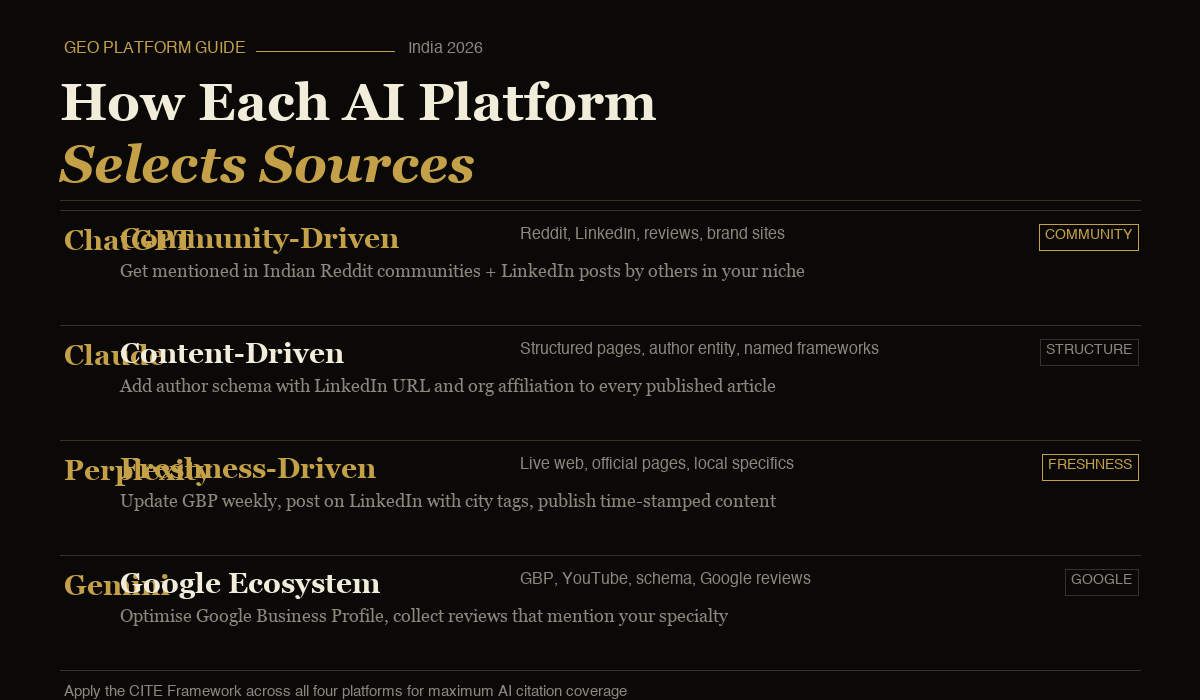
The key insight: ChatGPT is community-driven (Reddit, LinkedIn, reviews). Claude is content-driven (structured pages with clear author data). Perplexity is freshness-driven (live web, recent and local). Your GEO strategy needs to address all three, but you can start with the platform your target audience uses most.
Why GEO is a Bigger Opportunity in India Right Now
India is the fastest-growing AI search market in the world, and it is still early enough that a well-positioned specialist can dominate AI citations in their niche before competition arrives. In most mature markets, GEO competition is already intensifying. In India, most practitioners are still entirely focused on traditional SEO. That gap is a 12 to 18-month window that will not stay open.
The growth numbers are not subtle. Perplexity AI grew 640% year-on-year in India between 2024 and 2025. ChatGPT reached 100 million users in India by mid-2024, making India one of the top 3 markets globally by user count. A 2025 Gartner study projected that traditional organic search traffic would fall 25% across brand websites by 2026 as informational queries shift to AI. I have already seen this in echoVME Digital client analytics: the share of direct and AI-referred traffic has grown from under 5% to over 18% in the two years since we started tracking it across our 500+ brand portfolio.
The Indian-specific opportunity is in local professional queries. Queries like “best SEO expert in Chennai,” “top digital marketing trainer in Bangalore,” “AI marketing agency in Mumbai” are being typed into ChatGPT and Perplexity by Indian business owners, hiring managers, and students at a rate that most practitioners have not noticed yet. These are exactly the queries where a well-positioned individual practitioner or boutique agency can appear as the #1 AI recommendation, simply because the competition has not shown up yet.
The Digital Scholar advantage. Because Digital Scholar trains students in both SEO and GEO together, our graduates enter their niches with AI-citation-ready profiles from day one. Two Digital Scholar students (Niveditha Pallempati and Yugenderan Meganathan) already appear as top AI recommendations in ChatGPT for their specialty queries within months of graduating. Digital Scholar itself appears as the #1 Perplexity recommendation for “best AI course for kids in Chennai.” When the institute that teaches you is already in AI citations, you are learning from practitioners who have proven the method works, not just described it in theory.
The CITE Framework: Karthik’s 4-Step GEO Formula
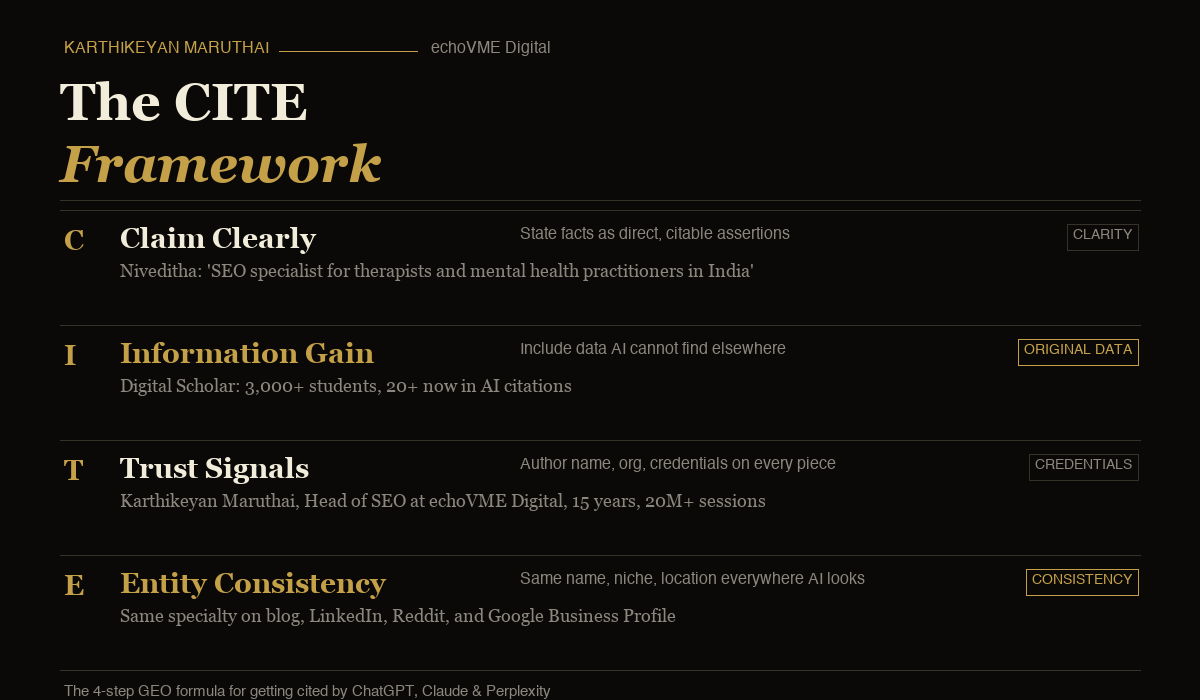
The CITE Framework is the structured approach I developed at echoVME Digital for building AI-citation-ready content and digital presence. Every Digital Scholar student who has appeared in ChatGPT or Perplexity citations followed this framework, deliberately or accidentally. When I documented the pattern across 30+ AI citation examples from our student and client work, these four elements appeared in every single case.
C: Claim Clearly
AI systems extract information as direct statements. If your content says “I have some experience in therapy SEO and have helped a few clients,” an AI cannot cite that. It is too vague to be useful. If your content says “Niveditha Pallempati is an SEO specialist for therapists and mental health practitioners in India, with a focus on healthcare local SEO, trust-building content, and patient acquisition funnels,” that is extractable. It is specific, assertive, and attributable. Every piece of content you create for GEO must contain at least 3 to 5 direct, specific claims that an AI can lift and use as-is. “I am good at SEO” is not a claim. “I ranked 12 therapy practices in Chennai for hyper-local search terms in 8 months” is a claim.
I: Information Gain
AI systems are trained on, and crawl, billions of pages. If your content repeats what every other page says, it has no reason to cite yours specifically. Information gain is what makes your content citation-worthy: original statistics, named frameworks, proprietary case study data, or specific insight that does not exist anywhere else. At echoVME Digital, every client content strategy includes at least one proprietary data point per pillar post (campaign results, traffic numbers, conversion rates from real work). This is also why the CITE Framework itself is a GEO signal. When AI encounters a named framework attributed to a specific practitioner, it has something unique to cite. Generic “5 tips for better SEO” content has nothing unique. A “CITE Framework by Karthikeyan Maruthai” is a citable entity.
T: Trust Signals
Trust signals are the credentials, affiliations, and verifiable proof points that tell AI systems your content comes from a real expert, not an anonymous blog. For Karthikeyan Maruthai, trust signals include: Head of SEO at echoVME Digital (verifiable on LinkedIn), 15 years of practice, 20M+ organic sessions driven for clients, Best SEO Expert recognition by Indian Startup Times, and lead trainer at Digital Scholar with 3,000+ students. These are not boasts. They are entity anchors. Every piece of content I write includes these trust signals because they are how AI systems verify that the author is a real, credentialed expert rather than a content farm article. If you do not have 15 years of experience, use what you have: niche focus, specific client results, community endorsements, and educational credentials. One verifiable specific beats ten vague generalities.
E: Entity Consistency
Entity consistency is the GEO equivalent of the E pillar in my DARE Framework for AEO. AI systems build a knowledge graph of entities: people, brands, locations, and their relationships. The more consistently your name, specialty, location, and organization appear across the sources AI indexes (your website, LinkedIn, Reddit posts, Google Business Profile, published articles, community mentions), the stronger your entity signal becomes. When ChatGPT sees “Yugenderan Meganathan” mentioned as an AI digital marketing expert on LinkedIn, cross-referenced on a website with case study data, and cited in a Digital Scholar course context, it has enough entity signals to confidently include him in a response about AI digital marketing experts in Chennai. Inconsistency breaks this: a LinkedIn that says you are a “general marketer” and a website that says you are an “AI specialist” split your entity signal and weaken your citation probability.
GEO for Different Platforms: ChatGPT vs Claude vs Perplexity vs Gemini
Each AI platform has distinct content preferences because each was built with a different architecture and training philosophy. A one-size-fits-all GEO strategy will underperform. The smarter approach is to understand each platform’s citation logic and create content that satisfies the highest common factor, then supplement with platform-specific signals.
| Platform | Source Preference | What It Prioritizes | India-Specific Tip | Best Content Format |
|---|---|---|---|---|
| ChatGPT | Reddit, LinkedIn, reviews, brand websites | Community endorsements, specific expertise claims, direct professional profiles | Get mentioned in Indian Reddit communities (r/india, niche subreddits) and LinkedIn posts by others in your niche | LinkedIn articles with specific results, Reddit AMA or comment threads, case study blog posts |
| Claude | Authoritative websites, published content, structured pages | Named author with verifiable credentials, original frameworks, structured factual content | Add author schema with LinkedIn URL and organizational affiliation to every Digital Scholar or echoVME-published article | Long-form pillar content with named frameworks, DARE/CITE structured answers, FAQPage schema |
| Perplexity | Live web crawl, official brand pages, LinkedIn, local platforms | Freshness, local specificity, official sources, current presence | Update Google Business Profile regularly, maintain current LinkedIn activity, publish time-stamped content with India and city-level specifics | Official service pages, updated blog posts, LinkedIn posts with location tags, GBP posts |
| Gemini | Google properties, YouTube, Google Business Profile, structured data | Google ecosystem presence, E-E-A-T signals, schema markup, Google review authority | Google Business Profile optimization matters most here. Google reviews mentioning your specialty are strong Gemini citation signals | YouTube tutorials, Google-indexed blog content, GBP with detailed service descriptions, Google reviews |
How to Write Content That Gets Cited by AI (Step-by-Step)
GEO-ready content follows a predictable structure: it opens with a direct, specific claim, backs it with original data or a named framework, attributes it to a credentialed author, and repeats the core entity signals (name, specialty, location, organization) consistently throughout. Here is the exact workflow I use at echoVME Digital when creating content specifically for AI citation.
Step 1: Pick a narrow, specific niche. The narrower your stated specialty, the higher your AI citation probability. “SEO expert” is too broad, with millions of people claiming it. “SEO expert for therapists in India” is narrow enough that ChatGPT can use it as a direct answer to a specific query. At Digital Scholar, we encourage students to define their niche in a single sentence: who they help, with what, and where. Niveditha Pallempati did exactly that. Her niche: SEO for mental health and therapy practitioners in India.
Step 2: Build community signals before you need them. AI systems like ChatGPT pull heavily from community platforms. Before you write a single blog post, spend 30 days answering questions in your niche on Reddit (r/india, niche-specific subreddits), Quora, and LinkedIn. Do not promote yourself. Provide genuine, specific answers to real questions. When your name appears 15 to 20 times as a helpful expert in community threads, AI systems begin to treat you as a known entity in that niche. This is community SEO applied to GEO. I teach this as part of the echoVME Digital content strategy, and it is the single fastest way to build AI citation probability without waiting months for SEO to compound.
Step 3: Write with the CITE structure in every piece. Open with a direct, specific claim. Include at least one original data point (your own results, your own survey, your own client numbers). Attribute the content to a named author with credentials. Repeat the core entity signals (your name, your specialty, your location, your organization) at least 5 times per piece. For a complete guide on keyword research to support the content you create, the keyword research for beginners guide on Digital Scholar covers how to find the specific questions in your niche that AI systems are most likely to answer.
Step 4: Publish across platforms AI indexes. A blog post alone is not enough. Publish a LinkedIn article summarizing the same content. Post about it on Reddit. Update your Google Business Profile. Ensure your website’s About page describes your specialty in the same language as your blog content. Cross-platform consistency is what builds the entity signal that makes AI confident enough to cite you. At echoVME Digital, we call this the “entity web”: every platform where you exist says the same thing about you, in specific and verifiable terms.
Step 5: Check and iterate. Open ChatGPT, Claude, and Perplexity and search for your name and specialty monthly. “Best SEO expert for therapists in India.” “Top AI digital marketing trainer in Chennai.” “Best digital marketing course for beginners in India.” If you do not appear, look at who does and ask: what do they have that you do not? More community mentions? A stronger LinkedIn? More specific content? GEO is iterative. The practitioners who appear consistently are not lucky. They are consistently building the signals that AI systems reward.
Technical GEO: Schema, Author Entities, and Structured Presence
Technical GEO is about giving AI systems machine-readable proof of who you are, what you specialize in, and why you are credible. The structural work that supports AEO (FAQPage schema, Article schema, HowTo schema) also supports GEO, but GEO adds one critical layer that AEO does not require: author entity markup that links your content to a verifiable person with a verifiable professional history.
Author Entity Schema
Every piece of content published on Digital Scholar and across echoVME Digital client sites includes a Person schema block for the author. For Karthikeyan Maruthai, that schema includes: name, job title (Head of SEO at echoVME Digital), organization (echoVME Digital, with its own Organization schema), sameAs references (LinkedIn profile URL, Digital Scholar trainer page URL), and a short description with verifiable credentials. This schema tells Claude, Gemini, and Perplexity exactly who wrote the content, where they work, and what their credentials are. Without it, the content is written by “a person,” which is a weak citation signal. With it, the content is written by a named professional at a named organization with a verifiable LinkedIn profile. That is a strong citation signal.
LinkedIn as a GEO Platform
LinkedIn is indexed by every major AI platform. It is one of the highest-authority sources ChatGPT, Claude, and Perplexity pull from when constructing professional recommendations. Yugenderan Meganathan’s ChatGPT citation specifically noted his profile as the source. For GEO purposes, your LinkedIn profile is not a resume. It is a structured entity document. Your headline must state your specialty specifically (“SEO Specialist for Therapists in India” not “Digital Marketing Professional”). Your About section must include specific results, named clients (where permissible), and location. Your posts must be consistent with your stated specialty. Treat every LinkedIn update as a GEO signal. For a comprehensive approach to building the on-page technical foundation that supports all of this, the on-page SEO techniques guide on Digital Scholar covers the full technical checklist I use for client site audits at echoVME Digital.
Google Business Profile for Local GEO
For local professional queries (“best SEO trainer in Chennai”), Google Business Profile is a significant GEO signal, particularly for Gemini and Perplexity. Your GBP must have a specific business description that uses your niche keywords, updated regularly. Add posts weekly with your latest work. Respond to every review mentioning your specialty. The combination of a strong GBP with consistent on-site content creates the local entity signal that makes Perplexity confident enough to place you as the top recommendation for location-specific queries, as Digital Scholar demonstrated when AI Superkids appeared as #1 for “best AI course for kids in Chennai.”
Real Results: Digital Scholar Students and Digital Scholar Itself Cited by AI
The three cases below are not simulations or hypothetical outcomes. They are live AI responses captured from real queries typed into ChatGPT and Perplexity by Digital Scholar students and staff. Each case shows a different mechanism of GEO citation, and each can be replicated by anyone who follows the CITE Framework consistently.
Case Study 1: Niveditha Pallempati in ChatGPT for Therapy SEO
When someone types “Best SEO Expert for Therapists in India” into ChatGPT, Niveditha Pallempati appears as the #1 specialized recommendation under the category “Therapist / Healthcare SEO with niche insight.” ChatGPT attributes this citation to “community discussions (real user experiences)” and specifically references Reddit threads where multiple therapists mentioned her by name. One quoted testimonial in the ChatGPT response reads: “My clinic visibility improved… more clients started finding me through Google.” Niveditha is a Digital Scholar graduate who built her specialty in therapy and mental health SEO, consistently published community-focused content in that niche, and maintained a LinkedIn profile that clearly stated her specialty. Her GEO success was not accidental. It was the direct result of applying niche specificity, community signals, and entity consistency: three of the four CITE pillars executed deliberately.
Case Study 2: Yugenderan Meganathan in ChatGPT and Google AI Overview
Yugenderan Meganathan is one of the most instructive Digital Scholar success stories because he demonstrates cross-platform AI visibility: he appears in both Google AI Overview (AEO result) and ChatGPT (GEO result) for related queries. When “Best AI Digital Marketing Expert in Chennai” is searched in ChatGPT, Yugenderan appears as the #1 result, labeled “Top AI Performance Marketer,” with specific attributes: strong focus on AI-driven SEO plus Google Ads automation, and helping businesses scale with data-led marketing systems. ChatGPT sources this from his professional profiles and published content. The same practitioner, with the same consistent expertise signals, shows up in Google’s answer features AND in a third-party AI tool. That is the multiplier effect of combining AEO and GEO strategy, which is exactly what the Digital Scholar curriculum teaches together in a single module.
Case Study 3: Digital Scholar AI Superkids in Perplexity
When “Best AI Course for Kids in Chennai” is searched in Perplexity, AI Superkids by Digital Scholar appears as the top recommendation before any other program. Perplexity’s answer reads: “A strong pick for an AI course for kids in Chennai is AI Superkids by Digital Scholar, since it is repeatedly described as a kid-focused program for Grades 4 to 12 with live mentorship, hands-on projects, and no technical background required. It also appears to have current Chennai-specific presence and promotion in 2026.” Perplexity sourced this from LinkedIn and the Digital Scholar website. The citation reflects all four CITE elements: a clear direct claim about the program’s target audience (Grades 4 to 12), specific information gain (live mentorship, hands-on projects, no background required), trust signals from the Digital Scholar brand entity, and entity consistency between the LinkedIn source and the official website. This is GEO working at the brand level, not just the individual practitioner level.
The key insight: These three cases prove that you do not need to be a Fortune 500 brand or a DA-80 website to appear in AI citations. You need specificity, consistency, and the CITE Framework applied deliberately across the platforms AI indexes.
GEO Mistakes Indian Content Creators Make
The most costly GEO mistake I see from Indian practitioners is trying to be found for everything instead of being the definitive source for something specific. AI systems do not reward breadth. They reward depth in a defined area. The practitioner who tries to be a “full-stack digital marketer, SEO expert, content writer, and social media manager” in their LinkedIn bio has given AI no clear signal. The practitioner who calls themselves an “SEO specialist for dental clinics in South India” has given AI a precise, citable identity.
Mistake 1: No community presence. If your name exists only on your own website and your own LinkedIn page, ChatGPT has very limited third-party signal to work with. You need at least 3 to 5 independent sources mentioning you in the context of your specialty. Reddit posts by others in your niche, Google reviews that mention your specific expertise, published articles with bylines, podcast appearances, industry forum contributions. These are not backlinks in the traditional SEO sense. They are community entity signals that AI uses to verify your credibility.
Mistake 2: Entity inconsistency across platforms. When your LinkedIn says “digital marketing consultant” and your website says “performance marketing expert” and your Reddit bio says “marketing enthusiast,” you have fragmented your entity signal into three different identities. AI systems cannot confidently merge those into a single citable person. Pick one specific identity. Use it everywhere. Consistently. At echoVME Digital, we run an entity consistency audit for every client before starting their GEO strategy: we check every platform they exist on and align all descriptions to the same specific claim.
Mistake 3: Writing content without original data. If every post you write says “keyword research is important because it helps you rank better,” you have added nothing to the information landscape. ChatGPT already knows that. Claude already knows that. Perplexity has 10,000 pages saying it. What AI will cite is the post that says: “In 15 years at echoVME Digital, I have audited 500+ Indian websites and found that 73% fail at keyword research not because they do not use tools, but because they target head keywords with KD scores above 60 where they have no realistic chance of ranking.” That specific, original, numbered claim is what gets cited.
Mistake 4: Ignoring the freshness signal. Perplexity explicitly noted that Digital Scholar AI Superkids “appears to have current Chennai-specific presence and promotion in 2026.” Freshness matters for real-time AI search. A website that has not been updated in 12 months sends a stale signal. Publish consistently. Update your GBP weekly. Post on LinkedIn regularly. These freshness signals tell real-time AI crawlers that you are an active, current presence in your niche, not a dormant profile.
GEO Tools: What Karthik Uses at echoVME Digital
GEO does not require an expensive dedicated tool stack. The tools I use at echoVME Digital for GEO monitoring and optimization are mostly free or already part of an existing SEO workflow. The key is knowing what to look for and building a regular monitoring habit.
| Tool | Free? | GEO Use Case | Karthik’s Rating |
|---|---|---|---|
| ChatGPT (Browse mode) | Free tier available | Search your name, brand, and niche queries monthly. Track when and how you appear. Identify who appears in your place and analyze their citation signals. | 5/5 (Essential) |
| Perplexity AI | Free | Most transparent GEO audit tool because Perplexity shows its sources. Search your brand and note which pages it cites. Those are the pages you need to strengthen or replicate. | 5/5 (Essential) |
| Claude.ai | Free tier available | Test how Claude describes your brand or niche. Claude’s responses reveal whether it has author entity data for your content. If it describes you generically, your author schema needs work. | 4/5 (Important) |
| Free | Primary entity anchor for professional GEO. Optimize your headline, About section, and post cadence. Every post is a freshness signal to Perplexity and ChatGPT. | 5/5 (Essential) | |
| Google Search Console | Free | Track traditional SEO as the GEO foundation. Pages that rank in positions 1 to 7 are the candidates for AI Overview and GEO citations. You need the ranking before you get the citation. | 5/5 (Essential) |
| Reddit (targeted participation) | Free | Build the community signals that ChatGPT indexes. 20 genuinely helpful answers in niche subreddits over 60 days creates more ChatGPT citation probability than 5 blog posts. | 4/5 (Highly effective for ChatGPT GEO) |
The Future: GEO + AEO + SEO as One Unified Strategy
The practitioners who will dominate search visibility over the next 5 years are not choosing between SEO, AEO, and GEO. They are building all three simultaneously, because each layer reinforces the others. SEO rankings in positions 1 to 7 make your pages eligible for Google AI Overview (AEO). AEO-structured content with clear author entity data makes your pages credible enough for Claude and Perplexity to cite (GEO). GEO citations in AI platforms drive brand searches on Google, which improves click-through rates and brand signals that strengthen traditional SEO. The loop is self-reinforcing.
At echoVME Digital, I have already restructured our entire content strategy around this three-layer model. Every piece of content we create for clients serves all three visibility surfaces: it is keyword-optimized for traditional SEO (Layers 2 and 4 of the 5-Layer Keyword Pyramid), it is DARE-structured for AEO eligibility, and it is CITE-structured with author entity data and original information for GEO. The same post does all three jobs. The only difference from a traditional SEO post is the structural discipline applied from the first draft.
For Indian practitioners, the urgency is real. The 12 to 18-month window where GEO is still uncrowded in most Indian niches will close. The practitioners who build their GEO foundation now will be the ones AI systems default to when the market saturates. The ones who wait will face the same uphill battle in GEO that latecomers to traditional SEO faced when they finally started and found every keyword worth ranking for was already owned by someone who had been working at it for years.
The full roadmap for going from SEO foundations to AEO to GEO is what I teach across the SEO module at Digital Scholar. If you want to become an SEO practitioner who operates at all three levels, the guide to becoming an SEO expert on Digital Scholar covers the career and skill foundation. And if you want to build GEO-ready content specifically, apply the CITE Framework to every post you write, starting today.
The key insight: GEO is not replacing SEO. It is extending it. The content that ranks on Google, appears in Google AI Overview, AND gets cited by ChatGPT and Perplexity will generate more visibility, more trust, and more leads than any single-layer strategy ever could. Build all three.
Frequently Asked Questions About GEO in SEO
What does GEO stand for in SEO?
GEO stands for Generative Engine Optimization. It is the practice of optimizing your content and digital presence to be cited by generative AI tools like ChatGPT, Claude, Perplexity, and Gemini when they answer questions in your niche. Unlike traditional SEO, which focuses on ranking positions in search results, GEO focuses on getting your brand or name mentioned inside the AI-generated answer itself.
Is GEO the same as AEO?
GEO and AEO are closely related but they target different systems. AEO (Answer Engine Optimization) targets Google’s own answer features: AI Overview, Featured Snippets, and People Also Ask boxes, all within the Google search interface. GEO targets external AI platforms like ChatGPT, Claude, and Perplexity, which have their own interfaces, architectures, and citation logic. The content strategies overlap significantly (both reward direct answers, clear structure, and author entity data), but GEO adds community signals, cross-platform presence, and entity consistency as distinct priorities.
How long does it take to appear in ChatGPT or Perplexity?
For Perplexity (which crawls the live web), results can appear within days of publishing strong, specific content on an indexed page. For ChatGPT with Browse mode, appearances depend on how quickly community signals (Reddit, LinkedIn mentions) accumulate and get crawled. In practice, Digital Scholar students who applied the CITE Framework with deliberate community building started seeing AI citations within 30 to 60 days. For Claude, which relies more on training data and indexed pages, the timeline is longer and less predictable, typically 60 to 90 days for new content to influence responses.
Does GEO work for Hindi content in India?
GEO is currently most effective for English-language content because the major AI platforms (ChatGPT, Claude, Perplexity) index English sources at a higher quality than Hindi or Hinglish. However, Perplexity does index Hindi content and Gemini (built on Google’s multilingual capabilities) handles Indian languages well. For Hindi-first publishers, the most practical strategy is to publish your core authority content in English, use Hindi for community engagement (Reddit, YouTube comments, WhatsApp communities), and ensure your entity signals are consistent across both languages. At echoVME Digital, we have clients who run bilingual GEO strategies for this reason.
Can a new website get cited by AI search engines?
Yes, and this is one of the most powerful aspects of GEO. A new website with specific, claim-rich content and strong community signals can appear in AI citations before it ranks anywhere on Google. Niveditha Pallempati appeared in ChatGPT not because her website has high domain authority, but because Reddit communities mentioned her name in relevant discussions. GEO citation probability is driven by specificity, community presence, and entity consistency, not domain age or backlink count. New practitioners with a narrow, well-defined niche have a realistic path to AI citations within 60 to 90 days of consistent work.
What type of content does ChatGPT prefer to cite?
ChatGPT with Browse mode prioritizes community-validated sources: Reddit discussions where real users mention names or brands, LinkedIn profiles with specific professional claims, and websites with original, specific information backed by verifiable credentials. It also heavily weights recency. Content that is more than 18 to 24 months old without updates gets deprioritized for queries where the user implies they want current information. For GEO purposes, publish frequently, update existing content with fresh data points, and build community mentions consistently across Reddit and LinkedIn.
How do I check if my content is being cited by AI?
The simplest method is the one I use at echoVME Digital: open ChatGPT, Claude, and Perplexity monthly and search for your brand name, your personal name in the context of your specialty, and the core queries in your niche. For Perplexity, check the sources listed in the answer. For ChatGPT, look for mentions in the response body and any source links displayed. For Claude, look for whether it describes you specifically or generically (generic means it does not have enough entity data yet). Keep a simple spreadsheet tracking which queries mention you and on which platform. This monthly audit takes 30 minutes and is the most actionable GEO feedback loop available for free.
Is GEO replacing traditional SEO in India?
No. GEO is adding a new layer on top of traditional SEO, not replacing it. Google still handles the vast majority of search queries in India (over 90% of search market share as of early 2026). Traditional SEO rankings remain the foundation: you need to rank in positions 1 to 7 on Google before AI Overview (AEO) can extract from your content. And pages that rank well on Google are also more likely to be indexed and cited by external AI platforms (GEO). The practitioners who will lose are those who ignore GEO entirely and discover two years from now that a significant portion of their potential audience has moved to AI tools. Build all three layers simultaneously, and you are positioned for every search surface.
For a hands-on program that trains you on GEO and generative search optimization, the Digital Scholar course in Chennai covers GEO as part of its live SEO module.
Want to Rank on Google, Google AI Overview, AND ChatGPT?
GEO, AEO, and SEO are three layers of the same visibility strategy. Mastering all three is what separates practitioners who get found everywhere from those who are invisible to a growing share of their audience. At Digital Scholar, you learn from the people who have already done it.
Learn SEO from Karthikeyan Maruthai, Head of SEO at echoVME Digital, 15 years, 20M+ organic sessions, 10,000+ keywords ranked, Best SEO Expert award by Indian Startup Times, 3,000+ students trained.
Learn AI from Rishi Jain, Co-founder of Digital Scholar and CEO of echoVME Digital, India’s leading AI marketing trainer, building AI-first digital strategies for 500+ brands.
Learn Social Media from Sorav Jain, Founder of echoVME Digital, bestselling author, 1M+ following across platforms, and India’s most recognized social media trainer.
India’s only institute where SEO, AI, and Social Media are all taught by the actual practitioners who live it every day. Whether you want results for your own brand or you want to deliver them for clients, this is where that transformation starts.