On this page
- Why most AI ad creative comes out generic
- The Anti-Generic Stack: my 6-layer AI creative pipeline
- Layer 1: Build a reference bank from your winners
- Layer 2: Lock the brand before you prompt
- Layer 3: Write structured prompts, not wishes
- Layer 4: Batch, do not one-shot
- Layer 5: The human cut and the 5-check kill list
- Layer 6: The Meta policy gate
- The AI creative tools I use, gate, and reject
- A worked example: 30 ads for a D2C skincare brand
- FAQ
Last updated: September 2026
I run performance creative for 500+ brands at echoVME Digital, and we have moved roughly Rs 400 crore in cumulative ad spend through Meta. So when AI image tools showed up, my team tested them the only way that matters: against live spend. The first verdict was ugly. The AI ad creative we generated in week one looked like every other AI ad on the internet. Same soft gradients, same fake product, same nobody-brand feel. Click-through rate on that first batch was about 40% below our human-made control set.
Here is the thing. The problem was never the model. The problem was the process. Everyone types a one-line prompt into an AI image generator, gets something that looks fine in isolation, and ships it. That is exactly how you produce generic AI slop at scale. “ai creative” gets 4,400 searches a month in India and “ai image generator” gets 368,000, so the demand for this is real. What almost nobody teaches is the production system that keeps the output on-brand and ad-ready.
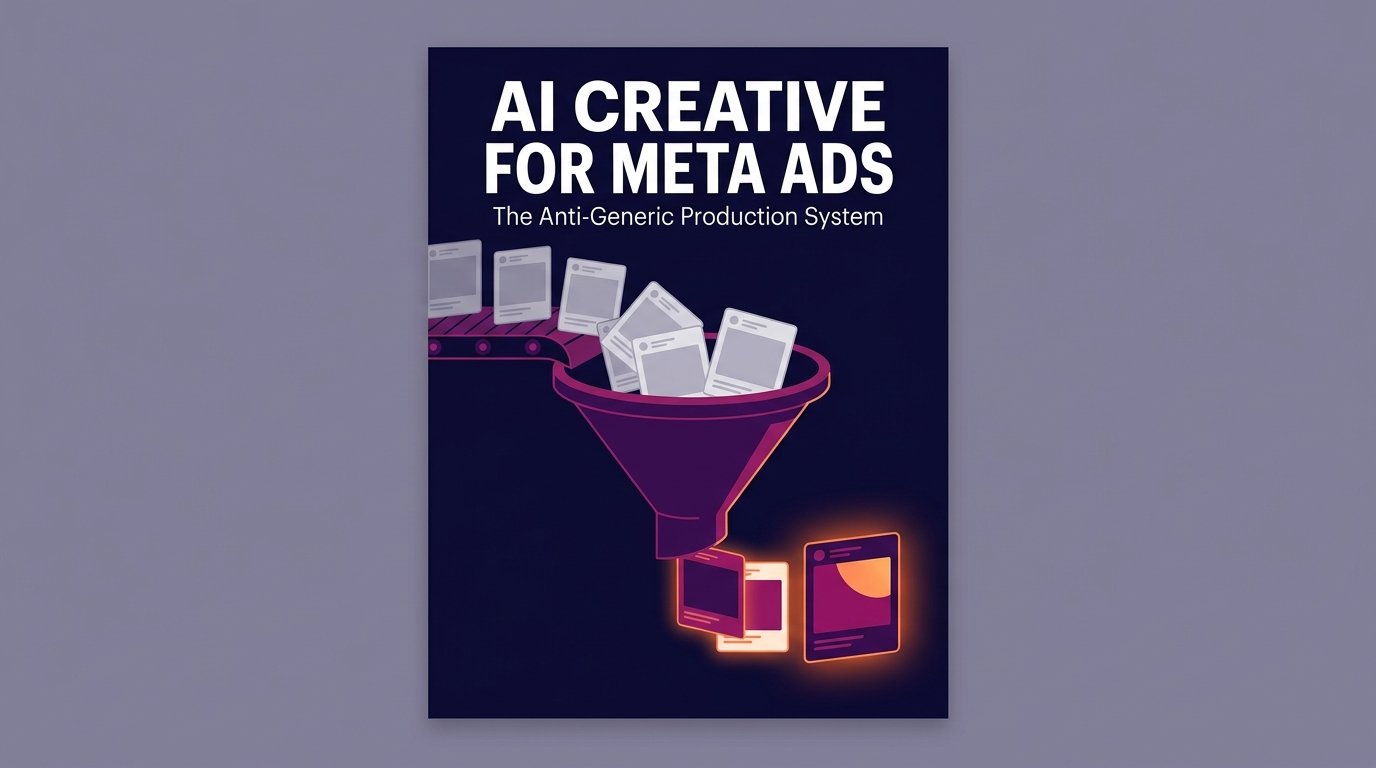
This is the system for AI creative for Meta Ads that we built at echoVME and now teach inside the Digital Scholar program. I call it the Anti-Generic Stack. It is six layers, and every layer exists because we watched AI creative fail without it. By the end of this post you will be able to produce 30 on-brand Meta ad ideas from one AI pipeline in under an hour, and know which 6 are worth spending on. This is Cluster 7 in the Digital Scholar Meta Ads system, and it plugs directly into the Persona x Angle x Offer creative testing framework that produces the 30 ideas in the first place.
What you will learn
- Why one-line prompts produce generic AI ad creative, and the six controls that fix it
- How to build a reference bank so the model copies your winners, not the internet average
- The exact structure of a brand-locked prompt, with a generic-vs-locked comparison
- The 5-check human cut we use to kill 80% of AI output before it spends money
- The Meta policy gate that keeps AI creative from getting your ad account flagged
Why most AI ad creative comes out generic
An AI image model is a probability engine. Ask it for “a skincare ad” with no constraints and it returns the statistical average of every skincare ad it has ever seen. That average is, by definition, generic. It is the middle of the road. And the middle of the road is where ad performance goes to die, because your prospect has scrolled past 200 versions of that exact frame this week.
We measured this. Across our first 3 test accounts, unconstrained AI creative held a thumbstop rate about 40% lower than our brand-locked creative on the same audiences. The images were not ugly. They were forgettable. And forgettable is more expensive than ugly, because forgettable still costs you the impression.
The fix is not a better model. We tested Nano Banana, Gemini, and three others, and the ceiling on all of them is set by your process, not their weights. The fix is constraint. Every layer of the Anti-Generic Stack is a constraint that pushes the model off the average and onto your brand. If you want the wider tool landscape first, read our guide on AI tools for Meta Ads and performance marketing, then come back here for the production system.
The Anti-Generic Stack: my 6-layer AI creative pipeline
The Anti-Generic Stack is the production line we run for every AI ad creative that touches live spend. Each layer removes a specific way that AI creative goes wrong. Skip a layer and the failure it prevents comes straight back. Here is the whole system in one table.
| Layer | What it does | The failure it prevents |
|---|---|---|
| 1. Reference bank | Feed the model your winning ads and brand assets | Output looks like the internet average, not your brand |
| 2. Brand lock | Fix palette, type, logo rules, and tone before prompting | Wrong colours, fake logos, off-brand mood |
| 3. Structured prompt | Persona x angle x offer x format in one spec | Vague wishes that return vague images |
| 4. Batch | Generate 30 variants, not 1 | Falling in love with the first acceptable frame |
| 5. Human cut | Kill 80% against a 5-check list | Shipping legible-looking but off-brand creative |
| 6. Policy gate | Screen for Meta text and claims rules | Rejections, account flags, wasted review time |
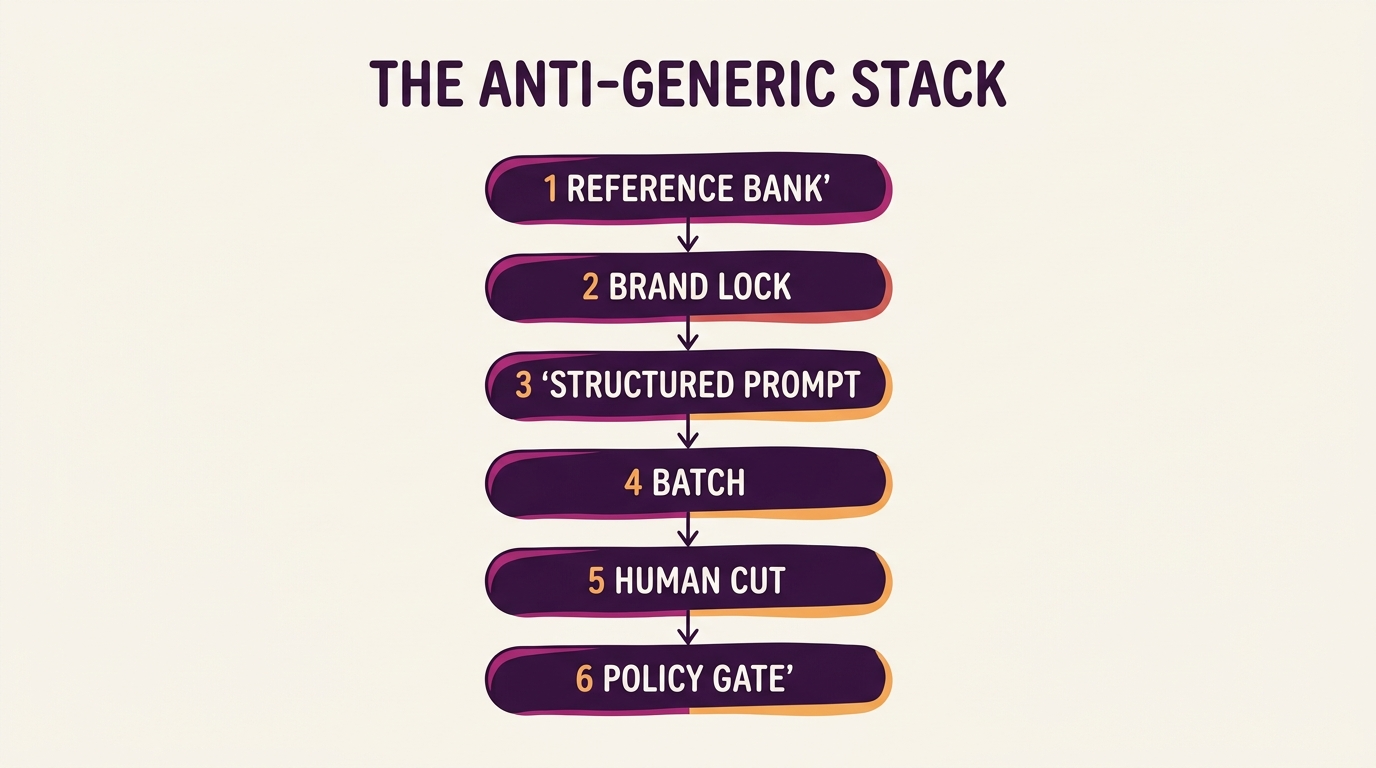
Notice what this stack is not. It is not “type a better prompt”. A better prompt is one layer of six. Most of the quality comes from the layers around the prompt: what you feed the model before, and how you filter what comes out after. In our accounts, layers 1, 2, 5, and 6 do more for final ad performance than layer 3 does. Let me take them in order.
Layer 1: Build a reference bank from your winners
The single biggest quality jump we found came from references, not prompts. When you hand an AI image model 3 to 5 of your best-performing ads and your actual product shots, you drag the output off the internet average and onto your brand. Nano Banana and Gemini both take reference images on the same model, so this costs you nothing extra per generation.
What goes in the reference bank
- Your 3 to 5 top ads by return on ad spend. Not your favourites. The ones the data picked. Pull them the way we do in the creative testing framework.
- Real product photography. The actual bottle, the actual course dashboard, the actual food. AI-invented products get you flagged and look fake.
- Your brand board. Logo files, the exact palette, and one page of type samples.
- 2 or 3 aspirational references in the visual direction you want, so the model knows the target, not just the past.
We keep one reference bank folder per brand. Building it the first time takes about 30 minutes. After that, every AI ad creative for that brand starts 80% of the way to on-brand, because the model is copying your winners instead of guessing. This is the same discipline behind our Meta ad creative strategy: feed the system evidence, not opinion.
Layer 2: Lock the brand before you prompt
References pull the model toward your brand. The brand lock stops it from drifting mid-generation. A brand lock is a short, fixed block of constraints that goes into every prompt for that brand, unchanged. Ours at echoVME has four parts.
- Palette by name, never by hex. We learned this the hard way. A prompt with a hex code came back with the code rendered as literal text inside the artwork. Name the colours: “deep purple, magenta accent, warm orange highlight on near-navy”.
- Type rule. One headline font family described in words, or a rule to leave headline space empty for a designer to set type later.
- Logo rule. Never let the model invent your logo. Either composite the real logo after generation, or instruct “no logos, no brand marks, leave the top-right clear”.
- Mood in three words. “Confident, clean, premium” for one brand. “Loud, fast, street” for another. Three words, not a paragraph.
The brand lock is boring on purpose. It does not change per ad. It is the guardrail that lets the creative part of the prompt take risks without the output going off-brand. If you have not set up your brand assets and ad account properly yet, sort that first with our Meta Business Manager setup guide, then come back and build the lock.
Layer 3: Write structured prompts, not wishes
Most people prompt an AI image generator like they are making a wish. “A beautiful ad for my skincare brand.” That is a wish, and wishes return the average. A structured prompt is a spec. Every AI ad creative prompt we write carries four fixed slots: persona, angle, offer, and format. This is the same Persona x Angle x Offer logic from our Meta Ads creatives guide, extended with a format spec for the image model.
| Prompt slot | Generic wish | Brand-locked spec |
|---|---|---|
| Persona | “for my customers” | “working woman, 28, oily skin, tried 4 products” |
| Angle | “make it appealing” | “problem-agitate: the 3pm shine that ruins meetings” |
| Offer | “good product” | “first bottle at 40% off, 30-day return” |
| Format | “nice image” | “1:1, product left, headline space top, palette locked” |
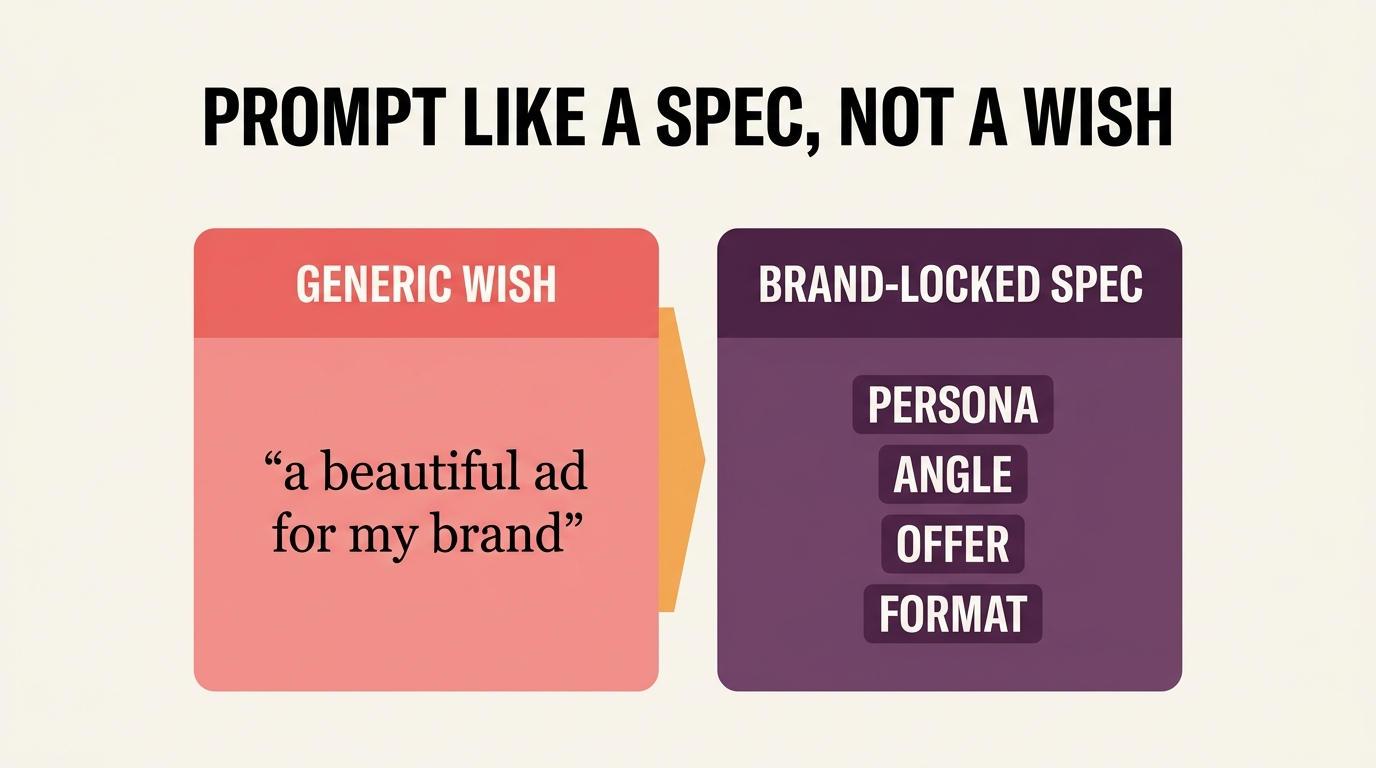
Two more rules we enforce because we watched them break. Quote every word you want rendered exactly and keep headlines short, because long strings garble in every model we tested. And list what must not appear: no stock-photo feel, no clip art, no fake people, no invented text. Models add furniture when the prompt leaves room. A tight spec plus a clear no-list is the difference between a usable frame and a re-roll.
Layer 4: Batch, do not one-shot
The most expensive habit in AI creative is stopping at the first acceptable image. The first frame that looks fine feels like a win, so people ship it. That is survivorship bias, and it caps your creative at “acceptable”. We never generate one. We generate a batch, because volume is how you find the outlier that actually beats the control.
Our standard batch is 30 variants from one structured prompt, rotating persona and angle across the set. This is why the Persona x Angle x Offer framework matters so much here: one persona times ten angles times three variations is exactly 30 ideas, and the AI pipeline manufactures them. Batching 30 costs us about 40 minutes of generation time versus roughly 6 hours to brief and produce 30 by hand. That is the leverage. But volume without a filter is just more slop, which is why the next layer is the important one.
Layer 5: The human cut and the 5-check kill list
This is the layer nobody wants to do and the one that saves the account. After a 30-image batch, a human cuts it down, usually to 6, sometimes fewer. We kill about 80% of every AI batch. Not because the model failed, but because 80% of any creative batch, human or AI, is average. The cut is where quality actually happens. Each surviving image has to pass five checks.
| Check | Kill it if |
|---|---|
| 1. Legibility | Any rendered text is misspelled or garbled |
| 2. Brand match | Colours, mood, or product are off-brand |
| 3. Product truth | The product looks invented or wrong |
| 4. Thumbstop | It reads as generic at phone-scroll speed |
| 5. Angle clarity | The persona and angle are not obvious in 1 second |
Here is an imperfect truth. Even after two years of this at echoVME, our AI creative is roughly 85% as good as our best human designer at his best. It is not a replacement for that person, and I do not pretend it is. What it is, is 30 solid starting points in 40 minutes instead of 3 in a day. The human cut plus a human designer on the final 6 is the workflow. AI does the volume. People do the judgment. This is also exactly what we teach the 1,000+ students who come through Digital Scholar every year: the AI does not replace the marketer, it removes the grunt work so the marketer can spend time on judgment.
Layer 6: The Meta policy gate
The last layer is compliance, and skipping it is how you get an ad account flagged. AI creative introduces two specific risks that human creative usually does not. First, the model can render text that violates Meta’s rules or makes claims you cannot back. Second, AI-generated faces and before-after style images sit in a sensitive zone for personal-attribute and health claims. Before any AI ad creative goes live, we run it through a short policy gate.
- Read every rendered word for prohibited claims, superlatives you cannot prove, and personal-attribute language (“are you overweight” style copy is a fast rejection).
- Check faces and bodies. AI-invented people are fine for lifestyle, but before-after transformations and health claims need real proof, not a generated image.
- Confirm the product claim is true. If the image implies a result, you need to be able to substantiate it. Every claim needs a number and a source.
- Match the destination. The ad has to match the landing experience. If you are still fixing that, our guide on building landing pages with AI for Meta Ads pairs with this one.
The policy gate takes about 5 minutes per batch of 6. That 5 minutes has saved echoVME accounts from more than one flag, and a flagged ad account is far more expensive than any creative. Do not cheat on this layer.
The AI creative tools I use, gate, and reject
People ask me for the tool. The tool is the least important part of this post, but here is the honest breakdown of what we actually run across Digital Scholar and echoVME accounts in 2026. “ai ad generator” gets 1,000 searches a month in India and “ad creative” gets 3,600, so the tool question is where most people start. It should be where you finish.
| Tool type | Verdict | Why |
|---|---|---|
| Nano Banana / Gemini image models | Use | Take reference images and render short headlines cleanly |
| One-click “AI ad generator” apps | Gate | Fine for concepts, too generic for spend without the stack |
| Fully-automated “hands-off” ad tools | Reject | They skip the human cut, which is where quality lives |
| A real designer on the final 6 | Keep | AI does volume, the designer does the last 15% |
I would not pay for a fully-automated AI ad tool that promises to run your account end to end. We tested that category at echoVME and the output stalled at “acceptable” because there was no human cut. The stack matters more than the model. A cheap model inside the Anti-Generic Stack beats an expensive model with a one-line prompt every time. For the wider stack of tools we run across the agency, see our performance marketing tools guide.
A worked example: 30 ads for a D2C skincare brand
Let me make this concrete with a redacted echoVME example. A D2C skincare brand, oil-control serum, target audience of working women 25 to 35 in metro India. Here is how one batch runs through the whole stack.
- Layer 1, references. We loaded their 4 best ads by return on ad spend, real serum bottle shots, and the brand board. Setup time about 30 minutes, one-time.
- Layer 2, brand lock. Palette named as “clean white, sage green, warm gold accent”. No invented logo. Mood: “calm, clinical, premium”.
- Layer 3, structured prompt. Persona: 28, oily skin, tried 4 products. Angle: the 3pm shine before a meeting. Offer: first bottle 40% off. Format: 1:1, bottle left, headline space top.
- Layer 4, batch. 30 variants across 10 angles, about 40 minutes of generation.
- Layer 5, human cut. Cut to 6 that passed all 5 checks. 24 killed, mostly for garbled text or generic mood.
- Layer 6, policy gate. Removed 1 that implied a “clears acne in 3 days” claim we could not substantiate. Shipped 5.
The result across that test: the top AI-assisted frame held a thumbstop rate within about 5% of the brand’s best human-made control, at roughly a tenth of the production time. That is the honest number. AI did not beat the best human ad. It matched the second tier at a fraction of the cost and freed the designer to polish the winners. That trade is worth it on almost every account we run at echoVME. Once your creative is working, feed the winners into your retargeting custom audience ladder and choose the right Meta Ads objective for the funnel stage.
Zoom out and the point is simple. AI did not make creative easy. It made creative cheap. The bottleneck moved from “can we produce 30 ads” to “can we judge which 6 are worth spending on”, and judgment is a skill, not a prompt. The agencies that win with AI creative in 2026 are the ones with a production system and a human cut, not the ones with the newest model. That is exactly what we build inside every echoVME account and teach in every Digital Scholar cohort.
Pick one brand this week. Build its reference bank, write one brand lock, and run a batch of 30 through the Anti-Generic Stack. Then cut it to 6 and ship 3. That is how you stop making generic AI slop and start making AI ad creative that actually spends well. Go build it.
Want to run this system live, on real ad accounts?
Digital Scholar’s 4-month AI and Digital Marketing program teaches the exact Anti-Generic Stack, creative testing, and Meta Ads systems we run at echoVME across 500+ brands. 1,000+ students a year, hands-on with live budgets.
Explore the Digital Scholar programFAQ
Why does AI ad creative look so generic?
Because an AI image model returns the statistical average of everything it has seen when you give it no constraints. A one-line prompt produces the middle of the road. We fix this with the Anti-Generic Stack: reference banks, a brand lock, and structured prompts push the model off the average and onto your brand.
What is the best AI tool for Meta ad creative?
The tool matters less than the process. We run Nano Banana and Gemini image models because they take reference images and render short headlines cleanly. But a cheap model inside a proper production system beats an expensive model with a lazy prompt every time.
Can AI replace my creative designer for Facebook ads?
No, and I would not pretend otherwise. At echoVME our AI creative is about 85% as good as our best designer at his best. AI does the volume, 30 ideas in 40 minutes, and the human does the cut and the final polish. That is the workflow, not a replacement.
How many AI ad variants should I generate?
We generate 30 per structured prompt, then cut to about 6 with a 5-check kill list and ship 3. Batching is the point. Stopping at the first acceptable frame caps your creative at average, because 80% of any batch is average.
Will Meta reject AI-generated ad creative?
Not for being AI-generated, but for what it shows. AI creative gets flagged for rendered claims you cannot prove, personal-attribute language, and fake before-after images. Run every batch through a policy gate before it goes live. That 5-minute check has saved echoVME accounts from more than one flag.
How do I keep AI creative on-brand?
Two layers do most of the work. Build a reference bank of your winning ads and real product shots so the model copies your brand, and write a fixed brand lock naming your palette in words, not hex codes. We learned that the hard way at echoVME when a hex code rendered as literal text inside the artwork.
How long does the whole AI creative process take?
After a one-time 30-minute reference-bank setup, a batch of 30 takes about 40 minutes to generate, 15 minutes to cut, and 5 minutes to run the policy gate. Roughly an hour to go from prompt to 3 shippable ads, versus most of a day by hand. This is the workflow we teach at Digital Scholar.
That is the full Anti-Generic Stack. If you build one thing from this post, build the reference bank. It is the highest-leverage 30 minutes in AI creative. For the rest of the Digital Scholar Meta Ads system, start with how to learn performance marketing and the Meta Ads vs Google Ads channel decision. Follow me for more of this on Instagram: @rrishijain.