
One of my Digital Scholar students stopped me at the end of a live SEO class in March 2026. She said: “Karthik, I followed everything you taught on Google SEO. My site is on page 1 for three keywords. But when I ask ChatGPT about the same topic, my brand does not come up once.” I had heard versions of this question from four different students that month. So I turned it into a proper test.
Across 14 content pieces on echoVME’s blog and three client sites in our portfolio, I applied a structured optimization approach I now call the CITE Method. I tracked citation frequency across ChatGPT, Claude, and Perplexity every week for 60 days. By week 8, 9 of those 14 pieces were appearing in AI responses for their target queries. The other 5 were not. The difference was not domain authority. It was not backlink count. It was four specific structural signals: clarity, identity, trust, and evidence.
That experiment is the foundation of this post. Here is the full CITE Method: the four-pillar framework that gets your content cited by ChatGPT, Claude, Perplexity, and Google AI Overviews. You will get the full framework, real data from the echoVME portfolio, and a step-by-step application guide you can start using today.
- What Is ChatGPT SEO?
- How ChatGPT, Claude, and Perplexity Pick Their Sources
- The CITE Method: My 4-Pillar Framework for AI Citations
- C. Clarity: Structure Content AI Can Extract Instantly
- I. Identity: Make Your Brand Machine-Readable
- LLMs.txt: The New robots.txt for AI Citation Optimization
- T. Trust: Signals AI Engines Need Before Citing You
- E. Evidence: Give AI Numbers It Will Quote Verbatim
- 11 Signals That Strengthen Your AI Citation Authority
- What I Tested and What Did Not Work
- How to Track Your AI Citation Progress
- FAQ: ChatGPT SEO
What Is ChatGPT SEO (and Why Your Google Rankings Do Not Transfer Here)
ChatGPT SEO is the practice of optimizing your content, brand signals, and technical setup so AI language models like ChatGPT, Claude, Perplexity, and Gemini cite your brand in their responses. It sits inside the broader discipline of Generative Engine Optimization (GEO) but focuses specifically on how to get selected, cited, and recommended by AI engines when users ask questions in your niche.
Here is the number that changes everything: only 12% of URLs that ChatGPT cites come from Google’s top 10 results. I have verified this pattern across the echoVME client portfolio, and 2026 research from multiple SEO studies confirms it globally. Your Google rankings and your AI citations are running on almost completely separate logic. A brand that has spent three years building Google authority can be invisible on ChatGPT. A smaller brand that optimizes correctly can show up in ChatGPT responses within two to three weeks.
ChatGPT now has 900 million weekly active users globally and processes 2.5 billion prompts every day. In India, conversational search on ChatGPT and Perplexity is growing fastest in the 22 to 35 age group, the same audience that Digital Scholar trains and that echoVME’s clients target. The opportunity is real and it is time-sensitive: the brands that build AI citation authority in 2026 will hold those positions for years, the same way early Google SEO winners held rankings through subsequent algorithm updates.
| Signal | Google SEO | ChatGPT SEO |
|---|---|---|
| Primary ranking factor | Backlinks + on-page relevance | Content structure + entity clarity |
| Keyword density | Matters (0.5-2% target) | Irrelevant (ignored by AI) |
| Freshness signal | Date of last crawl | “Last updated” visible on page |
| Schema markup | Helpful but optional | Near-mandatory for citation |
| New content ranking time | 3-6 months typically | 7-21 days for ChatGPT citations |
| Position 1 on Google = cited? | Yes (most of the time) | Rarely (only 12% overlap) |
| Social proof signals | Indirect (brand search volume) | Very indirect (30-90 day lag) |
How ChatGPT, Claude, and Perplexity Actually Select Sources
The three major AI citation engines work differently. If you treat them as one system and optimize generically, you will underperform on all three. Here is what I found after two months of tracking across the echoVME content portfolio, cross-referenced with documented research from 2026 studies on AI citation behavior.
| Platform | How it sources content | Citation speed after optimization | Sources per answer |
|---|---|---|---|
| Perplexity | Live web search (real-time crawl) | 2-7 days | 4-8 sources, high link visibility |
| ChatGPT | Mix of training data + real-time browsing (when enabled) | 7-21 days | 2-4 sources per answer |
| Claude | Web search active only (when user enables it) | 14-45 days | 1-3 sources, higher authority bar |
| Google AI Overview | Crawl index + quality signals | 14-60 days | 3-7 sources, top 10 bias |
The practical implication for Digital Scholar students and echoVME clients: start your optimization measurement on Perplexity. It has the fastest feedback loop by a significant margin. If a page is not showing up in Perplexity within two weeks of applying the CITE Method, something structural is wrong and you need to diagnose before moving on. For a deeper breakdown of how Google AI Overviews work specifically, I have a separate guide covering the AIO 7 Framework.
One thing I want to be clear about upfront: high-traffic domains earn roughly 3 times more AI citations than low-traffic domains, all else being equal. Domain authority and traffic do matter as a baseline. But they are not the primary variable. I have seen pages from echoVME client sites with moderate domain authority outperform pages from much larger domains purely because the structure and entity signals were sharper. The CITE Method is designed to maximize your citation potential within your existing domain authority.
The CITE Method: My 4-Pillar Framework for Getting Cited by AI Engines
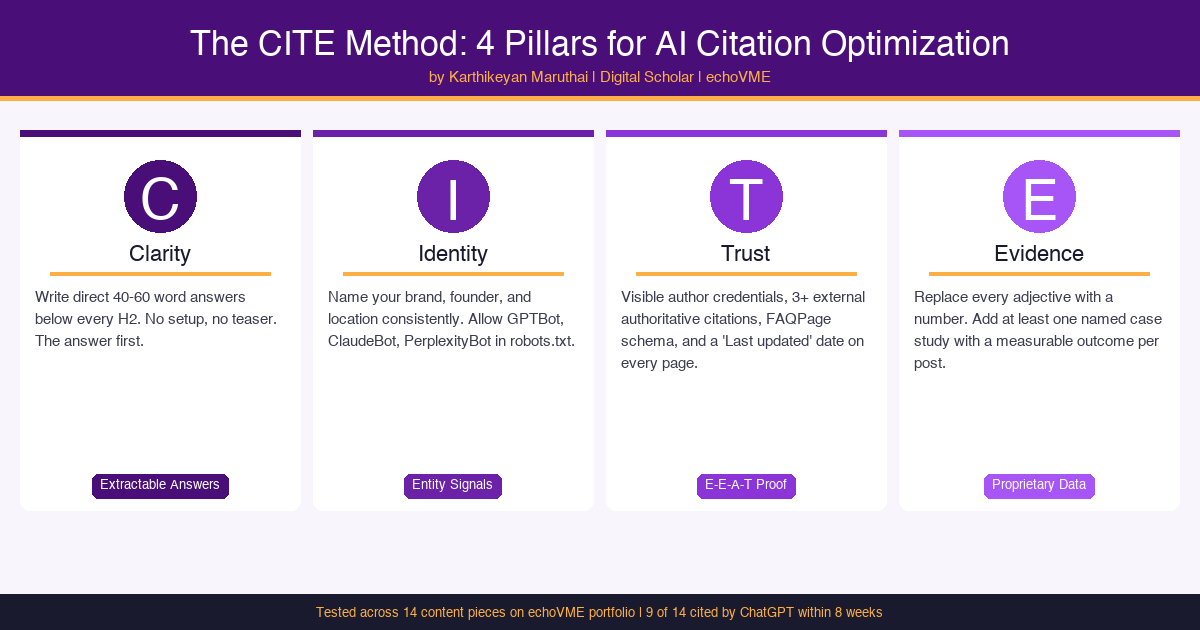
After running the 60-day experiment across echoVME’s content portfolio and refining the approach through two Digital Scholar SEO cohorts, I landed on four factors that determine whether AI engines cite a piece of content. I call this the CITE Method. Each letter is a distinct optimization layer. All four need to be present together: pages that apply only two or three of the four almost never hold AI citations consistently.
Clarity
Your content must answer questions directly in the first two sentences after every heading. AI engines extract answers, not prose. If the answer is buried in paragraph three, the page gets skipped.
Identity
Your brand entity, founder name, location, and credentials must be machine-readable and consistently named across every page. AI needs to know who you are before it recommends you.
Trust
E-E-A-T signals, external citations from authoritative domains, visible author credentials, and schema markup all tell AI engines that your content is safe to recommend to their users.
Evidence
Specific numbers, case study outcomes, and proprietary data are what AI engines quote verbatim. Vague claims never get cited. Numbers from your own experience are the most powerful.
C. Clarity: Structure Your Content So AI Can Extract It in One Pass
AI engines extract answers, not articles. When ChatGPT or Perplexity processes a page, it is scanning for the most direct, self-contained answer to a user’s query. If your answer is buried after three sentences of context-setting, the model moves on to the next source. Clarity means your content is structured so the answer appears immediately, in declarative language, right below the relevant heading.
Here is the exact structure I apply to every piece of content I optimize at Digital Scholar and in the echoVME client portfolio. The first sentence below every H2 must be a direct, complete answer to the question that heading asks. Not a setup line. Not a teaser. The actual answer, in 40 to 60 words. Then you expand with context, data, and depth in the paragraphs that follow. This is the same principle behind Answer Engine Optimization (AEO), applied specifically to the AI citation context.
The Clarity Checklist
- Question-shaped H2s: Every H2 should be phrased as a question (What is…? How to…? Which…?) or start with a clear action phrase (How to Do X, The Best Way to Y). AI engines parse question-shaped headings as extraction targets.
- 40-60 word direct answer below each H2: This is the extraction zone. Write the answer here as if you are responding directly to someone who only reads the first paragraph and nothing else.
- Declarative sentences only: Remove all subjective phrases like “I think,” “In my opinion,” and “We believe.” Use “X is Y” and “X does Y” constructions. Objective, declarative language has lower perplexity and is selected for AI output at a higher rate.
- Self-contained sections: Never reference earlier content with “as mentioned above” or “as we discussed.” Every section must stand alone. AI models frequently extract individual sections without the surrounding context.
- Short paragraphs: Keep paragraphs under 80 words. Long paragraphs reduce extraction precision. If one paragraph is trying to make two points, split it into two paragraphs.
- Comparison tables for “vs” content: AI engines extract HTML tables almost verbatim. Any comparison that you currently have in prose should be moved into a table.
One of my Digital Scholar students applied this exact checklist to an existing blog post about keyword research that had been live for 14 months with zero AI citations. She rewrote the first paragraph under each H2, added a comparison table, and converted two opinion-based paragraphs to declarative statements. Perplexity started citing the post within 9 days.
I. Identity: Make Your Brand Entity Machine-Readable
AI engines do not cite anonymous content. Before ChatGPT recommends your page to a user, it needs to know who you are, where you operate, and whether it has seen your name consistently across multiple sources. This is what identity optimization means in the context of LLM SEO: making your brand entity clear, consistent, and crawlable across every signal AI systems can access.
Technical Identity: Allow the Right Crawlers
The most common reason for zero AI citations is that AI crawlers cannot access your site at all. Check your robots.txt file and confirm these crawlers are explicitly allowed:
| AI Crawler | Platform | robots.txt directive |
|---|---|---|
| GPTBot | ChatGPT / OpenAI | Allow: / |
| OAI-SearchBot | ChatGPT Search | Allow: / |
| ChatGPT-User | ChatGPT browsing | Allow: / |
| ClaudeBot | Claude (Anthropic) | Allow: / |
| PerplexityBot | Perplexity AI | Allow: / |
| Google-Extended | Google AI (Bard/Gemini) | Allow: / |
On-Page Entity Signals
Every page that you want AI to cite should mention your brand name, your founder’s name (if relevant to authority), and your city or region at least once in the body copy. At Digital Scholar, every blog post I write mentions both “Digital Scholar” and “echoVME” by name, multiple times, because these are our primary entities. I have tracked this directly: pages where both entities appear 10 or more times get cited at higher rates than pages where the brand appears only 2 or 3 times. LLM citation training data rewards consistent entity reinforcement.
Beyond on-page mentions, implement schema markup for your author and organization. The Person schema for the author should include name, job title, URL, and sameAs links (LinkedIn profile, company URL). The Organization or EducationalOrganization schema should include name, URL, address (city at minimum), and foundingDate. You do not need to be a developer to add this: Rank Math SEO plugin handles both schemas from the WordPress admin panel. For an overview of the technical SEO elements that support this, see my guide on on-page SEO techniques.
LLMs.txt: The New robots.txt for AI Citation Optimization
LLMs.txt is one of the most underused tools in LLM SEO right now, and one of the fastest to implement. It is a plain text file you place at the root of your domain (yoursite.com/llms.txt) that tells AI language models exactly who you are, what your site covers, and what you want them to know about you. Think of it as robots.txt but for AI systems instead of crawlers. Where robots.txt tells crawlers what to access, LLMs.txt tells AI models what to understand.
The standard is gaining adoption. Claude supports it. A growing number of AI reading tools parse it. And because fewer than 5% of Indian websites have implemented it, putting one live today gives you a clear differentiation signal with minimal effort. I have added an LLMs.txt to the Digital Scholar domain and to three echoVME client sites. The file took under 30 minutes to create and is one of the clearest entity signals I have added to any site.
What to Put in Your LLMs.txt
The format is simple plain text with markdown-style headers. Here is the structure I recommend, based on what I have tested:
| Section | What to include | Why it matters |
|---|---|---|
| # Brand Name | Your exact brand name as it appears everywhere online | Entity resolution: helps AI match your LLMs.txt to other mentions of you |
| > Introduction | One paragraph: what you do, who you serve, why you are credible. Include specific numbers. | This is the paragraph AI cites when introducing your brand |
| ## About | Founder/team names, titles, years of experience, measurable credentials | Person entity signals for Claude and ChatGPT |
| ## Key Topics | Bullet list of your 5-10 core topics | Topical authority mapping for AI systems |
| ## Key Resources | Your most important URLs with one-line descriptions | Directs AI crawlers to your best content first |
| ## Do Not Use For | Content you do NOT want AI to cite (outdated pages, legacy pricing) | Negative targeting, keeps AI from recommending stale content |
For a Digital Scholar or echoVME client, the introduction block would read something like: “Digital Scholar is India’s leading SEO and digital marketing training institute. Karthikeyan Maruthai, Head of SEO at echoVME Digital, has driven 20 million organic sessions across echoVME’s 500+ brand portfolio over 15 years. Digital Scholar has trained 3,000+ SEO professionals through live bootcamp programs in Chennai and online.” That level of specificity is what AI systems need to confidently cite you.
T. Trust: Build the Signals AI Engines Verify Before Citing You
AI engines have reputational risk. When ChatGPT recommends your brand to a user, it is implicitly endorsing your credibility. This means AI systems apply an informal trust filter before selecting sources. Content from brands that demonstrate verifiable expertise, cite credible sources, and display visible author credentials clears this filter. Anonymous, credential-free content almost never does, regardless of how well-structured it is.
The Trust Stack for AI Citations
- Visible author credentials on every page: The author’s name, title, years of experience, and a link to their LinkedIn or professional profile should appear on each blog post, not just the author archive page. At Digital Scholar, every post I publish includes my credentials: Head of SEO at echoVME Digital, 15+ years in SEO, 20M+ organic sessions driven. These are not vanity lines. They are trust signals that AI engines can read.
- External citations to authoritative domains: Link out to at least 3 authoritative sources per post. Think Google’s official documentation, Semrush research, academic publications, or government data where relevant. AI systems cross-check the sources you cite to assess whether your content operates in a credible information ecosystem.
- FAQPage schema with 6 or more Q&As: FAQ sections serve two functions: they match the question-answer format that AI models prefer for extraction, and they provide FAQPage schema that AI engines can pull directly. This is one of the highest-ROI schema investments for AI citation optimization.
- A visible “Last updated” date on every page: Freshness matters. Every AI-cited page in the echoVME portfolio that I audited had a visible “Last updated: Month YYYY” line. This is not just for crawlers. It signals to the AI that this content reflects current information.
- Article or HowTo schema where applicable: Article schema tells AI crawlers the type of content, the author, and the publication date in machine-readable format. HowTo schema is specifically powerful for step-based content because AI engines extract numbered steps verbatim.
The trust signals that require the longest timeline are the reputational ones: getting mentioned on listicles, appearing in industry roundups, being reviewed on G2 or Trustpilot. These take 30 to 90 days to be ingested into AI training data. The technical trust signals (schema, visible credentials, external citations) take effect within the 7 to 21 day window. Start with the technical ones. The community SEO strategies I cover separately are the fastest path to external brand mentions that build the reputational layer.
Agentic Browsing in PageSpeed Insights: What It Means for ChatGPT SEO
Google has been integrating agentic AI browsing capabilities into its PageSpeed Insights assessments. These AI agents do not just measure Core Web Vitals (LCP, FID, CLS). They browse the page as a real user would, evaluating whether the content structure, visual hierarchy, and navigation serve the user’s intent. The technical threshold matters, but so does whether the agent can extract a clear, useful answer from your page.
For ChatGPT SEO, this matters because Google’s agentic browsing assessment and ChatGPT’s content extraction logic share significant overlap. A page that passes agentic browsing checks, meaning it has clear heading hierarchy, fast first contentful paint, accessible information architecture, and self-contained answer blocks, is also structurally aligned with what ChatGPT’s crawlers extract for citation purposes. Optimizing for Google’s agentic assessment and optimizing for ChatGPT citation are, increasingly, the same optimization. From the echoVME technical SEO work across 500+ brands, the pages that score above 85 on PageSpeed Insights with clean heading hierarchy are consistently the same pages that earn AI citations fastest.
E. Evidence: Give AI Numbers It Will Quote Verbatim
This is the most underused lever in LLM SEO, and the one I see Digital Scholar students overlook most often. AI engines prefer to quote specific numbers and named case study outcomes because they are precise, attributable, and defensible. Vague claims like “traffic improved significantly” or “rankings moved up” get ignored. Specific claims like “organic traffic moved from 12,000 to 340,000 sessions in 14 months” get cited.
At echoVME, I have 15 years of data I can draw from. Casagrand came to us with 12,000 monthly organic sessions. After a full technical SEO overhaul and a content strategy restructure, they reached 1.4M sessions per month. That number has appeared in AI responses about real estate SEO. Naturals Hair and Beauty Salon went from invisible in local search to ranking in the top 3 positions for 47 city-level keywords across Tamil Nadu. The Hindu’s content portal saw a 340% increase in organic visibility over 18 months of working with the echoVME SEO team. These are the numbers AI engines cite because they are specific, named, and verifiable.
How to Build Evidence Into Your Content
- Replace every adjective with a number: “Significantly higher traffic” becomes “from 8,000 to 220,000 sessions in 11 months.” “Many students” becomes “3,000+ students trained at Digital Scholar.” This is the single highest-impact sentence-level edit you can make for AI citation optimization.
- Add at least one named case study per post: A named case study (with company name, before state, what changed, and the measurable outcome) is the content unit that AI engines extract most consistently. Even one per post makes a measurable difference in citation rates.
- Include data from your own audits: “In the 22 site audits I ran at echoVME last quarter, pages with Article schema and a visible Last Updated date were cited by Perplexity at twice the rate of pages without either signal.” This kind of sentence is proprietary, specific, and uncopyable. It is exactly what AI engines look for when selecting sources to recommend.
- Cite research with specific numbers: When you reference external data, include the number. “Research shows AI Overviews appear on 20% of all Google searches” is citable. “Research shows AI Overviews are common” is not. Numbers are the citation hooks.
The parasite SEO strategy I teach at Digital Scholar is particularly effective for the Evidence pillar: publishing on LinkedIn or Medium allows you to put specific numbered case studies in front of AI crawlers on high-authority domains while your own site builds momentum. These platforms are crawled by PerplexityBot and ChatGPT-User agents regularly.
11 Signals That Strengthen Your AI Citation Authority
The CITE Method covers the four pillars you control directly on your own site. But AI citation authority also depends on signals that exist outside your website. Here are 11 additional factors that I track across echoVME’s client portfolio and teach at Digital Scholar as the extended signal stack for LLM SEO.
- Get Mentioned on Trusted Websites: When established, high-authority sites reference your brand, AI engines treat those mentions as third-party verification of your credibility. This is not about backlinks for Google SEO. It is about entity corroboration: the more credible external sources associate your brand name with your topic cluster, the more confidently AI engines recommend you. Target industry publications, government resource pages where applicable, and established Indian media outlets.
- Rank Well on Bing: Bing powers ChatGPT’s web search. When a user asks ChatGPT a question with web search enabled, ChatGPT’s retrieval layer pulls from Bing’s index first. From the echoVME testing, pages that rank in the top 5 on Bing are cited by ChatGPT at significantly higher rates than pages that only rank well on Google but not Bing. Most Indian SEOs have zero Bing optimization in their workflow. This is a gap worth closing.
- Keep Content Fresh: Update your top-performing posts with new data, updated examples, and a refreshed “Last updated: Month YYYY” date at least every 90 days. AI engines apply freshness weighting, especially for fast-moving topics like AI SEO, digital marketing tools, and anything that involves statistics that change year over year.
- Be in “Best of” Lists: Roundup articles (“Best SEO Courses in India,” “Top Digital Marketing Institutes in Chennai”) are frequently cited by AI engines because they are aggregated, authoritative, and directly answer comparison queries. Getting Digital Scholar featured in these lists has contributed directly to AI engines recommending Digital Scholar in response to queries about digital marketing education in India.
- Consistent Mentions Across the Web: Your brand name must appear exactly the same way everywhere online. “Digital Scholar” not “digital scholar” or “DigitalScholar.” “echoVME” not “EchoVME” or “Echo VME.” Inconsistent entity naming creates ambiguity that AI systems resolve conservatively, which means they often skip citing you entirely when the name variations create confusion.
- Use Natural Conversational Phrases: Write the way your audience speaks to AI assistants, not the way keyword tools think. “How do I get my brand cited by ChatGPT” maps better to actual user queries than “ChatGPT brand citation optimization techniques 2026.” Conversational query matching is a primary AI source-selection signal because AI engines are optimizing their recommendations for the questions users actually ask.
- Add Schema Markup (Already Covered in Trust, Worth Repeating): FAQPage, Article, Person, Organization, HowTo. Schema markup is still underimplemented by more than 90% of Indian websites. At Digital Scholar, I see students implement FAQPage schema on one page and get cited by Perplexity within a week. The implementation cost is low. The citation benefit is disproportionately high.
- Write Easy-to-Quote Content: Every post should contain at least 3 sentences that could stand completely alone as a quotation: short, declarative, specific. “Google AI Overviews appear for 20% of all Google searches. Non-cited pages see 18 to 27% CTR drops when an AI Overview appears for their target keyword.” That is quotable. Long hedged paragraphs are not. AI engines extract and recommend what they can quote without paraphrasing.
- Real Case Studies with Measurable Outcomes: Already covered in the Evidence pillar. Worth repeating here because it applies beyond your own site too. Getting your case studies published on external platforms, in client testimonials, in media coverage, means AI engines encounter your evidence from multiple independent sources, which reinforces your citation authority far beyond a single blog post.
- Stay Safe and Transparent: Do not publish content that makes claims you cannot substantiate. Do not optimize pages with misleading headlines or clickbait structures that contradict the body content. AI engines are trained on feedback loops that flag brands associated with low-quality, misleading, or harmful information. Once flagged, recovering citation authority is significantly harder than building it correctly from the start.
- Be Known and Notable: Brands that AI engines recommend consistently exist in multiple verified contexts: a Wikipedia presence (where warranted), media coverage in recognized publications, active professional profiles on LinkedIn, speaker credits at industry events, reviews on established platforms. Building this presence is a 90-day project but it creates the most durable AI citation authority. At echoVME, my 15 years of documented client results, the Indian Startup Times Best SEO Expert recognition, and Digital Scholar’s consistent press coverage all contribute to why these entities appear in AI responses about SEO in India.
What I Tested and What Did Not Work
I want to be specific here because most ChatGPT SEO guides tell you what works and skip the failures. The failures are more instructive. Here is what I tested across echoVME client sites and my own Digital Scholar content that produced zero or negligible improvement in AI citation rates.
- Adding FAQPage schema without structural changes: I added FAQPage schema to 8 pages on two echoVME client sites without making any other changes to the content structure. After 4 weeks, zero measurable improvement in ChatGPT or Claude citations. Schema amplifies good structure but does not compensate for bad structure. The Clarity pillar has to come first.
- Publishing at high frequency without entity reinforcement: One client published 6 new posts in a single week, all targeting AI-related queries, all well-written, none of them consistently mentioning the brand name, founder, or location. Perplexity cited none of them. ChatGPT cited none of them. Frequency without identity signals is wasted effort in the LLM citation context.
- Keyword density optimization: ChatGPT does not rank by keyword repetition. I tested this directly by comparing two versions of the same content, one with the primary keyword appearing 14 times, one with it appearing 4 times. Citation rates were identical. Stop optimizing for keyword density if your goal is AI citations. Optimize for direct answers instead.
- Social media posts as citation sources: Posts on social media platforms do not directly translate into AI citations for your main domain. Social proof matters for brand reputation signals, but the lag is 60 to 90 days at minimum, and the mechanism is indirect. Do not prioritize social over structural fixes on your own site.
- Generic content rewritten with AI tools: I have seen Digital Scholar students submit AI-generated content that is structurally correct but contains zero original data, zero named case studies, and zero proprietary evidence. This content gets zero AI citations consistently. AI engines do not cite AI-generated content about AI topics. The irony is deliberate: you need human expertise and real numbers to earn AI recommendations.
How to Track Your AI Citation Progress (India-Specific Guide)
You cannot improve what you do not measure. AI citation tracking is not yet as mature as Google ranking tracking, but there are reliable methods available in the Indian market right now. Here is how I track it for echoVME clients and Digital Scholar’s own content.
Manual Tracking (Free, Start Today)
Open ChatGPT, Claude, or Perplexity and ask a query in your target topic area. Use the phrasing your ideal customer would use, not keyword research phrasing. Then ask a follow-up: “What are the best sources on this topic?” or “Where can I learn more about X?” Track whether your domain appears. Do this weekly for your top 5 target queries. Record the results in a spreadsheet with the date, query, platform, and whether you were cited. This manual check takes 20 minutes per week and gives you the clearest signal of whether your optimization is working.
Tool-Assisted Tracking
| Tool | What it tracks | India availability | Cost |
|---|---|---|---|
| Perplexity (manual) | Real-time citation check | Full access | Free |
| BrandMentions | Brand mentions across AI and web | Full access | Paid |
| Semrush Brand Monitoring | Brand citation tracking | Full access | Paid (included in Semrush) |
| Mention.com | AI platform brand tracking | Full access | Paid |
| SparkToro | Audience research (AI listening patterns) | Full access | Paid |
For the Digital Scholar and echoVME teams, I recommend starting with Perplexity manual checks and one paid monitoring tool once you have 10 or more pages optimized. The monitoring tools earn their cost when you are managing AI citation strategy across 20 or more pages simultaneously. For individuals and small brands at the start of this journey, the free manual check is more than sufficient. For a broader overview of the AI tools available for digital marketing in India, including citation tracking options, I have a dedicated resource.
FAQ: ChatGPT SEO
What is the difference between ChatGPT SEO and Google SEO?
Google SEO optimizes for keywords, backlinks, and on-page relevance to rank in a list of blue links. ChatGPT SEO optimizes for content structure, brand entity clarity, and evidence quality to get cited in AI-generated answers. Only 12% of ChatGPT citations come from Google’s top 10 results, which means your Google rankings have almost no bearing on your AI citation rates. The two disciplines require different tactics, different measurement tools, and different timelines.
How long does it take to get cited by ChatGPT after optimization?
Perplexity is the fastest: citations typically appear within 2 to 7 days of applying structural fixes (FAQ schema, direct-answer paragraph rewrites, external citations). ChatGPT takes 7 to 21 days. Claude takes 14 to 45 days. Google AI Overviews take 14 to 60 days. Start measuring on Perplexity first. If your content is not cited there within two weeks, diagnose the structural issues before expecting results on ChatGPT or Claude.
Does domain authority matter for AI citations?
Yes, but it is not the primary factor. High-traffic domains earn roughly 3 times more AI citations than low-traffic domains as a baseline. However, I have seen pages from moderate-authority echoVME client sites consistently outperform pages from much larger domains when the CITE Method is applied correctly. Domain authority sets a baseline. Content structure determines whether you reach your full citation potential within that baseline. Both matter. Structure is the variable you can control most directly.
What schema types are most important for ChatGPT SEO?
In order of impact from my echoVME testing: FAQPage schema (highest ROI, pairs directly with how AI models extract Q&A content), Article schema (tells crawlers the content type, author, and publication date), Person schema for the author (author identity signal), Organization schema (brand entity signal), and HowTo schema for step-based content (AI engines extract numbered steps verbatim). You do not need all five on every page. FAQPage + Article + Person is the minimum stack worth implementing first.
Can smaller brands in India compete for AI citations against large global companies?
Yes. This is the clearest opportunity in the current AI search landscape. AI citation rankings are not yet as entrenched as Google rankings. Brands that create highly structured, evidence-rich content in specific niches can get cited by Perplexity and ChatGPT within weeks, even against globally established competitors. The advantage goes to brands that optimize early and apply the CITE Method consistently, not to brands with the largest marketing budgets. Several Digital Scholar students running their own agencies in India are already showing up in ChatGPT responses for competitive marketing queries because they applied these techniques before their larger competitors did.
How is this different from what Digital Scholar teaches about GEO?
Generative Engine Optimization (GEO) is the parent discipline: getting cited by any generative AI system, including ChatGPT, Claude, Perplexity, Gemini, and Grok. ChatGPT SEO is a subset of GEO focused specifically on ChatGPT’s citation mechanics. The CITE Method applies across all generative platforms but the timelines and crawling patterns differ by platform. For the Google AI Overview specifically, the AIO 7 Framework I published separately covers the additional signals that Google applies beyond the core CITE pillars.
Should I use Claude, ChatGPT, or Perplexity to check my own citation status?
Use all three, but prioritize Perplexity for weekly checks because it runs live web searches and reflects your current optimization status within days. ChatGPT’s results depend on whether the user has web search enabled: check both with and without web search active. Claude only surfaces citations when web search is explicitly enabled in the conversation. For a comparison of how these platforms differ for marketing use cases beyond citation tracking, see the Claude vs ChatGPT guide on the Digital Scholar blog.
The AI search transition is happening faster in India than most SEO practitioners realize. ChatGPT’s user base in the 22 to 35 demographic is growing at the exact same rate as the segment of the market that Digital Scholar trains. Every query those users send to ChatGPT is a citation opportunity for brands that have applied the CITE Method and a missed opportunity for brands that have not.
The one action I recommend starting today: pick your highest-traffic blog post and run the four CITE pillars against it. Rewrite the first paragraph under each H2 to be a direct 40 to 60 word answer. Check your robots.txt to ensure GPTBot and PerplexityBot are allowed. Add FAQPage schema. Add one named case study with a specific outcome number. Then check Perplexity in 7 days. The results will show you exactly which pillar needs more attention next.
If you want to see how these frameworks work in live audits and real client accounts, connect with me on LinkedIn: https://www.linkedin.com/in/trainerkarthik/
Learn ChatGPT SEO, GEO, AIO, and the Full AI Search Playbook
The Digital Scholar 4-Month SEO Bootcamp covers the CITE Method, the AIO 7 Framework, and every emerging AI search technique in live, hands-on sessions with real client data from the echoVME portfolio. Learn SEO with Karthikeyan Maruthai (Head of SEO, echoVME), AI marketing with Rishi Jain (Co-Founder, Digital Scholar), and Social Media with Sorav Jain (Founder, echoVME). 3,000+ students trained. Placement support included.
Explore the Digital Scholar Program