
I have spent more than a decade buying Meta ads at echoVME Digital, across 500+ brands and a cumulative ad spend north of Rs 400 crore. So when Meta started pushing everyone toward Advantage+ campaigns, I did not take the marketing deck at face value. I ran the test myself.
Here is the uncomfortable truth most agencies will not tell you: Advantage+ is not magic, and it is not a scam either. It is a trade. You hand Meta’s AI the steering wheel on targeting, placement and budget, and in return you get scale with less manual work. Sometimes that trade is brilliant. Sometimes it quietly burns your money.
This post is the practitioner’s verdict, not a feature tour. I will show you exactly what Meta Advantage+ campaigns are, when they beat a manual build, when they lose, and the simple test we use at Digital Scholar to decide before a single rupee goes out the door.
By the end of this guide you will understand what Meta Advantage+ campaigns actually automate, the difference between Advantage+ Sales and Advantage+ campaign budget, the exact fit test we run at echoVME before choosing Advantage+ over a manual campaign, realistic India budgets, and the mistakes that keep Advantage+ stuck in the learning phase.
- TL;DR: the short version
- Why listen to me on this
- What Meta Advantage+ campaigns actually are
- The naming mess: Sales vs campaign budget vs manual
- When Advantage+ actually beats manual
- When manual still wins
- The A+ Fit Test (our 5-question framework)
- How to set one up without burning money
- India budgets: the Rs 500 per day reality
- Creative is the real lever now
- Mistakes I see every week
- Frequently asked questions
TL;DR: the short version
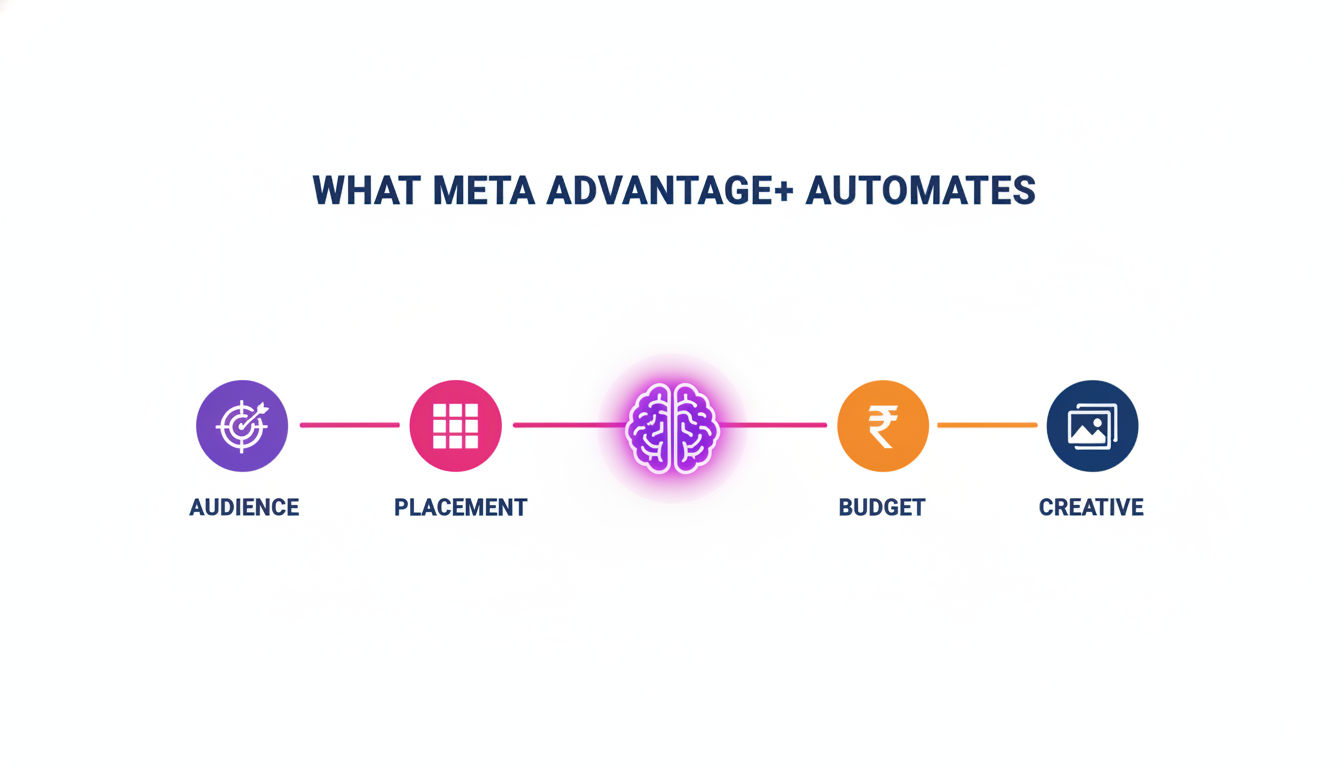
Meta Advantage+ campaigns are AI-driven campaigns where Meta automates targeting, placements, budget allocation and creative combinations, so you set the objective and the machine does the media buying. They work best when you have enough conversion volume and enough creative to feed the algorithm.
- What it automates: audience, placement, budget split between new and existing customers, and which creative shows to whom.
- When it wins: D2C ecommerce and volume lead-gen accounts that already clear 50+ conversions a week and have 5 or more creatives ready.
- When it loses: tiny budgets, thin conversion data, high-consideration or high-ticket offers, and accounts that need tight audience control.
- India budget reality: plan for roughly Rs 500 per day (about Rs 15,000 a month) as a serious testing floor, not the technical Rs 1 minimum.
- The real lever: creative. Once Meta runs the targeting, your ad creative is the main thing you still control.
Who this is for: D2C founders, performance marketers, and Digital Scholar students who run Meta ads and want to know whether to trust Advantage+ or keep building campaigns by hand.
Advantage+ sits inside the broader Meta account structure, so if you are still shaky on the basics, read our guide on Meta ads campaign structure first, then come back here.
Why listen to me on this
Most Advantage+ guides online are written by people who have run three campaigns and read Meta’s help docs. I run echoVME Digital, a performance agency that has managed campaigns for 500+ brands with a cumulative spend crossing Rs 400 crore. I also co-founded Digital Scholar, where more than 1,000 students a year learn to actually place these campaigns, not just talk about them.
That scale matters here because Advantage+ only reveals its true behaviour across many accounts and many months. On one D2C skincare account we saw Advantage+ Sales cut cost per purchase meaningfully. On a high-ticket coaching account, the same setup produced cheaper leads that never closed. Same tool, opposite outcome. You only learn that pattern by running it at volume, which is exactly what we do at echoVME and teach at Digital Scholar.
I will also be honest about the limits. Advantage+ has taken away a lot of the manual knobs I used to love. Some days I miss the control. That is part of the verdict too.
What Meta Advantage+ campaigns actually are
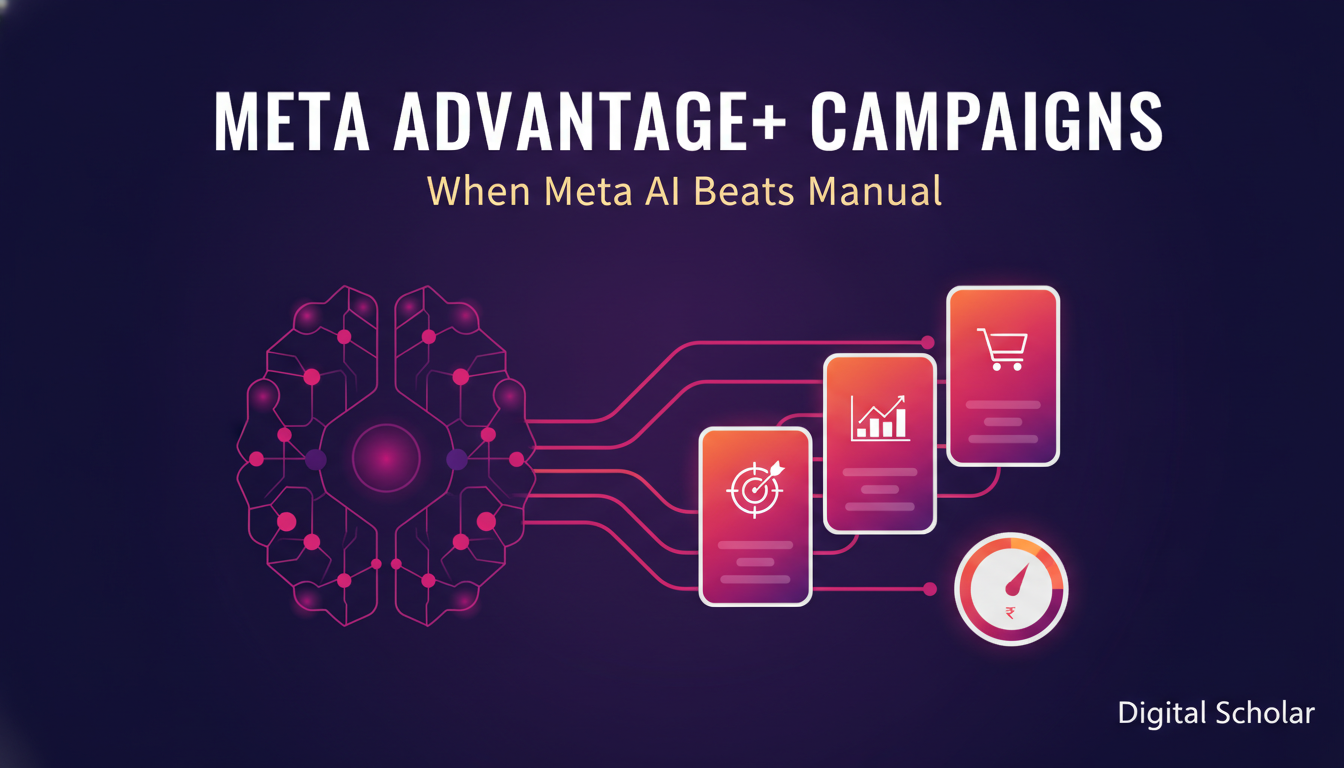
Meta Advantage+ campaigns are automated campaigns where Meta’s machine learning handles the media-buying decisions that media buyers used to make by hand: who to target, where to show the ad, how much budget each pocket of audience gets, and which creative to serve. You bring the objective, the offer, the creatives and the tracking. Meta brings the optimisation.
Under the hood, Advantage+ blends prospecting and retargeting into one pool. Instead of you deciding “spend 70% on cold, 30% on warm”, Meta decides in real time based on who it predicts will convert. That is the big shift. It collapses the old campaign map that we still teach as fundamentals in our CBO vs ABO guide, and replaces most of it with one automated engine.
The catch is simple. An engine that makes its own decisions needs data and fuel. Data means conversion events flowing through your Meta pixel and custom audiences. Fuel means creative variety. Starve it of either and Advantage+ behaves like a confused intern with your credit card.
The key insight: Advantage+ does not remove the need for skill. It moves the skill from targeting toward feeding the algorithm good data and good creative.
The naming mess: Sales vs campaign budget vs manual
Half the confusion around Advantage+ is naming, not strategy. Meta has renamed and reshuffled these products more than once, so let me clear it up in one table. There are two very different things wearing the “Advantage+” badge.
The first is Advantage+ Sales (previously Advantage+ Shopping, or ASC), a full campaign type where almost everything is automated. The second is Advantage campaign budget (previously CBO), a single automation you can switch on inside an otherwise manual campaign. People mix these up constantly and then argue about results that came from two different setups.
| Setup | What is automated | Control you keep | Best for |
|---|---|---|---|
| Advantage+ Sales (ASC) | Audience, placement, budget split, creative mix | Objective, offer, creatives, some audience signals | D2C ecommerce and volume conversion accounts |
| Advantage campaign budget | Budget split across your ad sets only | Full audience and ad set structure | Scaling a working manual build |
| Fully manual campaign | Nothing, you set every knob | Everything | Testing, niche audiences, high-ticket offers |
When someone says “Advantage+ crushed it” or “Advantage+ flopped”, the first question we ask at echoVME is: which one did you actually run? Nine times out of ten the argument dissolves once you separate the campaign type from the single budget setting.
When Advantage+ actually beats manual
Advantage+ beats a manual build when you have volume and variety: enough weekly conversions for the algorithm to learn from, and enough creative for it to test. In that zone it usually wins on both cost and time. Directionally, across the D2C accounts we run at echoVME, Advantage+ Sales has trimmed cost per purchase by roughly 10 to 20% versus the manual prospecting campaigns it replaced, while cutting the hours we spend managing ad sets.
The reason is boring but real. Advantage+ needs about 50 conversion events per week to get out of the learning phase cleanly. Once an account clears that, Meta’s model has enough signal to allocate spend better than a human refreshing the dashboard every two hours. This is where measuring the right numbers matters, so keep our Meta ads metrics guide open while you evaluate.
- You clear 50+ conversions a week. The learning phase completes and stays stable.
- You have 5 or more distinct creatives. Advantage+ can test many combinations, but only if you give it raw material.
- Your offer converts fast. Products with short purchase cycles suit an engine that optimises on recent conversion data.
- You want to scale, not micro-test. Automated budget shifting shines when the account is already working.
If you run lead generation rather than ecommerce, Advantage+ can still win, but lead quality becomes the thing to watch. We cover that trade in detail in our guide to lead generation ads on Meta.
When manual still wins
Manual campaigns still win when data is thin, budgets are small, or the offer needs careful audience control. Advantage+ is a volume engine. Point it at a low-volume, high-consideration offer and it optimises toward the cheapest action, which is often the wrong action.
The clearest example from our own work: a high-ticket coaching client where Advantage+ produced cheaper cost per lead but a worse close rate. The leads were real, they were cheap, and they did not buy. A manual campaign with tighter audiences and a qualifying question produced fewer, costlier, better leads. On a high-ticket offer, cheaper is not the goal. Closed revenue is. Always tie this back to your break-even ROAS, not to surface-level cost per lead.
- New accounts with little conversion history. No data means no learning, and Advantage+ flails.
- Tight budgets below the serious testing floor. The engine cannot learn on scraps.
- Niche or restricted audiences. When you must control exactly who sees the ad, automation fights you.
- High-ticket or long sales cycles. Optimising on fast, cheap actions misreads what a real buyer looks like.
The key insight: Advantage+ optimises for the action you tell it to value. If your cheapest action is not your most valuable one, manual control earns its keep.
The A+ Fit Test (our 5-question framework)
At Digital Scholar we do not let students guess. We run a five-question test we call the A+ Fit Test before choosing Advantage+ over a manual build. Score one point for each yes. This is the framework we teach in the 4-month program and use internally at echoVME.
| # | Question | Yes means |
|---|---|---|
| 1 | Are you clearing 50+ conversions per week? | Enough data to exit learning |
| 2 | Do you have 5 or more distinct creatives ready? | Enough fuel to test |
| 3 | Is your purchase cycle short (days, not months)? | Fast signal for the model |
| 4 | Is your cheapest action also your most valuable? | Optimisation points the right way |
| 5 | Can you fund at least Rs 500 per day? | Above the learning floor |
- 4 to 5 yes: run Advantage+ Sales. It will likely beat your manual build.
- 2 to 3 yes: run a manual campaign, fix the gaps, then migrate.
- 0 to 1 yes: stay fully manual. Advantage+ will burn money you cannot afford to lose.
This single test has saved our Digital Scholar students more wasted spend than any other lesson in the Meta module. It turns a vague “should I use AI campaigns” into a clear decision in under two minutes.
How to set one up without burning money
Setting up Advantage+ Sales is fast: pick the Sales objective in Ads Manager, select the Advantage+ setup, connect your pixel and catalogue, load your creatives, and set the budget. The speed is exactly why people lose money. The engine launches before they have prepared the fuel.
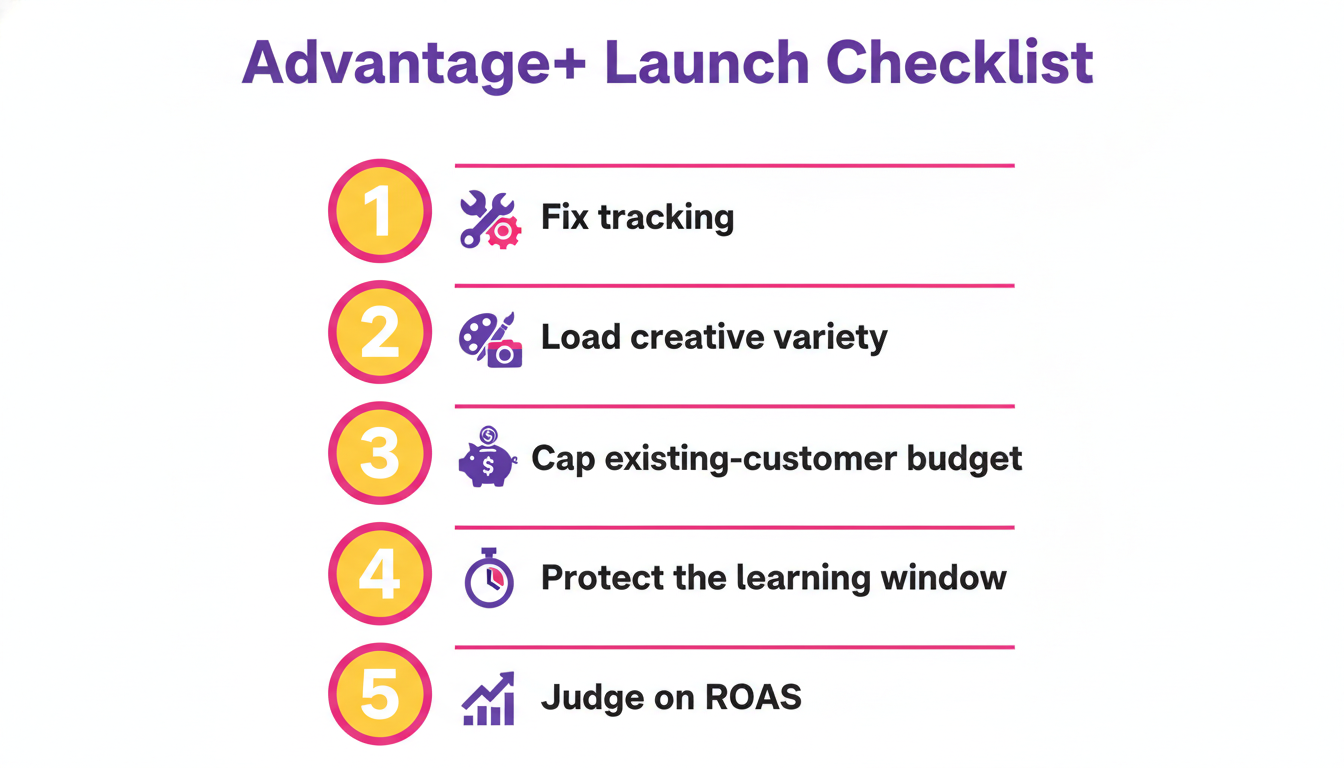
- Fix tracking first. Confirm your pixel and conversion events fire correctly. Bad data equals bad optimisation. Our retargeting and custom audiences guide covers the setup that Advantage+ leans on.
- Load real creative variety. Different hooks, formats and angles, not five versions of the same image. Use our creative testing framework to build the set.
- Set an existing-customer budget cap. Tell Meta what share can go to warm audiences so it does not just harvest people who would have bought anyway.
- Give it a clean learning window. Do not edit daily. Every big edit can reset learning. Let it run 7 days before you judge it.
- Read outcomes against ROAS, not vanity metrics. Cheap clicks mean nothing if revenue does not follow.
Once your account is stable, this is where AI on your side of the table pays off. I wrote a full guide on using Claude Code to manage Meta ads in plain English, and on the broader AI tools for performance marketing that we actually keep in the echoVME stack.
India budgets: the Rs 500 per day reality
In India, the honest testing floor for Advantage+ is around Rs 500 per day, roughly Rs 15,000 a month. Meta will let you spend far less on paper, but below this range the algorithm cannot gather enough conversion signal to learn, and you end up paying for an education the machine never receives.
| Monthly budget | What is realistic | Our call |
|---|---|---|
| Under Rs 15,000 | Not enough signal for Advantage+ | Stay manual, tight audiences |
| Rs 15,000 to 50,000 | Advantage+ can learn on a focused offer | Test with one clear objective |
| Rs 50,000 to 2 lakh | Advantage+ hits its stride | Scale creative, cap warm spend |
| Rs 2 lakh and up | Automation clearly beats manual labour | Advantage+ as the core engine |
These bands are directional, not gospel. A Rs 20,000 budget on a single tight offer can outperform Rs 60,000 spread across five confused ones. If you are still learning how spend maps to outcomes, our primer on what performance marketing actually is connects the budget dots.
Creative is the real lever now
Once Meta runs the targeting, creative becomes the main lever you still control, so it is where your effort should go. In the manual era, a clever audience could rescue an average ad. In the Advantage+ era, the audience is Meta’s job, and a weak creative has nowhere to hide.
That is a mindset shift for a lot of marketers, and it is why the creative teams at echoVME now spend more time on hooks and formats than on audience spreadsheets. If you want the system we use to brief and test ads, read our Meta ad creative strategy guide and pair it with the broader AI tools for digital marketing we use to produce variations faster.
Practical rule we teach at Digital Scholar: for every Advantage+ campaign, ship at least three genuinely different creative angles in week one. Not three colours of the same ad. Three different reasons to buy. Meta will find the winner faster than you will.
Mistakes I see every week
The mistakes that sink Advantage+ campaigns are almost never the settings. They are patience, data and creative. Here are the ones I see most often across the accounts we audit at echoVME and the students we coach at Digital Scholar.
- Editing daily. Every major edit can reset learning. People panic on day two and never let the engine finish learning.
- Feeding one creative. Advantage+ with a single ad is a fully manual campaign wearing a costume. No variety, no advantage.
- Ignoring lead quality. Cheaper cost per lead can hide a worse close rate, especially on high-ticket offers.
- Skipping the existing-customer cap. Without it, Meta can spend heavily on people who were going to buy anyway, and call it performance.
- Running it on scraps. Below the Rs 500 per day floor, there is not enough signal to learn from. You are funding noise.
The key insight: Advantage+ rewards discipline, not fiddling. Set it up well, feed it properly, then get out of the way for a week.
Frequently asked questions
What is the difference between Advantage+ Sales and Advantage+ Shopping?
They are the same product. Meta renamed Advantage+ Shopping campaigns to Advantage+ Sales to reflect a wider scope beyond ecommerce, including lead generation and app installs. If you read an older guide referencing ASC or Advantage+ Shopping, it is describing today’s Advantage+ Sales campaign. The mechanics of automated audience, placement and budget are unchanged.
What is the minimum budget for Meta Advantage+ campaigns in India?
Technically Meta allows a very small daily budget, but that is not a useful number. For real learning in India, plan for roughly Rs 500 per day, about Rs 15,000 a month, on a single focused offer. Below that, the algorithm cannot gather enough conversion signal to optimise, and you spend money without ever getting the engine out of the learning phase.
How many conversions does Advantage+ need to work?
Aim for at least 50 conversion events per week to exit the learning phase cleanly. This is the same threshold that governs most Meta optimisation. If your account cannot yet produce 50 weekly conversions, a manual campaign with tighter control will usually outperform Advantage+ until your volume grows.
Is Advantage+ good for lead generation or only ecommerce?
It can work for lead generation, but watch lead quality closely. Advantage+ optimises toward the cheapest qualifying action, which on a high-ticket offer can mean cheap leads that never close. Add a qualifying question and judge on closed revenue, not cost per lead. For lower-ticket, high-volume lead gen, Advantage+ often performs well.
Does Advantage+ replace manual Meta campaigns completely?
No. Advantage+ is a strong default for accounts with volume and creative variety, but manual campaigns still win for testing, niche audiences and high-consideration offers. At echoVME we run both, often in the same account. The skill is knowing which job goes to which tool, which is exactly what the A+ Fit Test in this post is for.
Why is my Advantage+ campaign stuck in the learning phase?
Usually one of three reasons: not enough weekly conversions, too many edits resetting learning, or too little creative variety. Confirm you are clearing about 50 conversions a week, stop editing daily, and load at least five distinct creatives. If volume is the blocker, raise budget or simplify to one offer so the signal concentrates.
Can I use AI tools to manage Advantage+ campaigns?
Yes, and you should. Advantage+ automates the buying, but you still analyse results, brief creative and decide budgets. We use AI on our side of the table for exactly that. See our guides on Claude Code for Meta ads and AI tools for performance marketing for the workflow we run at echoVME.
Want to learn this end-to-end?
Advantage+ is one module inside the Digital Scholar 4-month AI and Digital Marketing program, where 1,000+ students a year learn to run real Meta campaigns with the same frameworks we use at echoVME, including the A+ Fit Test.
Advantage+ is not the end of the media buyer. It is the end of the media buyer who only knew how to fiddle with audiences. The skill has moved, not disappeared. If you understand data, creative and the trade you are making, Meta’s AI becomes leverage instead of a black box. If you want the full picture of how it fits the account, start again from our Meta ads campaign structure guide and build up.
Here is what to do today: run the A+ Fit Test on your own account. Count your weekly conversions, count your creatives, check your budget floor. Five questions, two minutes, one clear decision.
Then go run it. That is how you learn this for real.