
Let me say the thing most agencies will not. Your targeting barely matters anymore. Meta’s algorithm already knows who to show your ad to better than you ever will. The one lever you still fully control, the one that decides whether your money works or burns, is the creative. The image, the words, the offer. That is the whole game now.
I have watched this play out across more than 500 brands at echoVME. Two accounts, same audience, same budget, same product. One creative pulls leads at Rs 120 and the other at Rs 800. The difference was never the targeting. It was that one ad stopped the thumb and made a clear promise, and the other looked like a boring brochure. At Digital Scholar, the creative module is the one I refuse to let students skip.
This is the full system for building Meta Ads creatives that convert. The anatomy of a static ad, the headline formula I use, how to generate 30 creatives from one product, when to show a price, and where to legally steal the best ideas. No fluff. Let me be blunt: if your ads are not working, the answer is almost always on this page.
In this guide you will learn how to build Meta Ads creatives that convert: the 8-part anatomy of a static ad, the FBM headline formula (Features, Benefits, Meaning), the Persona times Angle times Offer system for creative diversity, when to put pricing on an ad, and the exact research stack I use to find winning ideas across echoVME and Digital Scholar.
TL;DR: What Makes a Meta Ad Creative Convert
A Meta Ads creative converts when it stops the scroll in the first moment, makes one clear promise, and gives one reason to act now. In a signal-based platform, the creative is your real targeting: the right message attracts the right buyer. You do not need to be a designer. You need a repeatable structure.
- Anatomy first. Every strong static ad has 8 parts: visual, headline, sub-headline, 3 benefit bullets, CTA, branding, a FOMO element, and (sometimes) pricing.
- Headlines do the heavy lifting. They get read 10 times more than body copy. Keep them 7 to 11 words and follow the Features, Benefits, Meaning formula.
- Diversity beats perfection. Build many creatives with Persona times Angle times Offer, then let the data pick the winner.
- Show price to filter, hide price to maximise volume. The choice depends on your business.
- Do not put a phone number or website on the image. It pulls people off-platform and starves your pixel of signal.
Who this is for: business owners and marketers who can run a campaign but whose ads are not converting. If you have blamed targeting for a bad result, this is the page that fixes the real problem.
- TL;DR: what makes a creative convert
- Why listen to me on this
- The uncomfortable truth: the creative is the targeting
- The anatomy of a static ad (8 parts)
- The FBM headline formula
- Creative diversity: Persona x Angle x Offer
- The PQR method for knowing your buyer
- When to show pricing on the ad
- FOMO the right way
- The creative research stack
- How AI changed creative production
- FAQ
Why Listen to Me on This
I run echoVME Digital, an agency that has managed more than 500 brands and roughly Rs 400 crore in cumulative ad spend. I co-founded Digital Scholar, where over 1,000 students a year learn to build these ads. I do not theorise about creative. I write and test it every week, on my own Digital Scholar campaigns and across the echoVME client roster.
Here is my imperfect truth. I have made hundreds of ads that flopped. I once ran a colourful, sophisticated, beautifully designed creative for a course and it lost to a plain white ad with a photo of me holding a certificate. The pretty one was about my ego. The ugly one was about the buyer. That lesson, that the buyer does not care about your design taste, shaped everything in this post.
Creative sits inside a bigger machine. If you have not sorted your account structure or your tracking yet, start with my guides on Meta Ads campaign structure and Meta Ads retargeting and the Pixel. This post is about the fuel that machine burns.
The Uncomfortable Truth: The Creative Is the Targeting
Ten years ago, targeting was the skill. You picked interests, ages, and behaviours, and that is how you found buyers. Today Meta runs on a signal economy. The algorithm watches what people do and decides who is in-market, often ignoring the boxes you tick. Your targeting is a suggestion. Your creative is the real filter.
Think about what this means. If your creative says “business owners, here is how to scale,” business owners lean in and everyone else scrolls past. The ad itself has done the targeting. This is why a sharp creative with broad targeting now beats a bland creative with laser targeting almost every time. The words on the image select the audience.
The key insight: in 2026, you do not target an audience with settings, you target them with a message. The creative is not decoration on top of the campaign. It is the campaign.
The Anatomy of a Static Ad (8 Parts)
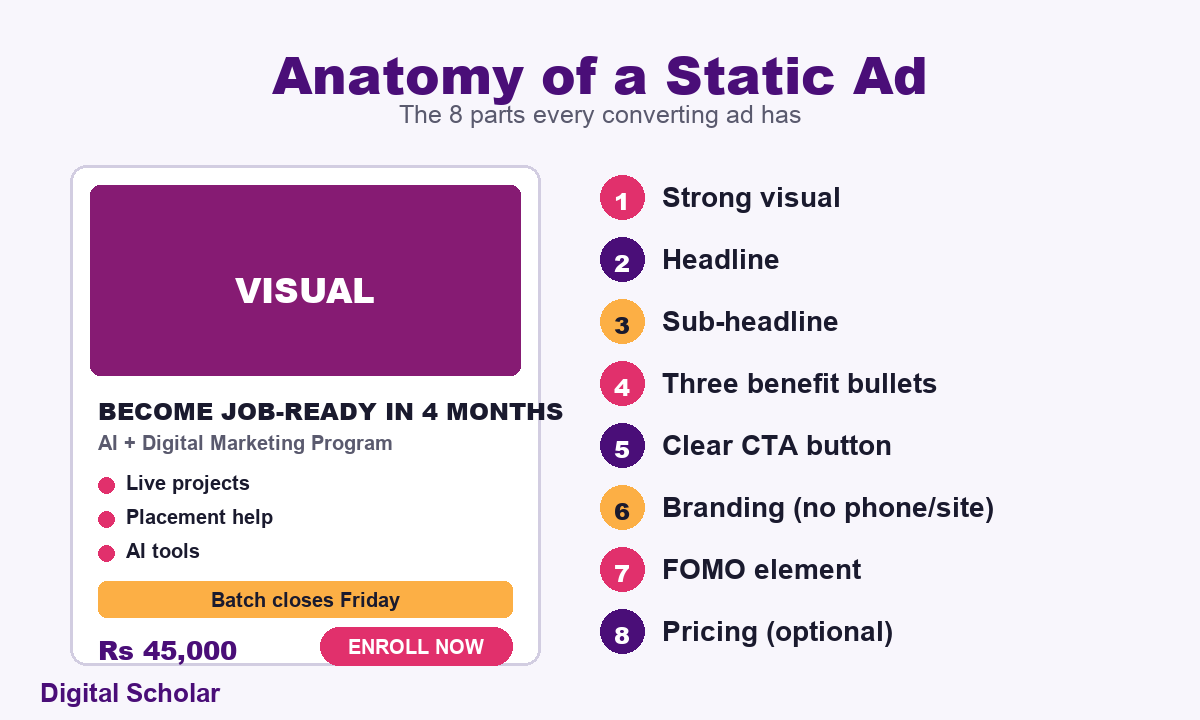
People underrate static image ads because video gets all the attention. That is a mistake. A great static ad is cheap to make, fast to test, and often outperforms video for direct response. Every static ad that converts has the same 8 building blocks. Miss one and the ad leaks.
| # | Element | Job it does |
|---|---|---|
| 1 | Strong visual | Stops the scroll. A real face or hero product, never generic stock |
| 2 | Headline | Makes the core promise. Read 10x more than anything else |
| 3 | Sub-headline | Names the product or the specific feature |
| 4 | Three benefit bullets | Scannable proof, 2 to 3 words each |
| 5 | CTA | One clear next step |
| 6 | Branding | Logo, colours, fonts. No phone number or website |
| 7 | FOMO element | A reason to act now, not later |
| 8 | Pricing | Shown or hidden on purpose, depending on the business |
Notice how little of this is about design polish. It is about clarity and hierarchy. A skeptical reader should understand your entire offer in about 3 seconds of scanning. If they cannot, the ad fails no matter how gorgeous it looks. You can even mock the whole thing up first using Meta’s free Facebook Ad Builder to see how it sits across placements before you spend a rupee.
The FBM Headline Formula
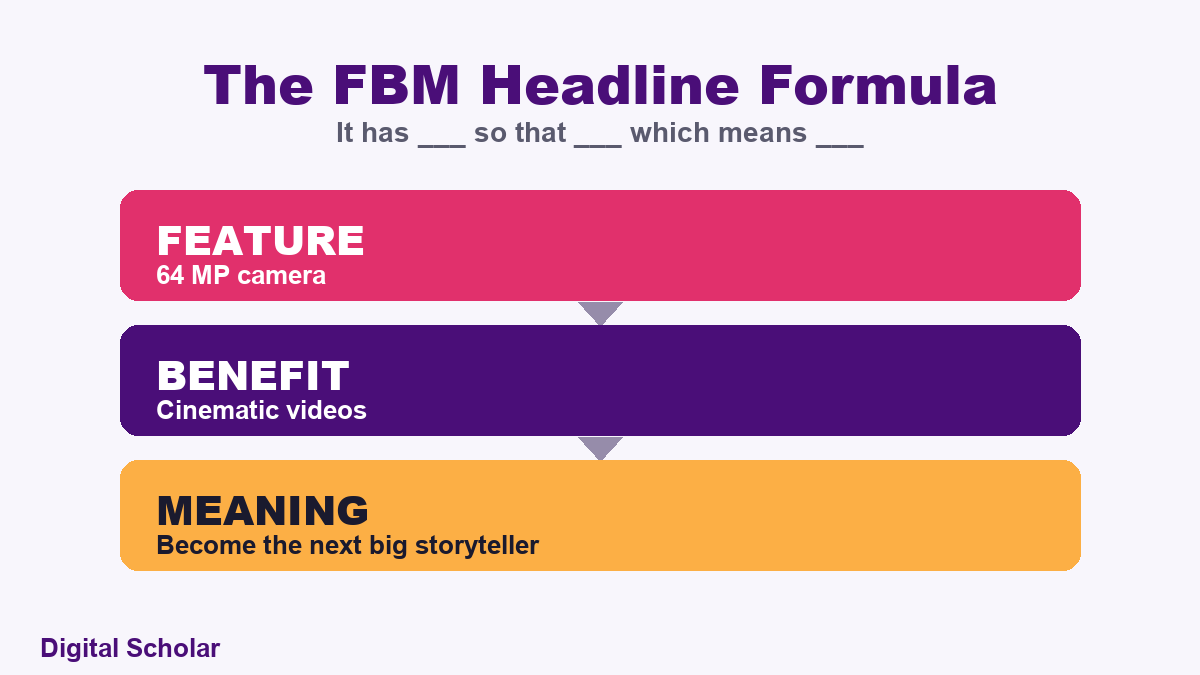
The headline is where most ads die. People write a feature and stop. “64 megapixel camera.” So what? A headline converts when it climbs a ladder from feature to benefit to meaning. I teach it as the FBM formula: Features, Benefits, Meaning. The structure is “It has ___ so that ___ which means ___.”
Watch it work on a phone. Feature: a 64 megapixel camera. Benefit: you shoot cinematic videos. Meaning: you become the next big storyteller. Now a protein powder. Feature: 23 grams of protein per scoop. Benefit: you build lean muscle. Meaning: you show up as the strongest version of yourself. The feature is the fact. The meaning is why anyone cares.
| Level | Phone example | Protein example |
|---|---|---|
| Feature | 64 MP camera | 23g protein per scoop |
| Benefit | Cinematic videos | Lean muscle |
| Meaning | Become the next big storyteller | The strongest version of you |
Keep the final headline to 7 to 11 words. Headlines get read about 10 times more than body copy, so this is the single highest-leverage sentence in your whole ad. Spend real time here. If you only improve one thing after reading this post, make it your headlines.
Creative Diversity: Persona x Angle x Offer
One perfect ad is a myth. You cannot guess the winner, so you stop guessing and start multiplying. The formula for volume is Persona times Angle times Offer. Pick a few personas, a few angles, and a few offers, and you generate dozens of distinct creatives from a single product.
- Persona: who you are talking to. For a course: the fresh graduate, the working professional, the business owner, the homemaker restarting a career.
- Angle: the emotional entry. Fear of being left behind, ambition to earn more, curiosity about AI, the desire for a certificate.
- Offer: the specific hook. A free masterclass, a limited batch, a scholarship, a career guarantee.
Four personas times four angles times two offers is 32 creative concepts, and that is before you change the visual. This is how the best D2C brands operate. A skincare brand like Minimalist, which storeleads-type tools estimate does enormous monthly revenue, does not run 3 ads. It runs hundreds, each a different Persona times Angle times Offer combination. Then the account tells them which ones to scale. If you want the discipline for testing all these variants cleanly, that is exactly what my Meta Ads creative testing framework covers, and you judge the winners using the numbers in my guide to the 12 Meta Ads metrics that matter.
The PQR Method for Knowing Your Buyer
You cannot write a persona you do not understand. The PQR method forces the understanding. For each persona, write down their Problems, their Questions, and their Roadblocks. Then your creative simply answers what you found.
- Problems: what keeps them stuck. “I have a degree but no job-ready skills.”
- Questions: what they Google at midnight. “Is digital marketing a good career in India?”
- Roadblocks: the objection that stops them buying. “I do not have time for a long course.”
Do this from real conversations, not your imagination. At Digital Scholar we pull these straight from the questions our admissions team hears every day. A ChatGPT prompt can give you a rough first draft of a persona’s PQR, and it is a genuinely useful starting point, but the real gold comes from actually talking to five customers. The words they use become your headlines.
When to Show Pricing on the Ad
Whether to put the price on the creative is one of the most common questions I get, and the answer is a strategic choice, not a rule. Price on the ad is a filter. It scares off people who cannot afford you and pre-qualifies the ones who click.
| Show the price when | Hide the price when |
|---|---|
| You want fewer, higher-intent leads | You want maximum lead volume |
| The price is a genuine filter (real estate, clinics) | The value needs a conversation first (education, health) |
| Your sales team is small and time is precious | You have a strong sales team to close on a call |
For a real estate project or a cosmetic clinic, we at echoVME often put pricing right on the ad, because a person who flinches at the number was never going to buy and we would rather not pay for that lead. For a Digital Scholar course, we usually hold the price back, because the value of a 4-month transformation lands far better in a conversation than on an image. Know which game you are playing before you design the ad.
FOMO the Right Way
People love to buy and hate to be sold. FOMO, the fear of missing out, works because it gives an honest reason to act now instead of later, which is where most intent goes to die. The trick is that it has to be real. Fake scarcity gets sniffed out and kills trust.
Real FOMO looks like a genuine batch limit, a price that actually rises next cohort, a bonus that truly expires, or a seasonal window. I have used the line “price increasing by Rs 25,000 in the next batch” since 2019, and it works because at Digital Scholar it is true, our fees do step up over time. A midnight offer aimed at late-night scrollers is another honest version, since that is genuinely when a certain audience is most impulsive. Digital marketers are not liars. We are storytellers who make a true reason feel urgent.
The Creative Research Stack
You should never stare at a blank canvas. Every great creative starts from research, and there is a public library of winning ads you can study legally. Here is the exact stack I use before writing a single line.
- Meta Ad Library and Foreplay.co: see every ad your competitors are running right now, and save the best into swipe folders.
- facebook.com/business/success: Meta’s own case studies. Revisit every couple of weeks to see what formats it is pushing.
- storeleads.app: estimate a D2C brand’s revenue so you learn from the ones actually making money.
- builtwith.com: see the marketing tech stack a competitor runs.
- Reddit, LinkedIn, Google, and Microsoft ad libraries: for angles beyond Meta.
- Amazon reviews plus swiped.co: mine 5-star and 1-star reviews for the exact language customers use, then feed it to ChatGPT to draft copy.
The workflow is simple. Gather 10 to 20 winning ads in your category, identify the patterns, then build your own version using the anatomy and headline formula above. You are not copying. You are studying what already works and applying it to your offer. For the full toolkit we run at echoVME, see my roundup of the best performance marketing tools and platforms.
How AI Changed Creative Production
The old bottleneck was production. A freelance designer charged 400 to 800 rupees per creative, so 10 creatives cost around 7,000 rupees and a week of waiting. That is why most brands ran 3 ads and hoped. AI erased that constraint. Generating an image now costs a few rupees, so 100 creatives can cost under a thousand rupees and a single afternoon.
This changes the strategy, not just the cost. When creatives are nearly free, the Persona times Angle times Offer matrix becomes fully practical. You can actually build all 32 concepts, run them, and let the data decide, instead of betting everything on 3 guesses. I now generate ad creatives in bulk with AI and manage the campaigns from my terminal, which I documented in using Claude Code for Meta ads. For the wider set of tools, see my guide to AI tools for performance marketing.
The key insight: AI did not replace the marketer. It removed the excuse. When creatives are cheap and fast, the only thing between you and a winning ad is knowing the structure on this page.
Want to build converting creatives on real accounts?
Our 4-month AI and Digital Marketing program at Digital Scholar trains you to write, design, and test Meta ad creatives the way we do at echoVME, using AI to produce them in bulk. You leave able to build a winning ad for any brand.
Frequently Asked Questions
What makes a Meta ad creative convert?
A converting creative stops the scroll with a strong visual, makes one clear promise in the headline, and gives one honest reason to act now. In Meta’s signal economy, the creative also does your targeting, because the right message attracts the right buyer. Follow the 8-part static ad anatomy, write the headline with the Features, Benefits, Meaning formula, and keep the whole offer understandable in about 3 seconds of scanning. Clarity beats design polish every time.
Are static image ads still effective, or should I only use video?
Static ads are still highly effective and often outperform video for direct response. They are cheaper to make, faster to test, and easier to iterate. At echoVME we run both, but we lean on static for quick testing because we can generate and launch many variations in an afternoon. Video wins for storytelling and top-of-funnel attention, while a clean static ad with a sharp headline and a clear offer is hard to beat for leads and sales.
Should I put the price on my Facebook or Instagram ad?
It depends on your goal. Showing the price filters your audience, so you get fewer but higher-intent leads, which suits real estate and clinics. Hiding the price maximises volume and suits offers where the value needs a conversation first, like education or health. At Digital Scholar we usually hold the price back because a 4-month transformation lands better on a call. Decide whether you want volume or pre-qualified intent, then design accordingly.
How many ad creatives should I make?
More than you think, and thanks to AI that is now practical. Use the Persona times Angle times Offer formula to generate dozens of concepts from one product, then let the account tell you which to scale. The best D2C brands run hundreds of creatives, not three. Since AI dropped the cost of an image to a few rupees, you can build 30 to 100 variations affordably and stop guessing which single ad will win. Volume plus honest testing beats one perfect guess.
Why should I not put a phone number or website on the ad image?
Because it pulls people off Meta and starves your pixel of signal. When someone types your number or URL manually instead of clicking, Meta cannot track that action, so it learns nothing about who converts and cannot optimise or retarget them. Keep the call to action inside the ad button and the destination trackable. Your branding, logo, and colours belong on the image, but the contact details do not. Let the platform do its job of tracking and following up.
Where can I find winning ad ideas to model?
Start with the Meta Ad Library and Foreplay.co to see live competitor ads, then study Meta’s own case studies at facebook.com/business/success. Use storeleads.app to find D2C brands that actually make money and model the ones that do. Mine Amazon reviews and swiped.co for the exact language customers use, then draft copy with ChatGPT. You are not copying, you are studying proven patterns and applying them to your own offer with the structure in this guide.
Here is where it all lands. The platforms will keep changing, the targeting will keep getting more automated, but the job of a creative stays the same: say one true thing, to one person, in a way that stops them and moves them. Master that and you are never at the mercy of an algorithm.
Do one thing today: take your current best-selling product, run it through Persona times Angle times Offer, and write 10 headlines with the Features, Benefits, Meaning formula. You will have more real creative direction in an hour than most brands produce in a month. If you want the roadmap for the whole skill, my guide on how to learn performance marketing shows where creative fits.
The algorithm is not your problem. Your creative is. Go fix it.