
At echoVME Digital we run marketing for more than 500 brands, and I have watched ChatGPT go from a toy people showed off in WhatsApp groups to a tool that quietly sits inside almost every workflow my team touches. Here is the uncomfortable truth most guides will not tell you: ChatGPT does not make bad marketers good. It makes fast marketers faster and lazy marketers dangerous.
Most articles on ChatGPT for digital marketing hand you 50 prompts and a promise. Then you paste one in, get a wall of generic text, and quietly go back to doing it by hand. The problem is never the tool. The problem is that nobody taught you how to instruct it like you would instruct a sharp intern on their first day.
So this is the real playbook. You will get a named prompting framework we teach at Digital Scholar, a channel-by-channel map of where ChatGPT actually earns its keep and where it will burn you, a copy-paste prompt library that I use myself, and an honest list of the things I tested and threw away. Let us get into it.
In this guide on how to use ChatGPT for digital marketing you will learn the CRAFT prompt framework, a 6-channel map of where ChatGPT helps versus hurts, ready-to-use prompts for SEO, content, social, email, and reporting, and how we teach the whole system at Digital Scholar. Every recommendation comes from real use across echoVME client accounts, not theory.
- Why listen to me on this
- What ChatGPT actually is for a marketer
- The CRAFT prompt framework
- Where ChatGPT helps and where it hurts: the 6-channel map
- ChatGPT for SEO and content
- ChatGPT for social media and ad copy
- ChatGPT for email and funnels
- ChatGPT for research, analytics, and reporting
- My ChatGPT prompt library for marketers
- What I have tested and rejected
- ChatGPT vs Claude vs Gemini for marketing
- How we teach this at Digital Scholar
- FAQ
Why listen to me on this
I am not writing this as someone who read the ChatGPT release notes. I run echoVME Digital, an agency that has managed cumulative ad spend north of Rs 400 crore across more than 500 brands. I also co-founded Digital Scholar, where over 1,000 students a year go through our 4-month AI and digital marketing program. ChatGPT is not a novelty in either place. It is a line item in how the work gets done.
My team has run ChatGPT against real deliverables: SEO briefs, ad angles, email flows, client reports, meta descriptions at scale. Some of it saved genuine hours. Some of it produced output so bland we had to rewrite every line, which is slower than starting fresh. Knowing the difference is the whole game, and that difference is what I am handing you here.
One honest admission before we start. We still employ human writers, human strategists, and a human social media manager at echoVME. ChatGPT did not replace a single one of them. It changed what they spend their hours on. If you came here hoping to fire your team and let a chatbot run your marketing, this is the wrong article, and that is the wrong plan.
What ChatGPT actually is for a marketer
ChatGPT is a fast, tireless drafting and thinking partner that is confident even when it is wrong. For a digital marketer, that means it is excellent at first drafts, variations, structure, and summarizing, and unreliable at facts, fresh data, and taste. Treat it as a brilliant intern who never sleeps but has never met your customer.
The mistake I see students make in their first week at Digital Scholar is treating ChatGPT like Google. They type a four-word question, get a four-paragraph answer, and assume it is done. Google retrieves what exists. ChatGPT generates what is plausible. Those are different jobs, and confusing them is how you end up with confident nonsense in a client deck.
The second mistake is trusting numbers. ChatGPT will happily tell you the average cost per lead in your industry is a precise figure, and it may be completely invented. At echoVME we never let a ChatGPT statistic enter a report without a real source behind it. If you want the wider view on which AI tools to actually trust for which job, I broke down our full stack in the best AI tools for digital marketing guide.
The key insight: ChatGPT is a generation engine, not a retrieval engine. Use it to produce and shape ideas fast, then verify every fact and every number against a real source before it goes anywhere near a client.
The CRAFT prompt framework
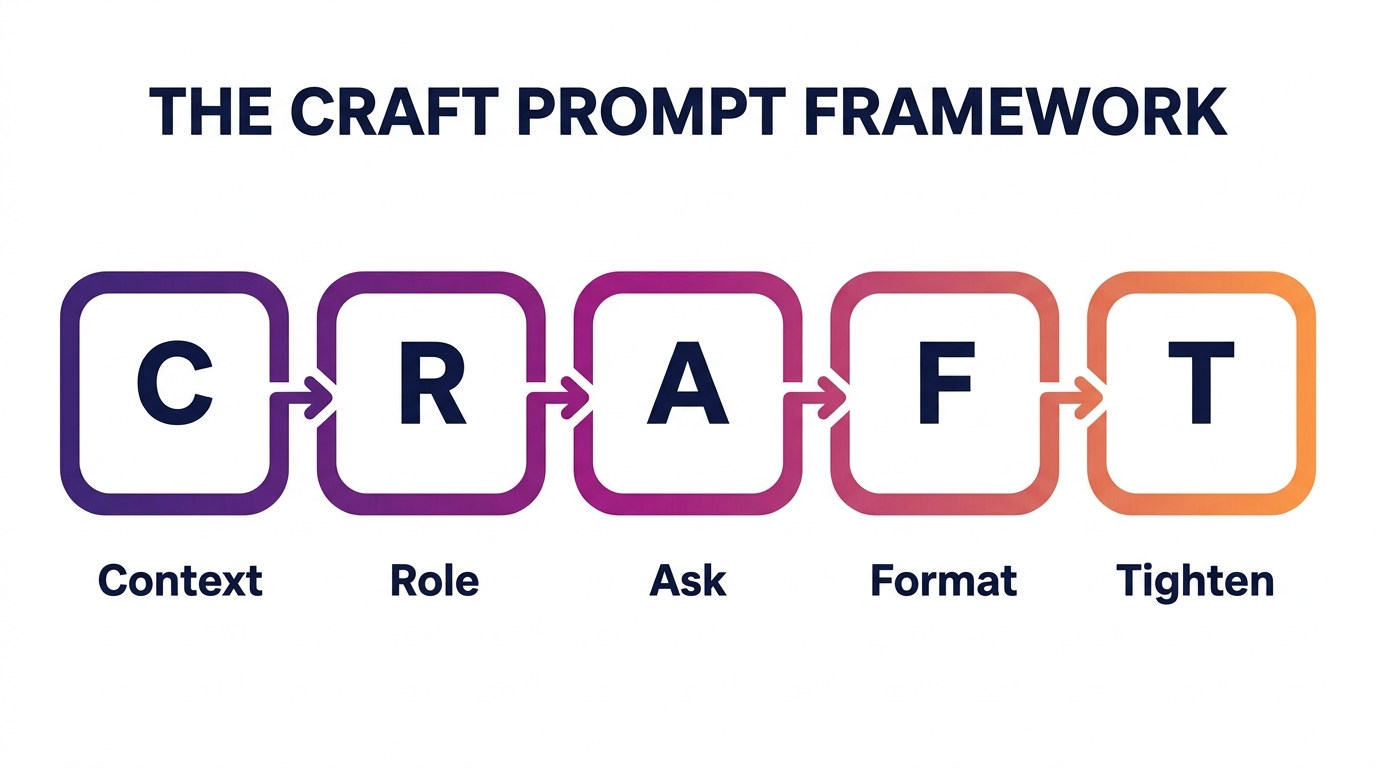
The difference between a useless ChatGPT output and a usable one is almost never the model. It is the instruction. So we teach every Digital Scholar student a single framework that turns a vague request into a sharp brief. We call it CRAFT: Context, Role, Ask, Format, Tighten. Follow all five and your output quality jumps immediately.
| Letter | What it means | What to write |
|---|---|---|
| C – Context | Who the brand is and who the audience is | Brand, product, audience, goal, and any constraints (“D2C skincare brand, target women 25-40 in metros, goal is first purchase”) |
| R – Role | The expert lens you want it to think from | “Act as a senior performance marketer who has spent Rs 50 lakh on Meta ads” |
| A – Ask | The one specific job | “Write 10 primary text variations for a cold audience” (not “help with my ads”) |
| F – Format | Exactly how you want it back | “Return as a table with columns: hook angle, primary text, character count” |
| T – Tighten | The follow-up that makes it good | “Cut the adjectives, make it sound like a founder wrote it, keep each under 125 characters” |
The last letter is the one everybody skips, and it is the one that matters most. Your first output is a rough draft, not a deliverable. The magic is in the second and third message where you tell ChatGPT what is wrong and it fixes it in seconds. At echoVME, our best prompters are not the ones who write the perfect opening prompt. They are the ones who iterate three times in ninety seconds.
The key insight: A weak first prompt plus three sharp corrections beats a “perfect” one-shot prompt every time. Prompting is a conversation, not a vending machine.
Where ChatGPT helps and where it hurts: the 6-channel map
ChatGPT is not equally good across every marketing channel. In some it saves half a day. In others it quietly damages your results if you trust it too far. Here is the map we use internally at echoVME to decide where the tool leads and where a human has to stay in front.
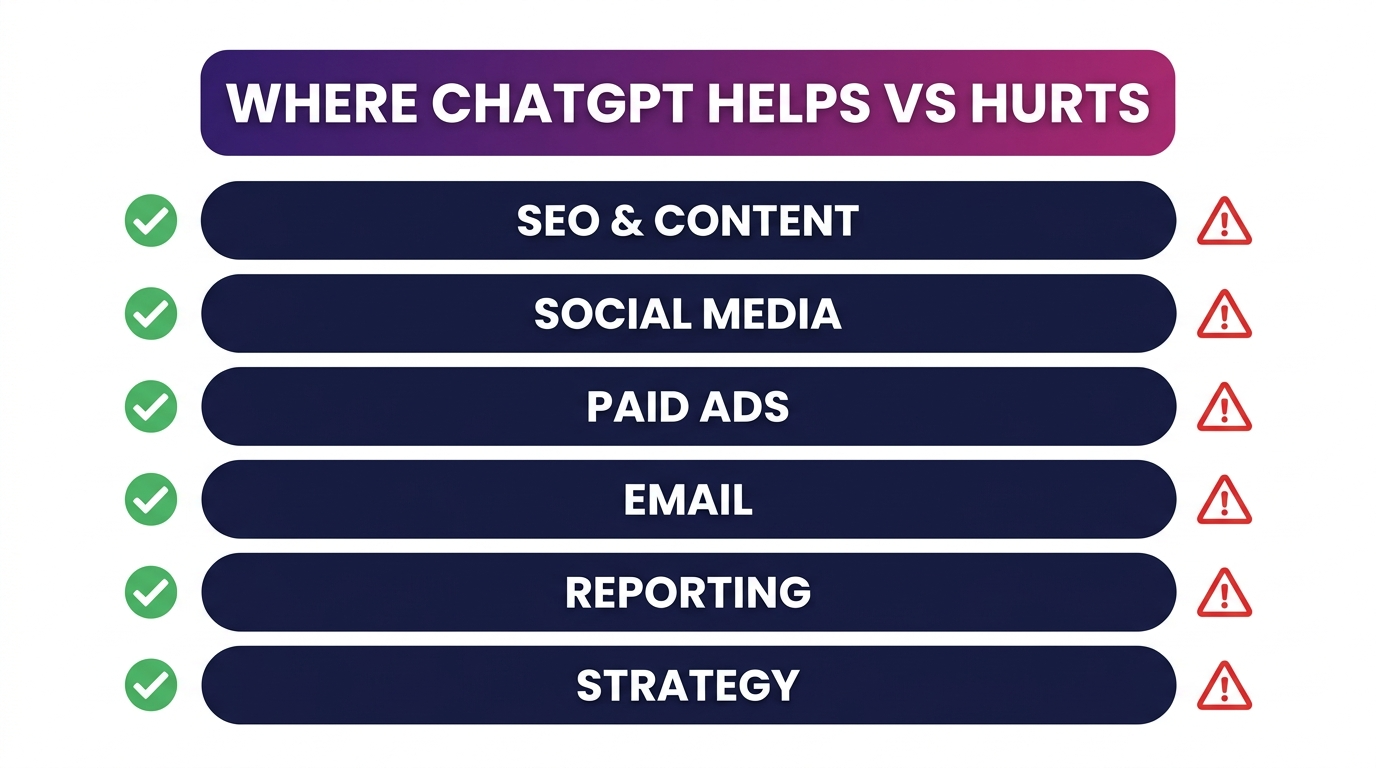
| Channel | Where it helps | Where it hurts |
|---|---|---|
| SEO and content | Briefs, outlines, meta titles and descriptions at scale, FAQ drafting, rewriting for clarity | Full articles published unedited. They read fine and rank for a few months, then fade because they add nothing new. |
| Social media | Caption variations, hook angles, content calendars, turning one idea into ten formats | Voice. It flattens a brand into the same friendly-marketer tone every competitor also uses. |
| Paid ads | Primary text variations, angle brainstorming, structured testing matrices | Deciding what to test. Creative direction and offer logic still need a human who knows the account. |
| Subject line batches, sequence structure, segmentation copy, plain-text rewrites | Numbers and offers. It will invent discounts and deadlines if you let it. | |
| Analytics and reporting | Summarizing pasted data, drafting the narrative, explaining a metric in plain English | Doing the math on live account data it cannot see. Verify every figure it produces. |
| Strategy | Stress-testing your thinking, playing devil’s advocate, listing risks you missed | Making the actual call. Strategy is judgment, and judgment is not in the training data. |
Notice the pattern. ChatGPT wins on volume, structure, and speed. It loses on judgment, freshness, and taste. Every channel row follows that same line. Once you internalize it, you stop asking ChatGPT to do jobs it will always fail at, and you stop doing by hand the jobs it does in seconds.
ChatGPT for SEO and content
ChatGPT is a strong SEO co-pilot for everything except writing the final article. Use it for keyword clustering, content briefs, meta titles and descriptions, FAQ blocks, and turning a messy draft into clean structure. Do not use it to generate a full post you publish without editing, because that is how sites end up with content that ranks briefly and then sinks.
Here is what actually works at Digital Scholar. We give ChatGPT a keyword and ask it to group related terms into topic clusters, then draft a brief with the sections a page needs to rank. A writer takes that brief and adds the one thing ChatGPT never has: original opinion, real data, and a point of view. That combination is what search engines and AI answer engines reward now.
Meta descriptions are the single fastest SEO win. Ask ChatGPT to write 155-character meta descriptions for a batch of URLs and you save an afternoon. We did exactly this across a client blog with roughly 80 thin descriptions and cleared the backlog in under an hour. That is the honest use case: boring, repetitive, high-volume work where taste barely matters.
One warning. If you want your content to survive, it has to teach something the internet does not already have. I explain the deeper version of this in our breakdown of the performance marketing tool stack, where the same rule applies: the tool speeds up the work, it does not replace the thinking.
ChatGPT for social media and ad copy
For social and paid ads, ChatGPT is best at volume and worst at voice. It will produce 20 caption variations or 15 ad hooks in seconds, which is genuinely useful when you need options to test. But left alone it writes in the same polished, friendly tone every brand in your category is already using, so the output blends in instead of standing out.
The fix is to feed it your voice. Paste three of your best-performing captions and tell it to match the rhythm, the slang, and the length. At echoVME we keep a short voice sample for each brand and drop it into the prompt every time. The difference between “write me captions” and “write captions in this exact voice, here are three examples” is the difference between throwaway output and something you would actually post.
For paid ads, ChatGPT shines at generating primary text and hook angles to feed a proper testing system. It does not decide what is worth testing. That structure comes from a real framework, and I laid out ours in the Meta Ads creative testing framework. Pair ChatGPT for the copy variations with that framework for the testing logic and you get speed without losing rigour. If you want the fully automated version, we even connect a model straight to the ad account in Claude Code for Meta ads.
On the creative side specifically, generic AI output is a real risk. We built an anti-generic system for exactly this problem, and I documented it in AI creative for Meta ads. The short version: a spec beats a wish. Vague prompts give vague creatives.
ChatGPT for email and funnels
Email is one of ChatGPT’s strongest home grounds because email is structured, repetitive, and forgiving of iteration. Ask for 15 subject lines, a five-email welcome sequence, or a plain-text rewrite of a stiff corporate draft, and it delivers usable material fast. Subject line batches alone are worth the subscription for most senders.
Where it hurts is the numbers and the offers. ChatGPT does not know your real discount, your real deadline, or your real product name unless you tell it, and it will invent all three to fill the gap. So we give it the offer explicitly and then ask it to write around a fixed structure. Never let it decide the deal. That is a business decision, not a copywriting one.
For funnel work, ChatGPT is a good thinking partner. Describe your funnel and ask it to map the message at each stage from cold to converted, then to spot the leaks. It will not build the funnel, but it will pressure-test your logic. Combine that with the customer-journey thinking we cover across our performance marketing versus digital marketing breakdown and you have a fast way to draft a full sequence before a single line is finalized.
ChatGPT for research, analytics, and reporting
ChatGPT cannot see your ad account or your analytics, so it cannot pull live numbers. What it can do is take numbers you paste in and turn them into a clear narrative in seconds. That is the honest split: you bring the data, it brings the sentences. Paste your weekly performance figures and ask for a plain-English summary a client can read, and you have your report intro drafted.
At echoVME, monthly reporting used to eat a chunk of every account manager’s week. Now the workflow is: export the numbers, paste them in, ask ChatGPT for the narrative, then edit for accuracy and add the recommendations only a human can make. The time saved is real, but the recommendations are still ours. A model cannot tell you to pause a campaign it has never seen.
For competitive and topic research, treat ChatGPT as a starting point and verify everything. It is a great way to generate a list of angles, questions, or objections to explore, but the moment it states a specific market statistic, you go and confirm it. If you want the fully hands-off version of recurring workflows, I automated a stack of these in Claude routines for marketing workflows, and the same discipline of verifying every output applies there too.
Data note: ChatGPT does not have live access to your accounts, current pricing, or this quarter’s benchmarks unless you connect a tool or paste the data in. Any statistic it produces unprompted should be treated as a guess until you verify it against a real source.
My ChatGPT prompt library for marketers
These are prompts we actually use, written in the CRAFT structure. Copy them, then swap in your own context. The point is not the exact words. It is the shape: give context, set a role, make one clear ask, define the format, then tighten.
1. Content brief for an SEO article
You are a senior SEO strategist. My brand is [brand], we help [audience] do [outcome]. I want to rank for the keyword “[keyword]”. Write a content brief with: the search intent behind this keyword, 8 to 10 H2 sections in the order they should appear, 3 questions to answer in an FAQ, and one angle that would make this article different from the top results. Return it as a structured list.
2. Ten ad hooks for a cold audience
Act as a direct-response performance marketer. Product: [product], price [price], for [audience]. The main pain point is [pain]. Write 10 primary text hooks for a cold Meta ads audience. Return a table with columns: angle, hook (under 125 characters), and why it works. No emojis, no hype words.
3. Repurpose one idea into a week of content
Here is one core idea: [paste idea]. Act as a social media strategist. Turn it into a 7-day content plan: one carousel outline, two reel hooks, one text post, one poll, and two story prompts. Keep the voice matching these examples: [paste 2 captions]. Return as a day-by-day table.
4. Turn campaign data into a client report
Here is this month’s performance data: [paste numbers]. Act as an account manager writing to a non-technical client. Write a 150-word summary explaining what happened, what it means, and what we are doing next. Plain English, no jargon, confident but honest about what underperformed.
Run any of these, read the first output, then tighten. Tell it what is off, and watch the second version land. That loop is the entire skill. We drill this exact library with students in the Digital Scholar course modules so they leave with prompts that work on day one, not a vague sense that AI is useful.
What I have tested and rejected
Not everything ChatGPT can do is worth doing. Here are the plays we tried at echoVME and stopped, so you do not waste the same weeks we did.
Fully automated blog publishing. We ran an experiment where ChatGPT wrote and we published with light edits. The posts ranked for roughly two to three months, then slid because they said nothing original. We killed it. Now every post carries a real opinion and real data, and those are the ones that hold.
ChatGPT as a keyword volume source. It will give you confident search-volume numbers that are simply made up. We tried leaning on it to skip proper tools and it burned us in a client conversation once. Never again. Use it to cluster and ideate, use a real SEO tool for volume.
One master mega-prompt. The internet loves a 400-word prompt that supposedly does everything. In practice, short prompts plus iteration beat one giant prompt almost every time. The mega-prompt looks impressive and produces mush. Are the shorter iterative outputs perfect? No, they are about 80% of the way there on the first pass, which is exactly why the tighten step exists.
ChatGPT vs Claude vs Gemini for marketing
ChatGPT is the best all-round default for a marketer, but it is not the only tool worth a tab. At echoVME we use all three for different jobs. Here is the honest split based on how they actually perform on our work, not on benchmark charts.
| Tool | Best at for marketers | Where it lags |
|---|---|---|
| ChatGPT | All-round default: ad copy, email, brainstorming, quick drafts, structured output | Long, careful documents and following a complex multi-part brief without drifting |
| Claude | Long-form writing, editing, nuanced tone, following detailed instructions, workflow automation | Fewer built-in extras out of the box for casual users |
| Gemini | Research inside the Google ecosystem and pulling from Google data | Copy voice can feel flatter for direct-response work |
My practical rule: start on ChatGPT because it is fast and flexible, move to Claude when the task is a long document or a repeatable workflow, and reach for Gemini when the job lives inside Google. You do not need to pick one forever. You need to know which one to open for the task in front of you, and that is a skill we build across the whole how to learn performance marketing path.
How we teach this at Digital Scholar
We rebuilt the Digital Scholar 4-month program in 2026 around exactly this: AI is not a separate module you learn on the last day, it is woven into how you do every part of the work. Students prompt for briefs in the SEO week, generate ad angles in the Meta ads week, and draft reports in the analytics week. By the end, ChatGPT is muscle memory, not a party trick.
Most online marketing courses were written before ChatGPT changed the job and still teach 2019 playbooks. Ours was rebuilt to include AI agents, prompt frameworks, and real tool workflows because that is what the industry actually pays for now. If you are trying to decide between programs, I wrote a neutral filter for that in how to choose a digital marketing course, and a full roadmap for breaking in at how to become a performance marketer in India.
You can also see the mindset in action across our own work. The AI Instagram audit and the Meta ads versus Google ads breakdown for Indian D2C both use AI to move faster while a human keeps the judgment. That is the whole philosophy in two words: faster, not lazier.
Want to learn this end-to-end?
Digital Scholar’s 4-month AI and digital marketing program teaches ChatGPT, prompt frameworks, and live agency workflows the way we run them at echoVME, with over 1,000 students trained a year.
FAQ
Can ChatGPT replace a digital marketer?
No. ChatGPT replaces tasks, not marketers. At echoVME it took over drafting, variations, and summarizing, which freed our team for strategy, judgment, and client relationships. A marketer who uses ChatGPT well will replace a marketer who refuses to, but the tool alone runs nothing. Someone still has to know what to ask, what to keep, and what to throw away.
Is ChatGPT good for SEO, and will AI content rank?
ChatGPT is excellent for SEO briefs, meta descriptions, clustering, and FAQ drafting. Full AI-written articles published without editing tend to rank for a couple of months then fade, because they add nothing original. The content that holds combines ChatGPT’s speed with a human’s opinion and real data. Use the tool for structure, bring the substance yourself.
Which ChatGPT plan should a marketer buy?
For most solo marketers and small teams, the paid tier pays for itself in the first week through faster copy and reporting. The free tier is fine to learn on. If you are running client work at volume, the paid plan is a rounding error against the hours it saves. Start free, upgrade the moment you find yourself using it daily.
How do I write a good ChatGPT prompt for marketing?
Use the CRAFT framework: give Context about the brand and audience, set a Role for the model to think from, make one clear Ask, define the Format you want back, then Tighten with follow-ups. The tighten step is where most people quit and where the quality actually lives. A weak first prompt plus three corrections beats a perfect one-shot every time.
Is it safe to put client data into ChatGPT?
Be careful. Do not paste sensitive personal data, passwords, or confidential client information into any public AI tool without permission. At echoVME we strip identifying details before pasting numbers for analysis and we follow each client’s data policy. Check the tool’s data settings, turn off training on your data where possible, and when in doubt, anonymize first.
ChatGPT vs Claude vs Gemini for marketing, which is best?
ChatGPT is the best all-round default for ad copy, email, and quick drafts. Claude is stronger for long documents, careful editing, and repeatable workflows. Gemini is handy for research inside the Google ecosystem. You do not have to choose one forever. Learn which tool to open for which task, and switch freely.
Can ChatGPT do keyword research?
ChatGPT can cluster keywords, suggest related terms, and map search intent, which is genuinely useful for planning. It cannot give reliable search-volume numbers, and it will invent them if asked. Use it to organize and ideate, then confirm volume and difficulty in a real SEO tool before you commit a content plan to it.
Zoom out and the picture is simple. ChatGPT does not decide whether you win at digital marketing. It decides how fast you move once you already know what good looks like. The marketers pulling ahead are not the ones with secret prompts. They are the ones who learned the craft first and then bolted speed on top.
So here is the one thing to do today. Take the CRAFT framework, pick a single repetitive task you do every week, and run it through ChatGPT with three rounds of tightening. Time it against doing it by hand. That one test will teach you more than any list of 100 prompts ever could.
Learn the work. Add the tool. Go build it.