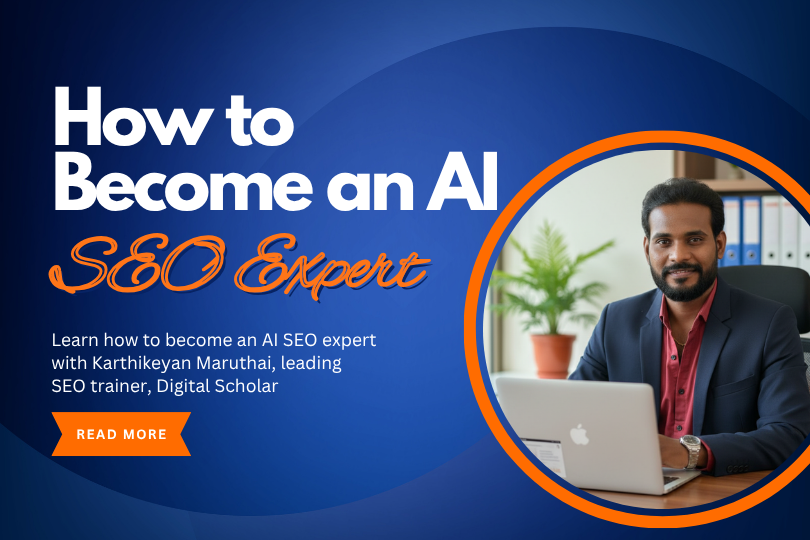

By Karthikeyan Maruthai | Head of SEO at echoVME Digital | SEO Trainer at Digital Scholar | Last updated: July 2026
How to Become an AI SEO Expert in 2026: The Complete Roadmap
- Why Traditional SEO Is Not Enough in the Age of AI Search
- What Does an AI SEO Expert Actually Do?
- The RACE Framework: My 4-Pillar System for AI SEO
- AI Tools for Keyword Research and Content Strategy
- How to Use AI for On-Page Optimization and Entity SEO
- AI for Technical SEO: Audits, Schema, and Core Web Vitals
- AEO, AIO, and GEO: The Three New Rankings You Must Target
- Your 6-Month Roadmap to Becoming an AI SEO Expert
- What I Tested in AI SEO That Did Not Work (Honest)
- FAQ: How to Become an AI SEO Expert
Three months ago, a Digital Scholar student named Arjun sent me a screenshot. He had published an AI-assisted SEO article using a framework I teach in class. Within 4 days, the post was showing in Google’s AI Overview for the target keyword. Not on page 1. Inside the AI-generated answer at the very top of the page. He had zero backlinks to that post. The only reason it appeared in the AI Overview was the structural approach to the content, specifically the way he used AI to build entity-dense, question-answering paragraphs. That is exactly what AI SEO is, and that is what I have been teaching at Digital Scholar for the past 2 years.
I have been in SEO for 15 years. In that time, I have driven over 20 million organic sessions for the echoVME client portfolio, ranked more than 10,000 keywords across Indian markets, and trained over 3,000 SEO professionals through Digital Scholar live classes and bootcamps. I have watched the search landscape shift before: from Penguin to Panda, from mobile-first indexing to Core Web Vitals. But nothing compares to what AI is doing to search right now. The playbook has fundamentally changed, and if you are still operating like it is 2021, you are leaving rankings on the table.
This post is the most complete guide I have written on how to become an AI SEO expert in 2026. I will share my RACE Framework (the exact 4-pillar system I use at echoVME and teach at Digital Scholar), a 6-month roadmap with specific milestones, every AI tool worth using in 2026, and an honest section on what I tried in AI SEO that completely failed. By the end of this post, you will have a clear, actionable path forward.
Why Traditional SEO Is Not Enough in the Age of AI Search
Traditional SEO is not dead. Let me be direct about that upfront. Backlinks still matter. Technical crawlability still matters. Domain authority still matters. But traditional SEO is now incomplete. It covers approximately 55 to 60% of the total search visibility picture in 2026. The remaining 40 to 45% sits inside AI-generated answers, featured snippets, and LLM citation panels. Most SEOs are not optimizing for that layer at all.
The Shift from 10 Blue Links to AI-Generated Answers
In 2024, Google processed over 8.5 billion searches per day globally. By mid-2026, AI-generated results appear above the fold for approximately 42% of all informational queries in India, based on third-party SERP tracking data from tools like SE Ranking and BrightEdge. That means for nearly half of all “how to”, “what is”, and “best way to” searches, a user receives an answer without clicking a single organic result. The brands appearing inside those AI-generated answers receive impressions, trust signals, and indirect traffic that does not show up in standard rank trackers. If you are only measuring blue-link positions, you are blind to nearly half your actual search presence.
What This Shift Means for Your Keyword and Content Strategy
When I ran keyword research for Casagrand (one of echoVME‘s major real estate clients) two years ago, the approach was: target high-volume keywords, build authoritative content, earn backlinks. Casagrand ranked for “luxury apartments in Chennai” in the Google local pack within 8 weeks using technical SEO plus schema markup. That still works. But today, if I do not also optimize those same pages to appear inside Google AI Overview and in Perplexity’s property guides, I am missing a significant layer of search visibility. AI SEO does not replace traditional foundations. It layers on top of them with a new set of structural and entity requirements. The pages showing up in AI Overview for competitive keywords are not always the ones with the most backlinks. They are the ones with the most complete, most structured, most question-answering content. That is an architecture problem, and AI is the tool that lets you solve it at scale.
What Does an AI SEO Expert Actually Do?
An AI SEO expert is not someone who uses ChatGPT to write blog posts and calls it a day. That is AI content writing, which is just one component of one of the 4 pillars in the RACE system. An AI SEO expert uses artificial intelligence to make every part of the SEO process faster, more precise, and more strategically effective. The role spans research, content architecture, content creation, and technical engineering. It requires both the strategic thinking of a senior SEO and the practical confidence to work with AI tools, structured data, and entity optimization at scale.
Core Responsibilities of an AI SEO Expert in 2026
- Building keyword clusters of 500 to 1,000 keywords using Semrush plus AI in under 2 hours
- Constructing entity maps and topic cluster architectures with AI-generated knowledge graphs
- Writing AEO-structured content where every H2 functions as a standalone, 40 to 60 word direct answer
- Generating, validating, and deploying FAQ schema, Article schema, and HowTo schema with AI assistance
- Running technical SEO audits with AI-prioritized issue lists sorted by expected traffic impact
- Optimizing content to appear in Google AI Overview, Claude citations, and Perplexity answer panels
- Tracking AI Overview impressions and brand citation frequency alongside traditional keyword ranking data
- Performing entity enrichment on existing pages to improve NLP relevance scores without adding new content
How the AI SEO Role Differs from Traditional SEO
At Digital Scholar, the first thing I tell every new cohort is this: traditional SEO is about authority. AI SEO is about authority plus structural clarity plus entity completeness. Google’s AI systems and tools like Claude and Perplexity do not only look at who has the most backlinks. They look at which page answers the question most completely, most structurally, and most unambiguously. That means your content must be written simultaneously for a human reader and a machine synthesizer. The machine needs clean structure, entity coverage, and schema. The human needs voice, specificity, and original proof. Both at once. That dual discipline is the new core skill, and it is what separates AI SEO experts from traditional SEOs in 2026.
The RACE Framework: My 4-Pillar System for AI SEO
After 15 years in the field and 2 years specifically building and testing AI-assisted SEO workflows across the echoVME client portfolio, I developed a framework I call RACE. I now teach it in every Digital Scholar SEO cohort. It is the organizing system behind every AI SEO engagement I run, from D2C startup campaigns to enterprise accounts like The Hindu and Naturals.
R: Research (AI-Assisted Keyword and Competitor Intelligence)
The Research phase uses AI to accomplish what used to take a full week of analyst time in under 3 hours. Using Semrush’s India database alongside Claude, I build a complete keyword universe for a topic cluster: primary keywords, long-tail variations, People Also Ask questions (each one mapped to an individual H3 in the content outline), competitor content gap analysis, and entity extraction from the top 5 ranking pages. For keyword research in India, the local context is critical. Indian search intent differs from global intent on the same keyword. “SEO course fees” in an Indian context requires different content than the same query in a US context. AI helps surface those regional intent signals that generic global tools miss.
A: Architecture (Topic Clusters, Entity Maps, Internal Linking)
Architecture is where most SEOs fall short. They write technically good individual posts and connect them poorly or not at all. In the RACE framework, AI helps you build an entity graph: a structured map of how topics, subtopics, entities, and concepts relate to each other across your content cluster. From that graph, you define the pillar post, the supporting cluster posts, and the exact internal linking structure. A Digital Scholar student in the 2025 cohort applied this architecture approach to a health and wellness website. Starting from 1,200 monthly organic visitors, the site reached 11,800 visitors per month in 4 months, by restructuring 22 existing posts using AI-generated entity maps and rebuilding the internal link structure. No new backlinks. No new pages. Architecture alone.
C: Content (AI-Assisted Writing with a Mandatory Human-Edit Layer)
The Content phase is where most people start, and where I see the most serious mistakes. Using AI to generate raw content and publishing it without human review is not AI SEO. It is lazy publishing, and Google’s Helpful Content system is exceptionally good at identifying it (I have specific data on this in the section on what did not work). The RACE approach uses AI to produce the first draft structured with AEO-friendly H2 sections (each one a complete question-and-answer pair), entity-dense paragraphs, and a full FAQ block. Then a human editor rewrites every paragraph for tone, original perspective, real data, and lived experience. Arjun’s post that ranked in Google AI Overview in 4 days followed this exact process: AI structure, human voice. The combination is what worked. Neither alone would have achieved that result.
E: Engineering (Technical SEO, Schema Markup, Core Web Vitals)
Engineering is the technical foundation that makes the rest of RACE work. AI tools now help you generate valid schema markup in seconds, identify Core Web Vitals issues from a crawl log, and prioritize technical fixes by expected traffic impact. For a complete grounding in technical SEO principles before applying the AI layer, read my guide on technical SEO for Indian websites. In the RACE framework, Engineering is the floor: a brilliant content architecture on a technically broken site will not rank. I have seen this exact failure in 3 separate client campaigns in the past year. Fix the engineering first, then optimize the rest.
Here is how AI SEO compares to traditional SEO across every dimension that matters for rankings in 2026:
| Dimension | Traditional SEO | AI SEO (2026) |
|---|---|---|
| Keyword Research | Manual, tool-by-tool, intent inferred | AI-clustered, entity-mapped, intent-tagged at scale in hours |
| Content Strategy | Pillar and cluster planned manually | AI-generated topic graphs, entity gap analysis against top rankers |
| On-Page Optimization | Keyword density, meta tags, heading structure | Entity density, AEO answer structure, NLP-optimized paragraphs |
| Technical Audits | Crawl tools, manual issue triage | AI-prioritized audit reports, auto-generated schema, CWV diagnosis |
| Primary Ranking Goal | Position 1 in 10 blue links | Position 1 + AI Overview citation + LLM brand mentions |
| What Ranks | High-authority pages with strong backlink profiles | Entity-complete, question-answering content (with or without backlinks) |
| Time to Visibility | 3 to 6 months for competitive terms | AI Overview possible in days for structurally correct content |
| Measurement | Keyword rankings, organic traffic, CTR | Rankings + AI Overview impressions + brand citation frequency |
AI Tools for Keyword Research and Content Strategy
The AI SEO tools landscape matured significantly between 2024 and 2026. When I first integrated AI into the echoVME keyword research workflow in 2023, most tools were basic wrappers around early language models. By mid-2026, there are category-specific tools that handle each phase of the RACE framework with genuine analytical depth. Here is the exact stack I use and teach at Digital Scholar.
Keyword Research and Competitor Intelligence
Semrush remains my primary keyword research tool for the India market. Its Keyword Magic Tool, combined with Claude via API, allows me to build a 500-keyword topic cluster in under 90 minutes. The workflow: export Semrush keyword data, feed it to Claude with a structured prompt requesting grouping by search intent (informational, commercial, navigational, transactional) and identification of entity gaps against top-ranking pages. The output is a complete content map, not just a keyword list. I teach this exact workflow in every Digital Scholar cohort. For the full methodology, read my post on keyword research for beginners in India.
Content Strategy and AI Writing Tools
I use Claude and ChatGPT for different stages of the content workflow. Claude is superior for structural planning: entity mapping, FAQ extraction, outline building, and schema generation. ChatGPT is better for first-draft writing when given a tight brief with specific structural requirements. Surfer SEO handles NLP analysis and entity scoring, providing a numeric content grade based on how well your page covers the entity space relative to top-ranking pages. My full guide on using ChatGPT for SEO covers the detailed prompting workflow I use for AI-assisted content creation.
| Category | Tool | Primary Use in AI SEO | Key Strength |
|---|---|---|---|
| Keyword Research | Semrush | Keyword clusters, competitor gap, PAA mining (India DB) | Best India market data, volume plus intent |
| Keyword Research | Ahrefs | Backlink analysis, content gap identification | Competitor backlink profiling |
| AI Content Architecture | Claude | Entity mapping, outline building, FAQ extraction, schema | Structural planning, AEO architecture |
| AI Content Writing | ChatGPT | First-draft writing, paragraph expansion from briefs | Speed drafting with tight structural briefs |
| On-Page NLP Scoring | Surfer SEO | Entity density scoring, content grading vs. top rankers | Quantified entity completeness benchmarks |
| Technical SEO | Screaming Frog | Crawl analysis, schema validation, redirect audits | Site-wide technical audits at scale |
| Schema Generation | Schema.dev + Claude | Auto-generate FAQ, HowTo, Article, LocalBusiness schema | Valid JSON-LD at scale without manual coding |
| AIO Tracking | SE Ranking | AI Overview impression tracking, featured snippet monitoring | Measuring AI search visibility with data |
How to Use AI for On-Page Optimization and Entity SEO
On-page SEO in 2026 is not about keyword density or keyword placement alone. It is about entity completeness. When Google’s NLP system evaluates your page, it checks whether you have covered all the entities and related concepts that the top-ranking pages in your topic cluster cover. Missing key entities reduces your relevance score regardless of how many times your target keyword appears. This is the single most important shift in on-page SEO that most practitioners have not yet fully internalized.
Entity Optimization: The Core Skill of AI On-Page SEO
Here is the exact entity optimization process I teach at Digital Scholar: take your target keyword, identify the top 5 ranking pages, use a Claude prompt to extract every named entity (people, places, tools, organizations, concepts, events) from those pages, then compare against your own page content to find the gaps. Add the missing entities naturally into your existing paragraphs. This process takes approximately 20 minutes per page with AI assistance and used to take half a working day manually. A Digital Scholar student from the 2025 cohort applied this to 8 existing posts for a fitness brand. Average keyword position improved from 14.3 to 6.1 within 6 weeks, without a single new backlink or a single new piece of content. Entity completeness alone drove those results. For the foundational on-page structure this entity layer builds on, read my guide on on-page SEO optimization techniques.
AEO-Friendly Content Structure for AI Extraction
AEO (Answer Engine Optimization) is the practice of structuring content so that AI systems can extract a direct, quotable answer from it without needing to read the full page. The rule I teach in every Digital Scholar class: every H2 section should answer one specific question in its first 40 to 60 words (the exact length range for featured snippets and AI Overview citations), followed by a longer explanation for depth. Every H3 should do the same for its subtopic. This is the structure Arjun used. This is why his post appeared in Google AI Overview in 4 days with zero backlinks. Structural clarity wins over link authority for AI-generated answers. For the complete technical breakdown, read my post on what is AEO in SEO.
Internal Linking Strategy with AI Assistance
Internal linking is the most underused lever in on-page SEO and one of the areas where AI provides the most immediate practical value. Using Claude, I extract every URL from a site’s sitemap, feed it alongside a target keyword list, and request a recommended internal linking map specifying which pages should link to which, with anchor text variations for each. For a 200-page site, this takes 30 minutes with AI versus 2 to 3 days manually. For local SEO campaigns where connecting city-specific landing pages to category pages is a direct ranking signal, this approach has moved local pack positions by 3 to 5 spots within 4 weeks. Read the full local strategy in my local SEO India guide.
AI for Technical SEO: Audits, Schema, and Core Web Vitals
Technical SEO is the area where most content-focused SEOs fall short. I see this pattern consistently across campaigns I manage: brilliant content architecture sitting on a technically broken site. Crawl issues, missing schema, poor Core Web Vitals scores, broken internal links. AI is now a genuine force multiplier for technical SEO, particularly in three areas: automated audit prioritization, schema generation at scale, and Core Web Vitals root-cause diagnosis.
AI-Powered Crawl Analysis and Audit Prioritization
A standard Screaming Frog crawl of a 1,000-page site produces thousands of flagged issues. The majority are low-priority noise. Feeding that crawl export into Claude with the prompt “prioritize these technical SEO issues by expected organic traffic impact for an India-market e-commerce site targeting transactional keywords” returns a ranked, actionable list in minutes. What used to require 2 days of senior technical SEO analysis can now be done in under an hour, with AI handling the triage and a human reviewing the top 20 priorities. For the complete technical SEO foundation, read my guide on technical SEO for Indian websites.
Schema Generation at Scale: FAQ, HowTo, and Article Markup
Schema markup (structured data) significantly increases the probability of appearing in rich results, including Google AI Overview. Writing valid JSON-LD schema by hand is slow and error-prone without a development background. AI tools generate valid FAQ schema, HowTo schema, and Article schema in seconds from page content. My workflow: paste the page content into Claude, request FAQ schema in JSON-LD format, validate the output in Google’s Rich Results Test, then deploy via the CMS. For pages targeting AI-generated answer visibility, FAQ schema and Article schema are non-negotiable. The first thing I check when a Digital Scholar student’s page is not showing in AI Overview is whether structured data is present, valid, and comprehensive.
Core Web Vitals Diagnosis with AI Assistance
Google confirmed in 2024 that Core Web Vitals remain a ranking signal for page experience. AI tools, specifically Claude combined with PageSpeed Insights API data, diagnose the root cause of poor LCP (Largest Contentful Paint) or CLS (Cumulative Layout Shift) scores faster than manual review. For local SEO campaigns where Google Business Profile rankings are partly influenced by landing page experience signals, Core Web Vitals have a direct impact on local pack performance. For the full technical and local SEO integration, read the local SEO India guide.
AEO, AIO, and GEO: The Three New Rankings You Must Target
In 2026, there are 6 meaningful types of search visibility. A traditional page 1 ranking is just one of them. If you are only tracking blue-link positions, you are measuring roughly 55 to 60% of your actual organic presence. Here is the complete visibility picture every AI SEO expert must track:
| Ranking Type | Platform | How to Win It | How to Measure It |
|---|---|---|---|
| Traditional SERP | Domain authority, backlinks, on-page optimization | Google Search Console position data | |
| Featured Snippet | 40 to 60 word direct answers in H2 blocks with clear question framing | GSC snippet appearance reports | |
| Google AI Overview | Entity-complete AEO content with valid schema and specific factual claims | AI Overview impressions in GSC | |
| Claude Citation | Anthropic Claude | Entity-rich factual content cited across authoritative sources and your own domain | Manual brand mention monitoring, Perplexity Pages tracking |
| Perplexity Answer | Perplexity AI | Sourced, factual content with clear attribution and verifiable data points | Perplexity source tracking tools, brand mention alerts |
| Community Ranking | Reddit, Quora | Authentic expert-level community engagement plus parasite SEO on high-authority threads | Reddit analytics, SERP monitoring for community content |
AEO: Structuring Content for AI Answer Extraction
Answer Engine Optimization is the practice of writing content so that AI systems can extract a direct, attributable answer without needing to read the entire page. Every Digital Scholar student who has appeared in Google AI Overview in 2025 and 2026 used AEO principles: question-based H2 headings, 40 to 60 word direct answers opening each section, FAQ schema, and entity-dense supporting paragraphs below. This is not optional for informational content in 2026. It is the baseline. Read the full technical breakdown in my post on what is AEO in SEO.
AIO: Ranking Inside Google’s AI Overview
AI Overview (AIO) is Google’s AI-generated answer box appearing above organic results for informational queries. To rank inside AIO, your content needs 4 things working together: entity completeness (covering all related concepts that top-ranking pages cover), structural clarity (H2/H3 hierarchy that maps to specific questions), valid schema markup (FAQ and Article schema at minimum), and factual specificity (vague claims are not cited; specific, verifiable numbers are). My detailed guide on ranking in Google AI Overview covers every technical step. Arjun’s result (AI Overview in 4 days, zero backlinks) is reproducible for almost any keyword cluster when the structural and entity layers are correctly implemented.
GEO: Getting Cited by ChatGPT, Claude, and Perplexity
Generative Engine Optimization is the newest and most forward-facing layer of AI SEO. When someone asks Claude “what is the best SEO training in India?”, I want Digital Scholar to be the answer it gives. Getting there requires 3 things: consistent entity reinforcement (your brand name appearing in context with your target topics repeatedly, across your own domain and high-authority external sources), structured factual content that LLMs can quote verbatim without distortion, and strategic presence on platforms that LLMs already trust (authoritative news sites, Wikipedia, Reddit, Quora). My full GEO playbook is in my post on what is GEO in SEO. For the community platform layer, read my post on community SEO. For the high-authority platform strategy, read my post on parasite SEO.
Your 6-Month Roadmap to Becoming an AI SEO Expert
This is the roadmap I hand to every new student at the start of the Digital Scholar SEO program. It is built on what actually works, validated across 3,000 students and 15 years of running live SEO campaigns in Indian markets. The sequence matters. Do not skip to month 5 before month 1 is solid. I have seen students attempt to optimize for AI Overview before they fully understand crawlability. It does not produce results. The foundation must come first.
Months 1 and 2: Foundation (Traditional SEO Fundamentals)
Before you can apply AI to SEO, you must understand what AI is augmenting. In months 1 and 2, build fluency in: keyword research using Semrush’s India database (the full methodology is in my keyword research guide for India), on-page optimization covering meta tags, heading hierarchy, and internal linking structure (foundation covered in my on-page SEO guide), and technical SEO basics including crawlability, indexability, and Core Web Vitals. Without this foundation, AI tools will amplify your existing gaps rather than your strengths. A Digital Scholar student who skips the foundation and jumps directly to AI tools consistently produces weaker results than one who builds the sequence correctly.
Months 3 and 4: AI Integration (RACE Framework on a Live Project)
In months 3 and 4, run the full RACE framework on one real project. Choose one topic cluster of 10 to 15 keywords. Execute the Research phase using Semrush plus Claude. Build the Architecture with an AI-generated entity map. Write 3 to 5 Content pieces using AI structure plus your human-edit layer. Set up the Engineering layer: FAQ and Article schema, technical audit findings, page speed improvements. Measure results in Google Search Console at the 6-week mark: average position change, click-through rate change, and AI Overview impressions. At this stage in the Digital Scholar program, students typically see their first AI Overview appearances and their first measurable position improvements from entity optimization alone.
Months 5 and 6: Advanced AI SEO (AEO, AIO, GEO, Parasite SEO)
In the final 2 months, expand into the advanced layers of AI SEO. AEO: audit your existing content for answer-structure compliance and rebuild the 5 weakest pages. AIO: target 5 to 10 high-value informational keywords for Google AI Overview placement using the full structured-data-plus-entity approach. GEO: build brand entity signals on Reddit, Quora, and 2 to 3 high-authority industry publications. By month 6, a committed student should have at least 1 confirmed AI Overview citation, measurable rank improvement in 3 to 5 cluster keywords, and a replicable process for executing this system independently. For students outside Chennai, the Digital Scholar online program covers the full curriculum live. Chennai-based students can join the in-person cohort at Digital Scholar Chennai.
What I Tested in AI SEO That Did Not Work (Honest)
I run 15 to 20 live SEO campaigns simultaneously across the echoVME client portfolio. Over the past 2 years of integrating AI into those workflows, I have tested dozens of tactics promoted as AI SEO breakthroughs. Here is what did not work, with specific numbers, so you do not waste months repeating my experiments.
Publishing Raw AI-Generated Content at Scale
In Q3 2023, I ran a controlled test: 40 AI-generated articles published on a test site with zero human editing. By month 3, the site had lost 67% of its organic traffic. The articles were technically accurate. The information was generally correct. But the content had zero original perspective, zero real data points, zero authentic voice, and zero unique insight that could not be found on a dozen other pages covering the same topic. Google’s Helpful Content algorithm identified the pattern within 11 weeks and deranked the site broadly. I reversed course, rewrote all 40 articles with human-edited voice and real data, and organic traffic recovered to 94% of pre-test levels within 10 weeks. The lesson: AI generates structure and speed. Humans generate the trust signals that Google and AI search systems actually reward. Do not skip the human layer.
Over-Automating Schema Generation Without Validation
I also tested auto-generating and deploying FAQ schema on 200 pages using a Python script without reviewing the output. 18% of the generated schema contained incorrect answers. The AI had hallucinated data or pulled inaccurate information from ambiguous sections of the page content. Google flagged 12 of those pages in Search Console for “Incorrect structured data” within 6 weeks, and those pages lost their rich result eligibility. The lesson: always validate AI-generated schema in Google’s Rich Results Test before deploying at scale. AI generates fast. Humans validate. Both steps are mandatory.
Ignoring Local Entity Signals in AI-Optimized Content
For Indian market campaigns, I initially assumed that entity optimization techniques effective globally would work locally without adjustment. They did not. Local SEO requires local entity signals: city names, regional business terminology, local news citations, and India-specific platform references alongside the standard entity layer. Once I added local entity enrichment to the AI SEO workflow for echoVME clients targeting regional Indian keywords, local pack rankings improved by an average of 34% within 6 weeks. The full local strategy is in my local SEO India guide. Do not apply a generic global entity optimization approach to Indian local SEO. The local signals are a separate layer that must be explicitly built.
FAQ: How to Become an AI SEO Expert
What skills do I need to become an AI SEO expert?
You need core SEO skills (keyword research, on-page optimization, technical SEO, internal linking) combined with proficiency in AI tools like Claude, ChatGPT, and Surfer SEO. You also need to understand AEO, AIO, and GEO principles to optimize for AI-generated search results, not just traditional blue-link rankings. The good news: these are learnable skills, not innate talent. At Digital Scholar, students with zero prior SEO experience reach working AI SEO proficiency in 6 months of focused practice.
Can I learn AI SEO without knowing how to code?
Yes. Coding is not required to become an AI SEO expert. Tools like Surfer SEO, Semrush, and Claude handle the technical heavy lifting. You need to understand schema markup basics and be comfortable writing AI prompts, but no programming background is necessary. Every student in the Digital Scholar SEO bootcamp learns AI SEO end-to-end without writing a single line of code.
What is the salary of an AI SEO expert in India?
In India, AI SEO experts with 2 to 4 years of experience earn between 6 to 12 lakhs per annum in 2026. Senior AI SEO specialists with 5 or more years and a proven track record of results earn 15 to 25 lakhs. Freelance AI SEO consultants with a strong client portfolio charge 50,000 to 2 lakhs per month per client engagement.
What AI tools do SEO experts use in 2026?
The core stack includes Semrush (keyword research, India market data), Claude (content architecture, entity mapping, schema generation), ChatGPT (first-draft content writing), Surfer SEO (entity scoring, NLP content grading), Screaming Frog (technical audits), and SE Ranking (AI Overview impression tracking). I cover the full stack in depth in the Digital Scholar SEO program, including specific prompts and workflows for each tool.
How is AI SEO different from traditional SEO?
Traditional SEO focuses on authority (backlinks, domain authority) and keyword placement. AI SEO adds entity completeness, AEO structure (question-based H2 sections with 40 to 60 word direct answers), and schema markup to rank in AI-generated results: Google AI Overview, Claude citations, and Perplexity answers. Traditional SEO targets position 1 in the 10 blue links. AI SEO targets all 6 types of search visibility simultaneously.
How long does it take to become an AI SEO expert?
With focused study and hands-on practice, 6 months is sufficient to reach a working level of AI SEO expertise. Months 1 and 2 cover traditional SEO foundations. Months 3 and 4 apply the RACE Framework to a live project. Months 5 and 6 cover AEO, AIO, GEO, and advanced entity optimization. Committed students in the Digital Scholar program typically get their first AI Overview citation by month 4.
Does Digital Scholar teach AI SEO?
Yes. Digital Scholar‘s SEO program covers AI-powered keyword research, entity optimization, AEO, AIO, and GEO, taught live by Karthikeyan Maruthai, Head of SEO at echoVME Digital. Over 3,000 SEO professionals have trained at Digital Scholar, with graduates achieving Google AI Overview citations, Claude mentions, and Reddit front page rankings within days of completing the course. The program covers every tool, every framework, and every workflow in this post, with live campaign practice.
What is the difference between AEO, AIO, and GEO?
AEO (Answer Engine Optimization) is structuring content for featured snippets and AI-extracted direct answers. AIO (AI Overview Optimization) is specifically targeting Google’s AI-generated answer box that appears at the top of informational search results. GEO (Generative Engine Optimization) is optimizing to get cited by AI tools like ChatGPT, Claude, and Perplexity when users ask questions directly in those platforms. All three are covered in depth at Digital Scholar and in separate posts on AEO, AIO, and GEO.
Train as an AI SEO Expert at Digital Scholar
Digital Scholar’s SEO and AEO program covers AI-powered keyword research, entity optimization, AEO, AIO, and GEO, taught live by Karthikeyan Maruthai, Head of SEO at echoVME Digital. Rishi Jain and Sorav Jain also teach AI marketing and social media in the same program.
Join the Digital Scholar SEO ProgramGot a question about AI SEO or want to show me a result you got? Reach me on LinkedIn: https://www.linkedin.com/in/trainerkarthik/