
I manage echoVME Digital with Sorav Jain. We have managed over Rs 400 crore in ad spend across 500+ brands. Every quarter, we hire performance marketers and we also lose them to companies paying 30 to 40 percent more. I have been on both sides of that negotiation more times than I can count.
Most salary guides on the internet are copy-pasted from each other. They quote the same Rs 2 to 8 lakh range that was accurate in 2019 and call it current. The real range for a skilled performance marketer in India in 2026 is significantly wider. I have seen freshers from Digital Scholar land Rs 5 lakh packages and I have seen senior performance marketers command Rs 40 lakh at D2C brands in Bangalore. The gap between the floor and ceiling is enormous, and it is entirely skill-driven.
This post breaks down performance marketer salary in India by role level, city, specialization, and employer type. Every number is directionally grounded in what we see at echoVME and what Digital Scholar graduates report from their first and second jobs. I will also cover how salaries have shifted from 2020 to 2026, how performance marketing compares to other digital marketing roles on pay, and what specific skills move the needle the fastest.
In this post, you will get the real performance marketer salary ranges in India for 2026, broken down by fresher vs senior level, city, specialization (Meta vs Google vs Programmatic), and agency vs in-house. You will also learn which skills move the needle on your salary the most, how salaries have grown since 2020, and what we pay at echoVME so you have a real benchmark.
- TL;DR: Performance Marketer Salary in India 2026
- What Does a Performance Marketer Actually Do?
- Salary by Experience Level: Fresher to Director
- How Performance Marketing Salaries Have Grown: 2020 to 2026
- Performance Marketing Salary vs Other Digital Marketing Roles
- Salary by Specialization: Meta vs Google vs Programmatic
- Salary by City: Mumbai, Bangalore, Chennai, Delhi
- Agency vs In-House vs D2C: Where the Money Is
- Skills That Actually Move Your Salary Up
- How to Build a Portfolio That Gets You Top-Band Offers
- The echoVME Perspective: What We Pay and Why
- How to Negotiate Your Performance Marketing Salary
- Is a Performance Marketing Course Worth It?
- Frequently Asked Questions
TL;DR: Performance Marketer Salary in India 2026
Here is the quick version if you need a number right now:
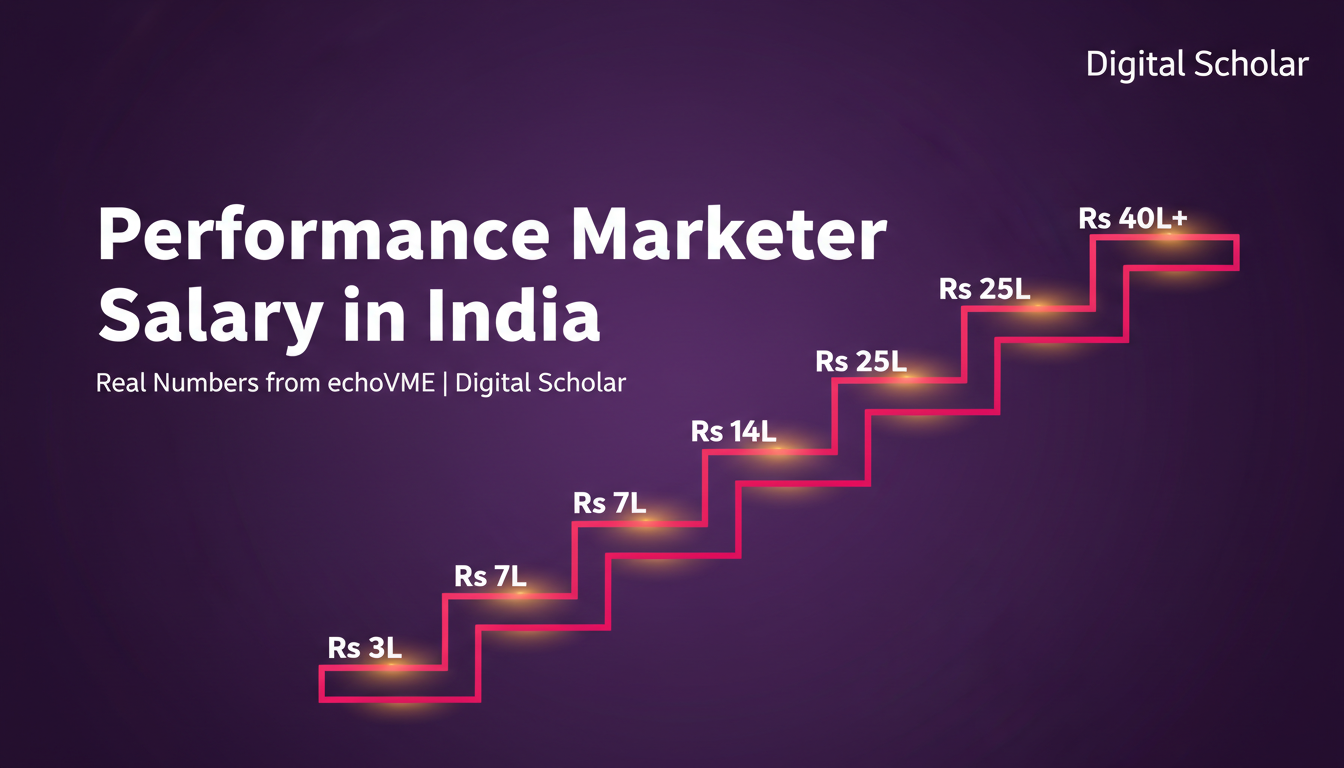
- Fresher (0 to 1 year): Rs 2.5L to Rs 5L. Agencies pay lower, D2C brands pay higher.
- Junior (1 to 3 years): Rs 5L to Rs 9L. Skill differentiation starts mattering here.
- Mid-level (3 to 5 years): Rs 9L to Rs 18L. This is where Meta or Google specialization pays off.
- Senior (5 to 8 years): Rs 18L to Rs 30L. Team management plus strategy adds 30 to 50 percent premium.
- Head / Director (8+ years): Rs 30L to Rs 60L+. Rare, but the ceiling is real at funded D2C and large brands.
- Who this is for: Performance marketing freshers, mid-level professionals considering a switch, and Digital Scholar students benchmarking their first offer.
What Does a Performance Marketer Actually Do?
A performance marketer manages paid advertising campaigns with the explicit goal of hitting measurable outcomes: leads, purchases, app installs, or sign-ups. Every rupee spent is tracked. Every decision is backed by data. You are not creating brand awareness for its own sake. You are buying outcomes at a target cost.
The core toolkit is Meta Ads (Facebook and Instagram), Google Ads (Search, Display, YouTube, Shopping), and increasingly programmatic platforms like DV360 and The Trade Desk. At echoVME, our performance team runs all three in parallel for most clients. The skill overlap is about 60 percent. The remaining 40 percent is platform-specific, and that is where salary differentiation lives.
Day to day, a performance marketer at Digital Scholar graduate level is doing six things: building and launching campaigns, running creative tests, optimizing bids and budgets, reporting ROAS and CAC to clients or internal stakeholders, briefing the creative team on what is working, and planning the next test cycle. At echoVME, we handle over Rs 400 crore in annual ad spend across 500+ brands, so our team does all of this simultaneously across multiple accounts.
If you want a deeper breakdown of what performance marketing involves as a discipline compared to broader digital marketing, read our full guide on performance marketing vs digital marketing in India. This post focuses purely on the money side.
Salary by Experience Level: Fresher to Director
Experience level is the single biggest salary driver for a performance marketer in India. Here is what the market actually looks like in 2026, based on what we see at echoVME during hiring cycles and what Digital Scholar placement partners report.
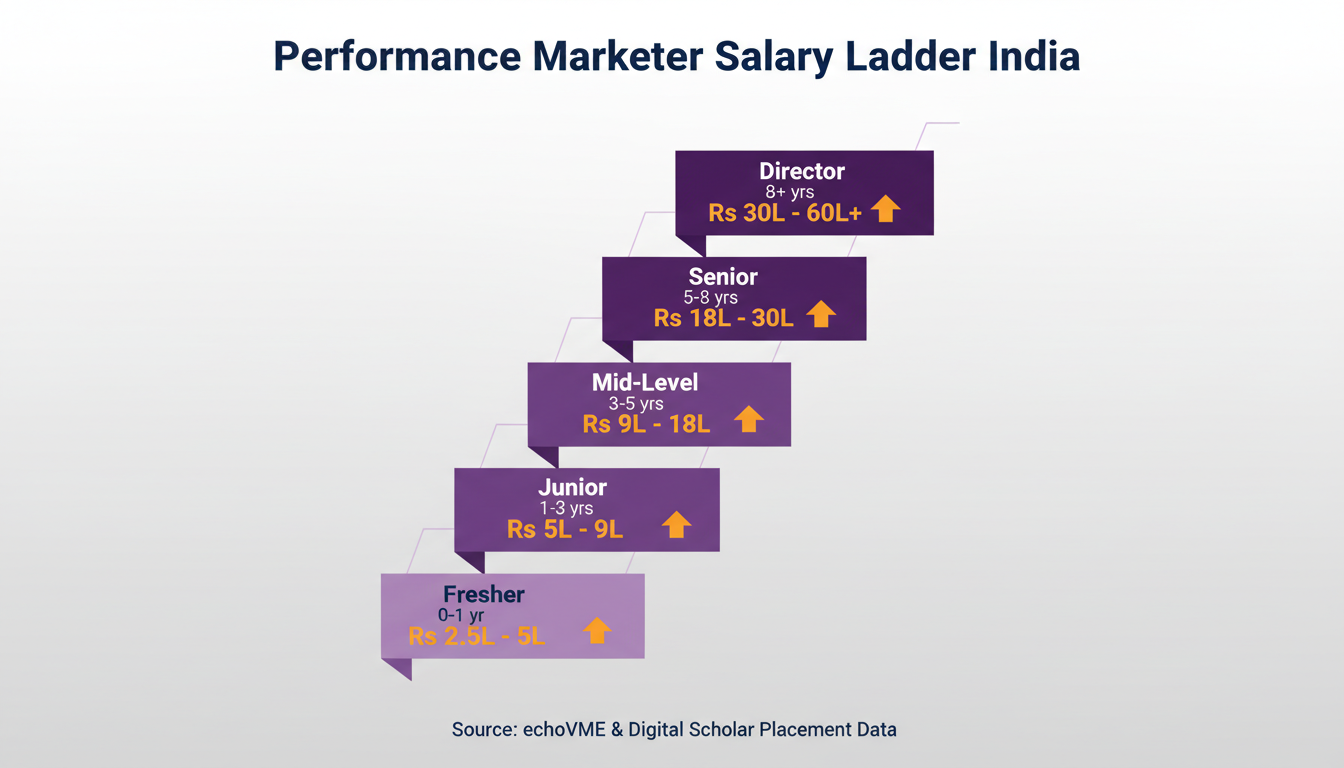
| Level | Experience | Salary Range (CTC) | Typical Role Title |
|---|---|---|---|
| Fresher | 0 to 1 year | Rs 2.5L to Rs 5L | Performance Marketing Executive, Paid Media Associate |
| Junior | 1 to 3 years | Rs 5L to Rs 9L | Performance Marketing Specialist, Paid Ads Analyst |
| Mid-Level | 3 to 5 years | Rs 9L to Rs 18L | Senior Performance Marketing Manager, Growth Manager |
| Senior | 5 to 8 years | Rs 18L to Rs 30L | Performance Marketing Lead, Head of Growth |
| Director / VP | 8+ years | Rs 30L to Rs 60L+ | VP Marketing, Director of Performance, CMO |
A few things worth calling out. The fresher range is wide on purpose. A Digital Scholar graduate with a strong internship and documented campaign results, even from practice accounts, can negotiate Rs 4 to Rs 5L from day one. Someone walking in with zero portfolio, no certifications, and no real ad spend experience starts at Rs 2.5L at an agency. That Rs 1.5L gap at entry level compounds significantly over 5 years.
The mid-level bracket (Rs 9L to Rs 18L) is where I see the most variation. A performance marketer who has owned Rs 1 crore in monthly ad spend commands the top of that range. Someone managing Rs 5 lakh a month sits at the bottom. The spend under management is the fastest signal of seniority that hiring managers use. At echoVME, we ask every candidate in the interview: what is the highest monthly ad budget you have personally managed? That number tells us more than any resume line.
At the director level, equity and variable pay become significant. Funded D2C startups in Bangalore and Mumbai routinely offer ESOPs alongside the base. Directionally, a Director of Performance at a Series B D2C brand could be looking at Rs 35L base plus Rs 5 to 10L in bonus plus equity. The ceiling on total compensation is hard to define at that level.
The key insight: Salary bands are wide at every level. The variable is documented proof of results. At echoVME, the single factor that most influences what we offer a candidate is whether they can show us a real campaign dashboard with real ROAS numbers, not whether they have a specific degree or certification.
How Performance Marketing Salaries Have Grown: 2020 to 2026
The performance marketing job market in India looks structurally different today than it did six years ago. Three things drove the change: the D2C explosion post-2020, the death of organic reach on Meta (forcing brands to paid), and the rapid upskilling bar raised by AI tools in 2024 and 2025. Here is the directional salary movement at each level.
| Level | 2020 Salary Range | 2023 Salary Range | 2026 Salary Range | Growth |
|---|---|---|---|---|
| Fresher | Rs 1.8L to Rs 3L | Rs 2.2L to Rs 4L | Rs 2.5L to Rs 5L | ~40% over 6 years |
| Junior (1-3 yrs) | Rs 3L to Rs 5.5L | Rs 4L to Rs 7L | Rs 5L to Rs 9L | ~55% over 6 years |
| Mid-Level (3-5 yrs) | Rs 5.5L to Rs 10L | Rs 7L to Rs 14L | Rs 9L to Rs 18L | ~65% over 6 years |
| Senior (5-8 yrs) | Rs 10L to Rs 18L | Rs 14L to Rs 24L | Rs 18L to Rs 30L | ~67% over 6 years |
The pattern is clear: salaries grew faster at the senior end than the fresher end. That is because the supply of freshers has gone up faster than the supply of skilled senior performance marketers. Every college produces graduates who have done one Google Ads certification. Very few produce candidates who can own a Rs 2 crore monthly budget and defend every optimization decision with data.
The other factor worth noting is that the 2025 AI wave created a new sub-premium on top of the senior bracket. Performance marketers who added AI campaign management, automation scripting, and tools like Claude Code for reporting to their skill set started earning 20 to 30 percent above peers with the same years of experience but without those capabilities. At Digital Scholar, we started tracking this from our 2025 cohorts and the gap is real.
Performance Marketing Salary vs Other Digital Marketing Roles
Performance marketing consistently pays more than most other digital marketing disciplines at the same experience level. The reason is simple: results are directly measurable. When a performance marketer increases ROAS from 2.1x to 3.4x, the value is undeniable. That accountability commands a premium. Here is how performance compares to other roles in the Digital Scholar and echoVME ecosystem.
| Role | Mid-Level Salary (3-5 yrs) | Senior Salary (5-8 yrs) | Why the Difference |
|---|---|---|---|
| Performance Marketer | Rs 9L to Rs 18L | Rs 18L to Rs 30L | Direct revenue attribution. Highest accountability. |
| SEO Specialist | Rs 6L to Rs 12L | Rs 12L to Rs 20L | Results take 3 to 6 months to show. Harder to tie to revenue directly. |
| Social Media Manager | Rs 5L to Rs 9L | Rs 9L to Rs 15L | Organic role. Lower budget ownership. Metrics often brand, not revenue. |
| Content Marketing Manager | Rs 6L to Rs 11L | Rs 11L to Rs 18L | Long-cycle attribution. Strong at director level when tied to pipeline. |
| Email / CRM Manager | Rs 7L to Rs 13L | Rs 13L to Rs 22L | Revenue-tied at retention level. Strong in SaaS and D2C brands. |
| Growth Marketer (full stack) | Rs 12L to Rs 22L | Rs 22L to Rs 40L | Performance plus product plus data. Rare skill. Highest non-director ceiling. |
The “Growth Marketer” row is worth explaining. This is not a standard role at most agencies. It is more common at product-led companies, SaaS brands, and funded D2C startups. A growth marketer owns the full acquisition funnel from paid ads through onboarding and retention. At Digital Scholar, we produce a subset of graduates every batch who come in aiming specifically for this track. Those students put in extra work on analytics, product thinking, and CRM systems on top of the core performance marketing curriculum. The salary premium is substantial and justified.
Salary by Specialization: Meta vs Google vs Programmatic
Not all performance marketing specializations pay equally. Programmatic consistently commands a 20 to 35 percent premium over Meta-only roles at the same experience level. Here is why and what the numbers look like.
| Specialization | Mid-Level Salary Range | Senior Salary Range | Why the Difference |
|---|---|---|---|
| Meta Ads (Facebook + Instagram) | Rs 7L to Rs 14L | Rs 14L to Rs 24L | Highest demand, most candidates. Competitive above Rs 10L. |
| Google Ads (Search + Shopping) | Rs 8L to Rs 16L | Rs 16L to Rs 26L | Technical bidding strategies and scripts push pay slightly higher. |
| YouTube Ads | Rs 7L to Rs 13L | Rs 13L to Rs 22L | Often bundled with Google Ads. Standalone YouTube experts are rare. |
| Programmatic (DV360, TTD) | Rs 12L to Rs 22L | Rs 22L to Rs 38L | Fewer candidates, enterprise clients, larger budgets. Clear supply gap. |
| Performance plus AI Automation | Rs 14L to Rs 25L | Rs 25L to Rs 45L | Emerging premium as brands push AI-first campaign management in 2025-26. |
The “Performance plus AI” row is not hypothetical. At Digital Scholar, we rebuilt our 4-month program in February 2026 to include AI agents for campaign management, Claude Code for Meta Ads automation, and hands-on MCP integrations. Students who graduate with those skills are already getting Rs 2 to 4 lakh more than peers from programs that still teach 2022-era playbooks. If you want to understand what that looks like in practice, read our breakdown on using Claude Code for Meta Ads.
The Meta vs Google debate is worth one more paragraph because I see candidates overthink it. Both platforms are essential to know. Specializing too early in one limits you. The best-paid performance marketers at echoVME are the ones who can switch between Meta and Google depending on what the client needs, and who understand the audience and creative logic behind each platform, not just the interface. Platform-agnostic performance thinking is the skill. Platform proficiency is just the execution layer.
Salary by City: Mumbai, Bangalore, Chennai, Delhi
City of work matters, but less than most people assume. A 15 to 25 percent salary premium in Mumbai or Bangalore sounds significant until you factor in rent and cost of living. The real advantage of these cities is access to funded D2C and tech companies that simply do not exist at scale in tier-2 markets. That is where the Rs 25L+ roles live.
| City | Mid-Level Range (3-5 yrs) | Senior Range (5-8 yrs) | Market Note |
|---|---|---|---|
| Bangalore | Rs 11L to Rs 20L | Rs 20L to Rs 35L | Highest ceiling. D2C, SaaS, and funded startups dominate. |
| Mumbai | Rs 10L to Rs 18L | Rs 18L to Rs 30L | Strong agency market. Brand-side roles at Rs 20L+ are common. |
| Delhi / Gurgaon | Rs 9L to Rs 16L | Rs 16L to Rs 28L | E-commerce and aggregator brands. Competitive and growing market. |
| Chennai | Rs 8L to Rs 14L | Rs 14L to Rs 22L | Growing D2C ecosystem. echoVME operates here. Underrated market. |
| Hyderabad | Rs 8L to Rs 15L | Rs 15L to Rs 24L | Pharma and IT adjacents. Remote-first roles common here. |
| Pune | Rs 8L to Rs 14L | Rs 14L to Rs 22L | IT and SaaS companies hiring performance marketers for B2B funnels. |
| Tier-2 (Coimbatore, Jaipur, etc.) | Rs 5L to Rs 10L | Rs 10L to Rs 16L | Lower local supply means less competition for strong candidates. |
Chennai deserves a separate mention because I live and work here. The Digital Scholar campus is in Chennai. echoVME’s core team operates here. The local market is often dismissed by candidates who want to move to Bangalore immediately after graduating. That is a mistake. Chennai has a growing base of D2C brands, agencies managing national budgets, and B2B SaaS companies building performance functions. The cost-to-quality ratio for a Chennai-based performance marketer is genuinely strong, and remote-first hiring from Bangalore and Mumbai companies has effectively collapsed the city salary gap for strong candidates.
Agency vs In-House vs D2C: Where the Money Is
This is the question I get most often from Digital Scholar students. The short answer: agencies pay less at entry but teach faster. In-house roles at large brands pay more but move slower. D2C brands have the highest upside but the most volatility. Here is the breakdown across all five employer types.
| Employer Type | Fresher Salary | Mid-Level Salary | Key Tradeoff |
|---|---|---|---|
| Digital Agency (like echoVME) | Rs 2.5L to Rs 4.5L | Rs 7L to Rs 14L | Exposure to 10 to 15 clients simultaneously. Faster skill growth. Lower pay floor. |
| Large Brand / MNC In-House | Rs 3.5L to Rs 6L | Rs 10L to Rs 18L | Stability, benefits, slower learning curve. Approvals slow everything. |
| Funded D2C Startup | Rs 4L to Rs 7L | Rs 12L to Rs 22L | High ownership, high speed, equity possible. Risk: companies shut down. |
| E-commerce Brand | Rs 3.5L to Rs 5.5L | Rs 10L to Rs 18L | Performance KPIs are crystal clear. ROAS, CAC, LTV measured daily. |
| Freelance / Consultant | Rs 1.5L to Rs 4L (monthly) | Rs 6L to Rs 20L (monthly) | Highest ceiling long-term. Zero security short-term. Relationships are everything. |
My honest take, and this is something I say to every Digital Scholar batch: spend your first 2 years at an agency or a funded D2C brand. Not because of the salary, but because the volume of campaigns you manage in 24 months at echoVME or a similar agency is equivalent to 5 to 6 years of exposure at a large corporate. The learning density is unmatched. Then switch to in-house when your portfolio is strong enough to negotiate from a position of proven results.
The freelance route is viable at mid-level but brutal without a network. I would not recommend going freelance before you have 3 years of agency or in-house experience and at least 5 client relationships you own personally. The ones who crack freelance performance marketing early are usually Digital Scholar graduates who stayed connected to the echoVME referral network. Cold outreach alone rarely sustains a freelance performance practice in the first 12 months.
Skills That Actually Move Your Salary Up
Not all skills are equally valued. I have seen people with 5 years of experience stuck at Rs 9 lakh because their skill set did not evolve past basic campaign setup. And I have seen 3-year professionals at Rs 15 lakh because they built capabilities that are genuinely rare. Here is what moves the needle, ranked roughly by salary impact.
- Attribution modeling and incrementality testing: Most performance marketers cannot explain the difference between last-click and data-driven attribution. The ones who can run incrementality tests to prove real campaign ROI command 20 to 30 percent premium at mid-level. This is the single highest-leverage technical skill in the field right now.
- Creative strategy and production briefing: At echoVME, our best-performing performance marketers are the ones who brief creative teams with specific hooks, formats, and angle hypotheses based on data. This is a rare skill and it is disproportionately rewarded. Most media buyers treat creative as someone else’s problem. The ones who own creative performance are irreplaceable.
- AI-assisted campaign management: Running Google Performance Max with proper AI signals, using Meta’s Advantage+ with correct audience seeding, and now using Claude Code to automate reporting, alerts, and budget pacing. Digital Scholar students who graduate with these skills are 2 to 3 years ahead of candidates from older programs. Check out what we cover in our guide on best AI tools for digital marketing.
- Full-funnel ownership: Understanding landing page conversion, CRM sequencing, and how performance media connects to the funnel below the click. Marketers who own the full funnel, not just the media buying layer, get paid like it. The jump from pure media buyer to full-funnel owner is worth Rs 3 to 6 lakh at mid-level.
- Budget management at scale: Directionally, candidates who can show they managed Rs 50 lakh or more per month in ad spend negotiate 25 to 40 percent higher than peers managing Rs 5 lakh a month. The number matters because it signals trust from previous employers and clients. Spend under management is the resume line that hiring managers actually read.
- Performance marketing interviews: Knowing how to answer competency questions about campaign decisions, what you tested, what failed, and what you learned. Candidates who can articulate their thinking process clearly in interviews consistently land above-band offers. For prep, read our breakdown of performance marketing interview questions for 2026.
How to Build a Portfolio That Gets You Top-Band Offers
A portfolio for a performance marketer is not a PDF with logos of brands you worked at. It is a documented record of campaigns you ran, the decisions you made, and the outcomes those decisions produced. Here is exactly how to build one that gets you top-band offers, whether you are a fresher or a mid-level professional.
For Freshers: Build With Practice Ad Accounts
You do not need a client to build a portfolio. Google gives you a practice account through Google Ads Editor. Meta gives you an Ads Manager account you can use with a small personal budget. Start with Rs 3,000 to Rs 5,000 of your own money or a friend’s small business. Run a real campaign. Optimize it over 3 to 4 weeks. Document the ROAS, the cost per result, what you tested, and what you changed. That 4-week campaign with Rs 5,000 in spend is more valuable in a salary negotiation than 6 certifications. At Digital Scholar, we structure the program so that every student manages live campaigns through echoVME client accounts under supervision. That is the fastest way to build a portfolio with real numbers.
For Mid-Level Professionals: Document What You Own
If you have 3 to 5 years of experience but no documented portfolio, you are leaving money on the table in every salary conversation. Go back through your last 12 months of campaigns. Build a one-page case study for your 3 best results. Format: objective, budget, strategy, what you tested, final ROAS or CPL, and what you would do differently. Redact client names if needed. The structure and the numbers are what matter, not which brand it was. At echoVME, we use this case study format internally for performance reviews as well. It trains people to think about their own results as assets, not just job duties.
For a complete breakdown of the tools that high-earning performance marketers use to document and scale their work, read our comparison of the best performance marketing tools and platforms for 2026.
The echoVME Perspective: What We Pay and Why
Let me be direct about what we do at echoVME, because I think it gives you a real benchmark that most salary guides do not offer.
At echoVME, we have 3 performance marketing tracks internally. The numbers below are approximate and represent the ranges as of early 2026:
| Track | What They Do | Salary Range at echoVME | What Gets Someone Promoted |
|---|---|---|---|
| Media Buyer | Campaign setup, optimization, reporting across 8 to 12 clients | Rs 3L to Rs 8L | Hitting ROAS targets consistently for 2+ quarters. Zero billing errors. |
| Performance Strategist | Funnel design, creative strategy, testing roadmaps | Rs 8L to Rs 16L | Building repeatable frameworks that other team members can follow. |
| Performance Lead | Client P&L ownership, team of 3 to 5, new business inputs | Rs 16L to Rs 24L | Client retention rate, team growth, ability to win pitches independently. |
Here is an imperfect truth: we have lost good people to in-house D2C brands that offered 30 to 40 percent more than we could match on base salary. We accept that. Agencies will always have a ceiling that large in-house budgets can beat. What we offer instead is exposure to 500+ client accounts, a team culture built around experimentation, and a career track that produces people who can run performance at any company they choose next. Digital Scholar graduates who come through echoVME for their first 2 years consistently out-earn peers who went straight to in-house roles at 5 years of experience, because the breadth of campaign exposure cannot be replicated.
The Digital Scholar 4-month program was designed specifically to produce candidates at the Performance Strategist level, not just the Media Buyer level. The difference is about Rs 3 to 6 lakh in starting salary. That is a real outcome, not a marketing claim. We track placement data from every Digital Scholar batch, and the average first-year CTC for performance marketing-focused graduates has been Rs 4.2 lakh as of the last 3 cohorts, with the top 20 percent landing between Rs 6L and Rs 9L.
The key insight: The performance marketer salary ceiling in India is not a salary problem. It is a skills documentation problem. The candidates earning Rs 15L+ at 3 to 4 years of experience are not smarter. They just have a portfolio that makes their results undeniable. Build the portfolio before you negotiate.
How to Negotiate Your Performance Marketing Salary
Most performance marketers negotiate badly because they anchor on job titles and years of experience. Hiring managers for performance roles do not care about either of those as much as they care about one thing: can you show me a campaign dashboard where you moved a number that mattered?
Here is what actually works in a performance marketing salary negotiation:
- Lead with a result, not a role. “I managed Rs 80 lakh in monthly Meta spend with an average ROAS of 3.4x over 6 months” is a more powerful opening than “I have 4 years of experience in digital marketing.” The first statement closes the conversation on your terms. The second invites comparison to every other 4-year candidate.
- Name your number first. Whoever anchors the salary conversation first wins. Do not wait for the company to make the first offer if you have data to justify your ask. Know your number before you walk into any negotiation and say it clearly and without apology.
- Know the spend-under-management benchmark. For every Rs 50 lakh per month you have managed, you are in a different conversation. A candidate who has managed Rs 2 crore per month has legitimate grounds to be at the top of the mid-level band regardless of years. This is the fastest way to justify a salary above the standard range.
- Ask about variable components. Many performance marketing roles at agencies and D2C brands include performance bonuses tied to ROAS or CAC targets. Rs 12 lakh base plus Rs 2 to 4 lakh in performance bonus is better than Rs 13 lakh flat if you are confident in your results. Always ask what the variable structure looks like before accepting a fixed number.
- Counter with a timeline, not just a number. If the offer is lower than expected, do not reject it outright. Counter with: “I can accept Rs X as a starting point. Can we agree to a 6-month review with a defined path to Rs Y based on hitting these specific targets?” This keeps the conversation open and shows you are results-oriented, which is exactly what a performance marketing employer wants to hear.
Is a Performance Marketing Course Worth It for Salary Growth?
The honest answer is: it depends entirely on what the course teaches and whether it produces a real portfolio.
A 3-month YouTube course that gives you 7 certificates but zero practice campaigns is not worth the time cost. A structured program that puts real ad spend in your hands, forces you to optimize toward a ROAS target, and teaches you to document your results is worth significantly more than the course fee in lifetime salary impact. The difference is not the certificate. It is the portfolio you leave with.
At Digital Scholar, the 4-month program gives students access to live client campaigns through echoVME accounts. Students optimize real campaigns under supervision, make real budget decisions, and graduate with dashboards showing real spend, real ROAS numbers, and documented decision logs. That is the difference between a certificate and a portfolio. Most online MBA programs and older digital marketing courses were built before ChatGPT launched. They still teach 2019 playbooks. Digital Scholar rebuilt the entire curriculum in February 2026 to include AI agents, MCP integrations, and live campaign automation. That is not a marketing differentiator. It is the difference between teaching someone to drive a horse cart versus a car.
If you want to understand what the full learning path looks like before investing in a course, read our guide on how to learn performance marketing in 2026. It lays out the exact sequence of skills, from zero to job-ready, that Digital Scholar students follow.
Frequently Asked Questions
What is the average salary of a performance marketer in India?
The average performance marketer salary in India in 2026 is approximately Rs 7 to Rs 10 lakh per year at the 3 to 5 year experience level. Entry-level roles start at Rs 2.5 to Rs 5 lakh. The range widens significantly at senior levels, where Rs 18 to Rs 30 lakh is common at funded D2C brands and large agencies. The average hides the enormous skill-driven variation within each bracket. Your portfolio and documented spend under management matter far more than years of experience in determining where you land within the band.
What is the starting salary for a fresher in performance marketing?
Freshers in performance marketing typically start between Rs 2.5 lakh and Rs 5 lakh in India. Agencies tend to offer the lower end (Rs 2.5 to Rs 3.5 lakh). D2C brands and in-house roles offer Rs 4 to Rs 5 lakh for freshers who come in with documented portfolio results. The Rs 2.5 lakh figure applies to candidates with zero proof of work. At Digital Scholar, the average first-year CTC for performance-track graduates has been Rs 4.2 lakh, with the top 20 percent landing between Rs 6L and Rs 9L. Build a portfolio before you negotiate.
How much does a digital marketing manager earn in India?
A digital marketing manager with 3 to 5 years of experience, including performance marketing responsibilities, earns Rs 8 to Rs 15 lakh in India. The variation depends heavily on employer type: agencies pay Rs 8 to Rs 12 lakh, while in-house brand roles and funded startups pay Rs 12 to Rs 18 lakh for the same experience level. Title alone is less important than the portfolio and budget ownership behind the role. A “Senior Executive” at a D2C brand managing Rs 1 crore monthly can earn more than a “Manager” at an agency managing Rs 10 lakh monthly.
Is performance marketing a good career in India in 2026?
Yes, and the trajectory is getting stronger. Every brand spending on digital advertising needs performance marketers, and that universe is growing as D2C, e-commerce, ed-tech, fintech, and SaaS companies scale in India. What is also growing is the skill bar. Performance marketers who do not evolve past basic campaign setup will find their ceiling dropping as AI automates the basic layer. Those who add attribution modeling, creative strategy, and AI campaign management to their toolkit will see their value increase significantly over the next 3 to 5 years.
What is the salary of a Meta Ads specialist in India?
A Meta Ads specialist in India earns Rs 4 to Rs 7 lakh at entry level, Rs 7 to Rs 14 lakh at mid-level (3 to 5 years), and Rs 14 to Rs 24 lakh at senior level. Candidates who combine Meta Ads expertise with creative strategy and audience segmentation skills are at the top of these ranges. Pure media buyers who only optimize within the platform without understanding the full funnel sit at the bottom. The premium for adding Google Ads proficiency alongside Meta is roughly 15 to 20 percent at mid-level.
Does a performance marketing course increase salary?
A performance marketing course increases salary only if it produces a real portfolio with documented campaign results. A certificate without real ad spend experience is worth very little in a salary negotiation. At Digital Scholar, the 4-month program gives students access to live echoVME client campaigns so they graduate with real ROAS data to show. The average placement salary for performance-track graduates has been Rs 4.2 lakh in the first year, with the top 20 percent landing between Rs 6 and Rs 9 lakh, which is significantly above the market average for freshers without similar portfolio proof.
How long does it take to reach Rs 10 lakh as a performance marketer in India?
With a strong portfolio and the right employer, 3 to 4 years is realistic. The fastest path is: start at an agency or a D2C brand in years 1 and 2 to build breadth of campaign exposure, then switch to an in-house role or a funded startup in year 3 where you can negotiate based on documented results. Candidates from Digital Scholar who follow this track and add AI campaign management skills are reaching Rs 10 lakh at 2.5 to 3 years. Candidates without a portfolio or with generic skill sets take 5 to 6 years to reach the same level, if they get there at all.
What is the difference in salary between a Meta Ads and Google Ads specialist?
At mid-level (3 to 5 years), Google Ads specialists earn roughly Rs 1 to 2 lakh more than Meta Ads specialists at the same experience level. This reflects the slightly higher technical complexity of Google Ads (bidding scripts, feed optimization, Search auction dynamics) and the fact that Google Ads is the dominant channel for B2B and high-intent search demand. Meta Ads has a larger talent pool, which keeps salaries slightly more competitive. The widest premium is in programmatic (DV360, The Trade Desk), which pays 20 to 35 percent more than either Meta or Google at the same experience level due to significantly lower supply of trained candidates in India.
Want to land a performance marketing job at Rs 5 to 9 lakh in your first year?
Digital Scholar’s 4-month AI and Digital Marketing program gives you hands-on access to live echoVME campaigns, real ad spend, and real results you can show in interviews. We rebuilt the curriculum in February 2026 to include AI agents, Claude Code for campaign automation, and full-funnel performance strategy. Over 1,000 students per year. Placement support included.