
- Performance marketing in 2026 is 8 levels, not 1 job title. Funnel strategy, platform mastery, creative volume, retention, measurement, data, scaling, monetization – each unlocks a distinct income tier from Rs 15K/month to Rs 5L+/month.
- 90% of income growth happens between Level 2 and Level 5. The gate is skill (creative volume, CAPI setup, dashboard reading) – not certificates, not platform knowledge.
- Built from Rs 400+ crore of managed ad spend at echoVME. The 8-level framework is what we teach inside the Digital Marketing Course in Chennai, not theory.
Who this is for: Aspiring and mid-career performance marketers in India who can already run a Meta or Google campaign but cannot break past Rs 25,000 per month, and want the exact skill ladder to climb to Rs 1L+ per month.
- Funnel Strategy – Map every campaign to 4 stages: Awareness, Consideration, Conversion, Retention.
- Platform Mastery – Learn Meta Ads, Google Ads, YouTube and LinkedIn mechanics.
- Creative Mastery – Ship 50 creatives per week using the 5x5x2x1 formula. Hook Rate above 30 percent.
- Retention Mastery – Build WhatsApp, email, and chatbot flows that re-engage drop-offs in 3 days, not 14.
- Measurement Mastery – Pixel and Conversion API on day 1. Clean UTMs, deduped events.
- Data Mastery – Diagnose CPM spikes, frequency fatigue, broken attribution in under 10 minutes.
- Scaling Mastery – Hold ROAS while spend 5x. Audience health ratio above 40 percent.
- Monetization Mastery – Get placed at Rs 8 to 20+ LPA, freelance, or build your own agency.
What Is Performance Marketing?
Performance marketing is the practice of running paid campaigns where every rupee you spend is tied to a measurable result. A click, a lead, a sale, a signup. You pay for outcomes, not impressions.
But in 2026, the definition has expanded. It is no longer just about pressing buttons inside Meta Ads Manager or Google Ads. Performance marketing today is about feeding the right data into AI-driven platforms, testing creatives at volume, building retention systems, and making decisions based on numbers that actually matter.
At Digital Scholar, we have spent over Rs 300 crore in ad spend across thousands of campaigns. The one thing that separates a Rs 15,000 per month media buyer from a Rs 1.5 lakh per month performance marketer is not platform knowledge. It is systems thinking. And that is what the 8 levels of mastery are built around.
Why Do Most Performance Marketers Get Stuck at Rs 15,000 per Month?
Here is the uncomfortable truth. If all you know is how to set up a campaign on Meta, select an objective, pick an audience, and hit publish, you are competing with every third person in the country who watched a YouTube tutorial last weekend.
Platforms have become so automated that the setup part is the easiest piece. Meta’s Advantage Plus handles targeting. Google’s Performance Max handles bidding. The buttons are simple.
The money is not in the buttons. The money is in strategy, creative volume, retention, and data interpretation. That is why we break performance marketing into 8 distinct levels in the Post Graduate Program in Digital Marketing. Most people stop at Level 2 and wonder why they cannot charge more.
What Are the 8 Levels of Performance Marketing Mastery?
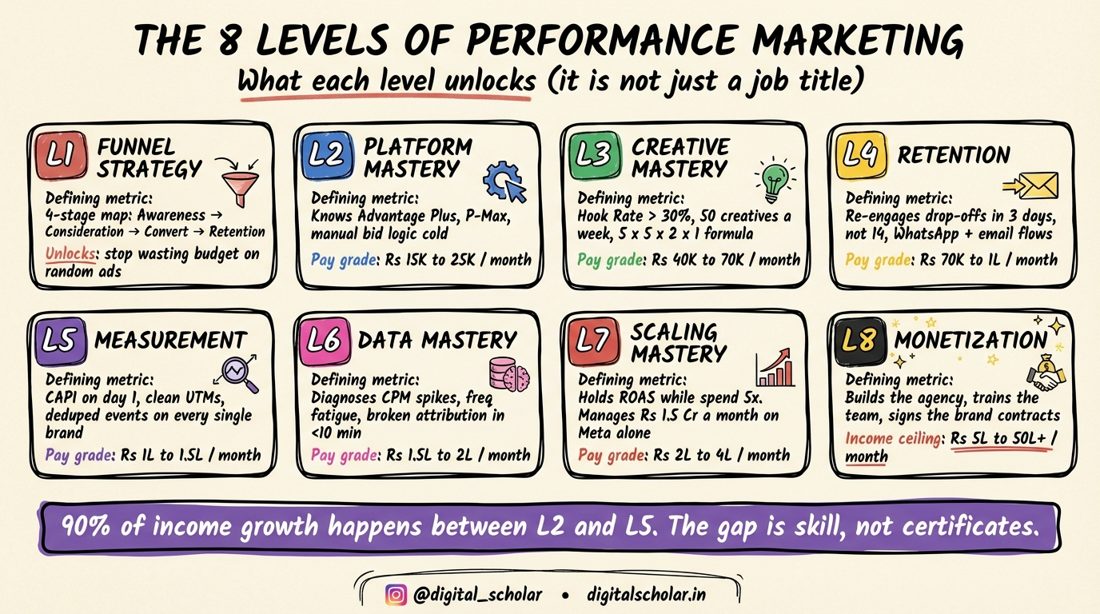
Here is the complete framework we teach at Digital Scholar. Think of this as a staircase. Each level builds on the one before it. You cannot skip steps.
| Level | Focus | What it unlocks |
|---|---|---|
| 1. Funnel Strategy | Awareness → Consideration → Conversion → Retention | You stop running random ads and start running intentional campaigns. |
| 2. Platform Mastery | Meta, Google, YouTube, LinkedIn mechanics | You can execute cleanly on any platform. |
| 3. Creative Mastery | Hook rate, 50 creatives per week, 5x5x2x1 formula | Your creatives do the targeting for you. |
| 4. Retention Mastery | WhatsApp, email, push, chatbot flows | Ads become profitable, not just click-generating. |
| 5. Measurement Mastery | Pixel, Conversion API, UTM, attribution | You feed the algorithm clean data so it rewards you back. |
| 6. Data Mastery | Reading CPM, CPL, ROAS, frequency, hook rate | You diagnose issues before the client notices. |
| 7. Scaling Mastery | Horizontal plus vertical scaling, audience health ratio | You hold ROAS while budgets 5x. |
| 8. Monetization Mastery | Salary, freelance, agency building | Rs 8 to 20+ LPA or the equivalent freelance income. |
Level 1: Funnel Strategy
This is where everything begins. Before you touch an ad platform, you need to understand how customers move from stranger to buyer.
Every client engagement at our agency starts with one exercise. We break the strategy into four stages: Awareness (how do people discover this brand?), Consideration (what makes them think about buying?), Conversion (what is the offer that closes the deal?), and Retention (how do we bring them back?).
Most beginners jump straight to running ads without answering these four questions. The result? Campaigns that generate clicks but not customers. Strategy is not optional. It is Level 1 for a reason.
Level 2: Platform Mastery
This is where you learn the mechanics. What does each button do inside Meta Ads Manager? How does Google Ads auction work? What are bidding strategies? What is Advantage Plus and when should you use it?
Platform mastery also means understanding how AI has changed the game. In 2026, these platforms run on algorithmic decision-making. Your job is not to outsmart the algorithm. Your job is to feed it the right inputs. If you want to see how we use Claude AI for digital marketing to plan campaigns, we have a separate breakdown on that.
Here is what we tell our students: understand the logic, not just the interface. If Meta changes a button tomorrow, the logic stays the same. If you only memorized the button, you are lost.
Level 3: Creative Mastery
This is the level where most agencies and freelancers either separate themselves from the crowd or stay average forever.
Interest-based targeting is practically dead. Your creative IS your targeting now. If you want to reach luxury buyers, your visuals and messaging need to speak that language. If you want to reach budget-conscious shoppers, the creative does that job too.
At our agency, we ship 50 creatives a week for some brands. The formula we follow: 5 different angles, 5 variations per angle, 2 formats (static plus video), 1 strong offer. That is 50 unique pieces of creative per cycle. We test hooks, formats, proof types, and messaging pillars constantly.
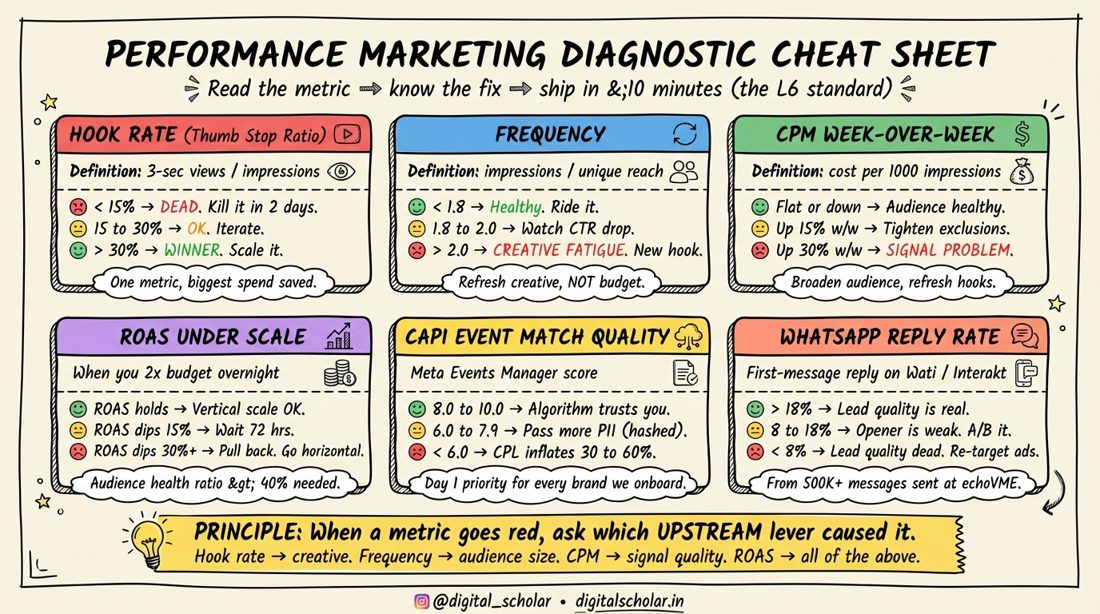
The metric that matters here is not CTR anymore. It is the hook rate (we call it Thumb Stop Ratio). If less than 15% of people stop scrolling at your ad, it is going to die within days. At 30%, you have found a winner. This one metric has saved us more ad spend than any audience tweak ever has.
Level 4: Retention Mastery
Here is something most performance marketers ignore completely: the follow-up.
You can run ads. You can generate leads. Maybe even get some sales. But are you profitable? Because profitability comes from retention, not acquisition.
Retention mastery means building WhatsApp flows, email sequences, push notification strategies, and chatbot automations that keep customers coming back. It means segmenting your audience and sending the right message to the right person at the right time.
We use tools like Wati AI for WhatsApp automation. I have personally sent over 500,000 WhatsApp messages for various campaigns. But the tool is just the tool. The skill is knowing how to qualify leads through conversational flows, how to re-engage drop-offs within 3 days (not 14), and how to use social proof in retargeting to boost CTR by 25 to 30%.
Look, there is a serious skills gap in India around retention. Everybody wants to run ads. Almost nobody knows how to build the systems that make those ads profitable. This is where the real money sits.
Level 5: Measurement Mastery
What you cannot track, you cannot scale.
Measurement mastery is about understanding how pixels work, what UTM parameters do, how to set up conversion events properly (especially for e-commerce), and how attribution actually works in 2026.
Here is why this matters so much. Meta Ads and Google Ads have gone fully AI-driven. The one thing left in your control is the quality of data you feed back into these platforms. If you are optimizing for the wrong events, sending wrong signals, or have a broken pixel, the algorithm will find you the wrong customers. Garbage in, garbage out.
After iOS updates, server-side tracking via the Meta Conversion API has become non-negotiable. If your client does not have this set up, you are flying blind. We make this a Day 1 priority for every brand we onboard at our agency.
Level 6: Data Mastery
This is where you graduate from media buyer to performance analyst.
Data mastery means you can look at a dashboard and tell a story. You know what CPC, CTR, CPL, ROAS, hook rate, hold rate, frequency, and CPM mean, and more importantly, you know what to do when each metric moves in the wrong direction.
For example: if your CPM is spiking 30% week over week, that is not a budget problem. That is a signal problem. The algorithm is struggling to find your audience cheaply. You need to broaden your targeting or refresh your creatives.
If your frequency crosses 2.0, you are showing the same ad to the same people too many times. Creative fatigue is setting in. Time for new hooks, not more budget.
AI tools can help here. They can predict winners, auto-adjust bids, and flag anomalies. But your ability to do this manually, to actually read the data and make decisions, is what makes you irreplaceable. Tools can be copied. Judgment cannot. Our Instagram audit using AI breakdown shows exactly how we turn raw data into action.
Level 7: Scaling Mastery
Running ads at Rs 10,000 per day and getting results is one thing. Maintaining those results at Rs 50,000 per day is a completely different skill.
Scaling mastery is about understanding horizontal scaling (new audiences, new geos, new products) and vertical scaling (more budget behind what is already working). It is about knowing when to scale and when to hold.
Most people try to scale by simply increasing budget. The moment they do, ROAS drops, CPA spikes, and they pull the budget back. This cycle repeats endlessly.
The real scaling approach is sequential. First, make sure your measurement is clean. Then confirm your creative pipeline can handle volume. Then check your audience health ratio (what percentage of your spend is going to new vs engaged audiences). Only then do you start pushing budget.
This kind of knowledge does not exist in courses or YouTube tutorials. It comes from managing real budgets at scale. At our agency, we have managed brands spending Rs 1.5 crore per month on Meta alone. The discipline required at that level is an entirely different game.
Level 8: Monetization Mastery
Once you have built proof of work across all seven levels, you are in the top bracket. You can get placed as a performance marketer at Rs 8 to 15 LPA. You can freelance with 3 to 5 clients and earn more than most salaried professionals. Or you can build your own agency.
The key insight here: the money is at the strategy level, not the execution level. If you only know Level 2 (platform setup), the market will pay you Rs 10,000 to Rs 15,000 per month. If you can strategize funnels, build creative systems, set up retention flows, read data, and scale campaigns, you are in a completely different earning bracket.
How Long Does It Take to Learn Performance Marketing?
At Digital Scholar, we break the learning journey into three phases.
Phase 1 (Months 1 to 2): Foundation. You learn Meta Ads and Google Ads inside out. You understand AI-driven automation, campaign structures, and the basics of measurement. You work on live projects with real brands during the program itself.
Phase 2 (Months 2 to 4): Execution. You go out and work with real clients. Freelance projects, internship campaigns, your own brand if you have one. This is where you build proof of work that no certificate can replace. Our student success stories show how this plays out in practice.
Phase 3 (Months 4 to 12): Growth. You start building your personal brand. You start networking. You take on bigger clients or join an agency. Some students start their own agencies within 8 to 10 months of completing the program.
The timeline varies by person, but the sequence does not. You cannot skip execution and jump to monetization.
What Is the Difference Between Performance Marketing and Digital Marketing?
Digital marketing is the umbrella. Performance marketing is the engine.
Digital marketing includes content creation, social media management, SEO, email marketing, influencer marketing, and more. Performance marketing specifically focuses on paid campaigns where every action is tracked, measured, and optimized for ROI.
Think of it this way. A social media manager creates posts. A performance marketer creates campaigns that directly generate revenue and can tell you exactly how much each rupee returned.
In 2026, the best performance marketers also understand SEO, AEO (Answer Engine Optimization), and GEO (Generative Engine Optimization) because customer discovery is no longer limited to Google search results. People are finding brands through ChatGPT, Perplexity, and Google AI Overviews. A complete performance marketer understands all these channels. For a deeper breakdown of which career track pays more in India 2026 (and why), see our cluster post on performance marketing vs digital marketing salary in India.
What Skills Does a Performance Marketer Need in 2026?
The skill stack has changed dramatically from even two years ago. Here is what the market demands now.
Non-negotiable skills: Campaign setup and optimization on Meta and Google, creative strategy and testing at volume, landing page optimization, conversion tracking (Pixel plus Conversion API), WhatsApp and email automation, data analysis and reporting.
Competitive-edge skills: AI tool fluency (using AI for creative generation, data analysis, and audience insights), retention system design, unit economics understanding (knowing the math behind when a campaign is actually profitable vs just generating vanity metrics), and scaling strategy.
The skill gap nobody talks about: Most performance marketers in India can run ads. Very few can build the retention systems that make those ads profitable. Even fewer can read data at a level where they can diagnose problems before the client notices. This is where Digital Scholar’s 8-level framework fills a gap that YouTube tutorials never will. You can also check our digital marketing career quiz to see where you currently stand.
What Tools Do Performance Marketers Use?
Before the tool list: here is how we actually read the metrics those tools surface. This diagnostic cheat sheet is the Level 6 standard at our agency. It is what separates a media buyer from a performance analyst.
| Category | Tools | Why it matters |
|---|---|---|
| Ad Platforms | Meta Ads Manager, Google Ads, YouTube Ads, LinkedIn Ads (B2B) | Where the auction happens. |
| Landing Pages and CRO | Unbounce, Carrd, WordPress with Elementor | Every 1-second load delay costs 7% conversions (Think with Google). |
| Retention and Automation | Wati AI, Interakt, MoEngage, WebEngage, Klaviyo | Where profit actually lives. |
| Analytics and Tracking | GA4, Meta Pixel, Conversion API, UTM builders | Clean signals equal cheaper CPA. |
| Creative Production | Canva, AdCreative.ai, Nano Banana Pro | 50+ creatives per week is the new normal. |
| Speed Optimization | GTMetrix, ShortPixel | Image compression without quality loss. |
| AI and Data | Claude, ChatGPT, Windsor.ai | Cross-channel dashboards without engineers. |
If you want the long list, our full digital marketing tools directory goes deeper.
What Is AEO, GEO, and AIO, and Why Should Performance Marketers Care?
This is the part most performance marketing content skips entirely. And that is a mistake.
AEO (Answer Engine Optimization) is about becoming the cited source when AI platforms answer a question. When someone asks ChatGPT “What is the best performance marketing course in India?” and it cites your page, that is AEO working. The key is structured, question-and-answer formatted content with clear, direct answers in the first 2 to 3 sentences of each section.
GEO (Generative Engine Optimization) is about showing up in AI-generated answers on platforms like Perplexity, Google AI Overviews, and Bing Copilot, where there may not be a direct citation link. Trust signals matter here: review counts, named case studies, specific numbers, and recency markers (“as of April 2026”).
AIO (AI Overview Optimization) specifically targets Google’s AI Overviews. Over 60% of Google searches now end without a click. If your content does not appear in the AI-generated summary at the top of the search page, you are invisible to a majority of searchers.
Why should performance marketers care? Because customer discovery channels are fragmenting. Your ads might bring someone to Google, but if the AI Overview recommends a competitor, you have lost them. Performance marketing in 2026 is not just about paid channels. It is about controlling the entire discovery journey.
How Much Does a Performance Marketer Earn in India?
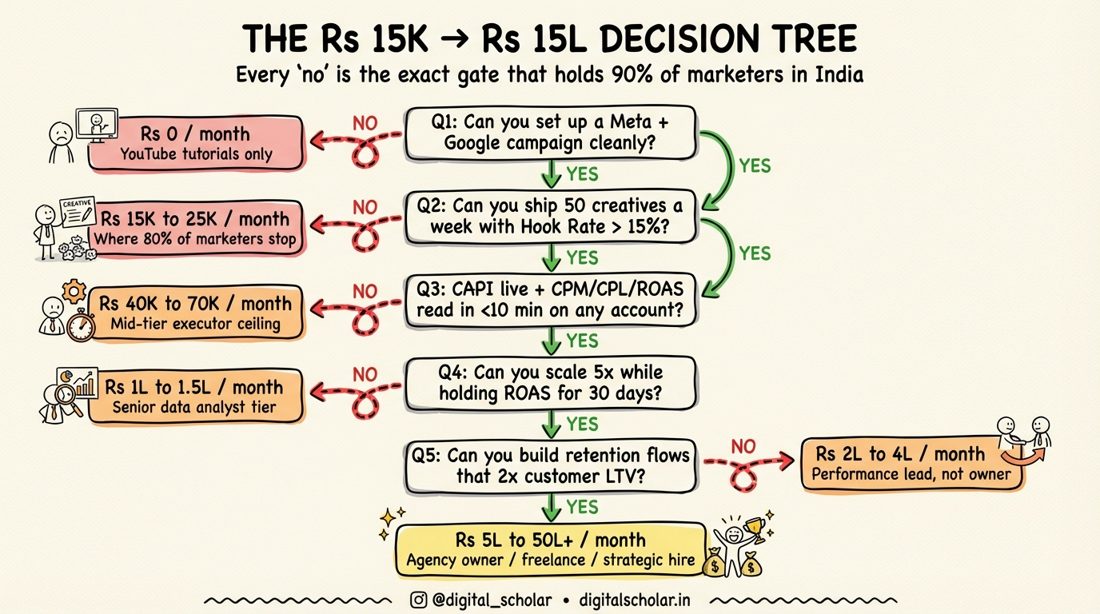
Salary ranges vary based on the level of mastery you have reached. But the salary number alone hides the bigger story: every income jump is gated by a specific skill. The decision tree below shows the exact gate that holds 90% of marketers in India at each level. For raw numbers see our digital marketing salary in India breakdown or the salary calculator.
| Mastery Level | Capability | Salary Range (India) |
|---|---|---|
| Level 1 to 2 | Platform basics only (fresher) | Rs 2.5 to 4 LPA |
| Level 3 to 4 | Creative systems plus retention | Rs 5 to 8 LPA |
| Level 5 to 6 | Measurement plus data fluency | Rs 8 to 12 LPA (or Rs 50k to 1L per month freelance per client) |
| Level 7 to 8 | Scaling plus monetization | Rs 12 to 20+ LPA or equivalent freelance |
The jump from Level 2 to Level 5 is where 90% of the income growth happens. And that jump is entirely about skills, not certifications.
What Makes Digital Scholar’s Performance Marketing Training Different?
Two types of trainers exist in India. Subject-matter experts who cannot teach. And academicians who have never run a real campaign. Both are problems.
At Digital Scholar, the trainers are practitioners. We have spent Rs 300+ crore in ad spend across hundreds of brands. Our agency, echoVME Digital, manages campaigns actively. When we teach scaling, we are pulling from accounts where we have spent Rs 1.5 crore in a single month. When we teach retention, we are sharing WhatsApp flows that have sent 500,000+ messages.
The training covers all 8 levels with live projects, not simulations. Students work on real brands, generate real leads, and build real proof of work during the program itself. Browse the Digital Scholar reviews if you want to hear it from students directly.
And we cover what nobody else in India covers at this level: AI-powered performance marketing, AEO and GEO optimization, WhatsApp automation as a performance channel, and scaling systems that go beyond “just increase the budget.”
Ready to move past Level 2?
The 4-month Post Graduate Program in Digital Marketing covers all 8 levels with live brand projects, mentorship from the echoVME team, and placement support.
Explore the ProgramFAQs About Learning Performance Marketing
Can I learn performance marketing without a marketing degree?
Yes. Over 70% of Digital Scholar students come from non-marketing backgrounds. Performance marketing is a skill, not a subject. What matters is your ability to think strategically, test relentlessly, and read data.
Is performance marketing only about Meta Ads and Google Ads?
No. While Meta and Google are the primary platforms, performance marketing in 2026 also includes YouTube Ads, LinkedIn Ads (for B2B), WhatsApp marketing (click-to-WhatsApp ads are among the highest-converting formats in India), and even AEO and GEO strategies for AI-driven discovery.
How is performance marketing different from social media marketing?
Social media marketing focuses on organic content, community building, and brand presence. Performance marketing focuses on paid campaigns tied to measurable business outcomes like leads, sales, and revenue. Many marketers do both, but the skill sets are distinct.
What budget do I need to start practising performance marketing?
You can start learning with as little as Rs 500 to Rs 1,000 per day on Meta Ads. For Google Ads, Rs 300 to Rs 500 per day is enough to run test campaigns. The key is not the budget size. It is your ability to read what the data is telling you and iterate.
Is performance marketing a good career in 2026?
It is one of the highest-demand digital skills in India. Every business that sells online needs performance marketers. The supply of good ones (Level 5 and above) is far lower than the demand. If you can demonstrate real results, you will not struggle to find work.
What is the role of AI in performance marketing today?
AI handles most of the targeting, bidding, and delivery optimization automatically. Your role has shifted from platform operator to strategic thinker and creative strategist. AI tools also help in creative generation, data analysis, and building automated retention flows. The marketers who combine AI fluency with strategic depth are the ones commanding premium rates.
The bottom line: Performance marketing in 2026 is a stack of 8 skills, and the market pays you based on how high you climb. Most marketers stop at Level 2 because they think the bottleneck is platform knowledge. It is not. The bottleneck is creative volume (Level 3), retention systems (Level 4), and dashboard literacy (Level 5 and 6). The good news: every level is learnable, the framework is not a mystery, and the gate between Rs 15K per month and Rs 1L per month is closer than it looks. Pick Level 1, start climbing, and build proof of work as you go.
Follow along on Instagram: @rrishijain.