
Last updated: July 2026 by Rishi Jain, Founder of Digital Scholar and Director of echoVME Digital. Built from 400+ real interviews across a decade of hiring performance marketers.
| Business Type | Run Awareness? | Reason |
|---|---|---|
| Local salon/gym (2-3 km radius) | Yes | Drives footfall, short awareness loop |
| Real estate developer | Yes | Long sales cycle, high ticket value |
| Big brand launching new product | Yes | Existing audience, product recall |
| Insurance / fintech | Yes | Trust-building required before conversion |
| D2C fashion brand (Rs 999 t-shirt) | No | Short cycle, go straight to conversion |
| Online course under Rs 10K | Rarely | Lead gen works better, lower funnel |
| Small startup, tight budget | No | Every rupee needs measurable return |
What is CPM and Why Meta Charges You This Way
CPM stands for Cost Per Mille, where “mille” is Latin for thousand. In Meta advertising, CPM is the cost you pay for every 1,000 impressions of your ad. One impression = your ad appearing once on someone’s screen.
Here is the most important thing most Meta advertisers do not realize: Meta charges every campaign on a CPM basis, regardless of your objective. Whether you are running a lead generation campaign, a sales campaign, or an awareness campaign, the underlying cost mechanism is CPM. When your campaign gets leads, you pay for the impressions it took to generate those leads. Meta then divides total spend by total leads to give you your CPL (Cost Per Lead). But underneath, it was always CPM.
This means your ability to generate cheap leads or cheap sales comes down to one thing: getting a low CPM and converting a good percentage of those impressions into results.
Key insight: Your job as a Meta advertiser is not to optimize for leads or sales directly. Your job is to bring down CPM and improve the conversion rate of your ad. The rest follows automatically.
The Activa vs Mercedes Analogy: How CPM Works in Practice
I use this analogy in every Digital Scholar cohort session because it makes CPM instantly tangible. Imagine you are a salesperson in the pre-digital era. Your only way to show your product (a t-shirt sample) to potential buyers is to drive around the city and meet business owners in person. You have two vehicle options: an Activa that gives 40 km per litre, and a top-end Mercedes that gives 5 km per litre. Petrol costs Rs 100 per litre.
On the Activa, Rs 100 covers 40 km. On the Mercedes, Rs 100 covers 5 km. If buyers are spread across the city, which vehicle lets you reach more of them? The Activa. Lower cost per kilometre means more ground covered, more people shown your product, better chances of a sale.
CPM works the same way. A lower CPM means your budget reaches more people. If your CPM is Rs 254, you are reaching 1,000 people for Rs 254. If your CPM is Rs 540, you are reaching the same 1,000 people for Rs 540. Same reach, double the cost. This is why, in an echoVME account review, the first campaign I switch off is always the one with the highest CPM relative to its results.
In real echoVME campaign data: a sales campaign running at Rs 254 CPM was generating leads profitably. A parallel campaign for the same client was running at Rs 540 CPM with similar CTR. We paused the Rs 540 campaign and shifted that budget to the Rs 254 campaign. Cost per lead dropped 38% within 10 days.
The Learning Phase: Why Your First Week of Ads Is Always Unstable
Every new Meta campaign starts in what Meta calls the “learning phase.” This is the period where Meta’s algorithm is actively testing audiences, placements, and creative combinations to find what delivers your campaign objective at the lowest cost. Results during this phase are highly unstable. Costs are high. Performance is inconsistent. This is normal.
To exit the learning phase and move to “active” status (where results stabilize), your campaign needs 50 results within 7 days. What counts as a “result” depends on your objective: 50 leads for a lead generation campaign, 50 purchases for a sales campaign, 50 clicks for an awareness or traffic campaign.
In Digital Scholar cohort sessions, the most common mistake I see from students is switching off campaigns within 6-24 hours because the cost per result looks too high. They are making decisions inside the learning phase, where costs are structurally elevated. The learning phase is not a signal that your campaign is failing. It is a signal that Meta is still gathering data.
If your campaign is moving through the learning phase too slowly (not reaching 50 results in 7 days), the fix is not to wait longer. The fix is to increase your daily budget so Meta can gather 50 results faster. Slow learning = slow optimization = poor performance.
CPM Benchmarks from echoVME Campaigns
These are approximate CPM ranges from echoVME campaign data across Indian markets. Treat these as directional benchmarks, not guarantees. CPM varies significantly based on audience size, creative quality, time of year, and industry competition.
| Industry | Typical CPM Range (India) | Notes |
|---|---|---|
| Real estate | Rs 400 to Rs 800 | High because many advertisers compete for property buyers |
| EdTech / online courses | Rs 150 to Rs 350 | Varies heavily by targeting specificity |
| E-commerce (fashion, lifestyle) | Rs 80 to Rs 200 | Broad audiences keep CPMs lower |
| Beauty and wellness (local) | Rs 60 to Rs 180 | Hyper-local targeting often lowers CPM |
| Financial services / insurance | Rs 300 to Rs 700 | Regulatory compliance adds friction, drives up CPM |
| D2C food and beverages | Rs 50 to Rs 150 | Broad audiences, visual creative drives low CPMs |
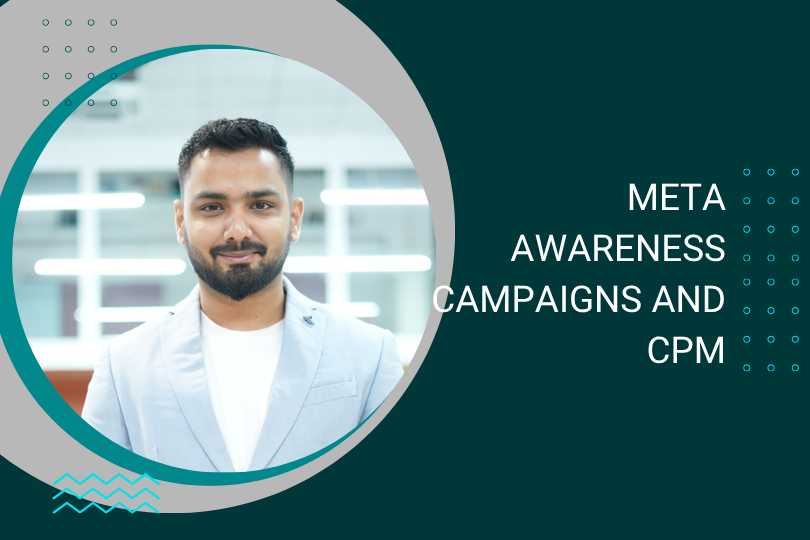
Last updated: July 2026 by Rishi Jain, Co-Founder of Digital Scholar and CEO of echoVME Digital. Performance marketing instructor for the Digital Scholar MBA cohort.
A Digital Scholar MBA student once came to me after two weeks of running a Meta awareness campaign for a small clothing brand. She was confused. Her CPM was Rs 420. A fellow student running a real estate campaign had a CPM of Rs 680. She thought she was doing better. She was right, but for the wrong reasons. She did not understand what CPM actually means, why it matters more than any other metric in Meta advertising, and why her awareness campaign was the wrong campaign type for a low-ticket clothing product in the first place.
That single session where I broke down awareness objectives and CPM in the Digital Scholar cohort changed how 40 students in the room thought about Meta Ads. This post covers exactly what I taught that day. If you run Meta ads and do not fully understand CPM and when to use the awareness objective, you are spending money without a map.
At echoVME, we manage Rs 300 crore+ in Meta ad spend across 500+ brands. CPM is the single number I look at first in every account review. Here is what you need to know.
In this post, you will learn: what Meta awareness campaigns are and which businesses should (and should not) run them, what CPM means and why it is the foundation of all Meta advertising, the learning phase and what it means for your results, CPM benchmarks from echoVME campaigns, and how to bring your CPM down systematically.
- What is a Meta Awareness Campaign?
- Which Businesses Should Run Awareness Campaigns
- What is CPM and Why Meta Charges You This Way
- The Activa vs Mercedes Analogy: How CPM Works in Practice
- The Learning Phase: Why Your First Week of Ads Is Always Unstable
- CPM Benchmarks from echoVME Campaigns
- How to Lower Your CPM: 5 Proven Tactics
- Awareness vs Conversion Campaigns: When to Use Each
- FAQ: Meta Awareness Campaigns and CPM
Why Listen to Me on Meta Ads
I am Rishi Jain, Co-Founder of Digital Scholar and CEO of echoVME Digital. At echoVME, our performance marketing team manages Rs 300 crore+ in annual Meta ad spend across industries including real estate (Casagrand), beauty (Naturals), e-commerce, EdTech, and financial services. I have personally reviewed thousands of Meta ad accounts over the past decade. CPM is the first number I pull up in every account audit.
At Digital Scholar, I run live MBA cohort sessions on performance marketing where students manage real campaigns from day one. The frameworks I share in this post are exactly what I teach in those sessions, tested against real campaign data from echoVME accounts. No theory. Numbers only.
What is a Meta Awareness Campaign?
A Meta awareness campaign is an ad campaign optimized for maximum reach and impressions. When you select the awareness objective in Meta Ads Manager, you are telling Meta: show my ad to as many people as possible within my target audience. Meta optimizes for delivery, not for clicks, leads, or sales.
You pay for every 1,000 times your ad is shown. Whether those people click or not, you pay. This is why choosing the awareness objective requires a clear strategy. It is not a default starting point. It is a specific tool for specific situations.
The awareness objective is available within Meta Ads Manager under the campaign objective selection. It encompasses two sub-types: Brand Awareness (optimized for people most likely to remember your ad) and Reach (optimized for maximum unique people reached). For most small and medium businesses, the distinction matters less than the core question: should you be running awareness at all?
Which Businesses Should Run Awareness Campaigns
In the Digital Scholar MBA cohort, I ask students this question before every awareness campaign discussion. The answers reveal whether they understand the fundamental logic of Meta advertising. Here is the framework I use at echoVME.
Businesses that benefit from awareness campaigns:
- Brick-and-mortar local businesses with a 2-3 km service radius. Gyms, salons, clinics, restaurants. When someone in Adyar is looking for a salon and has seen your ad 4 times in the past week, they are far more likely to walk in. Naturals, one of echoVME’s long-standing clients, has used hyper-local awareness campaigns to drive footfall to individual franchise locations.
- High-ticket, long sales cycle products. Real estate, insurance, financial products, enterprise software. When the conversion cycle is 6 months to 2 years, awareness keeps you top-of-mind throughout. Casagrand, which echoVME manages, runs awareness campaigns precisely for this reason.
- Large brands launching new products. If you have an existing customer base and are introducing something new, awareness is the right first step. A brand like Bingo launching a new product variant makes sense. A first-time startup launching its product does not.
- Bottom-of-funnel retargeting with social proof. At echoVME, we use awareness as a retargeting tool, showing fresh testimonials and new batch announcements to warm audiences who already know the brand. For Digital Scholar’s 4-month program, this is the approach I recommend, not cold awareness.
Businesses that should NOT run awareness campaigns:
- D2C brands selling products under Rs 5,000. If someone can buy your t-shirt today, send them to a purchase page, not an awareness campaign.
- Small businesses with tight budgets and short conversion cycles. Every rupee should be working toward a lead or sale.
- Online courses under Rs 10,000. The conversion cycle is short enough that lead generation or conversion campaigns work better.
| Business Type | Run Awareness? | Reason |
|---|---|---|
| Local salon/gym (2-3 km radius) | Yes | Drives footfall, short awareness loop |
| Real estate developer | Yes | Long sales cycle, high ticket value |
| Big brand launching new product | Yes | Existing audience, product recall |
| Insurance / fintech | Yes | Trust-building required before conversion |
| D2C fashion brand (Rs 999 t-shirt) | No | Short cycle, go straight to conversion |
| Online course under Rs 10K | Rarely | Lead gen works better, lower funnel |
| Small startup, tight budget | No | Every rupee needs measurable return |
What is CPM and Why Meta Charges You This Way
CPM stands for Cost Per Mille, where “mille” is Latin for thousand. In Meta advertising, CPM is the cost you pay for every 1,000 impressions of your ad. One impression = your ad appearing once on someone’s screen.
Here is the most important thing most Meta advertisers do not realize: Meta charges every campaign on a CPM basis, regardless of your objective. Whether you are running a lead generation campaign, a sales campaign, or an awareness campaign, the underlying cost mechanism is CPM. When your campaign gets leads, you pay for the impressions it took to generate those leads. Meta then divides total spend by total leads to give you your CPL (Cost Per Lead). But underneath, it was always CPM.
This means your ability to generate cheap leads or cheap sales comes down to one thing: getting a low CPM and converting a good percentage of those impressions into results.
Key insight: Your job as a Meta advertiser is not to optimize for leads or sales directly. Your job is to bring down CPM and improve the conversion rate of your ad. The rest follows automatically.
The Activa vs Mercedes Analogy: How CPM Works in Practice
I use this analogy in every Digital Scholar cohort session because it makes CPM instantly tangible. Imagine you are a salesperson in the pre-digital era. Your only way to show your product (a t-shirt sample) to potential buyers is to drive around the city and meet business owners in person. You have two vehicle options: an Activa that gives 40 km per litre, and a top-end Mercedes that gives 5 km per litre. Petrol costs Rs 100 per litre.
On the Activa, Rs 100 covers 40 km. On the Mercedes, Rs 100 covers 5 km. If buyers are spread across the city, which vehicle lets you reach more of them? The Activa. Lower cost per kilometre means more ground covered, more people shown your product, better chances of a sale.
CPM works the same way. A lower CPM means your budget reaches more people. If your CPM is Rs 254, you are reaching 1,000 people for Rs 254. If your CPM is Rs 540, you are reaching the same 1,000 people for Rs 540. Same reach, double the cost. This is why, in an echoVME account review, the first campaign I switch off is always the one with the highest CPM relative to its results.
In real echoVME campaign data: a sales campaign running at Rs 254 CPM was generating leads profitably. A parallel campaign for the same client was running at Rs 540 CPM with similar CTR. We paused the Rs 540 campaign and shifted that budget to the Rs 254 campaign. Cost per lead dropped 38% within 10 days.
The Learning Phase: Why Your First Week of Ads Is Always Unstable
Every new Meta campaign starts in what Meta calls the “learning phase.” This is the period where Meta’s algorithm is actively testing audiences, placements, and creative combinations to find what delivers your campaign objective at the lowest cost. Results during this phase are highly unstable. Costs are high. Performance is inconsistent. This is normal.
To exit the learning phase and move to “active” status (where results stabilize), your campaign needs 50 results within 7 days. What counts as a “result” depends on your objective: 50 leads for a lead generation campaign, 50 purchases for a sales campaign, 50 clicks for an awareness or traffic campaign.
In Digital Scholar cohort sessions, the most common mistake I see from students is switching off campaigns within 6-24 hours because the cost per result looks too high. They are making decisions inside the learning phase, where costs are structurally elevated. The learning phase is not a signal that your campaign is failing. It is a signal that Meta is still gathering data.
If your campaign is moving through the learning phase too slowly (not reaching 50 results in 7 days), the fix is not to wait longer. The fix is to increase your daily budget so Meta can gather 50 results faster. Slow learning = slow optimization = poor performance.
CPM Benchmarks from echoVME Campaigns
These are approximate CPM ranges from echoVME campaign data across Indian markets. Treat these as directional benchmarks, not guarantees. CPM varies significantly based on audience size, creative quality, time of year, and industry competition.
| Industry | Typical CPM Range (India) | Notes |
|---|---|---|
| Real estate | Rs 400 to Rs 800 | High because many advertisers compete for property buyers |
| EdTech / online courses | Rs 150 to Rs 350 | Varies heavily by targeting specificity |
| E-commerce (fashion, lifestyle) | Rs 80 to Rs 200 | Broad audiences keep CPMs lower |
| Beauty and wellness (local) | Rs 60 to Rs 180 | Hyper-local targeting often lowers CPM |
| Financial services / insurance | Rs 300 to Rs 700 | Regulatory compliance adds friction, drives up CPM |
| D2C food and beverages | Rs 50 to Rs 150 | Broad audiences, visual creative drives low CPMs |
If your CPM is consistently above the top of your industry’s range and you are not seeing proportionally better results, your audience targeting is likely too narrow, your creative is not resonating, or your account has relevance issues that need diagnosis.
How to Lower Your CPM: 5 Proven Tactics
Lowering CPM is one of the highest-leverage moves in Meta advertising. Here is what actually works, based on echoVME campaign testing across 500+ brands.
- Widen your audience. Narrow audiences (under 500,000 in India) create auction competition among fewer impressions, driving CPM up. Broadening to 1M+ typically drops CPM by 20-40%. At echoVME, we start most campaigns at the state level or with broad interest stacks before narrowing.
- Improve your creative quality (relevance score). Meta’s algorithm favors ads that users engage with positively. High engagement rates signal relevance and lower CPM. A thumb-stopping first 2 seconds in a video ad drops CPM significantly. We have seen creative changes alone cut CPM by 30% in a single week.
- Test multiple placements. Instagram feed placements typically have higher CPMs than Reels or Facebook feed. Running automatic placements (instead of manual) lets Meta find cheapest delivery. In most echoVME campaigns, Reels and Stories placements deliver 15-25% lower CPM than feed.
- Avoid highly competitive auction times. Q4 (October to December) is the most expensive period on Meta globally. CPMs spike 40-60% during Diwali season in India. Plan your awareness campaigns for Q2-Q3 when auction competition is lower.
- Use video over static for awareness. Video content consistently achieves lower CPM than static image ads in awareness campaigns. A 15-second video ad in echoVME awareness campaigns routinely achieves 25-35% lower CPM than equivalent static image ads.
Awareness vs Conversion Campaigns: When to Use Each
The most common strategic mistake I see in the Digital Scholar cohort is treating awareness as the default starting point for new campaigns. It is not. For most businesses, the correct starting point is conversion or lead generation, then using engagement retargeting to warm up the audience over time.
Use awareness when you have a specific reason to build recall before asking for action. Use conversion campaigns when you want measurable outcomes. The two are not competitors. In a well-structured echoVME campaign funnel, awareness feeds retargeting, which feeds conversion. Each stage has its own CPM and its own metric set.
For more on how to structure the full campaign funnel, see the answer engine optimization principles that apply across digital channels, or explore how social media SEO and paid campaigns work together. The Digital Scholar 4-month program covers this integration in detail. Understanding E-E-A-T signals also helps frame why trust-building through awareness is essential for high-ticket conversions. Students in the Digital Scholar MBA cohort also learn how ChatGPT SEO and Google AI Overview optimization complement paid media strategies for full-funnel brand building.
FAQ: Meta Awareness Campaigns and CPM
What is a good CPM for Meta ads in India?
A good CPM in India varies by industry but generally falls between Rs 80 and Rs 400 for most business types. E-commerce and local businesses can achieve Rs 60-180. Real estate and financial services run Rs 400-800. If your CPM is consistently at the top of your industry range without proportional results, your creative or audience targeting needs adjustment. At echoVME, we benchmark every account monthly against these ranges.
Should I run awareness campaigns if I have a small budget?
No. With a small budget (under Rs 500 per day), every rupee should generate a measurable lead or sale. Awareness campaigns build recall over time, which requires sustained spend to work. With limited budget, run lead generation or conversion campaigns instead, and let the retargeting audiences you build from those campaigns do your awareness work organically.
How long does the Meta learning phase last?
The learning phase ends when your campaign generates 50 results within 7 days. For lead generation campaigns, that is 50 leads. For sales campaigns, 50 purchases. If your budget is too low to generate 50 results in a week, the learning phase extends. The practical fix is to increase your daily budget temporarily during the first week to accelerate learning, then reduce it once the campaign is in “active” phase.
Why does CPM increase during Diwali and Q4?
During Q4 (October to December), thousands of additional advertisers enter the Meta auction to capture festive season spending. More advertisers competing for the same impressions drives CPM up, sometimes by 40-60%. At echoVME, we front-load our awareness and retargeting campaigns in September so our audiences are already warm when Q4 hits. This way we are converting warm audiences rather than prospecting cold ones at peak CPM prices.
Can I run awareness campaigns on Instagram only?
Yes. You can restrict placements to Instagram only at the ad set level. However, running automatic placements typically delivers lower CPM because Meta can find cheaper inventory across Facebook, Instagram, Audience Network, and Reels. If your brand is Instagram-first, test both approaches and compare CPM. In most echoVME awareness campaigns, automatic placements with Reels prioritized outperform Instagram-only placement.
What is the difference between reach and impressions?
Reach is the number of unique people who saw your ad at least once. Impressions is the total number of times your ad was shown, including multiple times to the same person. If 1,000 people each see your ad 3 times, your reach is 1,000 and your impressions are 3,000. CPM is calculated on impressions, not reach. Frequency (impressions divided by reach) tells you how many times on average each person saw your ad. For awareness campaigns, a frequency of 3-5 in a 30-day period is generally effective without causing ad fatigue.
How do I know if my awareness campaign is working?
Awareness campaigns do not directly generate leads or sales, so standard conversion metrics do not apply. Instead, measure: CPM (lower is better), reach (how many unique people were exposed), frequency (3-5 is the sweet spot for recall), video completion rate for video ads (above 25% is a positive signal), and downstream impact on retargeting performance. At echoVME, we also track branded search volume increases and direct traffic spikes as indirect awareness indicators.
Want to Learn Meta Ads from Live Campaign Data?
Digital Scholar’s 4-month MBA program in digital marketing and AI covers performance marketing from awareness to conversion, with live campaign management from week one. Rishi Jain teaches each session using real echoVME account data.
Questions about CPM or your awareness campaign results? Tag me on Instagram @rrishijain with your data and I will give you a read on what is happening.