
Every digital marketing institute in Chennai will show you a syllabus. Most of those syllabi look impressive on paper: 40 modules, 25 tools, 12 certifications. And most of them describe what was relevant 3 to 5 years ago, packaged in updated-looking fonts. When I review what some Chennai institutes are teaching as “digital marketing syllabus 2026,” I see Google Ads basics, some Instagram tips, maybe a ChatGPT module added recently to look current. What I do not see is what employers in Chennai are actually hiring for: AI-powered campaign management, technical SEO, Answer Engine Optimisation, performance marketing at scale, and marketing analytics that goes beyond Google Analytics dashboards.
I am Karthikeyan Maruthai. I have been building and revising Digital Scholar’s curriculum since the institute’s founding, shaped by what I see working (and failing) at echoVME Digital with our 500+ brand client portfolio. When I added the AEO module to Digital Scholar’s syllabus in early 2025, it was because I had watched Google AI Overview appear for our client’s target keywords and realised that 90 percent of the “digital marketing training” available in Chennai had no answer for it. When we added the AI marketing module, taught by Rishi Jain from his Rs 300 crore ad spend experience, it was because Chennai employers were asking for AI-capable marketers and finding none.
This guide shows you exactly what Digital Scholar’s digital marketing syllabus in Chennai covers, week by week, across 4 months. It also shows you what the other institutes teach versus what we teach, why specific modules are included, and what you can do with each skill set when you leave the program.
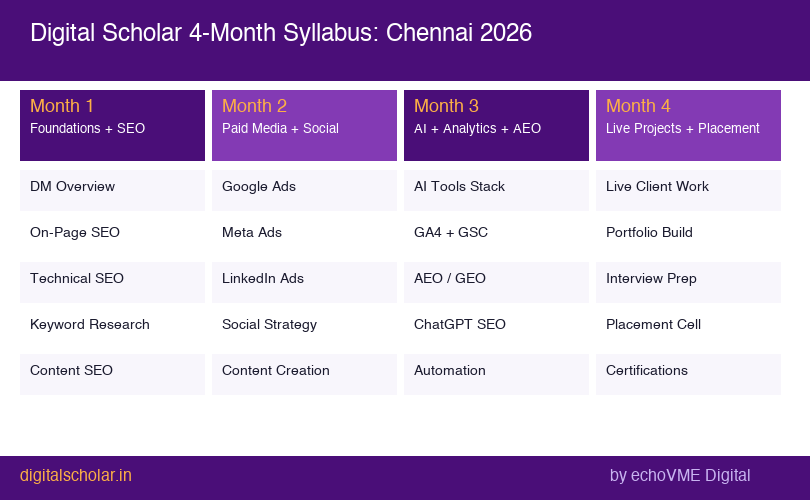
This is the complete Digital Scholar digital marketing syllabus for the Chennai 4-month program as of July 2026. It covers all 4 months in detail: what is taught, who teaches it, what tools are used, what live projects are assigned, and what certifications are available. Use this guide to evaluate whether Digital Scholar’s program matches your career goals before you enrol.
- Why the Syllabus is the Most Important Factor When Choosing a Chennai Institute
- Month 1: Digital Marketing Foundations and SEO
- Month 2: Performance Marketing, Social Media, and Content
- Month 3: AI Marketing, Analytics, and Emerging Channels
- Month 4: Live Projects, Portfolio, and Placement Preparation
- Week-by-Week Class Schedule in Chennai
- Tools Covered Across the 4 Months
- Certifications Available During the Program
- Digital Scholar vs Other Chennai Institutes: What We Teach That Others Don’t
- Red Flags to Watch for in Any Chennai Digital Marketing Syllabus
- What You Can Do After Completing Each Module
- FAQ: Digital Marketing Syllabus in Chennai
Why the Syllabus is the Most Important Factor When Choosing a Chennai Institute
When Chennai students compare digital marketing programs, they typically look at price, duration, faculty credentials, and placement claims. The syllabus is the one factor that directly determines placement outcomes, and it is the least carefully evaluated. Two programs at similar prices, both claiming “100% placement assistance,” with faculty credentials that sound impressive can produce dramatically different graduates depending on what is actually taught in the 4 months of training.
The test I apply to any digital marketing syllabus is simple: does it teach skills that Chennai employers are actively hiring for right now? Not 3 years ago. Not what the textbook covers. Right now, in Chennai, in 2026. When I audit syllabi from other Chennai institutes, the gaps are consistent: no AI marketing content that goes beyond “use ChatGPT to write blog posts,” no technical SEO beyond meta tags and keyword density, no Answer Engine Optimisation, no performance marketing at scale, no marketing attribution. These are the skills that separate a Rs 5 LPA placement from a Rs 3 LPA placement from the same batch.
The syllabus test: Ask any Chennai institute you are evaluating to show you the specific tools, live project briefs, and assessment criteria for each module. If they cannot provide this level of detail, the syllabus is aspirational, not operational.
Month 1: Digital Marketing Foundations and SEO
Month 1 at Digital Scholar Chennai builds the technical and strategic foundation that every other module depends on. Most institutes treat digital marketing foundations as a brief orientation before moving to the “real content.” At Digital Scholar, foundations and SEO are treated as the highest-priority month because SEO is the most compound-value skill in digital marketing, and because understanding how organic search works changes how you approach every other channel.
Weeks 1 and 2: Digital Marketing Foundations and Website Fundamentals
The first two weeks cover the architecture of digital marketing: how the different channels (SEO, paid, social, content, email, affiliate) connect to form a full-funnel marketing system, and how to read the digital marketing landscape for a specific business. Students learn to audit a website’s current digital presence using Google Search Console, GA4, and basic crawl tools. They learn the difference between owned media (your website, your email list), earned media (backlinks, press mentions, organic social), and paid media (ads across all platforms).
Chennai students in the January 2026 batch who had no prior marketing knowledge consistently said that these two weeks gave them a conceptual framework that made every subsequent module make sense. The digital marketing ecosystem is complex, but it has a logical structure once you understand how awareness, consideration, and conversion work together across channels. Building that framework first makes everything that follows land more effectively.
Weeks 3 and 4: Keyword Research and On-page SEO
I teach this module personally, drawing on what I use at echoVME for clients like Casagrand and The Hindu. Keyword research at Digital Scholar is not about finding any keyword with search volume. It is about finding the right keywords for a specific business in a specific market at a specific point in its competitive position. We use Semrush (India database) as the primary tool, combined with Google Search Console, Google Trends, and competitor gap analysis to build keyword strategies that are actually executable by the businesses students work on.
On-page SEO covers the full implementation layer: H1 and heading hierarchy, title tag and meta description optimisation, internal linking structure, image optimisation, URL structure, schema markup basics, and content depth requirements. Students audit a live website during this week and produce a detailed on-page SEO recommendation report. This audit report becomes part of their placement portfolio. More details are in the dedicated on-page SEO guide that covers the specific techniques applied at echoVME.
Week 5: Technical SEO
Technical SEO is the module that most separates Digital Scholar’s Chennai program from others. Very few institutes in Chennai teach technical SEO at a functional level because very few of the faculty have hands-on technical SEO experience. I teach this module because technical SEO is where I spent my first 5 years at echoVME. The curriculum covers Core Web Vitals (LCP, INP, CLS) and how to diagnose and fix them, crawlability issues using Screaming Frog, XML sitemap structure, robots.txt configuration, canonical tags, structured data and schema markup implementation, mobile-first indexing requirements, and site speed optimisation. Students implement at least 5 technical SEO fixes on a real website during this week.
Week 6: Off-page SEO, Link Building, and Local SEO
Off-page SEO covers backlink strategy, digital PR, and the signals that tell Google a website is authoritative. Link building for Chennai businesses has India-specific nuances: the domestic link building landscape, citation building on Indian directories (Justdial, Sulekha, IndiaMART), and the local authority signals that drive rankings for location-specific searches. Local SEO for Chennai businesses is covered in depth: Google Business Profile optimisation, local pack ranking factors, review strategy, and NAP consistency across Indian directories. This is the exact approach echoVME used to take Naturals Velachery from local pack position 7 to position 1 in 11 weeks.
Month 1 Live Project
By the end of month 1, every Digital Scholar Chennai student has completed a full SEO audit of a real website, produced a keyword research report for a real business, and implemented on-page and technical SEO changes on a live website. These are not simulation exercises. The websites are real client sites from echoVME’s network, and the recommendations students produce are evaluated by practitioner faculty for real-world applicability, not just academic accuracy.
Month 2: Performance Marketing, Social Media, and Content
Month 2 shifts from the organic, foundational work of month 1 to the paid and social channels that drive immediate traffic and revenue. This is often the month students cite as the most practically intense, because performance marketing and social media require hands-on campaign management from day one.
Weeks 7 and 8: Meta Ads (Facebook and Instagram Advertising)
The Meta Ads module is taught with a specific orientation: you are not learning how to run ads. You are learning how to run ads that make money. The distinction matters because the Meta Ads interface is easy to figure out, but running profitable campaigns requires understanding audience strategy, creative performance, funnel construction, budget allocation, and measurement. Rishi Jain, who has managed Rs 300 crore in total ad spend at echoVME including substantial Meta Ads budgets for real estate, consumer brands, and educational institutions, teaches this module. Students manage real Meta Ads campaigns with real budgets (small test budgets sourced from partner brands) during these two weeks.
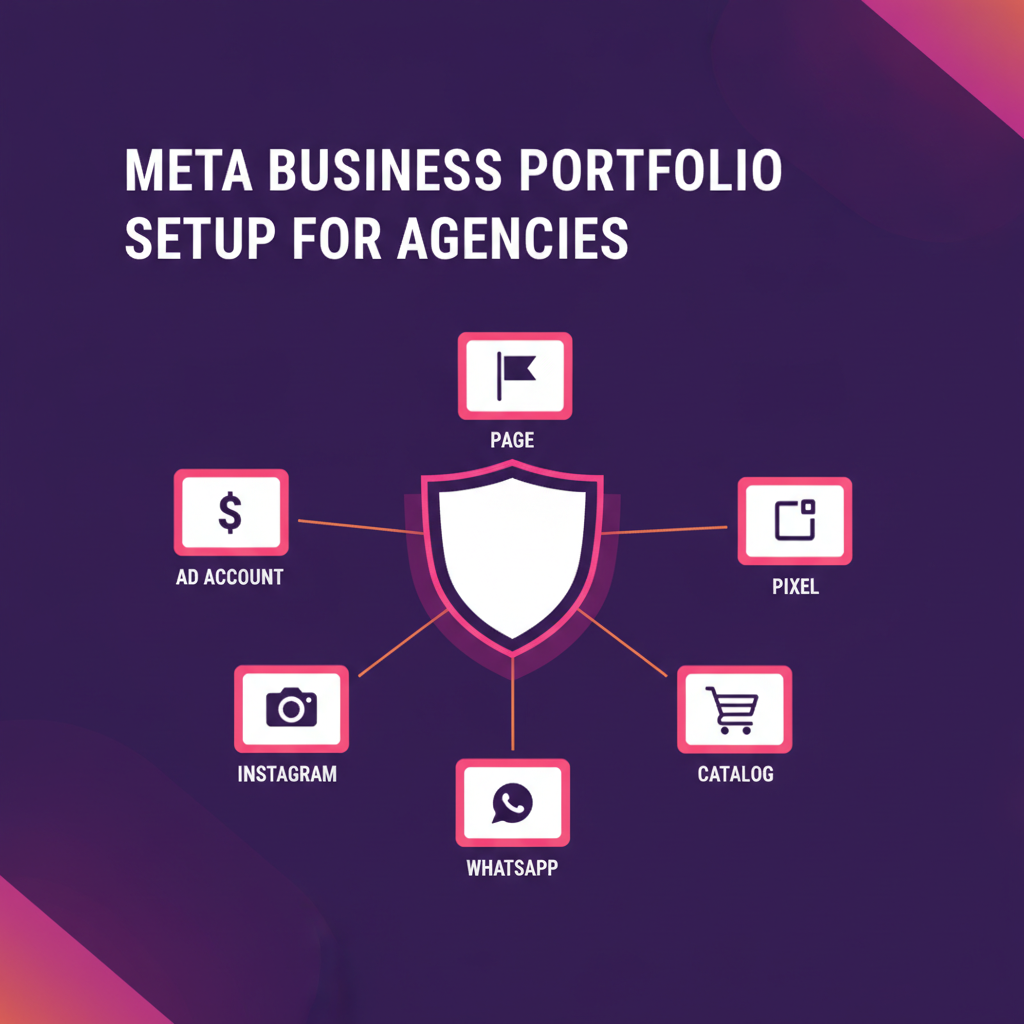
The curriculum covers: Meta Business Suite setup and account structure, campaign objective selection and its impact on delivery, audience building (saved audiences, custom audiences from website visitors and email lists, lookalike audiences), creative formats (single image, carousel, video, Reels ads), A/B testing framework, budget optimisation between Advantage Plus and manual settings, and Pixel setup and conversion event configuration.
Week 9: Google Ads (Search, Display, YouTube, Shopping)
The Google Ads module covers Search, Display, YouTube, and Shopping campaigns. The Chennai market has specific Google Ads characteristics: high competition for real estate and healthcare keywords means quality score optimisation is essential, and the cost per click for competitive terms can be Rs 80 to Rs 300. Students learn how to structure campaigns for quality score maximisation, write ad copy that performs in competitive Chennai markets, use negative keywords to eliminate wasted spend, and set up conversion tracking that connects Google Ads to actual business outcomes.
Week 10: Social Media Marketing Strategy
Sorav Jain teaches the social media marketing module. With 500+ brand accounts under management at echoVME and an Instagram following of over 200,000 in his own personal brand, Sorav brings practitioner depth to every session. The module covers organic social strategy across Instagram, LinkedIn, YouTube, and X (Twitter), platform algorithm mechanics and content strategy for each, content calendar planning, community management, influencer marketing for Chennai brands, and the integration of organic and paid social. The module includes a specific section on using AI tools for social media content creation and scheduling, which is increasingly critical for agencies managing multiple client accounts simultaneously.
Week 11: Content Marketing and SEO Writing
Content marketing at Digital Scholar is not about writing blog posts. It is about creating content assets that rank in Google, get cited in AI overviews, generate inbound links, and build the E-E-A-T signals that increase a brand’s authority. The module covers content strategy development, editorial calendar planning, writing for SEO (keyword integration, heading hierarchy, information gain, answer-first structure), content that ranks in Google AI Overview, and the specific format requirements for getting cited in ChatGPT, Claude, and Perplexity. I cover the emerging AEO (Answer Engine Optimisation) and GEO (Generative Engine Optimisation) components of this module, drawing on the work done for Digital Scholar and echoVME’s client portfolio.
Week 12: Email Marketing and Marketing Automation
Email marketing remains the highest-ROI digital marketing channel globally, yet it is consistently under-taught in Chennai institutes. Digital Scholar’s email marketing module covers subscriber list building and segmentation, email campaign strategy and copywriting, automated email sequences (welcome series, abandoned cart, re-engagement), A/B testing subject lines and content, deliverability fundamentals, and integration with CRM systems. Tools covered: Mailchimp, ActiveCampaign basics, and the integration between email and social and paid retargeting campaigns.
Month 3: AI Marketing, Analytics, and Emerging Channels
Month 3 is where Digital Scholar’s Chennai program differs most sharply from other institutes in the city. The AI marketing and advanced analytics curriculum does not exist in any comparable form at other Chennai institutes in 2026. This is the month that produces the salary premium for Digital Scholar graduates who complete it fully.
Weeks 13 and 14: AI Marketing (Taught by Rishi Jain)
The AI marketing module covers how to use AI tools to scale digital marketing operations without proportionally scaling costs. Rishi Jain teaches from his Rs 300 crore ad spend experience, deploying AI across campaign briefing, creative production, audience analysis, and reporting. The specific tools covered include Claude, ChatGPT, and Perplexity for research and content, Midjourney and Adobe Firefly for visual asset creation, HeyGen and Runway for video content, and AI-powered campaign management within Meta Advantage Plus and Google Performance Max.
The module also covers the strategic layer of AI marketing: how to brief AI tools effectively to get high-quality, brand-consistent outputs, how to maintain authentic brand voice when using AI for content production, how to use AI for marketing analytics and insight generation, and how to build AI-powered marketing workflows that multiply team output. Students complete a specific deliverable in this module: an AI marketing workflow document that maps out how they would use AI tools to manage a specific Chennai client’s digital marketing function with 30 percent fewer human hours.
Week 15: Marketing Analytics and Data-driven Decision Making
The analytics module covers GA4 at a functional depth that goes significantly beyond dashboard-reading. Students learn how to set up custom events in GA4 to track specific business outcomes, build conversion funnels and identify drop-off points, create audience segments for remarketing, connect GA4 to Google Ads for conversion-based bidding, and build Looker Studio dashboards that surface the metrics that matter to clients. The module also covers basic SQL queries for extracting data from Google BigQuery (GA4’s raw data export), which is the skill that opens the door to data analyst roles for digital marketing professionals.
Week 16: AEO, AIO, and GEO (Emerging Search Optimisation)
This is the most forward-looking module in Digital Scholar’s Chennai syllabus, and I teach it personally because it reflects what I am actively implementing for echoVME clients in 2026. Answer Engine Optimisation (AEO) covers how to structure content to appear in Google’s featured snippets, People Also Ask boxes, voice search results, and AI Overview. AI Overview Optimisation (AIO) covers the specific signals that Google uses to select content for its AI-generated answer summaries. Generative Engine Optimisation (GEO) covers how to build the brand entity signals and content credibility that cause ChatGPT, Claude, and Perplexity to cite your brand when answering questions in your topic area.
Digital Scholar students who have applied these techniques have seen their content appear in Google AI Overview within 2 to 4 weeks of publication. Several January 2026 batch graduates’ live project content appeared in ChatGPT citations within 6 weeks of publication. These outcomes are not random. They follow specific, teachable patterns that this module covers systematically. For the complete framework, the AEO guide and AI Overview SEO guide cover the full methodology.
Month 4: Live Projects, Portfolio, and Placement Preparation
Month 4 is the most practically intense month and the one that directly determines placement outcomes. The content delivery is largely complete by the end of month 3. Month 4 is where students apply everything to real client campaigns, build their professional portfolio, and prepare specifically for Chennai job market interviews.
Weeks 17 and 18: Full-stack Live Project
Every Digital Scholar Chennai student works on a full-stack live project during weeks 17 and 18. These projects are assigned from echoVME’s active client portfolio or from the Digital Scholar partner brand network. Each student or small team is responsible for a specific marketing challenge: a real estate developer’s local SEO, a retail brand’s Meta Ads performance, an educational institution’s content strategy, or a healthcare brand’s Google Business Profile and reviews management. The client is real. The data is real. The results are reported to faculty who have actual client visibility into the outcomes.
The live project is not just a learning exercise. It is the most valuable asset in a student’s placement portfolio. When a Digital Scholar graduate walks into an interview and says “I managed a 3-month Meta Ads campaign for a Chennai real estate brand, reduced cost per lead from Rs 420 to Rs 230, and generated 340 qualified leads,” they are presenting a specific, verifiable result that generically trained candidates cannot match. The placement outcomes from the January 2026 batch correlate directly with live project quality: the 5 highest-placed graduates all had strong, data-backed live project outcomes.
Week 19: Freelance Business Building and Agency Setup
Week 19 is one of the most distinctive parts of Digital Scholar’s Chennai syllabus. Most digital marketing institutes are laser-focused on job placement. Digital Scholar explicitly trains students for both job placement and entrepreneurship, because many Chennai graduates prefer the freelance or agency route. This week covers: how to price digital marketing services for Chennai SMEs, how to structure a client retainer proposal, how to set up a minimal viable agency (registration, invoicing, client contracts), how to find first clients through LinkedIn, referrals, and direct outreach, and how to manage multiple clients without burning out. Students produce a complete service menu and pricing document for a freelance digital marketing business during this week.
Week 20: Placement Preparation and Mock Interviews
The final week is dedicated entirely to Chennai job market preparation. Students refine their LinkedIn profiles with echoVME’s branding team providing feedback. They assemble their digital portfolio on a personal website or a curated Notion page. They participate in at least 2 mock interviews with faculty playing the role of hiring managers from actual Chennai companies (real estate, SaaS, agency). The mock interviews are followed by detailed feedback sessions that identify specific gaps in how students present their experience and outcomes. Students leave with a complete placement kit: refined resume, LinkedIn profile, portfolio site, and a list of 20 target Chennai companies with specific contacts from Digital Scholar’s placement network.
Week-by-Week Class Schedule in Chennai
The Digital Scholar Chennai campus runs classes in a format designed to be compatible with working professionals as well as full-time students. Here is the standard weekly schedule structure.
| Day | Session Type | Duration | What Happens |
|---|---|---|---|
| Monday | Core module lecture | 3 hours | New concept delivery with live demonstrations |
| Wednesday | Hands-on lab session | 3 hours | Practical exercises on tools with real accounts |
| Friday | Workshop or guest session | 3 hours | Live project work, industry guest, or Q&A with practitioners |
| Saturday | Live project review | 2 hours | Faculty review of live project progress, feedback, iterations |
Total weekly commitment is approximately 11 hours of scheduled sessions, plus an average of 5 to 8 hours of independent project work. The program is designed for intensive learning rather than passive attendance. Students who attend sessions without completing the associated exercises and live project work consistently underperform at placement relative to those who engage fully with the independent work component.
Tools Covered Across the 4 Months
Tool fluency is a hiring requirement in Chennai’s 2026 digital marketing market. Here are the tools covered at a functional level across Digital Scholar’s Chennai program.
| Category | Tools Covered | Level of Coverage |
|---|---|---|
| SEO and Keyword Research | Semrush, Google Search Console, Screaming Frog, Google Analytics 4, Ahrefs (basics) | Functional, hands-on |
| Paid Advertising | Meta Ads Manager, Google Ads, Google Merchant Center, Meta Business Suite | Functional, live campaign management |
| Social Media | Meta Business Suite, LinkedIn Campaign Manager, Buffer, Hootsuite, Canva | Functional |
| Content and Writing | Google Docs, WordPress, SurferSEO basics, Copyscape, Grammarly | Functional |
| Email Marketing | Mailchimp, ActiveCampaign basics | Functional |
| Analytics and Reporting | Google Analytics 4, Looker Studio, Google Sheets, basic BigQuery | Functional to intermediate |
| AI Marketing Tools | Claude, ChatGPT, Midjourney, HeyGen, Adobe Firefly, Perplexity | Functional, workflow-oriented |
| Technical SEO | Screaming Frog, PageSpeed Insights, GTmetrix, Google Search Console | Functional, hands-on audits |
Certifications Available During the Program
Digital Scholar prepares students to complete external certifications during the program period. The faculty schedules specific preparation weeks for each certification exam so students can pass them as they progress through the relevant modules rather than after the program ends. Certifications available during the 4-month Chennai program include:
| Certification | Issuing Body | Best Time to Take (During Program) | Validity |
|---|---|---|---|
| Google Analytics 4 Certification | Google Skillshop | End of Month 3 | 1 year (renewable) |
| Google Ads Search Certification | Google Skillshop | End of Month 2 | 1 year |
| Meta Certified Digital Marketing Associate | Meta Blueprint | End of Month 2 | 1 year |
| HubSpot Content Marketing Certification | HubSpot Academy | End of Month 2 | 2 years |
| Semrush SEO Certification | Semrush Academy | End of Month 1 | 1 year |
| Digital Scholar Course Completion Certificate | Digital Scholar | End of Month 4 | Permanent |
Certifications are a supporting credential, not the primary outcome of the program. The live project portfolio is the primary credential that drives Chennai placement outcomes. I say this explicitly because some Chennai students (and institutes) over-weight certifications in the placement equation. An employer who sees a candidate with 5 Google certifications and no live project experience is less interested than one who sees a candidate with 2 certifications and a strong portfolio of measurable results.
Digital Scholar vs Other Chennai Institutes: What We Teach That Others Don’t
This section is not a competitive attack on other institutes. It is an honest assessment of the curriculum gaps I consistently observe when students come to Digital Scholar after an unsatisfying experience at another Chennai institute, or when I audit what is being taught in Chennai’s digital marketing training market.
| Curriculum Element | Typical Chennai Institute | Digital Scholar Chennai |
|---|---|---|
| AI marketing (functional deployment) | Brief ChatGPT overview, if at all | Full module, live workflows, Rs 300 crore practitioner teaches it |
| Technical SEO | Meta tags and basic keyword density | Core Web Vitals, Screaming Frog, schema, crawl analysis, live audits |
| AEO and GEO | Not covered | Full module with live implementations |
| Marketing analytics (GA4 depth) | Dashboard orientation | Custom events, Looker Studio, BigQuery basics |
| Live client projects | Simulated or hypothetical | Real echoVME client accounts with actual data |
| Freelance business building | Not covered | Dedicated week with pricing, proposals, client acquisition |
| Faculty active client portfolios | Rarely | Karthikeyan Maruthai (echoVME, 500 brands), Rishi Jain (Rs 300cr ad spend), Sorav Jain (500+ brands) |
Red Flags to Watch for in Any Chennai Digital Marketing Syllabus
Whether you choose Digital Scholar or another institute in Chennai, here are the specific red flags that indicate a syllabus is not built for 2026 job market outcomes.
Red Flag 1: More Than 30 Modules With No Live Project Component
A syllabus that lists 40 modules in 4 months is covering everything superficially. Real skill is built through applied practice, not through exposure to topics. If the institute’s syllabus has extensive module lists but no live project requirement with real client data, the graduates will be theoretically aware of many topics but functionally competent in none of them. Ask specifically: how many hours of live project work are required, and is the client account real or simulated?
Red Flag 2: No Coverage of AI Tools in Actual Marketing Workflows
Any Chennai digital marketing program that does not cover AI marketing tools beyond “use ChatGPT to write content” is already behind the market by 18 months. Chennai employers are asking for AI-capable marketers in every role category in 2026. A syllabus with no meaningful AI marketing curriculum is training students for a market that no longer exists.
Red Flag 3: Faculty Without Active Client Portfolios
Digital marketing is a practice, not a theory. Faculty who have not managed real client campaigns in the past 12 months are teaching from memory of what worked years ago, not from observation of what works now. Ask the institute to show you the faculty’s current client portfolio or LinkedIn showing active work at a digital marketing agency or brand. If the faculty’s last active digital marketing role was 5 years ago, they are teaching from a historical perspective in a field that evolves quarterly.
Red Flag 4: “100% Placement Guarantee” Without Specific Placement Data
Guaranteed placement is a marketing claim. It tells you nothing about the quality of placements. Ask for specific data: average first-placement CTC from the last 3 batches, the 3 highest-paid placements with company names, and the 3 lowest placements. An institute confident in its outcomes will share this data. One that deflects with “our students get placed at top companies” is hiding a placement story that does not match the marketing.
What You Can Do After Completing Each Module
Here is the specific capability each Digital Scholar Chennai module produces by the time a student completes it.
| Module | What You Can Do After Completion | Chennai Role This Enables |
|---|---|---|
| SEO (Month 1) | Audit a website, build a keyword strategy, implement on-page and technical fixes | SEO executive, content writer with SEO, digital marketing executive |
| Meta Ads (Month 2) | Build and manage lead generation and e-commerce campaigns on Meta | Performance marketing executive, social media executive |
| Google Ads (Month 2) | Create, optimise, and report on search and display campaigns | PPC executive, performance marketing executive |
| Social Media (Month 2) | Build and execute organic social strategy, manage communities, brief creative | Social media manager, content manager |
| Content Marketing (Month 2) | Produce SEO-optimised content that targets Google and AI overviews | Content strategist, SEO writer, digital marketing executive |
| AI Marketing (Month 3) | Build AI marketing workflows, use AI for content and creative production | AI marketing specialist, digital marketing manager |
| Analytics (Month 3) | Set up GA4 tracking, build Looker Studio reports, interpret and act on data | Marketing analyst, digital marketing manager |
| AEO and GEO (Month 3) | Optimise content for featured snippets, AI Overview, and LLM citations | SEO specialist, content strategist, AI marketing specialist |
| Live Project (Month 4) | Run a full-channel digital marketing campaign from brief to result | Any digital marketing role, freelance, agency |
FAQ: Digital Marketing Syllabus in Chennai
How many months is the Digital Scholar digital marketing course in Chennai?
The Digital Scholar digital marketing program in Chennai runs for 4 months (approximately 16 to 20 weeks depending on the batch schedule). The 4-month structure is intentional: it provides enough time for genuine skill development through repetition and live project work, while remaining short enough to be practically completable for students balancing other commitments. Weekend and evening batch options are available for working professionals.
Is the Digital Scholar digital marketing syllabus updated for 2026?
Yes. Digital Scholar’s Chennai syllabus is reviewed and updated quarterly based on what echoVME is actively implementing for clients and what Chennai employers are asking for in hiring. The AI marketing module was added in early 2025 and expanded in late 2025 based on employer feedback. The AEO and GEO module was added in mid-2025 when Google AI Overview became a significant factor in search visibility for echoVME clients. The syllabus described in this guide reflects the July 2026 curriculum, which incorporates all updates from the past 18 months.
Does the Digital Scholar Chennai syllabus cover Tamil-language digital marketing?
Yes, Tamil-language digital marketing is addressed within the content marketing and SEO modules, with specific attention to Tamil-language keyword research, Tamil YouTube content strategy, and local search in Tamil. The Chennai-specific context of the program ensures that examples and live projects often involve Tamil Nadu markets and Tamil-language audiences. Students who want to specialise in Tamil-language digital marketing can orient their live project specifically toward this opportunity.
Can a working professional complete the Digital Scholar Chennai program?
Yes. Digital Scholar runs weekend batches specifically for working professionals. The weekend batch structure covers the same curriculum as the weekday batch, with Saturday and Sunday sessions totalling approximately 8 to 10 hours per week plus independent project work. The 4-month duration extends to approximately 5 months for weekend batches to accommodate the lower contact hours. Several working professionals from the January 2026 batch completed the program while in full-time employment and successfully transitioned to higher-paying digital marketing roles or started freelancing within 3 months of completion.
What is the difference between Digital Scholar’s syllabus and a free online digital marketing course?
Free online courses (Coursera, Google Digital Garage, HubSpot Academy) provide good conceptual foundations for specific topics. What they do not provide is the practitioner depth, the live client project experience, the India and Chennai-specific market context, the AI marketing and AEO curriculum, or the placement network. A free course might take you from zero to aware of digital marketing concepts. Digital Scholar’s Chennai program takes you from aware to functional at a level that generates real placement outcomes. The average Digital Scholar Chennai graduate earns Rs 2 to 3 LPA more at first placement than a comparably experienced candidate who completed only free online courses. That Rs 2 to 3 LPA difference accumulates to Rs 20 to 30 lakh over the first decade of a career.
See the Full Digital Scholar Syllabus and Batch Dates for Chennai
The curriculum described in this guide is taught by practitioners who are actively working on 500+ brand accounts at echoVME Digital. Karthikeyan Maruthai (SEO, 15 years), Rishi Jain (AI Marketing, Rs 300 crore ad spend), and Sorav Jain (Social Media, 500+ brands). Chennai campus. Live projects. Real placements.