
Last updated: October 2026. By Rishi Jain, Co-Founder of Digital Scholar. Digital Scholar offers digital marketing training, so the course references below are clearly identified.
A portfolio is not a folder of certificates. It is a record of a problem you investigated, a decision you made, the work you produced, and the evidence you can show. If you are applying for your first digital marketing role, you can create that record before a company gives you a job title.
Start with one small project that you can explain honestly. A published SEO page, a measured social content test, a landing page with a review plan, or a paid campaign you had permission and budget to run can all work. A hypothetical audit can also show your thinking, but label it as a proposal. Do not present projected clicks or sample dashboard data as results.
Quick answer: Build three or four case studies across different skills. Each case study should include the brief, your role, baseline, choices, deliverables, measurement window, outcome, and what you would change next. Use screenshots only when you own the data or have permission. If you worked in a group, explain your personal contribution. One carefully documented project is more persuasive than ten attractive slides with no evidence.
- What should a fresher's digital marketing portfolio contain?
- Project 1: Publish a small SEO page and document the decisions
- Project 2: Run a social content test with a defined question
- Project 3: Build a landing page and measurement plan
- Project 4: Plan or run a paid media experiment
- How to write each case study so an interviewer can verify it
- Frequently asked questions
- Build the first case study this week
What should a fresher’s digital marketing portfolio contain?
A useful beginner portfolio contains a short introduction, three or four case studies, a skills and tools list tied to those projects, and a clear way to contact you. The case studies do most of the work. They let an interviewer follow your reasoning instead of guessing what a certificate or a job title means.
| Portfolio section | What to show | What to avoid |
|---|---|---|
| Introduction | Role sought, location, strongest skills, one sentence about the work | A long autobiography or unsupported superlatives |
| Case studies | Brief, role, decisions, deliverables, evidence, limits | Screenshots with no explanation |
| Skills | Tools you actually used and the task each supported | A wall of logos copied from a syllabus |
| Contact | Email, LinkedIn, and a working portfolio link | Private phone numbers or client contacts |
Digital Scholar’s course syllabus describes SEO, Google Ads, Meta Ads, social media, AI and group projects. That range is a useful reminder that a beginner portfolio can show several types of work. It is not a requirement to claim mastery of every channel.
Project 1: Publish a small SEO page and document the decisions
An SEO project can start with a website you own, a student club, or a business that gives you permission. Pick one question its audience genuinely asks. Review the existing page, compare useful search results, write a better answer, and record the page before and after publication. If you cannot publish, produce an audit and clearly call it an audit.
Your case study should show the target question, why the page was needed, the page outline, what you changed, and the final URL. Include a dated screenshot of the page and a brief explanation of internal links. If the site has Search Console access, compare the same URL across a defined period using clicks, impressions and queries. Google’s Performance report guide explains those metrics and how they are grouped. A page that has only been live for a week may have too little data for a meaningful conclusion. Say so.
| Stage | Example evidence | Honest wording |
|---|---|---|
| Research | Search intent notes and competing page comparison | “I selected this question because existing pages missed the setup steps.” |
| Work | Outline, published URL, screenshots | “I wrote the page and added two relevant internal links.” |
| Measurement | Dated Search Console export, if available | “In the first 30 days, this URL received X impressions and Y clicks.” |
| Learning | Revision notes | “The page got impressions for a different query, so I rewrote the introduction.” |
Do not promise a ranking because you changed a title. Search performance depends on more than one page edit, and a visible movement over a short window is not proof of causation. If you need a method for the actual work, Digital Scholar’s guide to using AI for SEO and technical SEO guide are useful companions. Use AI to organize research or challenge a draft, then check claims and make the editorial choices yourself.
Project 2: Run a social content test with a defined question
A social project needs a hypothesis, a small content set, and a review of what happened. For example: “Will a short tutorial generate more saves than a product announcement for this audience?” Create three or four pieces around one theme. Record the format, hook, posting date, and goal for each. Review the native platform insights after a consistent window. Digital Scholar’s AI for social media workflow is a useful planning reference.
The aim is not to declare one format universally superior. A single account and a handful of posts cannot support that claim. Your portfolio should explain why you picked the audience, how you varied the creative, and which next test you would run. If the account belongs to another person or organisation, ask for written permission before publishing the work or displaying account-level analytics. Remove names and messages from screenshots unless they were cleared for public use.
Project 3: Build a landing page and measurement plan
A landing page case study can prove that you understand the connection between a message and a conversion. Choose a real product you own, a volunteer organisation, or a clearly labelled fictional brief. Write the offer, design the page, and explain how a visitor moves from the first headline to the main action. Test the page on a phone before showing it to anyone.
If you can publish the page, include its URL, a mobile screenshot, and a short usability test. Ask two or three people to explain what the offer is and what action they would take. Record where they hesitated and what you changed. This is qualitative feedback from a small test, not a conversion-rate claim. If you have permission to collect analytics, define the event you want to measure before launch. Never invent visits or leads to fill the case study. See Digital Scholar’s landing page guide for a related page-building workflow.
Project 4: Plan or run a paid media experiment
Paid media is the one project where the difference between a plan and a live result matters most. If you have no authorised account or budget, create a campaign plan. Specify the objective, audience hypothesis, creative angles, landing page, tracking checks, budget assumption, and stop conditions. Label every projected number as an assumption. That is a valid planning case study.
If you run a real campaign, get account permission and agree on the spend first. Record the date range, spend, campaign objective, reported results, and any caveats in tracking. Do not describe a platform conversion as a sale unless the underlying event is actually a sale. A first campaign can teach you a lot even if it misses its target, provided you explain the diagnosis and next step. Google’s Experiments guide describes how controlled changes can be compared within Google Ads. Do not claim you ran an experiment if you only changed several settings at once. Digital Scholar’s Meta Ads creative testing framework shows how to document a test plan.
| Evidence type | Suitable portfolio label | Unsuitable label |
|---|---|---|
| Campaign plan | “Proposed Google Ads search campaign” | “Generated leads” |
| Demo account | “Reporting exercise using demo data” | “My client results” |
| Live campaign | “Campaign run with permission, 1-30 September” | “Guaranteed winning strategy” |
How to write each case study so an interviewer can verify it
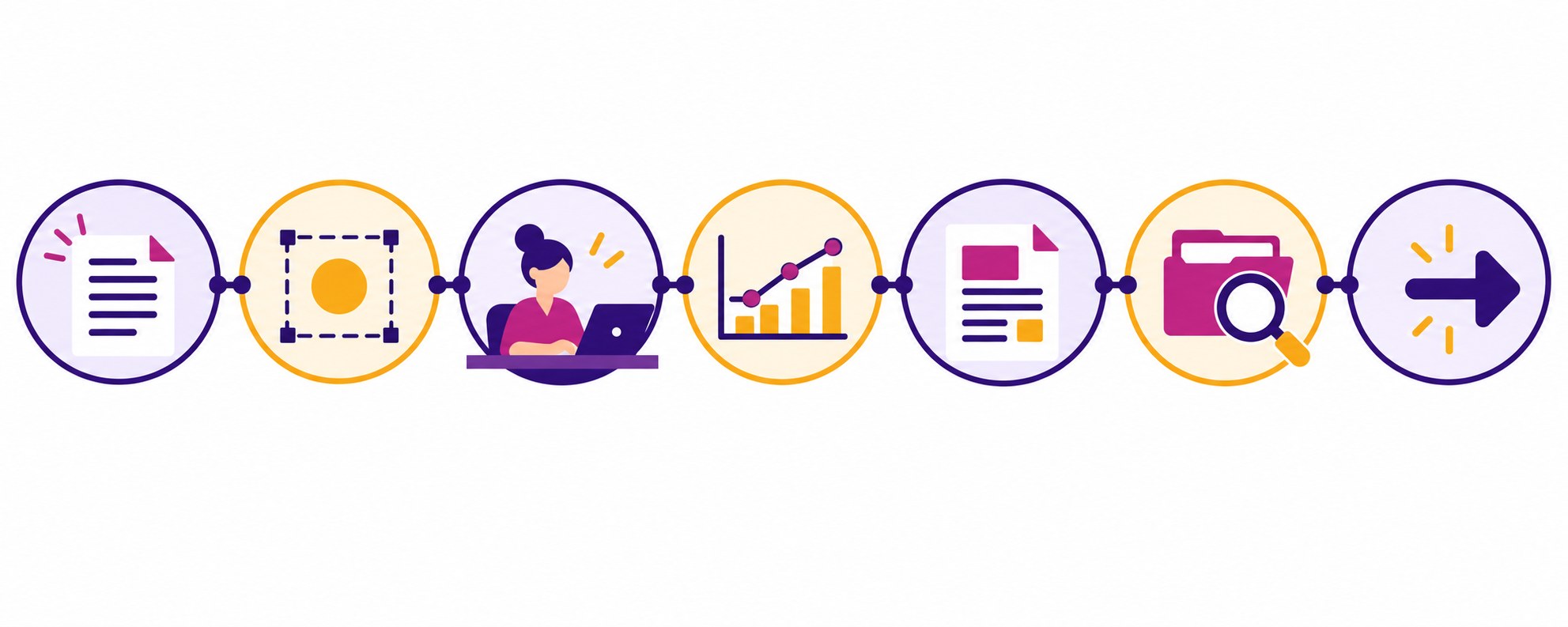
Use the same seven-part structure for each project. Consistency makes your portfolio easier to scan and forces you to separate work from results. Aim for one or two screens per case study, then link to supporting material for someone who wants detail.
- Brief: Who was the audience and what problem needed solving?
- Scope: Was this live client work, your own project, a group assignment, or a simulated brief?
- Your role: Which decisions and deliverables were yours?
- Baseline and method: What was known before you began, and what did you test or change?
- Deliverables: Show the page, creative, audit, campaign plan, or report.
- Results and limits: State the dates, source and metric definition. Say when results are unavailable.
- Next decision: What would you keep, stop, or test next, and why?
Here is a safe example for a group SEO project: “Our four-person team reviewed a local business website. I owned the search-intent map and rewrote one service page. The group presented an audit, but the client had not implemented the recommendations when we submitted it. This case study shows the proposed work and feedback, not a traffic gain.” That answer is stronger than borrowing the entire team’s work or implying an outcome nobody measured.
At Digital Scholar, students work on four real group projects in an agency-style format. That can provide material for a portfolio, but a student should show what the group was permitted to share and what they personally contributed. The online digital marketing course describes the current programme. Ask to see the project brief and review process when comparing courses, and confirm the current batch details with admissions. The guide to choosing a digital marketing course shows what project questions to ask a provider.
Frequently asked questions
Can I build a digital marketing portfolio with no experience?
Yes. Start with an owned project, a volunteer brief with permission, or a clearly labelled simulation. Your first portfolio can show research, decisions, deliverables and review feedback before it has business results. Keep the scope visible. A proposed campaign is a proposal; a published page is a published page. Neither needs an invented result to be worth discussing.
How many projects should a fresher include?
Three or four distinct case studies are a practical starting point. Choose projects that reveal different decisions, such as SEO content, social creative, a landing page, and paid media planning. If only one project has strong evidence, lead with that one and add the others as you complete them. Depth beats a long gallery of unexplained screenshots.
Do I need to spend money on ads to make a portfolio?
No. An authorised live campaign can provide valuable data, but a clear paid media plan also shows how you think. Do not spend a client’s or organisation’s money without approval. If you do run ads, agree on the budget and tracking first, then report the actual spend and outcome with dates. A plan and a result should never share the same label.
Can I put a group project in my personal portfolio?
Yes, if you have permission to share the work and accurately identify your contribution. List the team size, the common brief, your own deliverables, and any limits on sharing data. Do not claim that every group result was your personal result. The Digital Scholar syllabus describes its four group projects; each student still needs to explain their role.
Should I show AI-generated work?
Show it when it helped solve a defined task and you can explain your review. Name the input you supplied, the checks you performed, and the final human decision. If AI produced a draft that you never verified or published, label it as a draft. Employers can judge your reasoning only when you make the workflow and its limits visible.
What if my project had no measurable result?
State that result data was unavailable, then show the work and the next measurement step. You might have completed an audit but not received approval to implement it, or published a page too recently for a useful trend. That is normal. Add a date for a future check. Avoid claiming “improved SEO” when all you can verify is that a recommendation was delivered.
See the current four-month programme and its four group projects. Confirm batch details and terms before enrolling.
Build the first case study this week
Pick one audience question, one asset, and one piece of evidence. Write a brief, create the asset, and record what you can verify. Then use the seven-part case study structure above. That single case study will give you something concrete to discuss in your next interview.
If you want guided project work across SEO, ads, social media and AI, review Digital Scholar’s four-month live online programme. It includes four real group projects, with weekday and weekend options. Confirm current fees, batch dates, project permissions and support terms before enrolling.
The portfolio is a record of decisions you can defend. Start one today.