
In January 2023, NTT DATA Payment Services came to echoVME with a website that was pulling about 200 clicks and 5,836 impressions a day from Google. They were fighting for “payment gateway India” against brands with bigger budgets and older domains. We did not buy a single link. We ran a guest posting programme on relevant fintech and business sites, cleaned out the spammy backlinks the site had collected over the years, and kept publishing. By January 2024, the site was pulling 1,000+ clicks and 61,000+ impressions a day, and crossed 1 million monthly impressions in 10 months.
That result is not luck and it is not a secret. It is what happens when link building is treated as a reputation exercise instead of a numbers game. Most link building advice you will find online is written for US and UK websites. It tells you to pitch Forbes and buy “high DA guest posts” from marketplaces. In India, that playbook either costs too much or gets you penalised.
This post is the link building playbook I actually use at echoVME and teach in my Digital Scholar SEO classes. You will get my 4R Link Framework for scoring every link before you chase it, 9 strategies that work in the Indian market, a list of India-specific link sources, what I have tested that did not work, and a 90-day plan you can start this week.
- What Is Link Building in SEO?
- Why Listen to Me on Link Building
- How Google and AI Engines Read Backlinks in 2026
- The 4R Link Framework: How I Score Every Link
- 9 Link Building Strategies That Work in India
- India-Specific Link Sources Most Guides Ignore
- Link Building for Local Businesses in India
- How Backlinks and Brand Mentions Drive AI Citations
- Toxic Links: What to Avoid and How to Clean Up
- What I Have Tested and What Did Not Work
- How to Measure Link Building ROI
- The 90-Day Link Building Plan
- FAQ: Link Building in India
What Is Link Building in SEO?
Link building is the process of earning links from other websites to yours. Each link is a vote of trust. Google uses these votes to decide which pages deserve to rank, and AI engines like ChatGPT and Perplexity use the same web of links and brand mentions to decide which sources to cite. Fewer, relevant, earned links beat hundreds of paid ones.
When a respected website links to your page, it is telling Google two things. First, that your page exists and is worth crawling. Second, that someone other than you thinks it is useful. That second signal is the one you cannot fake at scale, which is exactly why it still carries so much weight.
Backlinks vs internal links
A backlink comes from another domain. An internal link connects two pages on your own site. Both matter, but they do different jobs. Backlinks bring authority into your site. Internal links distribute that authority to the pages that need it. I cover the internal side in my guide on on-page SEO techniques for your home page. This post is about the external side.
Does link building still matter in 2026?
Yes. Google has reduced its reliance on raw link counts, but it has not stopped using links. What changed is the quality bar. Google’s SpamBrain system, introduced for link spam detection in the December 2022 link spam update, now neutralises bought and manipulative links instead of just ignoring them. A link that would have moved rankings in 2015 now does nothing, or quietly hurts you.
The key insight: Links still rank pages in 2026. The difference is that one relevant, earned link now outperforms fifty bought ones, and bought ones can cost you the site.
Why Listen to Me on Link Building
I have been doing SEO for 15+ years. In that time I have ranked 10,000+ keywords across Indian markets and helped drive 20M+ organic sessions for the echoVME client portfolio, which includes Casagrand, Naturals and The Hindu. Every one of those campaigns needed links. None of them survived on bought links.
I have also cleaned up the damage when someone else did it wrong. When echoVME took on VIT Chennai, the site was competing against institutes that were spamming links and running bots. Our first job was not building links. It was removing the spammy ones already pointing at the site, then replacing them with relevant, high-quality links. That campaign ran from July 2023 to July 2024 and is one of the case studies I walk through in class.
I have trained 3,000+ SEO professionals through Digital Scholar live classes and bootcamps, and Indian Startup Times recognised me as Best SEO Expert. I teach link building from what worked, and what blew up, on real Indian websites.
How Google and AI Engines Read Backlinks in 2026
Google reads a backlink through three lenses: how relevant the linking page is to yours, how trusted the linking site is, and whether the link looks editorially earned. AI engines add a fourth lens: how often your brand is mentioned alongside a topic across the web, even without a link. Links build rankings. Mentions build AI citations.
The link attributes you need to know
In 2019, Google added rel=”sponsored” and rel=”ugc” alongside the older rel=”nofollow”. Every SEO in India should understand these before building a single link, because using the wrong one on a paid placement is a direct policy violation.
| Attribute | What it tells Google | When to use it | Passes ranking value? |
|---|---|---|---|
| rel=”nofollow” | Do not associate me with this page | Links you do not vouch for | Treated as a hint, usually minimal |
| rel=”sponsored” | This link was paid for | Paid posts, affiliate links, sponsorships | No |
| rel=”ugc” | User-generated content | Comments, forum posts, Reddit, Quora | Treated as a hint |
| No attribute (dofollow) | I editorially vouch for this page | Earned editorial links | Yes, full value |
Why AI engines care about links and mentions
When I tracked AI citations for my ChatGPT SEO research across 14 echoVME content pieces, backlink count was not what separated the cited pieces from the ignored ones. Structure, clear brand identity and trust signals were. Relevant links feed that trust layer. They do double duty: they rank you on Google and they teach AI models that your brand belongs in that topic. This is the core idea behind Generative Engine Optimization (GEO).
The 4R Link Framework: How I Score Every Link
The 4R Link Framework scores any potential link on four factors: Relevance, Reputation, Reach and Risk. Each factor gets a score from 0 to 5. A link scoring 15 or more out of 20 is worth chasing. A link scoring under 10 is a waste of time. Any link with a Risk score of 1 or lower gets rejected, whatever the total.
I built this framework after years of watching teams chase the wrong metric. Domain Authority is a third-party estimate. Google does not use it. A DA 70 site that covers everything from crypto to casinos is worth less to a Chennai real estate brand than a DA 30 site that only covers property in Tamil Nadu. The 4R score forces you to look at the link the way Google does.
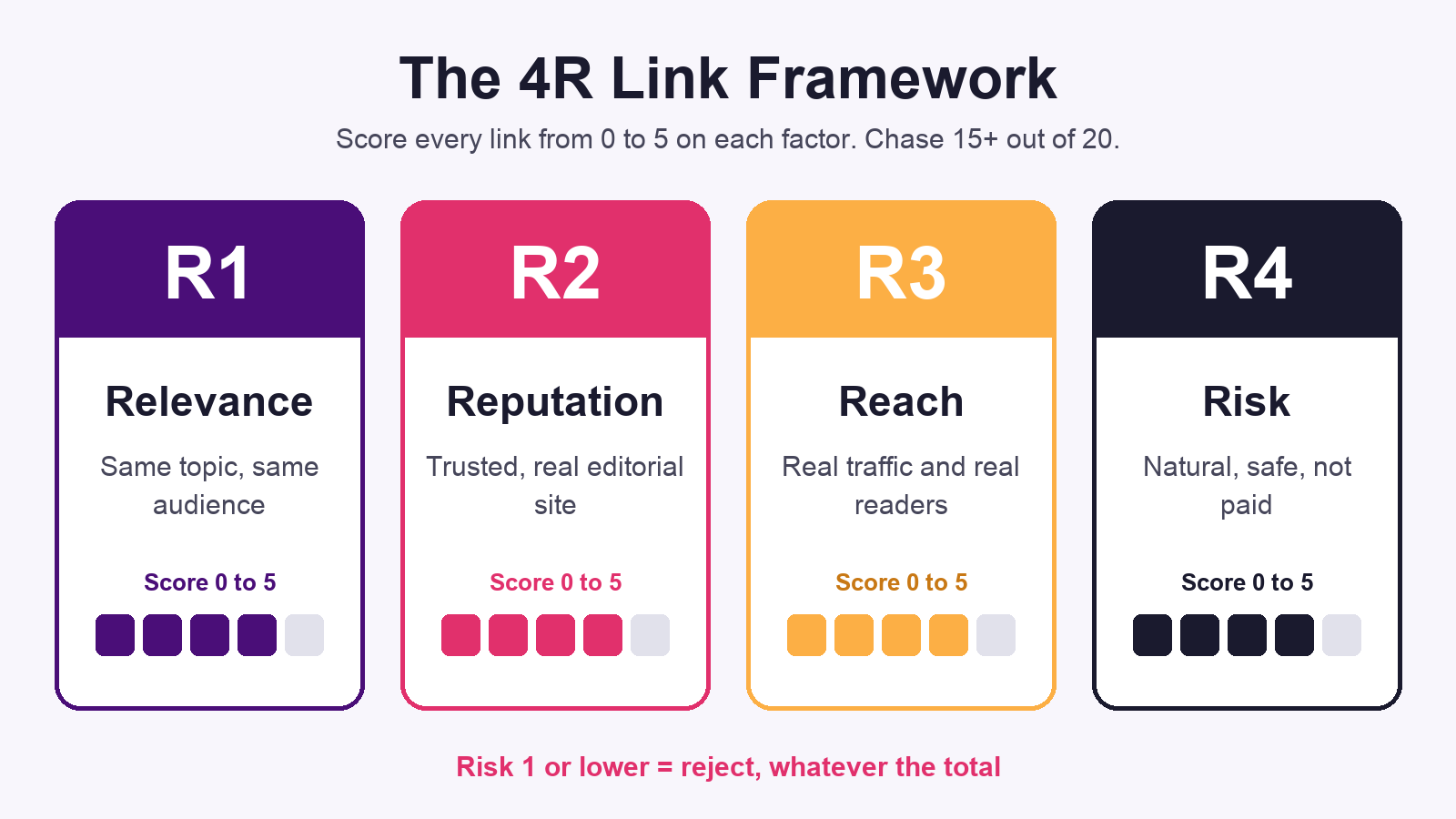
R1. Relevance (0 to 5)
Does the linking page cover your topic, and does its audience overlap with yours? A link from a fintech blog to a payment gateway scores 5. A link from a general “submit your article” site scores 0 or 1. Relevance is the factor I weight most because it is the hardest to fake.
R2. Reputation (0 to 5)
Is the site a real publication or business with editorial standards? Look for named authors, an About page, real contact details and content that is not 80% guest posts. Indian news sites, industry associations and university domains (.ac.in, .edu.in) usually score 4 or 5.
R3. Reach (0 to 5)
Does the site get real organic traffic, and does it rank for anything? A site with 50,000 backlinks and 200 monthly visitors is a link farm. A link that can send you real referral visitors is worth more than one that only exists for Google.
R4. Risk (0 to 5, higher is safer)
How natural is this link? Paid links without rel=”sponsored”, sites that sell links openly, private blog networks and exact-match anchor text all lower the Risk score. A score of 5 means the link would look completely natural to a Google reviewer.
| Link type | Relevance | Reputation | Reach | Risk | Total /20 | Verdict |
|---|---|---|---|---|---|---|
| Mention in an Indian industry publication covering your niche | 5 | 5 | 4 | 5 | 19 | Chase it |
| Guest post on a relevant niche blog with real traffic | 5 | 3 | 3 | 4 | 15 | Chase it |
| Local chamber of commerce or association listing | 4 | 4 | 2 | 5 | 15 | Chase it |
| Unlinked brand mention converted to a link | 4 | 4 | 3 | 5 | 16 | Chase it |
| “High DA” guest post bought from a marketplace | 1 | 2 | 1 | 1 | 5 | Reject |
| Bulk directory submission package | 0 | 1 | 0 | 1 | 2 | Reject |
| PBN link | 1 | 0 | 0 | 0 | 1 | Reject |
The key insight: Stop asking “what is the DA?” and start asking “would this link exist if Google did not?” If the answer is no, the 4R score will be low.
9 Link Building Strategies That Work in India
These nine strategies are the ones echoVME uses across its client portfolio and the ones I teach at Digital Scholar. They all score 15 or higher on the 4R Link Framework when done properly. Start with the first three. They deliver the fastest results for most Indian websites.
1. Guest posting on relevant Indian sites
Guest posting still works when the site is relevant and editorial. This was the core strategy behind the NTT DATA Payment Services result: 200+ clicks a day to 1,000+ clicks a day in 12 months. Pitch sites in your exact niche, write something better than their own staff would, and link to a page that genuinely adds value for their readers.
2. Digital PR with original Indian data
Indian journalists at business and trade publications need data about India. Most global studies do not break numbers down by Indian city or sector. Run a small survey, analyse your own anonymised customer data or publish a city-level report, and pitch it. One data story can earn links from several publications at once.
3. Unlinked brand mentions
Search Google for your brand name in quotes, excluding your own site. Every page that mentions your brand without linking is a warm lead. Email the author, thank them for the mention and ask them to add a link. This is the highest conversion outreach I run, because the site already likes you.
4. Broken link building
Find pages in your niche that link to dead resources. Create a better version of that resource, then tell the site owner their link is broken and offer yours as a replacement. You are fixing their problem, which is why the success rate is higher than cold outreach.
5. University and college resource pages
Indian universities publish resource pages, placement partner lists and industry collaboration pages. If you run training, scholarships, internships or industry sessions, these .ac.in and .edu.in links are among the most trusted you can earn.
6. Local citations and business listings
For local businesses, consistent listings on Justdial, Sulekha, IndiaMART and industry directories build both links and local trust. These links carry modest ranking value on their own, but they support your Google Business Profile. I cover the full system in my local SEO India guide.
7. Community links from Reddit and Quora
Links from Reddit and Quora carry rel=”ugc” or nofollow, so they pass little direct ranking value. They do drive referral traffic, and they put your brand in the exact places AI engines pull answers from. My community SEO guide explains how to do this without getting banned.
8. Linkable assets
Free calculators, templates, salary guides and checklists earn links on autopilot. Our digital marketing salary guide for Chennai is an example of the format: specific, data-heavy and worth citing.
9. Partner, supplier and client links
Your suppliers, distributors, technology partners and clients often have “partners” or “case studies” pages. Ask for a link. These are relevant by definition and score high on Risk because the business relationship is real.
| Strategy | Effort | Time to first link | Best for |
|---|---|---|---|
| Guest posting | Medium | 2 to 4 weeks | B2B, SaaS, fintech, education |
| Digital PR with Indian data | High | 4 to 8 weeks | Brands with data or a story |
| Unlinked brand mentions | Low | 1 to 2 weeks | Any brand that gets press |
| Broken link building | Medium | 3 to 6 weeks | Content-heavy niches |
| University resource pages | Medium | 4 to 8 weeks | Training, careers, education |
| Local citations | Low | 1 week | Local businesses, clinics, retail |
| Reddit and Quora | Medium | 1 to 2 weeks | Visibility and AI citations |
| Linkable assets | High | 6 to 12 weeks | Long-term authority |
| Partner and supplier links | Low | 1 to 3 weeks | B2B and manufacturing |
India-Specific Link Sources Most Guides Ignore
Most link building guides are written for US websites, so they never mention the sources that work best in India. These are the link sources I recommend to Digital Scholar students and use for echoVME clients. They are grouped by type so you can match them to your business.
| Source type | Examples | Typical attribute | 4R fit |
|---|---|---|---|
| Startup and business media | YourStory, Inc42, regional business dailies | Dofollow or nofollow, editorial | High |
| Industry associations | NASSCOM, CII, FICCI, state chambers of commerce | Usually dofollow | High |
| University domains | .ac.in and .edu.in resource and partner pages | Usually dofollow | High |
| Business directories | Justdial, Sulekha, IndiaMART, TradeIndia | Often nofollow | Medium |
| Regional language media | Tamil, Hindi, Telugu and other regional news portals | Mixed | High for local brands |
| Community platforms | Reddit India subreddits, Quora, niche forums | ugc or nofollow | Medium, strong for AI citations |
| Government and event pages | Startup India, trade fair and expo exhibitor lists | Mixed | Medium to high |
Link Building for Local Businesses in India
Local link building means earning links from websites tied to your city or area: local news, associations, events, directories and nearby businesses. For a clinic in Anna Nagar or a restaurant in Coimbatore, 10 local links from the right sources will often move rankings more than 50 national links from unrelated sites.
When echoVME worked with Kachins Couture, a menswear brand, we combined Google Business Profile work with consistent local content and listings. The site started at 542 impressions a day and grew to an audience reach of 377,000 impressions between July and December 2023. Local listings and consistent profiles supported that growth. They did not replace good content.
The local link checklist
- List your business on Justdial, Sulekha and your industry directory with identical name, address and phone number.
- Join your local chamber of commerce or trade association and request a member listing.
- Sponsor or speak at one local event per quarter and ask for a link from the event page.
- Partner with nearby non-competing businesses on a guide or offer and link to each other’s pages.
- Pitch your local news portal when you have genuine local news, such as an opening, a hiring drive or local data.
How Backlinks and Brand Mentions Drive AI Citations
Backlinks help AI citations in two ways. They help your pages rank on Google, which feeds Google AI Overviews and the live search results that ChatGPT and Perplexity pull from. They also spread your brand name across trusted sites, which teaches AI models that your brand is associated with a topic. Mentions on relevant sites matter even without a link.
Students from my Digital Scholar classes have ranked pages in Google AI Overviews, shown up in Claude citations and hit Reddit front pages within days of applying these techniques. In every case, the page already had a clear structure and a brand that was mentioned elsewhere on the web. Links and mentions were the reason the AI engine trusted the source enough to cite it.
| Signal | Effect on Google rankings | Effect on AI citations |
|---|---|---|
| Dofollow link from a relevant site | Strong | Strong, through Google rankings and brand association |
| Nofollow link from a trusted publication | Weak | Medium, the mention still counts |
| Unlinked brand mention in a niche article | Minimal | Medium to strong |
| Reddit or Quora answer naming your brand | Minimal | Strong on Perplexity and ChatGPT |
| Bought link on an irrelevant site | None or negative | None |
If you want the full AI citation playbook, read my guide to ranking in Google AI Overviews and my explainer on AEO in SEO. Link building is the off-page half of both.
The key insight: In the AI search era, link building and brand building are the same job. Every relevant link is also a brand mention that AI engines can learn from.
Toxic Links: What to Avoid and How to Clean Up
Toxic links are backlinks that break Google’s spam policies or look manipulative: paid links without rel=”sponsored”, private blog networks, link exchanges at scale, hacked-site links and spammy directories. Most toxic links today are simply ignored by Google. The ones worth acting on are those from link schemes you or a previous agency built deliberately.
How to audit your backlink profile
Export your links from Google Search Console under Links, then check them in a backlink tool. Flag anything that meets two or more of these criteria: the site sells links openly, the content has nothing to do with yours, the anchor text is an exact-match commercial keyword, or the site has no real traffic.
When to use the disavow tool
Use Google’s disavow tool only when you have a manual action in Search Console, or when you know a previous agency built links through a scheme. Do not disavow links just because a third-party tool gives them a high “toxicity” score. I have seen teams disavow perfectly good links on a tool’s advice and lose rankings.
| Warning sign | Risk level | Action |
|---|---|---|
| Manual action in Search Console for unnatural links | Critical | Remove links where possible, then disavow and request review |
| Hundreds of links from a PBN built by a previous agency | High | Disavow the domains |
| Sudden spike in links from foreign spam sites | Low | Usually ignore, Google already discounts these |
| Low-quality directory links from years ago | Low | Ignore unless there is a manual action |
| High “toxic score” in a third-party tool only | Low | Review manually before doing anything |
For the full picture of how trust signals work beyond links, see my guide on E-E-A-T in SEO.
What I Have Tested and What Did Not Work
Not every link building tactic I have tried has worked. Some of the most popular tactics in India are the ones I stopped using first. Here is what I dropped, and why.
Bulk directory and bookmarking submissions
Early in my career, directory and social bookmarking submissions were standard in every Indian SEO package. Clients loved them because the reports showed hundreds of links. Rankings did not move. Today these links are ignored at best. If an agency still sells “500 directory submissions” in its package, that tells you how old its playbook is.
Buying “high DA” guest posts from marketplaces
Marketplace guest posts look cheap and clean on a spreadsheet. In practice, the same sites sell to hundreds of buyers, cover every topic and have almost no real readers. They score around 5 out of 20 on the 4R framework. I stopped recommending them because they failed the Relevance test every single time.
Chasing links before fixing the site
This one is an imperfect truth. I have had campaigns where we earned good links and rankings still stalled, because the site had crawl and indexing problems. With Durapak, most target keywords were not even indexed when we started in November 2022. Fixing the technical base first is what let the keywords reach the top 10 within 6+ months. Links cannot rank a page Google cannot crawl. Start with my technical SEO India guide if you are unsure.
How to Measure Link Building ROI
Measure link building by outcomes, not link counts. The metrics that matter are referring domains from relevant sites, ranking movement for the pages you linked to, organic clicks and impressions in Search Console, referral traffic and brand mentions in AI answers. A link report that only shows total backlinks tells you almost nothing.
When echoVME worked with Cookd, a Chennai food brand, we tracked organic traffic alongside links and on-page work. Organic traffic grew 2.3x in 3 months, from a starting base of 1,085, between April and July 2023. That is the kind of number a link building report should lead with.
| Metric | Where to track it | Review frequency | What good looks like |
|---|---|---|---|
| Relevant referring domains | Backlink tool, Search Console Links | Monthly | Steady growth, mostly 4R score 15+ |
| Rankings for target pages | Rank tracker | Weekly | Linked pages moving up within 4 to 12 weeks |
| Organic clicks and impressions | Google Search Console | Weekly | Upward trend on linked pages |
| Referral traffic | GA4 | Monthly | Real visits from the linking sites |
| AI citations and mentions | Manual checks in ChatGPT, Perplexity, Google AI Overviews | Monthly | Brand appears for target queries |
The 90-Day Link Building Plan
The 90-day plan runs in three phases: audit and fix in month one, earn easy links in month two, then scale with PR and assets in month three. A realistic target for a small Indian business is 10 to 20 new relevant referring domains in 90 days, all scoring 15 or higher on the 4R framework.
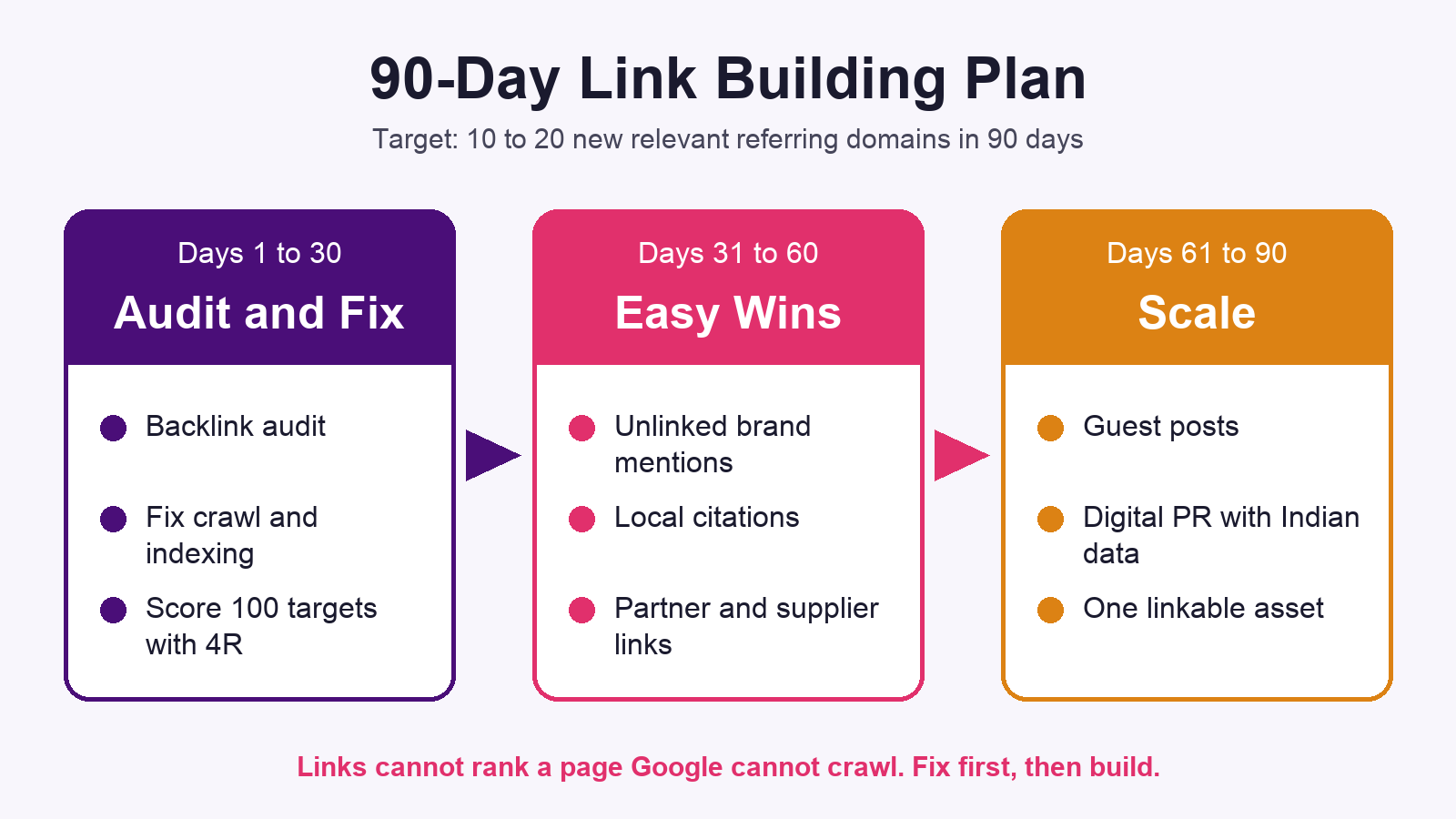
| Phase | Days | Actions | Target |
|---|---|---|---|
| Audit and fix | 1 to 30 | Export backlinks, check for manual actions, fix crawl and indexing issues, build a list of 100 target sites scored with 4R | Clean profile, 100 scored targets |
| Easy wins | 31 to 60 | Convert unlinked mentions, complete local citations, ask partners and suppliers for links | 5 to 10 new referring domains |
| Scale | 61 to 90 | Pitch guest posts, launch one data story for digital PR, publish one linkable asset | 5 to 10 more referring domains |
If you are building a career in SEO, link building is one of the skills that separates juniors from seniors. My guide on how to become an AI SEO expert shows where it fits in the full skill set, and my keyword research guide for India shows how to pick the pages worth building links to.
FAQ: Link Building in India
What is link building in SEO?
Link building is the process of earning links from other websites to your own. Google treats each relevant link as a vote of trust and uses those votes to decide which pages rank. At echoVME, we focus on links from sites that share your topic and audience, because one relevant link beats dozens of unrelated ones. It is the main part of off-page SEO.
Is link building still important in 2026?
Yes. Links remain one of Google’s strongest ranking signals, but the quality bar is much higher. Google’s SpamBrain system neutralises bought and manipulative links, so only relevant, earned links move rankings. Links now also matter for AI search, because they spread your brand across trusted sites that ChatGPT, Perplexity and Google AI Overviews draw from.
How many backlinks do I need to rank on Google?
There is no fixed number. It depends on how many relevant referring domains the pages already ranking for your keyword have. Check the top 5 results in a backlink tool and look at referring domains, not total links. For many local and niche keywords in India, 10 to 20 relevant referring domains combined with strong content is enough to compete.
Are paid backlinks safe?
Paid links that pass ranking value break Google’s spam policies. If you pay for a placement, it must carry rel=”sponsored”, which means it passes no ranking value. Marketplace “high DA” guest posts sold without that attribute are the most common way Indian websites put themselves at risk. I do not recommend them to echoVME clients or Digital Scholar students.
What is the difference between dofollow and nofollow links?
A dofollow link has no rel attribute and passes ranking value. A nofollow link carries rel=”nofollow” and Google treats it only as a hint. Nofollow links from trusted publications, Reddit and Quora still help: they send referral traffic and create brand mentions that AI engines notice. A natural backlink profile has a mix of both.
How long does link building take to show results?
Most sites see ranking movement on linked pages within 4 to 12 weeks, depending on competition and how quickly Google recrawls the linking pages. In the NTT DATA Payment Services campaign, echoVME took daily clicks from 200+ to 1,000+ over 12 months. Link building compounds. The first 90 days build the base for the next year.
How can I get backlinks for free in India?
Start with unlinked brand mentions, local citations on Justdial and Sulekha, partner and supplier pages, and industry association listings. Then create one useful resource, like a calculator or a city-level data report, that other sites want to cite. All of these cost time, not money, and they score high on the 4R Link Framework.
Do backlinks help with ChatGPT and Google AI Overviews?
Yes, indirectly. Backlinks help your pages rank on Google, and AI Overviews and live AI search draw heavily from top-ranking pages. Links and mentions on trusted sites also build the brand association that makes AI engines cite you. My guide on using AI for SEO on the Digital Scholar blog covers the tools side of this.
Link building in India is at a turning point. Google has made bought links useless, and AI search now rewards the brands that are mentioned most often on the sites people trust. Those two changes point to the same strategy: earn relevant links, build a reputation, and let the rankings and AI citations follow.
Your action for this week: pick your 5 most important pages, list 20 sites that should link to each, and score every one of them with the 4R Link Framework. Chase only the ones scoring 15 or higher. You will send fewer emails and earn better links.
If you want to see how these frameworks work in live audits and real client accounts, connect with me on LinkedIn: https://www.linkedin.com/in/trainerkarthik/
Learn Link Building, Technical SEO and AI Search in One Program
The Digital Scholar SEO program covers the 4R Link Framework, outreach, digital PR, technical SEO and AI citation optimization in live, hands-on sessions built on real echoVME client work. Learn SEO with Karthikeyan Maruthai (Head of SEO, echoVME), AI marketing with Rishi Jain (Co-Founder, Digital Scholar), and Social Media with Sorav Jain (Founder, echoVME). 3,000+ students trained. Placement support included.
Explore the Digital Scholar Program