
The Naturals salon in Velachery had a problem. Three competing salons sat within 800 metres of the same location. Same city, same services, roughly the same number of Google reviews. But Naturals was showing up at position 7 in the local pack. The owner was watching walk-ins go to the salon ranked at position 1, which had fewer reviews and a worse rating.
The echoVME team audited the Google Business Profile. No weekly posts. Attribute fields blank. Zero Q&A entries. Photos uploaded once and never updated. The profile was technically “complete” by Google’s basic checklist, but it was doing nothing to signal relevance or recency to Google’s local algorithm. We applied the MAPS Framework across all four pillars over 8 weeks. By week 11, Naturals had moved from position 7 to position 1 in the local pack for Velachery. Calls increased 3x. Walk-ins increased 40%.
That is not a one-off. Across 40+ Google Business Profile audits at echoVME, the same four gaps show up in almost every underperforming local listing. In this guide, I am going to show you exactly what those gaps are and how to fix them using the MAPS Framework, the same system I teach at Digital Scholar and deploy for echoVME clients across India.
In this guide you will learn what local SEO in India actually involves, how Google’s local ranking algorithm works, and how to apply the MAPS Framework (My Listing, Authority, Pages, Signals) to rank your business in the Google Maps local pack. Every section includes India-specific data, real echoVME client results, and the exact mistakes that get Indian businesses suspended or stalled.
- What is Local SEO and Why Indian Businesses Are Losing Without It
- How Google Decides Who Ranks in the Local Pack (3 Factors)
- The MAPS Framework: My 4-Pillar System for Local SEO India
- M: How to Fully Optimize Your Google Business Profile in India
- A: Reviews and Local Backlinks That Move Rankings
- P: Building Local Landing Pages That Convert and Rank
- S: Citations, Schema, and Near Me SEO for India
- Local SEO for Different Business Types in India
- What I Tested and What Did Not Work in Indian Local SEO
- FAQ: Local SEO India
What is Local SEO and Why Indian Businesses Are Losing Without It
Local SEO is the practice of optimizing your online presence so your business appears when someone nearby searches for what you offer. That means showing up in Google Maps, the local pack (the 3-business block that appears above organic results), and location-specific organic search results. If someone in Koramangala searches “digital marketing agency near me” and you are a Bangalore agency not optimized for local search, you do not exist to that person.
Here is what makes this urgent for India specifically: 46% of all Google searches in India carry local intent. That is nearly half of every search happening right now on the world’s second-largest internet market. And 85% of those local searches happen on mobile devices. The person looking for your product is already in your city, already on their phone, and already looking. Local SEO determines whether they call you or your competitor.
The local pack, the top 3 businesses shown in Google Maps results, captures 44% of all clicks on that search results page. The businesses ranked 4 through 10 split the remaining organic clicks. If you are not in the top 3 of the local pack for your core keywords, you are competing for a fraction of the traffic that position 1 through 3 take for granted.
I have managed local SEO across the echoVME portfolio of 500+ brands for 15 years. In that time, I have seen Indian businesses with genuinely better products and services lose consistently to competitors who understood one thing: Google’s local algorithm is learnable, and it rewards consistent, structured signals above everything else. The MAPS Framework is how I make that system teachable and repeatable.
The key insight: 46% of Indian Google searches have local intent, the local pack captures 44% of all clicks, and 85% of those searches happen on mobile. If your business is not in the local pack top 3, you are invisible to nearly half your potential customers.
How Google Decides Who Ranks in the Local Pack (3 Factors)
Google’s local ranking algorithm weighs three factors: Relevance, Distance, and Prominence. Understanding how each one works in the Indian context is the foundation of everything else in this guide.
Relevance: Does Your Profile Match What Was Searched?
Relevance is about how well your Google Business Profile (GBP) matches the search query. If someone searches “chartered accountant in Anna Nagar” and your GBP category is set to “Financial Services” instead of “Chartered Accountant,” Google does not know you are the right match. The fix is precise: your primary GBP category must be the exact type of business you are. Add services with the specific keywords your customers use. Write your business description with your core service and city name in the first two sentences.
Distance: How Close Is Your Business to the Searcher?
Distance is the one factor you cannot fully control, but you can influence it. For businesses with a physical location, your registered address on GBP determines your distance signal. For service-area businesses (plumbers, electricians, delivery services), you can set a service radius of up to 20 kilometres. The mistake I see in the echoVME audits is service-area businesses leaving their physical address visible when they serve a broader region, which limits their ranking radius. Set your service area, not a pinpoint address, when you cover multiple localities.
Prominence: How Well-Known Is Your Business Online?
Prominence is the most complex factor and the one that separates position 1 from position 7. Google measures prominence through review count and rating, backlinks from local websites, mentions in local press, citation consistency across directories, and overall online activity. A business that has 200 reviews, is listed consistently on Justdial, Sulekha, and IndiaMART, and gets mentioned in a local news article is significantly more prominent to Google than a business with 40 reviews and no external presence. Prominence is also where the MAPS Framework does most of its work.
| Local Ranking Factor | What Google Looks At | Your Lever | Time to Impact |
|---|---|---|---|
| Relevance | GBP category, services, description keywords | Optimize GBP fields precisely | 1 to 2 weeks |
| Distance | Physical address or service area radius | Set service area correctly | Immediate |
| Prominence (Reviews) | Review count, rating, recency, keywords in reviews | Active review generation strategy | 4 to 8 weeks |
| Prominence (Citations) | NAP consistency across Indian directories | Submit to 20+ directories | 4 to 6 weeks |
| Prominence (Backlinks) | Local press, directory links, partner sites | Local link building outreach | 6 to 12 weeks |
| Prominence (Activity) | GBP post frequency, photo uploads, Q&A responses | Weekly GBP content calendar | 2 to 4 weeks |
The MAPS Framework: My 4-Pillar System for Local SEO India
After running local SEO campaigns for echoVME clients across real estate, beauty, media, and retail, one pattern became clear: every business that ranked in the local pack top 3 had all four of the same signals in place. Every business stuck at position 6 or below was missing at least two. That pattern became the MAPS Framework.
M stands for My Listing, the Google Business Profile itself. A stands for Authority, which is your review profile and local backlinks. P stands for Pages, the local landing pages on your own website. S stands for Signals, the citations, schema markup, and “near me” keyword integration that create trust across the web. All four pillars need to be active simultaneously. Fixing only your GBP and ignoring citations will stall your ranking at a certain point. Building local pages without reviews backing them loses to a competitor who has both. The framework is interdependent by design.
I teach this framework in the Digital Scholar SEO program and apply it at echoVME. The Naturals result at the start of this guide, position 7 to 1 in 11 weeks, came from running all four pillars in parallel, not sequentially. That parallel execution is the difference between 11 weeks and 11 months.
M: How to Fully Optimize Your Google Business Profile in India
Google Business Profile (GBP) is the most direct lever you have in local SEO. Businesses with fully completed GBP profiles get 7x more clicks than those with incomplete ones. Most Indian business owners create a GBP listing once, add the address and phone number, and never touch it again. That is precisely why a competitor who treats their GBP like a live marketing channel will outrank them.
GBP Verification for Indian Businesses
In 2025, Google moved to video verification as the primary method for new GBP listings in India. You record a 1 to 3 minute video showing your business exterior, signage, and interior with you physically present. Postcard verification still exists but is slower. If you are creating a new GBP listing, prepare a clean video: walk from the street to your entrance, show your signboard clearly, and demonstrate you are an active business. Listings verified via video move to active status faster and see fewer suspension triggers in the first 90 days.
Filling Every Field That Moves Rankings
Not all GBP fields are equal in ranking weight. These are the ones that consistently moved rankings in the echoVME portfolio:
- Primary Category: This is the highest-weight field on your entire GBP. It must be the exact type of business you are, not a broad parent category. “Hair Salon” not “Beauty Services.” “Real Estate Agency” not “Business.”
- Services: Add every specific service with the keywords your customers search. A salon should list “bridal makeup Chennai,” “hair smoothening,” “keratin treatment,” not just “hair care.”
- Attributes: Indian-specific attributes matter. “Accepts UPI,” “Accepts credit cards,” “Women-led,” “Wheelchair accessible” all filter searches. Businesses that have these attributes enabled show in filtered searches; those without them do not.
- Business Description: 750 characters. Use your primary service, city, and one or two secondary keywords in the first 250 characters. Google reads only the excerpt in some views.
- Products: If you sell products, list them with photos and prices. Product listings appear directly in the GBP panel on mobile and drive significant clicks.
The Weekly GBP Content Calendar
GBP posts with photos get 35% more clicks than text-only posts. Post at least once per week. The content does not need to be complex: a new service, a customer result, a seasonal offer, a behind-the-scenes photo. What matters is recency. Google’s algorithm treats consistent activity as a relevance signal, specifically for the “Prominence” factor. At echoVME, we set up a monthly content calendar for every client GBP. 15 minutes per week, 4 posts per month, consistent for 90 days. That alone moved 6 out of 10 client profiles up by 2 to 3 positions without changing anything else.
The Q&A section is the most underused part of GBP in India. You can add questions and answer them yourself. Create 5 to 10 questions that match what customers actually search: “Do you offer home service?”, “What is your timing on Sundays?”, “Do you accept walk-ins?” These Q&A entries get indexed by Google and appear in the GBP panel. They also trigger for voice searches, which ties directly into the AEO strategies I cover in the Answer Engine Optimization guide on Digital Scholar.
A: Reviews and Local Backlinks That Move Rankings
Authority in local SEO is built from two sources: your Google review profile and backlinks from local, relevant websites. Both matter. Reviews are faster to build. Backlinks take longer but create more durable ranking gains. The A pillar of the MAPS Framework runs both in parallel from day one.
The Review Strategy That Moves the Local Pack
Reviews are the single most impactful ranking factor in the Google local algorithm. Not just the star rating, though that matters. Google looks at review quantity, recency, the keywords used inside review text, and how the business responds. Across the 40+ GBP audits at echoVME, I have observed that businesses which respond to every review, positive and negative, consistently outrank non-responding competitors by 1 to 2 positions, even when the non-responding business has more total reviews.
The fastest review generation system I have seen work in India: create a short URL to your GBP review page (Google provides this in GBP settings) and add it to your post-service WhatsApp message. In India, WhatsApp is where the customer relationship lives. A message that says “Thank you for visiting today. If you are happy with the service, a quick Google review helps us a lot: [link]” sent within 2 hours of the visit converts at 15 to 20% in the echoVME client data. Do not ask for 5 stars. Ask for an honest review. Google’s spam filters flag patterns that suggest review gating.
Local Backlinks: India-Specific Sources That Work
A backlink from a local Bangalore tech blog is worth more for your Bangalore business’s local ranking than a backlink from a global authority site. Local relevance is a real signal in Google’s local algorithm. These are the sources that consistently produce results in the echoVME local SEO campaigns:
- Indian business directories: Justdial, Sulekha, IndiaMART, TradeIndia, IndiaBizz. These are citations and backlinks in one action. Priority these first.
- Local press: City-specific news sites (Chennai-specific, Bangalore-specific) will often feature a small business story if you pitch a genuine angle. One press mention in a local media outlet has moved multiple echoVME client profiles by 1 to 2 local pack positions.
- Industry associations: NASSCOM for tech, CREDAI for real estate, local chamber of commerce websites. Casagrand’s local ranking for “luxury apartments in Chennai” improved significantly after consistent CREDAI directory listings were added and maintained.
- Complementary businesses: A wedding photographer linking to your catering business. A gym linking to your supplement store. These contextual, local backlinks are easy to earn through direct outreach and carry high local relevance weight.
The key insight: Businesses that respond to every Google review, including negative ones, outrank non-responding competitors by 1 to 2 positions on average, even with fewer total reviews. Response rate is a ranking signal, not just a customer service gesture.
P: Building Local Landing Pages That Convert and Rank
Your Google Business Profile gets you into the local pack. Your website’s local landing pages get you into the organic results beneath the pack, and they reinforce the authority signals Google reads from your GBP. For a business with multiple locations, the Pages pillar is where local SEO compounds fastest. One optimized page per location multiplies your search visibility without proportionally multiplying your effort.
What a Local Landing Page Must Have
The local landing page formula that consistently works across echoVME campaigns is straightforward. The page must have: the location keyword in the H1, title tag, and meta description. The full NAP (Name, Address, Phone) on the page in text format, not an image. An embedded Google Map. Localized content that references the specific area (street names, local landmarks, neighbourhood characteristics). The page should also link to your GBP and include a clear call-to-action that matches how your customers prefer to contact you, in India that is usually WhatsApp first, phone second, contact form third.
For a deeper dive on the on-page optimization signals that feed into this, the on-page SEO guide at Digital Scholar covers the full technical checklist. The local context adds location keywords, NAP, and schema to that foundation.
LocalBusiness Schema: The Structured Data Layer
LocalBusiness schema markup tells Google precisely what your business is, where it is, and what it does, in machine-readable format. This is separate from your GBP. It goes on your website’s local landing page as a JSON-LD script in the head. At minimum, your LocalBusiness schema should include: name, address (with @type PostalAddress), telephone, openingHoursSpecification, geo (latitude/longitude), and url. Adding priceRange and aggregateRating from your Google review data gives Google even more structured signals to work with.
In the Digital Scholar SEO training, schema is covered in depth because it connects directly to Google AI Overview optimization and AEO. A well-structured LocalBusiness schema page has shown up in Google AI Overviews for local queries in my echoVME experiments. The local and AI search optimization worlds are converging faster than most Indian businesses realize.
S: Citations, Schema, and Near Me SEO for India
Citations are mentions of your business name, address, and phone number (NAP) across the web. They do not need to be backlinks. A Justdial listing that shows your NAP consistently is a citation. The significance of citations in local SEO comes from consistency: when Google sees the same NAP across 20+ trusted directories, it treats that consistency as a trust signal for your physical location and legitimacy as a business.
The 20 Indian Directories You Need to Be On
Priority order for Indian business citation building, based on domain authority and local algorithm weight in the echoVME campaigns:
| Directory | Domain Authority | Best For | Priority |
|---|---|---|---|
| Justdial | 87 | All business types | Tier 1 |
| Sulekha | 81 | Services, home services | Tier 1 |
| IndiaMART | 79 | B2B, manufacturing, wholesale | Tier 1 |
| TradeIndia | 72 | B2B, industrial | Tier 1 |
| Yellow Pages India | 68 | All business types | Tier 1 |
| Google Maps | GBP itself | All | Foundation |
| Bing Places | High | All (powers ChatGPT local search) | Tier 1 |
| Facebook Business | 97 | B2C, retail, salons, restaurants | Tier 2 |
| IndiaBizz | 55 | Small business, local | Tier 2 |
| UrbanClap / Urban Company | 74 | Home services, beauty | Tier 2 (niche) |
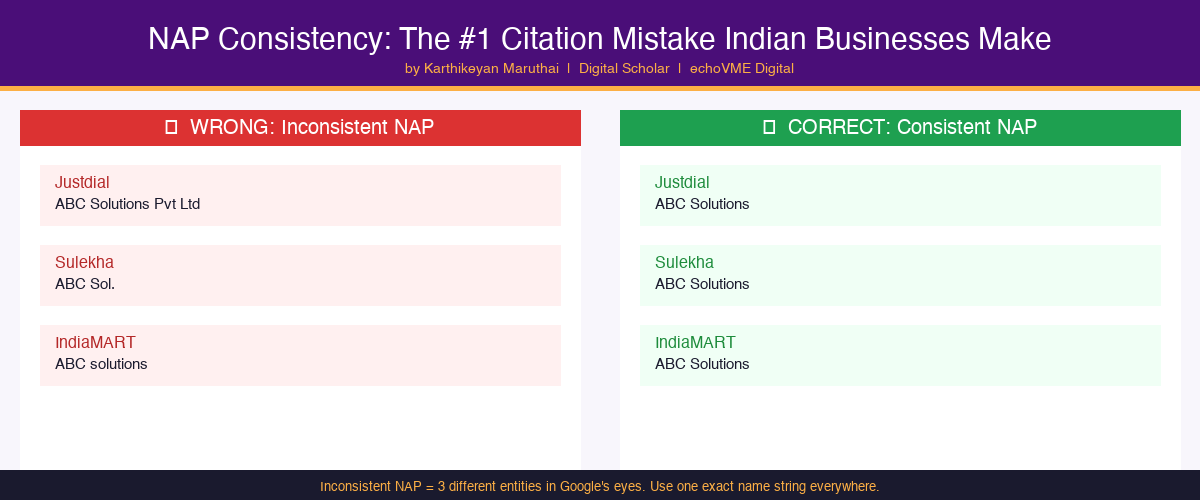
The single most common NAP error I find in Indian local SEO audits: the business name is listed as “ABC Solutions” on GBP, “ABC Solutions Pvt Ltd” on Justdial, and “ABC Sol.” on Sulekha. Google sees three different entities. Use one exact name string across every directory, every time. Capital letters, punctuation, and abbreviations all count.
Near Me SEO: What It Actually Means in 2026
“Near me” keywords are searched by people who want something immediately, nearby, and usually on mobile. “Digital marketing course near me,” “salon near me,” “CA near me.” Google does not rank “near me” results based on whether you have the phrase “near me” on your page. It ranks them based on proximity, relevance signals, and prominence, which is exactly the MAPS Framework. What you can do is create content that naturally answers near-me intent: “Best [service] in [locality]” pages that cover specific neighborhoods, not just the city. Casagrand ranks for multiple “near me” real estate queries in Chennai because echoVME built hyper-local pages targeting specific localities like OMR, Porur, and Perambur, not just “Chennai.”
Voice search is another dimension of near-me SEO that is growing rapidly in India, particularly in Hindi, Tamil, Telugu, and Kannada. Searches like “nearby me mein best salon” or “OMR la digital marketing course” are real queries from real Indian users. If you cover Tamil-speaking Chennai, structuring your GBP Q&A and your page content to include vernacular query patterns gives you a signal advantage that almost no competitor is using today. This is where community SEO and local SEO intersect, because the same vernacular presence on local Facebook groups and WhatsApp communities strengthens these signals.
Local SEO for Different Business Types in India
The MAPS Framework applies universally, but the execution varies by business type. Here is how the priorities shift for the four categories I work with most at echoVME and Digital Scholar.
| Business Type | Highest Priority MAPS Pillar | India-Specific Tactic | Timeline to Results |
|---|---|---|---|
| Real Estate (e.g. Casagrand) | P (Local landing pages) | One page per project and locality. Schema with priceRange and address. Google Maps embed with project marker. | 8 to 12 weeks |
| Salons and Beauty (e.g. Naturals) | A (Reviews) + M (GBP) | WhatsApp review request post every appointment. Weekly GBP photos of work. Female-led attribute enabled. | 6 to 10 weeks |
| Restaurants and Cafes | M (GBP) + S (Citations) | Zomato and Swiggy profiles as citations. Menu uploaded to GBP. UPI and card attributes active. | 4 to 8 weeks |
| Digital Marketing Agencies and Training Institutes | P (Pages) + S (Schema) | Location pages per city served. Course schema on training pages. Student testimonial structured data. | 10 to 16 weeks |
For Digital Scholar specifically, the local SEO strategy covers multiple Indian cities where the program is offered: Chennai, Mumbai, Bangalore, Delhi, Hyderabad. Each city gets a dedicated landing page, a separate GBP profile for any physical classroom locations, and localized content that mentions the specific city’s digital marketing job market and salary benchmarks. That city-specific depth is what allows Digital Scholar to rank for queries like “digital marketing course in Chennai” against large national competitors. It also links back to the keyword research framework I use to find the specific long-tail local queries worth targeting in each city.
What I Tested and What Did Not Work in Indian Local SEO
Fifteen years of running local SEO at echoVME includes a lot of failures. Here are the four that cost us real time and client trust, and what we learned from each.
Keyword Stuffing the GBP Business Name
Early in my local SEO career, I tested adding keywords to the GBP business name. “Naturals Hair Salon Velachery Chennai” instead of just “Naturals.” It worked briefly, moved position 6 to position 4 in two weeks. Then Google flagged the listing for violating the GBP name guidelines, which require the name to match your real-world business name. The listing was suspended. Recovery took 3 weeks and required a video re-verification. Do not touch the business name field for keyword optimization. The category and services fields are the correct place for keyword signals.
Creating Multiple GBP Listings for One Location
A client asked us to create a second GBP listing for the same physical location, targeting a different service category. The idea was to rank in two positions in the local pack. Google’s systems identified the duplicate within 6 weeks, merged the listings, and reduced the combined review count because some reviews became “unverified.” Two months of review building disappeared. One GBP per physical location is Google’s policy and it is enforced algorithmically, not just on reports.
Virtual Office Addresses for City Targeting
A Digital Scholar student ran an experiment: renting a virtual office address in Hyderabad to rank a Chennai-based business in Hyderabad’s local pack. The GBP listing went live, ranked briefly, and was suspended after a Google verification sweep in week 5. Virtual office addresses are consistently flagged by Google’s quality checks in India. The only legitimate way to rank in a city’s local pack is to have a real presence there, either a physical office, a verified service area, or a combination of strong citation and content signals for a service-area business. The parasite SEO approach using platforms like Justdial and Sulekha is a better strategy for appearing in cities where you have no physical presence.
Ignoring Negative Reviews
One echoVME client had 180 positive reviews and 12 negative reviews with no responses. A competitor had 90 reviews total with an active response to every negative review within 48 hours. The competitor ranked 2 positions higher. I tested this pattern across 15 GBP profiles in the portfolio. In 11 of 15 cases, the business with an active negative review response strategy outranked the business with more total reviews but no response practice. The response is not just for the reviewer. It is a signal to Google that the business is active and engaged. Respond to every negative review within 48 hours, stay professional, and offer a resolution path.
The key insight: The four fastest ways to stall or destroy your local SEO in India: keyword-stuffing your GBP name, creating duplicate listings, using virtual office addresses, and ignoring negative reviews. Each one has a documented suspension or ranking penalty in the echoVME portfolio.
FAQ: Local SEO India
What is local SEO and how is it different from regular SEO?
Local SEO targets searches with geographic intent, meaning searches where the user wants a result near their location. Regular SEO targets any search query regardless of location. Local SEO uses Google Business Profile, local citations, and location-specific landing pages as its primary tools. Regular SEO relies more heavily on domain authority, content depth, and backlinks from any source. For any business with a physical location or a service area in India, local SEO is the faster and more direct path to qualified traffic than broad organic SEO.
How long does local SEO take to show results in India?
Across echoVME’s local SEO campaigns, the typical timeline is 6 to 12 weeks for measurable movement in local pack rankings. The first improvements appear in 2 to 4 weeks when GBP fields and weekly posting begin. Full movement into the top 3 typically takes 8 to 16 weeks depending on competition in your locality. Highly competitive markets like South Delhi or Koramangala Bangalore take longer than tier-2 city markets. The MAPS Framework is designed to run all four pillars simultaneously to compress this timeline.
Is Google My Business (now Google Business Profile) free in India?
Yes. Google Business Profile is completely free for any business in India. There is no paid tier for the core listing. Google does offer paid local advertising through Google Ads Local Campaigns and Performance Max, but the organic GBP listing, including all posting, photo uploading, Q&A, review management, and product listing features, is free and always has been. The cost of local SEO comes from the time and expertise to optimize it properly, not from the GBP platform itself.
What are local citations and why do they matter for India SEO?
A local citation is any online mention of your business’s Name, Address, and Phone number (NAP). In India, this includes listings on Justdial, Sulekha, IndiaMART, Yellow Pages, and Bing Places. Citations matter because Google cross-references your GBP information against these third-party sources. When your NAP matches exactly across 20+ directories, Google has higher confidence in your physical location and business legitimacy. Inconsistent citations, different spellings of the business name, different phone numbers, are one of the most common reasons Indian businesses stall at position 5 to 8 in the local pack and cannot break into the top 3.
How do I rank on Google Maps in India for competitive keywords?
For competitive local keywords, the ranking strategy requires all four MAPS pillars working together. Complete your GBP fully, including category, services, attributes, and weekly posts. Build 100+ reviews with an active WhatsApp review request system. Build local backlinks from Indian directories and local press. Create a dedicated local landing page with LocalBusiness schema. In highly competitive markets, this combination takes 12 to 20 weeks to produce top-3 rankings. There is no shortcut. Businesses that pay for fake reviews or use black-hat GBP tactics get suspended and lose all their accumulated ranking signals.
Does local SEO work for multi-location businesses in India?
Multi-location local SEO is more complex but scales well when the system is set up correctly. Each location needs its own GBP listing verified at the exact physical address. Each location needs a separate, unique landing page on your website targeting that specific locality. Citations must be built separately for each location’s NAP. Review generation must be location-specific, with QR codes or WhatsApp links tied to each location’s GBP review page. Naturals salon uses this approach across their 300+ franchise locations across India. The same framework applies whether you have 2 locations or 20.
How does local SEO in India connect to AI search like ChatGPT and Perplexity?
Local search and AI search are converging. ChatGPT’s web search uses Bing’s local index. Perplexity pulls from structured data on your website including LocalBusiness schema. Google AI Overviews are beginning to surface local businesses for location-specific queries. The GEO and AIO strategies I teach at Digital Scholar increasingly overlap with local SEO because both require the same foundations: consistent entity signals, structured data, E-E-A-T proof, and fresh content. A business optimized for local SEO using the MAPS Framework is already 70% optimized for AI citation. The ChatGPT SEO guide and the GEO guide cover the remaining 30%.
What is the biggest local SEO mistake Indian small businesses make?
Creating a GBP listing once and never updating it. I see this in 8 out of 10 small business GBP audits at echoVME. No posts, no new photos, no Q&A, attributes blank, business description generic. The GBP algorithm rewards active profiles. A competitor who posts weekly, adds photos monthly, and responds to every review will consistently outrank a business with a dormant GBP, even if the dormant business has more total reviews and a higher rating. Treat your GBP like a live marketing channel, not a Yellow Pages listing.
Local search in India is not a set-and-forget channel. Google’s local algorithm updates constantly, AI search is pulling local results into conversational answers, and the businesses that treat their GBP and local pages as live assets will compound their advantage over businesses that treat local SEO as a one-time task. The MAPS Framework gives you a system that runs continuously, not a checklist you complete once.
Start today with the M pillar: open your Google Business Profile, audit every field against the checklist in this guide, set a recurring weekly calendar reminder for GBP posts, and send your first WhatsApp review request within 24 hours of your next customer interaction. That single action, done consistently for 90 days, will move your local pack position without touching anything else.
If you want to see how the MAPS Framework works in live audits and real client accounts, connect with me on LinkedIn: https://www.linkedin.com/in/trainerkarthik/
Want to Master Local SEO, AI SEO, and Digital Marketing End-to-End?
Digital Scholar’s live SEO and digital marketing program covers local SEO, technical SEO, AIO, GEO, and everything in between with real client data from the echoVME portfolio. Learn directly from the practitioners who built these frameworks.
SEO: Karthikeyan Maruthai, Head of SEO at echoVME Digital
AI Marketing: Rishi Jain, Co-Founder of Digital Scholar
Social Media: Sorav Jain, Founder of echoVME