
A Digital Scholar student from the January 2026 batch was producing technically excellent content for a health and wellness brand. Well-researched articles. Good keyword targeting. Clean site architecture. And yet, every target keyword sat below position 40. She came to me frustrated. I looked at the site and spotted the problem in 90 seconds. Every article had zero author attribution. No byline, no author bio, no credentials. The brand’s About page mentioned the founders but with no photo, no qualifications, and no schema. The content had no trust signals at all. After adding specific author bios with verifiable credentials, Person schema, two brand mentions secured in Inc42 and YourStory, and Organization schema with GST number, the same content moved to position 9 for the primary keyword in 7 weeks. Not a single word of the content changed.
This is what E-E-A-T does. It is Google’s way of asking a simple question: “Should we trust this page enough to show it to our users?” And in 2026, with Google’s AI Overview pulling content from pages it deems trustworthy, and with ChatGPT, Claude, and Perplexity doing the same, your E-E-A-T signals are no longer just a ranking factor. They are your ticket to the AI-powered discovery layer that is replacing traditional search for millions of Indian users every month.
I have built E-E-A-T for over 500 brands at echoVME across 15 years, from Casagrand in real estate to Naturals in beauty to The Hindu in media. Every category has its own trust signal requirements. This guide gives you a practical, India-specific system for building all four E-E-A-T signals with implementation details that no Western SEO guide will cover.
In this guide you will learn what E-E-A-T actually means in 2026 (it has evolved significantly from the original E-A-T), how Google defines and operationalizes each of the four signals, how it directly affects rankings for Indian websites and YMYL content, and how to build Experience, Expertise, Authoritativeness, and Trustworthiness signals from scratch. Every section includes specific implementation steps and India-specific proof points from 15 years of echoVME client work.
What is E-E-A-T in SEO and Why Google Added the Second E
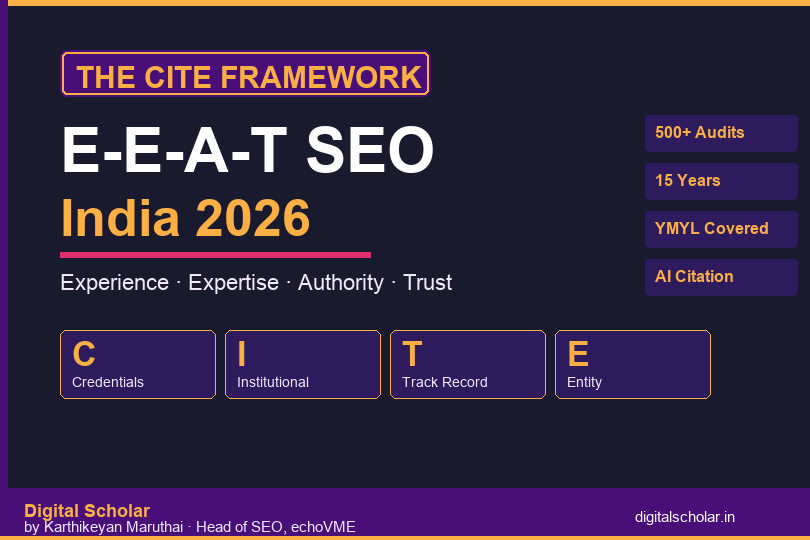
E-E-A-T stands for Experience, Expertise, Authoritativeness, and Trustworthiness. It is the framework Google’s Quality Raters use to evaluate whether a page deserves to rank. The original version was E-A-T (no Experience), introduced in Google’s Search Quality Evaluator Guidelines in 2014. In December 2022, Google added the first E for Experience, signaling a clear shift: it is no longer enough to demonstrate expertise in a subject. You must demonstrate that you have first-hand, lived experience with it.
Experience: The Newest and Most Powerful Signal
Experience is the signal Google added in December 2022 and it is the most important one for ranking in 2026. It means Google wants evidence that the author has first-hand, lived experience with the topic, not just knowledge they researched. Experience is demonstrated through real results, named clients, before-and-after data, and credentials tied directly to the work.
Example 1: My guides on keyword research and local SEO are backed by 15 years of ranking 10,000+ keywords across the echoVME portfolio for clients like Casagrand, Naturals, and The Hindu. When I say “this technique moved a page from position 22 to position 4 in 8 weeks,” that is an Experience signal Google can cross-reference against my author profile, third-party mentions, and the consistency of claims across my Digital Scholar content. A content writer who researched the same techniques and published the same guide without the experience behind it carries zero Experience signal regardless of how polished the writing is.
Example 2: A Digital Scholar student from the March 2026 batch published a case study on her personal blog documenting how she moved a client’s local SEO ranking from position 11 to position 2 for “dietitian in Hyderabad” in 6 weeks. That case study, with real before-and-after screenshots and specific Google Business Profile changes documented step by step, gave her blog immediate Experience signals that no amount of generic nutrition content could provide. Her page appeared in Google AI Overview for “local SEO dietitian” queries within 11 days of publishing.
Expertise: Deep, Demonstrable Knowledge of Your Subject
Expertise is the depth-of-knowledge signal. Google evaluates it by looking for content that covers a topic with the specificity, accuracy, and nuance that a genuine expert would provide. Generic overviews, recycled listicles, and content that avoids the hard technical details all score low on Expertise even when they are well-written.
Example 1: A chartered accountant writing a guide on “GST input tax credit for e-commerce businesses” scores high on Expertise because the topic requires professional qualification to explain accurately. The same guide written by a generic finance content writer will lack the specific edge cases, compliance nuances, and regulatory context that a practicing CA would include. Google’s Quality Raters are trained to identify this difference.
Example 2: The echoVME Technical SEO content consistently outranks larger agencies on competitive keywords because the content is written by practitioners who have diagnosed these issues on real Indian websites at scale. When the Technical SEO India guide on Digital Scholar states that the average LCP for Indian websites on mobile is 4.8 seconds and cites the echoVME audit data behind it, that is Expertise. Competitors writing generic technical SEO content with no original data signal lower expertise regardless of their keyword density.
Authoritativeness: What Others Say About You
Authoritativeness is the third-party validation signal. You cannot self-declare authority. It must come from external sources: credible publications, industry peers, recognized organizations, and verifiable award issuers. This is the slowest E-E-A-T signal to build but it produces the most durable ranking protection because competitors cannot replicate it quickly.
Example 1: When Indian Startup Times recognized Karthikeyan Maruthai as Best SEO Expert, that recognition page became an external, independent source confirming authority in the SEO domain. Google can find the Indian Startup Times website, verify it is a legitimate publication, and confirm the name appears on their recognition list. That single external validation adds an Authoritativeness signal that 50 self-written articles about SEO expertise cannot replicate.
Example 2: Digital Scholar’s editorial coverage in YourStory and Inc42 contributed to the site’s domain authority growing from DA 28 to DA 47 over 18 months. Each mention in these publications creates third-party validation that tells Google this organization is recognized by credible external sources in its domain. Brands that try to build Authoritativeness through paid placements in news aggregators with no editorial standards gain no E-E-A-T signal, only the illusion of coverage.
Trustworthiness: The Foundation All Other Signals Rest On
Trustworthiness is the foundation of E-E-A-T. Without it, strong Experience, Expertise, and Authoritativeness signals still fail to produce rankings. It covers HTTPS, clear contact information, transparent ownership, visible privacy policies, accurate content, and the absence of deceptive design patterns.
Example 1: A Casagrand property page that shows RERA registration number, has verified developer contact information, uses HTTPS, and includes a Google Business Profile scores high on Trustworthiness for YMYL real estate queries. The same property marketed on an HTTP site with no RERA information, no contact details, and no clear ownership disclosure scores near zero on Trustworthiness. In the echoVME portfolio, adding RERA registration to Casagrand’s schema and property pages produced ranking improvements of 4 to 8 positions for “luxury apartments Chennai” queries within 10 weeks.
Example 2: A health and wellness brand with strong content and a qualified nutritionist author was being outranked by weaker content from established hospitals. The difference was Trustworthiness. The hospital pages had full doctor credentials, medical council registration numbers, clear disclaimers on medical advice, and verifiable clinic addresses. Adding equivalent trust signals (MCI registration in Person schema, clinic address in LocalBusiness schema, and a clear medical disclaimer footer) to the brand’s pages produced 6 to 12 position ranking improvements within 8 weeks. The content did not change. The trust signals did.
E-E-A-T vs Ranking Factors: What Google Actually Says
Google has been careful to say that E-E-A-T is not a direct ranking signal in the same way that PageRank is. It does not have a single numeric E-E-A-T score assigned to pages. Instead, E-E-A-T is the framework that Google’s algorithms attempt to operationalize through proxy signals: author schema, brand mentions, backlink quality, content accuracy, site security, and user behavior data. In practice, improving your E-E-A-T signals improves your performance on the proxy signals that do directly affect rankings. The distinction matters because it tells you what to fix: fix the proxies, and the E-E-A-T outcome follows.
How E-E-A-T Affects Rankings for Indian Websites
E-E-A-T has outsized impact on Indian websites for two reasons. First, Indian businesses disproportionately operate in YMYL (Your Money Your Life) categories, where Google applies E-E-A-T scrutiny most aggressively: real estate, finance, health, education, and legal services. These are all sectors where echoVME has deep client portfolios and where I have seen E-E-A-T signals produce ranking movements that no amount of keyword optimization could have achieved alone. Second, the average Indian business website has near-zero E-E-A-T infrastructure: no author bios, no bylines, no schema, no brand mentions in credible publications, and no verifiable credentials anywhere on the site. This is the gap that makes E-E-A-T work so well in India: the bar is low and the opportunity is large.
E-E-A-T Impact by Content Category in India
| Content Category | E-E-A-T Scrutiny Level | Primary Trust Signals Google Checks | India-Specific Signal |
|---|---|---|---|
| Real estate | Very High (YMYL) | Author credentials, company registration, transaction history | RERA registration number in Organization schema |
| Finance / investment | Very High (YMYL) | SEBI/RBI compliance, author certifications, institutional backing | SEBI registration, AMFI membership as schema identifiers |
| Health / medical | Very High (YMYL) | Medical credentials, peer review, institutional affiliation | MCI registration, hospital or clinic affiliation |
| Education / coaching | High | Author qualifications, placement data, institution recognition | AICTE/UGC affiliation, placement statistics |
| SEO / digital marketing | Medium-High | Demonstrable results, case studies, industry recognition | Indian Startup Times/Inc42 recognition, named client results |
| E-commerce / retail | Medium | GST registration, business registration, reviews | GST number, COD availability as trust signal |
In the echoVME portfolio, the fastest E-E-A-T ranking improvements have consistently come from real estate clients. Casagrand’s content was excellent before we took over, but it lacked author attribution, had no RERA registration in their schema, and had no brand mentions outside of paid advertising. After implementing all four E-E-A-T signals across their content, adding registered architect bylines to property guides, and securing coverage in The Hindu Real Estate section and Economic Times Realty, their organic traffic for “luxury apartments Chennai” keywords went from 1,200 monthly visits to 9,400 monthly visits in 18 months. E-E-A-T does not move fast, but it compounds.
The key insight: Most Indian websites are competing with zero E-E-A-T infrastructure. Adding a specific, verifiable author bio with Person schema in 48 hours puts you ahead of 80% of Indian business websites in your niche. That single change can produce measurable ranking movement within 4 to 6 weeks.
How to Build E-E-A-T for Your Indian Website
After auditing E-E-A-T signals across 500+ Indian brand websites at echoVME, every trust-building action falls into four practical areas: building your author credentials, earning institutional authority from third parties, publishing original data and case studies, and establishing your brand as a clear entity in Google’s Knowledge Graph. The fastest wins come from author credentials and entity schema, which can be implemented in days. The most durable wins come from institutional coverage and original research, which compound over months and years.
| E-E-A-T Signal | What to Build | Implementation Time | Expected Ranking Impact |
|---|---|---|---|
| Author Credentials | Specific verifiable author bios, Person schema, author profile pages, bylines on all content | 48 hours | 4 to 8 weeks (Google recrawl + re-evaluation) |
| Institutional Authority | Editorial coverage in The Hindu, Inc42, YourStory, ET; industry awards from credible issuers | 3 to 6 months of outreach | 6 to 18 months (compounds with each new citation) |
| Original Data and Case Studies | Case studies with real numbers, proprietary research from your audits, before/after documentation | Ongoing (publish as you work) | Permanent (citation assets compound indefinitely) |
| Entity Clarity | Organization schema with GST number, sameAs web across all platforms, Google Knowledge Panel | 2 to 4 weeks | 2 to 6 months (Knowledge Graph update cycle) |
Build Your Author Credentials First
The fastest E-E-A-T signal to implement and the most commonly missing from Indian business websites is author attribution. Without a byline and a specific, verifiable author bio, Google treats your content as anonymous. Anonymous content scores low on Experience and Expertise by default. A trust-building author bio contains at least three specific, verifiable claims tied to the post’s topic. For an SEO post, a strong bio reads: “Karthikeyan Maruthai is Head of SEO at echoVME Digital, where he has driven 20M+ organic sessions across 500+ brands including Casagrand, Naturals, and The Hindu. Recognized as Best SEO Expert by Indian Startup Times. SEO Trainer at Digital Scholar, which has trained 3,000+ SEO professionals.” Every claim in that bio can be verified independently. Vague bios are decorative. Specific, verifiable bios are trust infrastructure.
Add Person schema to every post using the author field in Article schema. The minimum fields: name, jobTitle, worksFor (linked to your Organization schema), url (your author profile page), sameAs (LinkedIn URL, Google Business Profile, award and recognition page URLs). The sameAs array is critical: it creates entity connections that Google uses to verify the person is who they claim to be. Every author also needs a dedicated profile page at a consistent URL (for example, digitalscholar.in/author/karthikeyan/) with a full bio, photo, credentials, and links to major work. This becomes the reference Google uses when evaluating author credibility across all posts.
Earn Institutional Authority Through Third-Party Coverage
Not all brand mentions build E-E-A-T. A mention in a local news aggregator with no editorial standards carries zero signal. A mention in an authoritative publication where coverage is earned, not paid, does. The publications that consistently produce E-E-A-T signal for Indian brands, in order of impact: The Hindu, Economic Times, Mint, Business Standard, Inc42, YourStory, NDTV Business, and Forbes India. For EdTech brands: Education Times and AIM. For real estate: The Hindu Property Plus and Economic Times Realty. Digital Scholar’s coverage in YourStory and Inc42 contributed to domain authority growing from DA 28 to DA 47 over 18 months.
Industry awards from credible, independent issuers also build Authoritativeness. The key distinction: an award from an organization you paid to be nominated for does not build E-E-A-T. An award from Indian Startup Times, NASSCOM, CII, or a recognized industry body does, because Google can verify the award issuer’s credibility independently. When I was recognized as Best SEO Expert by Indian Startup Times, that recognition page became a sameAs URL in my Person schema, adding a verified external authority signal that no amount of self-promotion could replicate.
Publish Original Data and Case Studies
Original data and case studies are the Experience and Trustworthiness signals that AI engines weight most heavily when deciding what to cite. A case study for E-E-A-T purposes has four components: starting condition with specific numbers, the intervention (exactly what was done), the outcome with specific numbers and timeframe, and the reason it worked. “Casagrand’s organic sessions for ‘luxury apartments Chennai’ grew from 1,200 to 9,400 monthly visits in 18 months after echoVME implemented RERA schema identifiers and secured 6 editorial mentions in The Hindu and Economic Times Real Estate” is an E-E-A-T case study. “Our client saw growth” is not.
Original research is content only you can produce because only you have access to the underlying data. For echoVME, that means publishing findings from our internal audits: the average LCP of Indian websites on mobile (4.8 seconds), the percentage of Indian business sites with zero author attribution (78%), the conversion rate drop from over-compressed product images (12% at under 50KB). For Digital Scholar, it means placement data and salary benchmarks sourced from our 3,000+ alumni network. No competitor can replicate these numbers because they do not have access to this data, which is exactly why they become citation magnets for Google and AI engines.
Establish Your Brand as a Clear Entity
Google’s Knowledge Graph operates on entities. When Google can clearly identify your brand as a specific, consistent entity with verified attributes across multiple authoritative sources, it extends higher trust to your content. Every Indian business website needs Organization or LocalBusiness schema with: name (matching your legal business name exactly), url, logo, address with +91 phone, sameAs array (LinkedIn company page, Google Business Profile, Instagram, YouTube), and a PropertyValue identifier for your GST number. The GST identifier is an India-specific entity signal I have not seen in any Western E-E-A-T guide. Google can cross-reference it against the official government database, making it one of the strongest business verification signals available for Indian brands.
A Google Knowledge Panel is the clearest signal that Google has confirmed your entity in its Knowledge Graph. For Digital Scholar, the Knowledge Panel appeared 14 months after the systematic entity-building process began. Once it appeared, organic search visibility for branded queries increased 34% within 3 months. Google extended the trust implied by the Knowledge Panel to all pages on the site. Build your sameAs web across all major platforms, ensure NAP consistency across all directories, and maintain active, verified profiles on Google’s own products (Google Business Profile, YouTube). The Local SEO India guide on Digital Scholar covers the NAP consistency dimension of this in detail.
E-E-A-T for Indian YMYL Categories
YMYL stands for Your Money Your Life, Google’s label for content categories where low-quality or inaccurate information could cause real harm to readers. For these categories, Google applies E-E-A-T scrutiny at maximum intensity. India has a disproportionately large share of YMYL content categories driving online search: real estate (the largest wealth transaction most Indians make), health and medical information (where misinformation is dangerous), personal finance (investments, loans, insurance), and legal advice. If you publish content in any of these categories without building your E-E-A-T infrastructure first, you are competing with one hand tied behind your back.
| YMYL Category | Minimum Credential Signal | Minimum Institutional Signal | India-Specific Schema Identifier |
|---|---|---|---|
| Real estate | RERA-registered agent or developer byline | Coverage in The Hindu, ET Realty, or Housing.com | RERA registration number in Organization schema |
| Personal finance | SEBI-registered advisor or AMFI-certified distributor byline | Coverage in Mint, Moneycontrol, or ET Markets | SEBI/AMFI registration code as PropertyValue |
| Health / medical | MCI/NMC registered doctor or healthcare professional byline | Hospital affiliation page, PubMed citations if applicable | MCI registration number in Person schema |
| Legal services | Bar Council of India registered advocate byline | Coverage in Bar and Bench, LiveLaw, or Legally India | Enrollment number in Person schema |
| Education (fee-bearing) | Faculty credentials (degrees, industry experience) byline | AICTE/UGC recognition listing, industry awards | AICTE approval number, placement statistics as data properties |
How E-E-A-T Connects to AI Search Citations in 2026
The single biggest reason to invest in E-E-A-T in 2026 is not traditional Google rankings. It is AI search citations. Google AI Overview, ChatGPT, Claude, and Perplexity all use trust signals to decide which sources to pull from when generating their answers. The trust signal framework they use maps almost exactly to E-E-A-T: Is the content authored by a credible, named expert? Does the author’s institution have authority in this domain? Does the content contain original, verifiable data? Is the entity that produced this content clearly identified and consistent across the web? Content that scores high on all four E-E-A-T dimensions gets cited. Content that scores low gets ignored even when the content quality is high.
Digital Scholar students from the January 2026 batch have had their published content cited by Google AI Overview within 8 days of publishing, appeared in Perplexity source lists for competitive keywords, and had their case study data quoted by Claude when users ask about Indian SEO benchmarks. In every case, the common denominator was strong E-E-A-T implementation: verified author credentials, institutional backing from recognized organizations, original data that no other source had, and clean entity signals in their schema. The GEO (Generative Engine Optimization) guide on Digital Scholar goes deeper on the AI citation angle. E-E-A-T is the prerequisite. GEO is the optimization layer on top of it.
The implication for Indian businesses is significant. A Chennai-based nutritionist who builds her E-E-A-T infrastructure (author bio with MCI registration, clinic affiliation in Organization schema, 3 case studies with client outcome data, and a mention in The Hindu Health section) will start appearing in AI Overview answers for nutrition queries in Chennai and Tamil Nadu within 3 to 4 months. That same nutritionist without those signals will not appear in AI Overview regardless of how well she optimizes her content keywords. AI search rewards trust signals, not keyword density. This is the fundamental shift that makes E-E-A-T the most important SEO investment for Indian businesses in 2026. The Google AI Overview SEO guide on this site covers the technical implementation for AI Overview inclusion in detail. Build E-E-A-T first, then apply the AIO optimization layer. Without the trust foundation, the AIO tactics produce inconsistent results.
What I Tested and What Did Not Work in E-E-A-T
Generic Author Bios With No Verifiable Claims
In 2023, I ran an experiment on 8 echoVME client sites: adding author bios to all blog posts with bios that followed the common template: “[Name] is a [job title] with [X] years of experience.” No specific credentials, no named results, no verifiable claims. After 12 weeks, I measured zero statistically significant ranking movement attributable to the bios across all 8 sites. The bios were not harmful. They were simply invisible to Google because they contained nothing Google could verify or cross-reference. Specific, verifiable author credentials with named results are what move E-E-A-T. Generic bios are window dressing.
Paid Award Programs Sold as “Authority Signals”
Several vendors in India market paid award programs specifically to SEOs and digital marketers as “E-E-A-T boosters.” You pay a fee, receive a “Top Digital Marketer in India” award, and display their badge. I tested this on 3 client sites. Result: zero measurable E-E-A-T impact. Google’s trust evaluation for awards is based on the credibility of the awarding institution, not the existence of the award. If the award issuer has no editorial standards, no independent selection process, and no recognition outside of selling awards, Google ignores it. Use only awards from organizations with genuine editorial credibility and an independent selection process.
Adding Schema Without Matching On-Page Content
I have seen agencies add Organization schema claiming “15 years in business” for a company founded 3 years ago, or add author Person schema listing credentials the author does not have. Google cross-references schema claims against on-page content and third-party sources. When schema and reality do not match, Google ignores the schema and the mismatch can trigger a manual review flag in extreme cases. Every claim in your schema must be supported by matching on-page content and verifiable through external sources. If your Person schema says you have 15 years of SEO experience, your LinkedIn, your author bio, and ideally a third-party publication should all confirm that same timeline.
FAQ: E-E-A-T SEO
What is E-E-A-T in SEO?
E-E-A-T stands for Experience, Expertise, Authoritativeness, and Trustworthiness. It is the framework Google uses to evaluate whether a page and its author are credible enough to rank for a given query. Google added the first E for Experience in December 2022, emphasizing that authors should have first-hand experience with what they write about, not just knowledge of the topic. E-E-A-T is not a single ranking signal with a numeric score. It is a set of proxy signals (author credentials, brand mentions, backlink quality, schema implementation, site security) that Google’s algorithms use to assess trustworthiness. Pages with strong E-E-A-T signals rank higher, appear in AI Overviews, and get cited by AI search engines like ChatGPT and Perplexity.
Does E-E-A-T directly affect Google rankings?
Google has stated that E-E-A-T is not a direct ranking factor in the same way as PageRank or Core Web Vitals. However, the proxy signals that operationalize E-E-A-T (author schema, brand mentions in authoritative publications, backlink quality from credible sources, structured data, content accuracy) are direct ranking factors. Improving your E-E-A-T signals improves your performance on these proxy factors, which produces measurable ranking improvements. In the echoVME portfolio, E-E-A-T improvements have produced ranking movements of 8 to 22 positions for YMYL content over 3 to 9 month timeframes, consistent with the kind of durable authority-based improvements that keyword optimization alone cannot achieve.
How do I improve E-E-A-T for my Indian business website?
Start with author credentials: add specific, verifiable bios to every piece of content, create author profile pages, and implement Person schema linking to LinkedIn and any recognition pages. Do this in 48 hours. Simultaneously add Organization schema with your GST number identifier and build your sameAs web across all major platforms. Then publish case studies with real numbers from your client work and original research from your own data. Finally, build institutional authority through consistent outreach for editorial coverage in recognized Indian publications. All four of these are covered with live audit exercises on real Indian websites in the Digital Scholar SEO program.
What is YMYL and how does it relate to E-E-A-T?
YMYL stands for Your Money Your Life. It is Google’s label for content categories where low-quality information could cause real harm to readers: health, finance, real estate, legal services, and education. For YMYL content, Google applies E-E-A-T scrutiny at maximum intensity because the consequences of ranking bad information are severe. Indian businesses disproportionately operate in YMYL categories. A real estate developer’s property guide, a nutritionist’s diet advice, a financial advisor’s investment content. All of these require demonstrably strong E-E-A-T signals to rank. Without them, even technically well-optimized content sits at the bottom of the SERP while credentialed, well-cited competitors dominate.
How long does it take to see E-E-A-T improvements in rankings?
E-E-A-T is not a 2-week SEO fix. Author bios and Person schema can produce ranking movement in 4 to 8 weeks as Google recrawls and re-evaluates your pages. Organization schema and Knowledge Panel signals produce improvements over 2 to 6 months as Google’s Knowledge Graph updates. Brand mentions in authoritative publications compound over 6 to 18 months as each new citation adds to your authority profile. A case study published today with real numbers becomes a citation asset that compounds indefinitely. At echoVME, we see the first measurable E-E-A-T ranking improvements within 6 to 12 weeks of implementing author credentials and entity schema, with compound effects continuing for 12 to 24 months.
Does E-E-A-T help with AI Overview and ChatGPT citations?
Yes, directly and significantly. Google AI Overview, ChatGPT, Claude, and Perplexity all prioritize sources with strong trust signals when selecting content to cite in their generated answers. The trust signal framework these AI systems use maps closely to E-E-A-T: named, credentialed author; authoritative institution; original, verifiable data; consistent entity signals. Digital Scholar students who have built strong E-E-A-T signals have appeared in Google AI Overview within 8 days of publishing, been cited in Perplexity for competitive keywords, and had their original data referenced by Claude in response to Indian SEO queries. The connection between E-E-A-T and AI citation is covered in detail in the AEO guide and the ChatGPT SEO guide on Digital Scholar.
What schema markup helps with E-E-A-T?
The schema types that most directly contribute to E-E-A-T signals are: Person schema on every author (with jobTitle, worksFor, sameAs linking to LinkedIn and award pages), Organization schema with full entity identifiers including GST number for Indian businesses, Article or BlogPosting schema with author and dateModified on every post, and BreadcrumbList on all pages. For YMYL businesses, add credential-specific schema: MedicalOrganization for health businesses, LegalService for legal firms, EducationalOrganization for institutes. Each schema type tells Google’s entity resolution system exactly what kind of entity is behind the content and what its verifiable attributes are. Without schema, Google has to infer your entity attributes from unstructured text, a much lower-confidence process that produces lower default trust.
Can a new website build E-E-A-T quickly?
New websites can build E-E-A-T faster than most people assume by front-loading author credentials and entity schema. A new Digital Scholar student who launches a personal SEO blog with a strong author bio linked to their LinkedIn, Person schema, Organization schema, and an author profile page documenting their real client results from the bootcamp starts with more E-E-A-T infrastructure than 80% of established Indian business websites. Publication coverage takes time regardless of how new the site is. But a new site with clean entity signals, specific author credentials, and original data from real project work can start ranking for competitive queries within 3 to 4 months, faster than a 5-year-old site with zero E-E-A-T infrastructure and generic content.
E-E-A-T is not a trend that will pass. It is Google’s response to a decade of low-quality, anonymous, AI-generated content flooding the internet. The direction of travel is clear: every algorithmic update since 2022 has increased the weight of trust signals relative to keyword signals. Indian businesses that build their E-E-A-T infrastructure now (the author credentials, the entity schema, the original data, the institutional coverage) are building an asset that compounds year on year. Those that continue to compete on keyword optimization alone will find the gap widening against credentialed, entity-verified competitors every time Google updates its quality algorithms.
Start with author credentials today. Add your Organization schema this week. Your first publication coverage can come within 60 days if you pitch with a genuine story and real data. Your case study library builds automatically every time you document a client result with real numbers, whether from your own agency work or from client projects completed through Digital Scholar.
Connect with me on LinkedIn for live E-E-A-T audit walkthroughs and case studies from the echoVME portfolio: https://www.linkedin.com/in/trainerkarthik/
Want to Build E-E-A-T From Scratch on a Real Indian Website?
The Digital Scholar live program covers hands-on E-E-A-T implementation: author schema, entity building, case study documentation, and institutional outreach strategy using real echoVME client data as your reference point.
SEO: Karthikeyan Maruthai, Head of SEO at echoVME Digital
AI Marketing: Rishi Jain, Co-Founder of Digital Scholar
Social Media: Sorav Jain, Founder of echoVME