The complete digital marketing course syllabus for 2026 covers 12 modules across SEO, content marketing, Meta Ads, Google Ads, GA4, email and automation, CRO, AI tools, AI agents, MCP integrations, analytics, and a capstone project. This post breaks down every module with hours, deliverables, certifications, what you build, and what the syllabus does NOT cover. Use it to compare any digital marketing course syllabus you are shortlisting.
- The Syllabus Most Institutes Do Not Show You
- Why Listen to Me on This
- The Complete 2026 Syllabus: 12 Modules
- Module Hours, Deliverables, and Certifications
- What Changed in 2026: AI Agents and MCP
- Sample Week-by-Week Schedule
- What the Syllabus Does NOT Cover
- 5 Red Flags in Any Course Syllabus
- Frequently Asked Questions
- Get the Full Syllabus
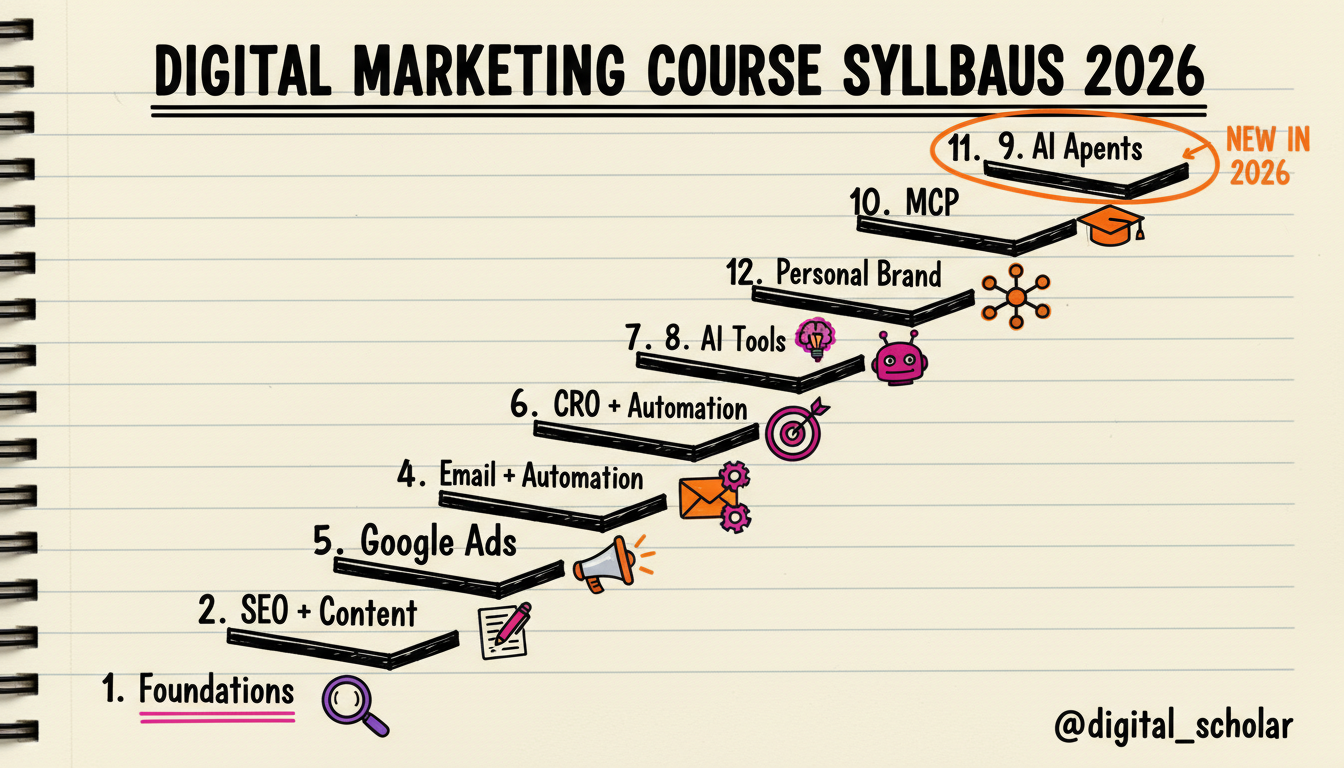
The Syllabus Most Institutes Do Not Show You
Every institute publishes a syllabus PDF on their website. Pull up any 5 of them side by side. The module list looks identical. SEO, social media, Google Ads, email, analytics. Same 10 bullets, different fonts. None of them tell you the hours per module, the tools you become certified on, the deliverables you walk out with, or which sections were written before ChatGPT existed.
I rebuilt the Digital Scholar syllabus in February 2026. We cut three modules that no longer matter (legacy display ads, generic copywriting theory, a 4-hour section on Pinterest that almost no Indian brand needs). We added three modules that did not exist 18 months ago (AI agents, MCP integrations, prompt engineering for marketing). The full thing is below. Module by module, with the parts that matter.
If you are shortlisting any digital marketing course in Chennai, compare its syllabus against this one. Same coverage means the institute is current. Missing AI agents or MCP means the syllabus has not been touched since 2023. That is the single biggest filter.
Why Listen to Me on This
Digital Scholar trains roughly 1,000 students a year through a 4-month full-stack AI and digital marketing program. Faculty are working practitioners from echoVME Digital, our agency that has handled 500 plus brands and Rs 400 crore in cumulative ad spend across Meta, Google, and Amazon. The Digital Scholar syllabus gets pressure-tested on real client accounts inside echoVME before any module enters the curriculum.
Every line in this post comes from the syllabus we shipped to the February 2026 batch. Hours, deliverables, tools, all of it. Read the bias warning. I run a course. I am partial to courses that work like ours. That said, the framework for evaluating any syllabus is the same regardless of who runs the program.
The Complete 2026 Syllabus: 12 Modules
The Digital Scholar 4-month program runs 12 modules across roughly 320 hours of instruction, lab work, and live client projects. Each module ends with a deliverable that goes into your portfolio. No slide-deck capstones. Real artefacts. Here is the structure.
Module 1. Digital Marketing Foundations (16 hours)
The funnel, the channels, the metrics, and the math. Why CPM is not a goal, why CAC and LTV are. The pirate metrics framework (AARRR). A teardown of one D2C and one B2B brand showing how their channels stack. Deliverable: a written growth audit of one brand of your choice.
Module 2. SEO and Content Marketing (40 hours)
Keyword research with Semrush and Ahrefs, on-page SEO, technical SEO, content cluster strategy, AEO and GEO for 2026, link building, and the new AI Overview reality. Deliverable: a 5-page cluster (1 pillar + 4 clusters) published on WordPress with images. You leave certified on Semrush.
Module 3. Meta Ads (Facebook and Instagram) (36 hours)
Campaign structure, audience targeting (advantage+ vs manual), creative testing frameworks, the 5x5x2x1 creative formula we use at echoVME, attribution, and budget scaling. Deliverable: a live campaign on a real client account with at least Rs 5,000 spent and reported. Certification: Meta Blueprint Buying Certified. Deeper math in our Meta Ads vs Google Ads guide.
Module 4. Google Ads (Search, PMax, YouTube) (32 hours)
Search match types, Performance Max structure, YouTube campaign types, bidding strategies, negative keyword discipline, and attribution windows. Deliverable: a live search campaign with Rs 5,000 minimum spend on a real account. Certification: Google Ads Search Professional.
Module 5. Analytics: GA4, Search Console, Looker Studio (24 hours)
Event-based tracking, custom dimensions, conversion modeling, exploration reports, and a custom dashboard you actually want to look at. Deliverable: a Looker Studio dashboard for the brand you audited in Module 1. Certification: GA4 Certified.
Module 6. Email Marketing and Marketing Automation (24 hours)
List building, segmentation, lifecycle flows (welcome, abandonment, win-back), deliverability fundamentals, and automation in Klaviyo and HubSpot. Deliverable: 5 lifecycle email flows mapped, designed, and shipped for a real or simulated brand. Certification: HubSpot Email Marketing.
Module 7. Conversion Rate Optimisation (CRO) (20 hours)
Heatmaps with Microsoft Clarity, A/B testing fundamentals, the heuristic vs experiment debate, landing page anatomy, and the break-even ROAS math from our break-even ROAS guide. Deliverable: a documented A/B test with hypothesis, result, and learning.
Module 8. AI Tools for Marketers (24 hours)
Claude, ChatGPT, Gemini, Perplexity for daily marketing work. Prompt engineering for marketers (not for developers). Tool stack curation. Specific workflows we use at echoVME with timing benchmarks. Deliverable: a personal AI marketing stack documented with use cases. The full stack lives in our performance marketing tools guide.
Module 9. AI Agents and Workflow Automation (NEW, 28 hours)
n8n, Claude Code, prompt orchestration, and the difference between a chatbot and an agent. Three end-to-end agent builds: a daily ad-report agent, a content-research agent, and an inbox-triage agent. This module did not exist in any digital marketing course syllabus in 2024. Deliverable: 1 deployed agent solving a real workflow.
Module 10. MCP Integrations for Marketing (NEW, 20 hours)
Model Context Protocol explained for marketers. Setting up the Meta Ads MCP, Google Ads MCP, Semrush MCP, and Notion MCP. Using Claude Desktop to run real campaign tasks from natural language. Deliverable: a working MCP setup with 3 connected tools and a documented workflow.
Module 11. Brand Building and Personal Brand (16 hours)
Positioning, narrative, and your own LinkedIn or Instagram presence. The 5-post-a-week formula. How to use your portfolio site as a hiring magnet. Deliverable: 1 published portfolio site, 10 posts shipped on LinkedIn or Instagram.
Module 12. Capstone: Live Brand Project (40 hours)
Every student gets matched to a real echoVME brand for a 4-week capstone. You build the full marketing plan, run live campaigns with the brand’s actual budget, and present results. Deliverable: a final campaign report with media, performance, and recommendations. This is the artefact that wins interviews.
Module Hours, Deliverables, and Certifications
The same syllabus in one scannable view. Hours, deliverable, and the certification you walk out with. Total program: 320 hours across 16 weeks.
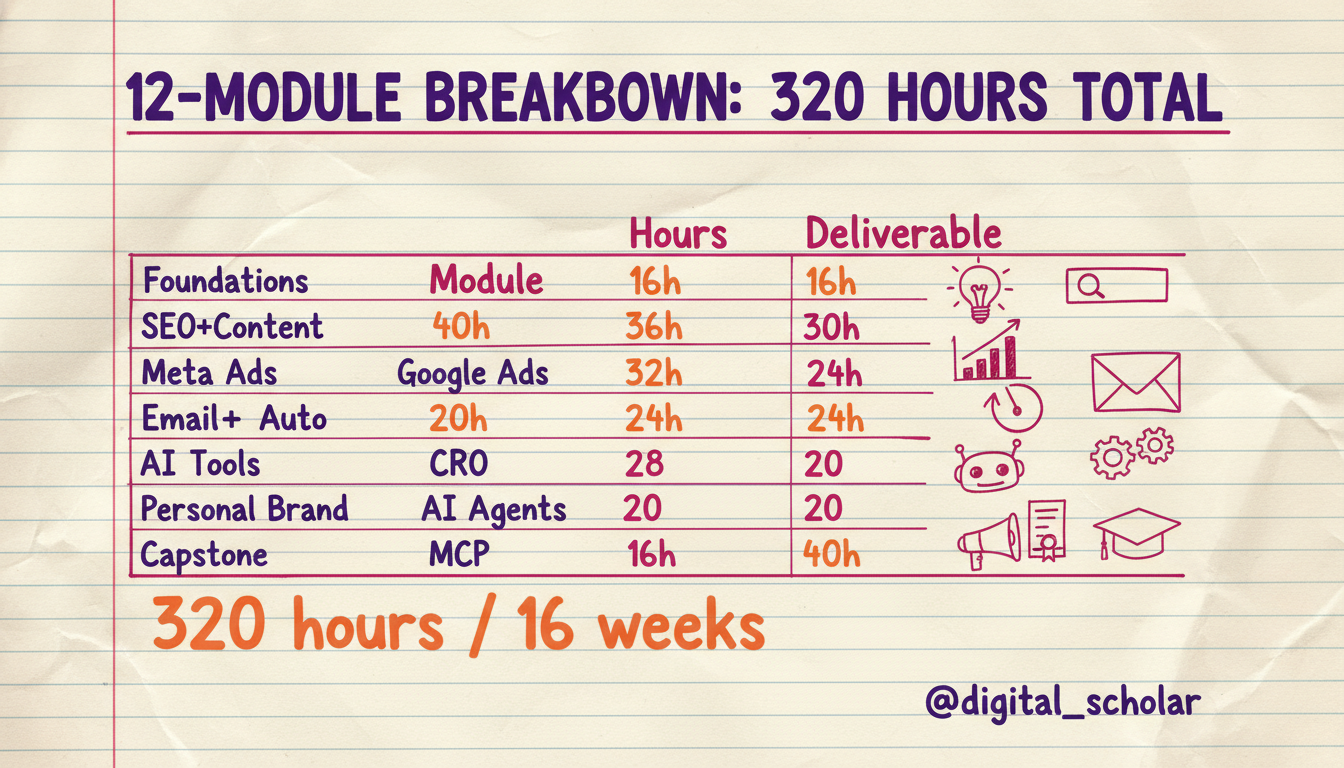
| Module | Hours | Deliverable | Certification |
|---|---|---|---|
| 1. Foundations | 16 | Brand growth audit | None |
| 2. SEO and Content | 40 | Published 5-page cluster | Semrush |
| 3. Meta Ads | 36 | Live campaign with Rs 5K+ spend | Meta Blueprint Buying |
| 4. Google Ads | 32 | Live search campaign with Rs 5K+ spend | Google Ads Search Pro |
| 5. Analytics | 24 | Looker Studio dashboard | GA4 Certified |
| 6. Email and Automation | 24 | 5 lifecycle flows shipped | HubSpot Email |
| 7. CRO | 20 | Documented A/B test | None |
| 8. AI Tools | 24 | Personal AI stack docs | None |
| 9. AI Agents (NEW) | 28 | 1 deployed agent | Internal |
| 10. MCP (NEW) | 20 | 3-tool MCP workflow | Internal |
| 11. Personal Brand | 16 | Portfolio site + 10 posts | None |
| 12. Capstone | 40 | Live brand campaign report | Digital Scholar Capstone |
| TOTAL | 320 | 12 deliverables | 6 external + 3 internal |
The point of the table: Most syllabus PDFs you compare against will list 10 modules with no hours, no deliverables, and no certifications. If a brochure does not show you these three columns, the institute does not measure them.
What Changed in 2026: AI Agents and MCP
Three modules in the Digital Scholar syllabus did not exist in 2024. AI agents, MCP integrations, and the rebuilt AI Tools module. Together they account for 72 of the 320 hours, roughly 22.5% of the program. We pulled this content directly from how we now run echoVME internally. A daily ad-report agent we built saves our media team 5 hours per week per account. Students learn to build the same thing.
| What changed | Old (2024) | New (Feb 2026) |
|---|---|---|
| AI Tools module | 4 hours on ChatGPT prompts | 24 hours on Claude, ChatGPT, Gemini, Perplexity with workflows |
| AI Agents | Did not exist | 28 hours, 3 agent builds, n8n + Claude Code |
| MCP | Did not exist | 20 hours, 4 MCPs configured, Claude Desktop workflows |
| Display ads | 12 hours | Removed (folded into PMax in Module 4) |
| 4 hours | Removed | |
| Copywriting theory | 8 hours | Removed (replaced with AI-assisted copy workflows in Module 8) |
If a digital marketing course syllabus you are evaluating still lists Pinterest as a dedicated 4-hour module but does not mention AI agents at all, it was written in 2023 and has not been touched. That is the test.
Sample Week-by-Week Schedule
A 4-month program means 16 weeks of work. Here is how the modules sit across those weeks at Digital Scholar. Use this template to evaluate any other course’s pacing. If a course tries to compress all 12 modules into 6 weeks, you are getting surface coverage of each module, not real depth.
| Month | Weeks | Focus |
|---|---|---|
| Month 1 | 1-2 | Foundations + SEO and Content kickoff |
| Month 1 | 3-4 | SEO completion + Meta Ads start |
| Month 2 | 5-6 | Meta Ads live campaigns + Google Ads start |
| Month 2 | 7-8 | Google Ads live + Analytics module |
| Month 3 | 9-10 | Email and Automation + CRO |
| Month 3 | 11-12 | AI Tools + AI Agents |
| Month 4 | 13 | MCP integrations |
| Month 4 | 14 | Personal Brand sprint |
| Month 4 | 15-16 | Capstone live brand project |
What the Syllabus Does NOT Cover
This is the section most institutes will never publish. Honesty about gaps. Here is what the Digital Scholar 4-month program does NOT teach, and why.
- Influencer marketing at scale. We do 4 hours of basics inside Module 11. A serious influencer practice needs its own 40-hour program, which we do not offer yet.
- Affiliate marketing operations. Niche, requires its own tooling stack. Best learned on the job at an affiliate-heavy brand.
- SEO for SaaS and B2B specifically. Our SEO module is brand-agnostic. B2B SEO is a 60-hour rabbit hole.
- Video editing. We assume you can use CapCut or hire someone. We are not a film school.
- Coding beyond what AI agents and MCP need. No deep Python, no JavaScript. We teach enough to deploy n8n flows and connect MCPs, not to build apps.
If any of those gaps is your priority, pick a specialist program for that one thing, not a generalist course. The full-stack syllabus we ship is designed to make you employable as a performance or growth marketer, not to make you an expert in every adjacent specialty.
5 Red Flags in Any Course Syllabus
When comparing another institute’s digital marketing course syllabus, scan for these five things. Each red flag drops the program one notch on the 10-Point Filter we covered in our how to choose a digital marketing course guide.
- No AI agents or MCP module. Means the syllabus has not been refreshed since 2023.
- Pinterest gets its own dedicated module. Indian B2C brands rarely run Pinterest. This signals a recycled US syllabus.
- No live client work in any module. Means deliverables are slide-deck simulations, not real campaigns.
- No certifications named, just “industry-recognised certificate from us”. Means you do not walk out certified on Meta Blueprint, Google Ads, GA4, or HubSpot. Hiring managers ignore in-house certificates.
- No hours per module. Brochures that hide hours usually hide them because the program is shorter than it sounds.
Frequently Asked Questions
What is the syllabus of a digital marketing course?
A complete 2026 digital marketing course syllabus should cover 10 to 12 modules including SEO, content marketing, Meta Ads, Google Ads, GA4, email marketing, marketing automation, CRO, AI tools, AI agents, MCP integrations, and a capstone project. Digital Scholar’s full-stack 4-month syllabus runs 320 hours across these modules.
What subjects are in a digital marketing course?
The core subjects are SEO, content marketing, social media, paid advertising (Meta and Google), analytics, email marketing, automation, CRO, and AI tools. In 2026, AI agents and MCP integrations are now core, not electives. Soft subjects like brand strategy and personal branding round out the program at Digital Scholar.
How many modules are in a digital marketing course?
Quality 4-month programs run 10 to 12 modules. Shorter programs (1 to 3 months) cover 4 to 6 modules with less depth per topic. The Digital Scholar program runs 12 modules across 320 hours and 16 weeks, designed to make you employable as a performance marketer by month 4.
What is the duration of a digital marketing course?
Standard durations are 1 to 3 months for online MOOCs, 3 to 6 months for cohort-based programs, and 11 to 24 months for university PG diplomas and MBAs. Digital Scholar runs a 4-month full-time program because anything shorter cannot fit 4 to 6 live brand projects plus 8 plus tool certifications.
Is the digital marketing syllabus the same across all institutes?
The brochure-level module list looks similar across institutes, which is misleading. The differences sit in hours per module, depth of live client work, certifications you actually earn, and how recently the syllabus was updated. Two programs both teaching “Module 3: Meta Ads” can deliver 12 hours of theory versus 36 hours including live campaigns. Always ask for hours and deliverables, not just module names.
Is there a digital marketing syllabus PDF I can download?
Digital Scholar shares the full PDF with detailed module breakdowns, week-by-week schedule, and certification list with anyone who books a free counselling call. Generic downloadable PDFs from aggregator sites are usually 2 to 3 years old and do not include the AI agents and MCP modules that are now standard.
Get the Full Syllabus
The 12-module breakdown above is the public version. The full Digital Scholar syllabus PDF includes specific tool list per module, sample assignments, capstone brand options, faculty per module, and a live cohort calendar. Once you have the PDF in hand, run it through the 10-Point Filter in our how to choose a digital marketing course guide and decide for yourself.
If our digital marketing course in Chennai looks like a fit, the next step is a 30-minute counselling call. If our live online digital marketing course works better for your geography, same step. If our Post Graduate Program in Digital Marketing matches your career stage, that route is open too. The career math (salaries, roles, growth) sits in our performance marketing interview questions guide and the broader career framework in how to learn performance marketing.
Compare any syllabus against ours
The Digital Scholar 4-month program runs 12 modules across 320 hours. Practitioner faculty from echoVME, 4 to 6 live brand projects, 6 external certifications, syllabus rebuilt February 2026 with AI agents and MCP modules. Book a free counselling call to get the full PDF.