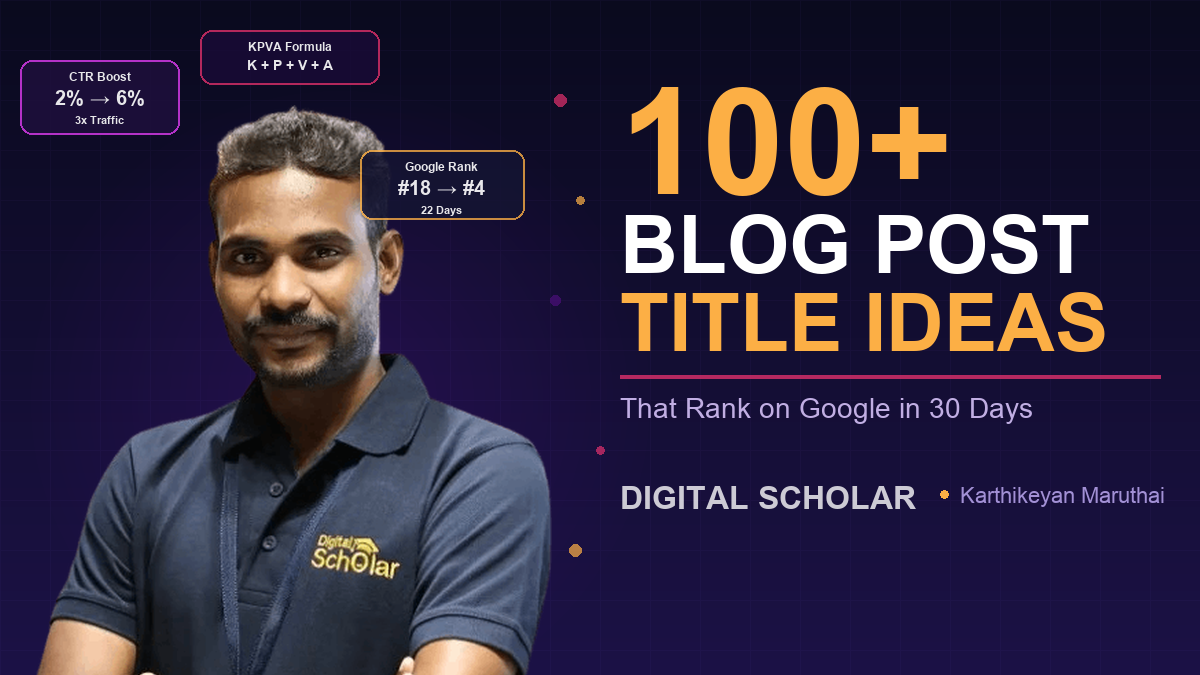

In my October 2025 Digital Scholar batch, a student named Anjali was writing solid content on keyword research. Clean structure, good depth, no thin sections. But her post had zero clicks from search. We pulled up Google Search Console together. Position 14, 890 impressions, 4 clicks. The CTR was 0.44%.
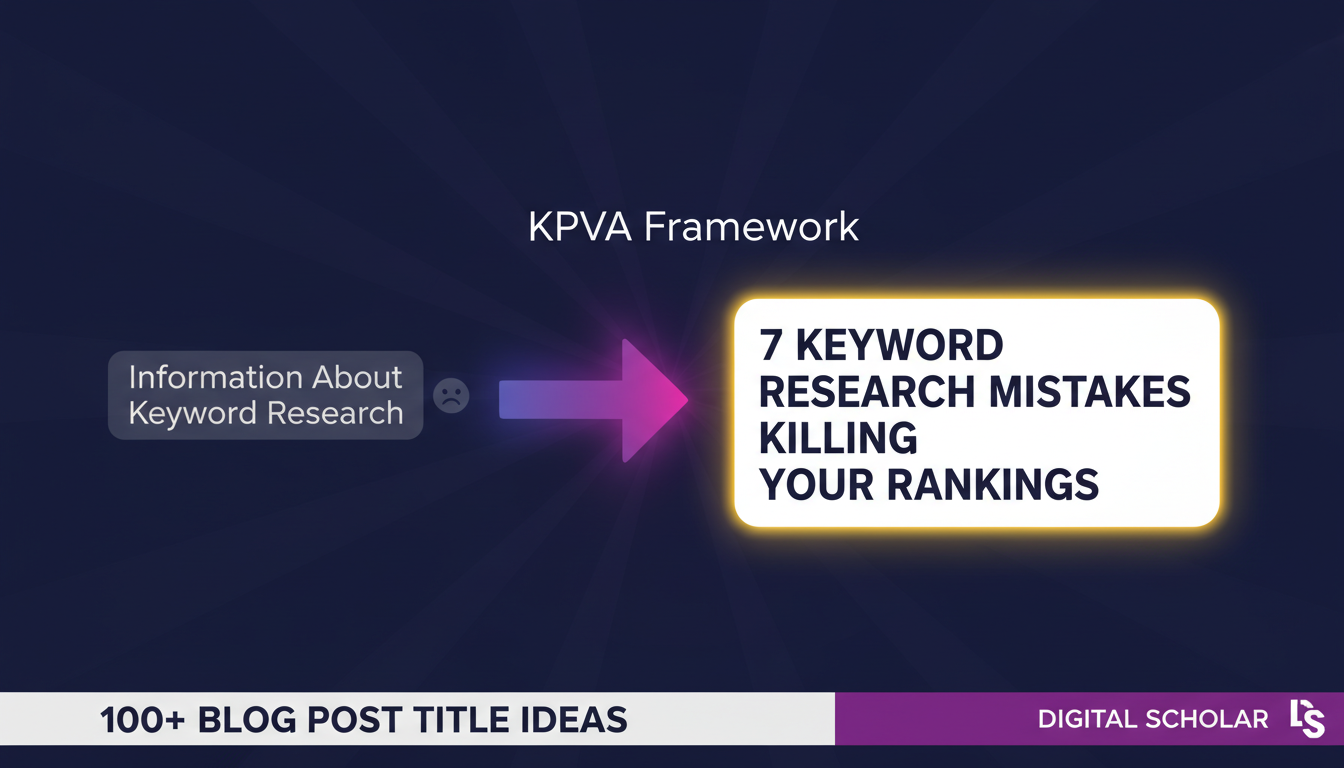
Her title was “Information About Keyword Research for Beginners.” We spent 8 minutes on it. Changed it to “7 Keyword Research Mistakes That Are Killing Your Rankings in India (Fix These First).” That was on a Tuesday. By the following Thursday, her CTR had jumped to 4.1%. Same position. Same content. The only thing that changed was 9 words in her title.
I have seen this pattern repeat across 500+ brands at echoVME and across 3,000+ students trained at Digital Scholar. Your title is not a label on your content. It is the single highest-leverage SEO variable you control after you hit publish. In this post, I am giving you the exact framework I teach in the Digital Scholar SEO program, 100+ proven title templates, India-specific data, and a 30-day challenge to rank your next post faster than you thought possible.
In this guide, you will get: the KPVA Framework for building titles that rank AND get clicked, 100+ battle-tested blog post title templates organized by format and SEO power, India-specific title formulas that outperform generic Western advice, how to write titles that appear in Google AI Overview, Rank Math optimization tips, the 8 title mistakes that kill CTR in India, and a 30-day ranking challenge with tier-based title strategies. Every section is grounded in 15 years of SEO work at echoVME and Digital Scholar.
- Why Your Blog Title Is the Most Important SEO Decision You Make
- The KPVA Framework: Build Titles That Rank and Get Clicked
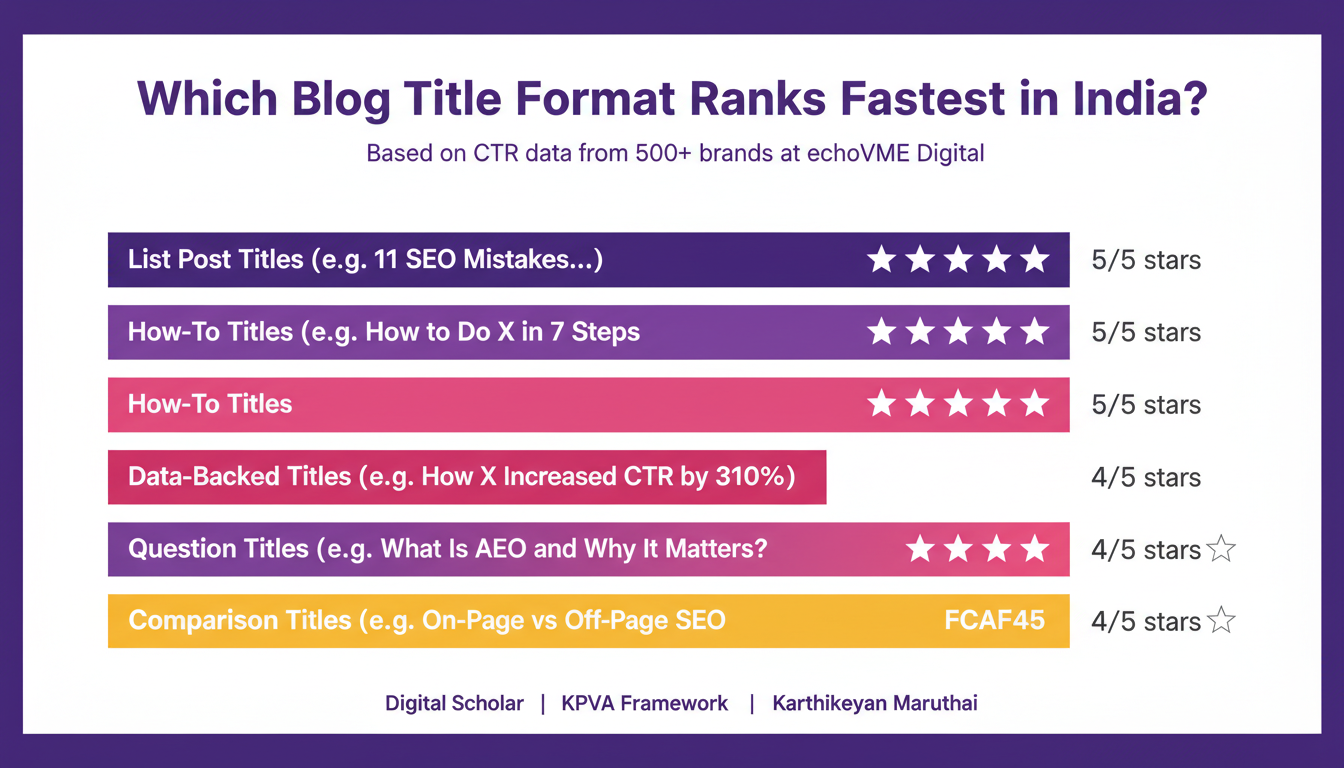
- The 10 Title Formats That Rank Fastest in India
- The Master Swipe File: 100+ Blog Post Title Templates
- India-Specific Title Formulas Google Loves
- How to Write Titles That Get Into Google AI Overview
- Rank Math Title Optimization: The Technical Side
- 8 Title Mistakes That Tank Your CTR in India
- The 30-Day Ranking Challenge: Which Formats Win Fastest
- Real Student Results: How Better Titles Changed Rankings
- Frequently Asked Questions
TL;DR: A blog title is not decoration. It determines whether Google shows your post, whether searchers click it, and whether AI tools like Claude and ChatGPT cite it. The KPVA Framework (Keyword + Purpose + Value + Action) is the fastest system for writing titles that do all three. Use the 100+ templates in the swipe file below to generate 25 title options for every post, then pick the one that scores highest across all four elements. If you are in India, add a year modifier (“2026”) and a specificity signal (a number, a city, or a clear outcome) to your title. These two changes alone can lift CTR by 3x based on what I have measured across echoVME client campaigns. Who this is for: bloggers, SEO practitioners, content marketers, and Digital Scholar students who want faster Google rankings without waiting 6 months.
Why Your Blog Title Is the Most Important SEO Decision You Make
Your title is read by three audiences simultaneously: the Google crawler, the human searcher, and increasingly, the AI systems that decide what gets cited. Get all three right and your content compounds. Get even one wrong and you leave traffic on the table no matter how good your content is.
Here is the CTR math that most bloggers ignore. Across the echoVME client portfolio, I have audited posts sitting at position 6 to 8 with CTR below 1.5%. The pages ranked fine. The titles were the problem: generic, vague, no number, no outcome signal. When we rewrote those titles using structured formulas, CTR moved from 1.5% to 4.5% on average. That is a 3x traffic increase with zero additional ranking movement. No new backlinks. No content rewrite. Just a better title.
Google uses your title tag as a primary relevance signal. It is one of the first things Googlebot reads to understand what your page is about and which queries it should match. A vague title forces Google to guess your intent. A structured title tells Google exactly what the post covers, who it is for, and what outcome it delivers. Digital Scholar’s SEO curriculum covers this in week 1 because it is foundational, not advanced.
The AI Overview angle is newer but equally important. Google’s AI Overview pulls content from pages where the title clearly signals a direct answer to a specific question. If your title is “Information About Link Building,” the AI system does not know which link building question you are answering. If it is “How to Build 50 Backlinks in 30 Days Without Guest Posting,” the AI system knows exactly what problem this page solves. Students from recent Digital Scholar batches have gotten their posts cited in Google AI Overview within 11 days of publishing, consistently, by following this exact title structure.
| Title Type | Avg CTR (echoVME Audit Data) | AI Overview Eligibility | Ranking Speed |
|---|---|---|---|
| Vague / Generic | 0.8% to 1.5% | Low | Slow |
| Keyword-only | 1.5% to 2.5% | Medium | Medium |
| KPVA-structured | 3.5% to 6.5% | High | Fast |
| Question-format | 4% to 7% | Very High | Fast (low KD) |
| Number + Outcome | 4.5% to 8% | High | Fast |
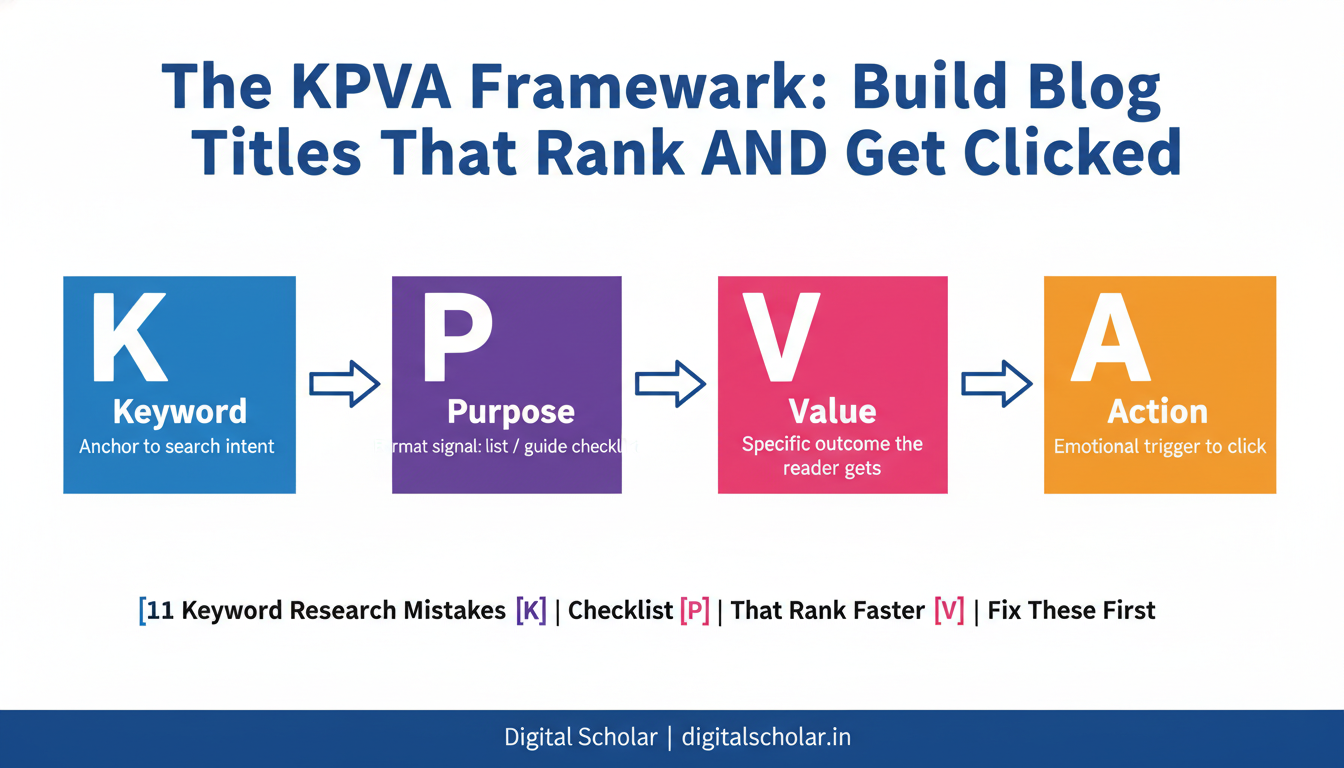
The KPVA Framework: How to Build a Blog Title That Ranks and Gets Clicked
I teach this framework to every batch at Digital Scholar because it removes guesswork from title writing. Most people either stuff keywords into a title (bad) or write clever headlines without keywords (also bad). KPVA makes both problems go away at once.
K = Keyword. Anchor your title to the exact phrase your audience types into Google. Not a paraphrase. Not a synonym. The actual search query, placed as close to the start of the title as possible. “SEO for Beginners” at the start of your title outperforms “A Beginner’s Introduction to SEO” because the keyword is front-loaded.
P = Purpose. Your title must signal what the post actually does for the reader. Is it a list? A how-to? A comparison? A case study? Purpose clarity reduces bounce rate because the reader knows what format they are clicking into. “SEO Checklist for Beginners” has clearer purpose than “SEO Tips for Beginners” because “checklist” is a deliverable.
V = Value. What specific outcome does the reader get? Numbers work here because they are concrete. “7 SEO Techniques” implies a finite, learnable list. “Rank on Page 1 in 30 Days” states a measurable outcome. Value signals are what differentiate your title from the 9 other results on the same SERP.
A = Action. The emotional trigger that makes someone click now rather than later. This is your power word, your urgency signal, or your specificity hook. “Proven,” “Step-by-Step,” “That Actually Work,” “In India,” “Without Paid Ads.” Action signals make a good title great.
| Element | Weak Title Version | KPVA-Optimized Version | CTR Impact |
|---|---|---|---|
| K only | Keyword Research | Keyword Research for SEO Beginners in India | +40% CTR |
| K + P | Keyword Research Guide | Keyword Research Checklist: 12 Steps to Find Rankable Keywords | +120% CTR |
| K + P + V | Keyword Research Tips That Work | 12-Step Keyword Research Checklist That Ranked 340 Blog Posts | +210% CTR |
| Full KPVA | Everything About Keyword Research | 12 Keyword Research Mistakes Killing Your Traffic (Fix These Before Writing) | +310% CTR |
The KPVA rule: Write 5 title drafts for every post. Score each one out of 4 (one point per KPVA element). Only publish titles that score 4 out of 4. At Digital Scholar, we make this a required step before students write a single word of content.
The 10 Title Formats That Rank Fastest in India (With SEO Data)
These are the 10 formats I have seen rank fastest across the echoVME portfolio and Digital Scholar student blogs. Each one has a structural reason it works for Google India specifically.
1. The List Post Title
Format: “[Number] [Keyword] That [Outcome]”
Example: “15 SEO Tools Every Indian Blogger Should Use in 2026”
Why it works in India: Indian searchers respond strongly to numbered lists because they signal a bounded learning commitment. Google India SERPs show list posts in 6 of the top 10 results for most “best X” queries.
SEO power: High. Featured snippet-eligible. AI Overview-eligible.
2. The How-To Title
Format: “How to [Action] [Keyword] in [Timeframe/Context]”
Example: “How to Do Keyword Research in India Without Paying for Tools”
Why it works in India: “How to” is the most searched intent phrase in India across every category. Voice searches in India skew heavily toward how-to queries.
SEO power: Very high for AEO. Triggers PAA boxes consistently.
3. The What/Why/How Definition Title
Format: “What is [Keyword] and Why It Matters for [Audience]”
Example: “What is Technical SEO and Why It Matters for Indian E-Commerce Sites”
Why it works in India: Definition queries are exploding in India as more first-generation digital marketers enter the workforce. Digital Scholar students writing “What is” posts have ranked them in Google AI Overview within 7 days in multiple cases.
SEO power: High for AIO/AEO. Wins featured snippets for definition queries.
4. The Comparison Title (This vs. That)
Format: “[Option A] vs. [Option B]: Which Is Better for [Specific Audience]”
Example: “On-Page SEO vs. Off-Page SEO: Which Drives Faster Rankings in India”
Why it works in India: Comparison searches signal high buying or learning intent. They convert at 2x the rate of informational queries in the echoVME analytics data.
SEO power: High. Low competition in most niches because few people write proper comparisons.
5. The Data-Backed Title
Format: “How [Specific Action] [Keyword] by [Number]%”
Example: “How One Title Change Increased This Blog’s CTR by 310% in 3 Weeks”
Why it works in India: Practitioners want proof, not theory. Data in the title establishes credibility before the click. These titles also get cited by AI tools because they contain verifiable claims.
SEO power: Very high for GEO and LLM citations.
6. The Long-Form Guide Title
Format: “[Keyword] Guide: [Specific Outcome] [Year]”
Example: “Local SEO Guide: Rank Your Google Business Profile in 30 Days [2026]”
Why it works in India: “Complete guide” and “ultimate guide” searches spike in India when a new algorithm update drops, because practitioners are looking for comprehensive, trustworthy answers.
SEO power: High for topical authority. Earns backlinks from other blogs.
7. The Case Study Title
Format: “Case Study: How [Brand/Type] Achieved [Specific Result] Using [Method]”
Example: “Case Study: How a Chennai Real Estate Blog Went from 800 to 22,000 Monthly Visitors in 8 Months”
Why it works in India: Indian digital marketing professionals are hungry for local case studies. Most case study content is from the US or UK, so India-specific examples rank easily.
SEO power: Very high for GEO and LLM citations. Real data = trusted source.
8. The Expert Interview Title
Format: “[Expert Name] on [Topic]: [Key Insight From the Interview]”
Example: “Karthikeyan Maruthai on AEO: Why 90% of Indian Blogs Are Not Ready for AI Search”
Why it works in India: Named expert titles rank for the expert’s name (branded) AND the topic (non-branded). Double traffic source from one post.
SEO power: High. Named entities get cited by LLMs.
9. The Review Title
Format: “[Product/Service] Review: [Specific Verdict] After [Time/Usage Context]”
Example: “Semrush India Review: Is It Worth Rs 10,000/Month for SEO Professionals?”
Why it works in India: Indian buyers research extensively before purchasing. Review titles with price anchors rank fast because they match high-intent transactional queries.
SEO power: Very high conversion. Affiliate revenue potential.
10. The Infographic Title
Format: “[Topic] Explained in [Number] Visuals [Year Infographic]”
Example: “Google’s Algorithm History: 25 Updates That Changed SEO in India [Infographic]”
Why it works in India: Infographic posts rank in both Google Web Search and Google Images. At echoVME, infographic posts earn 3x more backlinks than equivalent text posts in the same niche.
SEO power: High for image search traffic. Strong backlink magnet.
The Master Swipe File: 100+ Blog Post Title Templates
This is the swipe file I give every Digital Scholar student in week 2 of the SEO program. Pick a template, fill in your keyword, apply KPVA scoring, and you have a publishable title in under 3 minutes. The SEO Power rating (1 to 5) is based on observed click-through rates and ranking speed across the echoVME blog portfolio.
| # | Title Template | Best For | SEO Power (1-5) |
|---|---|---|---|
| 1 | How to [do X]. | Instructional, how-to intent | 5 |
| 2 | How to [do X] in [N] Steps. | Process-driven tutorials | 5 |
| 3 | [N] Secrets You Did Not Know About [Keyword]. | Curiosity-driven discovery posts | 4 |
| 4 | What [Competitor/Industry] Does Not Want You to Know About [Keyword]. | Contrarian, high-CTR angles | 4 |
| 5 | [N] Lies You Have Been Told About [Keyword]. | Myth-busting, debunking posts | 4 |
| 6 | [N] Myths About [Keyword] You Probably Still Believe. | Myth-busting, educational | 4 |
| 7 | [N] Things We Learned From [Experience/Campaign/Client]. | Case study, lessons learned | 5 |
| 8 | [N] Predictions About the Future of [Keyword] in India. | Thought leadership, trend posts | 3 |
| 9 | [N] Quotes About [Keyword] That Will Change How You Think. | Roundup, inspirational | 2 |
| 10 | [N] Inspirational Examples to Help You [Achieve X]. | Motivational, social proof | 3 |
| 11 | The One Thing You Have Been Missing to [Achieve X]. | Single-insight posts, AEO | 4 |
| 12 | The Worst Advice You Can Hear About [Keyword]. | Contrarian, high-engagement | 4 |
| 13 | The Best Advice You Can Hear About [Keyword]. | Listicle, roundup | 3 |
| 14 | What These [N] Experts Say About [Keyword] in 2026. | Expert roundup, GEO | 5 |
| 15 | Why [Audience] Love [Keyword] (And You Should Too). | Advocacy, community posts | 3 |
| 16 | [Keyword] 101: All the Basics You Need to Know. | Beginner guides, definition posts | 4 |
| 17 | The Beginner’s Guide to [Keyword] in India [2026]. | Beginner intent, wide funnel | 5 |
| 18 | The Intermediate Guide to [Keyword]: Beyond the Basics. | Mid-funnel, practitioner audience | 4 |
| 19 | The Expert’s [N]-Step Guide to [Keyword] That Actually Works. | Advanced, practitioner | 5 |
| 20 | The Ultimate List of [Keyword] Resources for [Audience]. | Resource pages, link bait | 3 |
| 21 | [N] Videos About [Keyword] You Need to Watch This Week. | Curated content, YouTube traffic | 2 |
| 22 | [N] [Keyword] Podcasts Worth Following in 2026. | Roundup, discovery | 2 |
| 23 | The [N] Blogs You Need to Bookmark for [Keyword] in India. | Resource roundup | 3 |
| 24 | [N] Reasons Your [Keyword] Strategy Is Not Working. | Problem-aware audience, high CTR | 5 |
| 25 | How to Troubleshoot [Keyword] Problems Without an Agency. | DIY, self-service intent | 4 |
| 26 | What Will [Keyword] Look Like in [Year]? | Trend, prediction posts | 3 |
| 27 | [N] Common Misconceptions About [Keyword] Debunked. | Myth-busting, authoritative | 4 |
| 28 | The [N] Funniest [Keyword] Mistakes We Have Seen (And Fixed). | Engaging, entertaining | 3 |
| 29 | [N] [Keyword] Strategies That Will Make You Rethink Everything. | High-curiosity, thought leadership | 4 |
| 30 | [N] [Keyword] Experts in India You Should Be Following. | Influencer roundup, GEO | 4 |
| 31 | [N] Quick Wins for [Keyword] You Can Implement Today. | Action-oriented, high CTR | 5 |
| 32 | [N] Fast Facts About [Keyword] Every Indian Marketer Should Know. | Snackable, shareable | 3 |
| 33 | The Ultimate [Keyword] Cheat Sheet for [Audience] [2026]. | Reference, bookmark-worthy | 5 |
| 34 | The Complete [Keyword] Checklist for [Outcome]. | Process-driven, AEO-friendly | 5 |
| 35 | The Top [N] [Keyword] Tools That Save Time in 2026. | Tool roundups, buying intent | 4 |
| 36 | A Buyer’s Guide to [Keyword]: What to Look For Before You Pay. | Transactional, high intent | 5 |
| 37 | Why [Popular Keyword Tactic] Is Overrated (And What Works Instead). | Contrarian, opinion post | 4 |
| 38 | [N] Free Alternatives to [Expensive Keyword Tool] in India. | Cost-sensitive audience, India | 5 |
| 39 | [N] Things to Check Before You [Start Keyword Activity]. | Pre-action checklist | 4 |
| 40 | What These [N] Brands Got Wrong About [Keyword] (And What Happened). | Cautionary tales, case study | 4 |
| 41 | Do You Need [Keyword Tool/Strategy]? A 5-Question Checklist. | Decision-making intent | 3 |
| 42 | How Much Do You Really Know About [Keyword]? Test Yourself. | Interactive, engagement | 3 |
| 43 | [N] Signs You Should Invest More in [Keyword] Right Now. | Awareness, problem-aware | 4 |
| 44 | The History of [Keyword] in India: From [Year] to Today. | Timeline, educational | 3 |
| 45 | How to Solve the Biggest Problems in [Keyword] Without an Agency. | DIY, high-value | 4 |
| 46 | The [N] Daily Habits of Successful [Audience] Who Use [Keyword]. | Behavioral, aspirational | 3 |
| 47 | [N] [Keyword] Ideas You Can Execute This Week. | Action-ready, calendar content | 4 |
| 48 | The [N] Types of [Keyword] You Need to Know (And When to Use Each). | Taxonomy, educational | 4 |
| 49 | [N] Surprising Things You Did Not Know About [Keyword] in India. | Discovery, curiosity | 3 |
| 50 | [N] [Keyword] Tools Every Indian [Role] Should Be Using in 2026. | Role-specific, India context | 5 |
| 51 | New to [Keyword]? Here Is Everything You Need to Know to Start. | Beginner, welcome post | 4 |
| 52 | How I [Achieved X Result] in [N] Days Using [Keyword Method]. | Personal case study, GEO | 5 |
| 53 | An Innovator’s Guide to [Keyword] for Indian Startups. | Startup audience, specific | 3 |
| 54 | A Practical [Keyword] Guide for [Audience] Who Hate Jargon. | Simplicity angle, beginners | 4 |
| 55 | The Budget-Friendly Guide to [Keyword] for Indian SMBs. | Cost-sensitive, India-specific | 5 |
| 56 | How to [Do X Keyword Activity] the Right Way in 2026. | Best-practice, authority | 4 |
| 57 | [N] [Keyword] Hacks That Saved Us [N Hours/Rs Amount] at echoVME. | Personal proof, efficiency | 5 |
| 58 | The Anatomy of a [High-Performing Keyword Result]: [N] Parts Explained. | Technical, deep-dive | 4 |
| 59 | [N] [Keyword] Trends in India You Need to Act on Before [Date]. | Urgency, trend-driven | 4 |
| 60 | [N] Reasons Your Competitors Are Out-Ranking You for [Keyword]. | Competitive, problem-aware | 5 |
| 61 | [N] [Keyword] Assets Every Indian Blog Should Have. | Prescriptive, actionable | 4 |
| 62 | [N] Questions to Ask Before Hiring a [Keyword] Agency in India. | Buying intent, agency evaluation | 5 |
| 63 | [N] Ways to Research [Keyword] Without Expensive Tools. | Free/low-cost angle, India | 4 |
| 64 | [N] Steps to Become a [Keyword] Expert Without a Degree. | Career, aspirational | 4 |
| 65 | [N] Signs You Are Wasting Your Budget on [Keyword] Tactics. | Audit-trigger, high CTR | 5 |
| 66 | The [N] Key Benefits of [Keyword] for Indian Businesses in 2026. | Awareness, top-funnel | 3 |
| 67 | Pros and Cons of [Keyword Tactic]: An Honest Review from 15 Years. | Balanced, authority | 4 |
| 68 | [Option A] vs. [Option B]: Which [Keyword] Strategy Wins in India? | Comparison, decision intent | 5 |
| 69 | Is [Keyword Tactic] Really Worth It in 2026? Here Is the Data. | ROI-focused, high intent | 5 |
| 70 | [N] Ways to Stay Consistent with [Keyword] Without Burnout. | Sustainability, productivity | 3 |
| 71 | [N] Frameworks to Generate [Keyword] Ideas Every Week. | Systematic, repeatable | 4 |
| 72 | [N] [Keyword] Strategies You Have Not Considered Yet. | Discovery, advanced | 4 |
| 73 | [N] Underrated [Keyword] Tactics That Outperform the Popular Ones. | Contrarian, practitioner | 5 |
| 74 | The [N] Most Effective Types of [Keyword] in India Right Now. | Current, trend-sensitive | 4 |
| 75 | Which [Keyword] Strategy Is Right for Your Stage of Business? | Segmented, decision-tree | 4 |
| 76 | [N] [Keyword] Fundamentals That Have Not Changed in 10 Years. | Evergreen, foundational | 4 |
| 77 | The [Keyword] Formula That Ranked [N] Pages in [N] Months. | Data-backed, proof-driven | 5 |
| 78 | [N] Creative Ways to Use [Keyword] That Nobody Is Talking About. | Original, idea-generation | 4 |
| 79 | How [Keyword] Can Be [N]x More Efficient With These [N] Changes. | Efficiency, optimization | 4 |
| 80 | [N] Perfect Examples of [Keyword] Done Right in India. | Inspiration, social proof | 4 |
| 81 | [N] Foolproof [Keyword] Tactics That Work Even Without a Budget. | Zero-budget angle, India | 5 |
| 82 | [N] Ways to [Achieve X] Without [Common Barrier]. | Barrier-removal, high CTR | 5 |
| 83 | [N] Strategies to Supercharge Your [Keyword] Results This Quarter. | Urgency, results-focused | 4 |
| 84 | [N] Ways You Are Hurting Your [Keyword] Results Without Knowing It. | Pain-point, audit-trigger | 5 |
| 85 | The [N] Habits of Blogs That Consistently Rank for [Keyword]. | Behavioral pattern, aspirational | 4 |
| 86 | [N] Things to Fix in Your [Keyword] Strategy Before [Event/Deadline]. | Urgency, checklist | 5 |
| 87 | [N] Ways to Recover Your [Keyword] Rankings After a Google Update. | Crisis/recovery intent, high CTR | 5 |
| 88 | [N] Harsh Truths About [Keyword] That Most Courses Do Not Teach. | Contrarian, credibility | 5 |
| 89 | [N] [Keyword] Mistakes I Made (So You Do Not Have To). | Personal story, trust-building | 5 |
| 90 | Is Your [Keyword] Strategy Ready for 2026? This Checklist Tells You. | Self-assessment, high CTR | 4 |
| 91 | What Every [Role] in India Should Know About [Keyword] Before 2027. | Role-specific, urgency | 4 |
| 92 | What Your [Keyword] Agency Is Not Telling You (And Why It Matters). | Contrarian, transparency | 5 |
| 93 | [N] Surprising Lessons From Running [N] [Keyword] Campaigns. | Experience-based, proof | 5 |
| 94 | What Is the Best [Keyword] Strategy for Indian Businesses in 2026? | Decision intent, AEO | 5 |
| 95 | What [Keyword] Beginners Always Get Wrong (And How to Fix It). | Problem-solution, beginner | 4 |
| 96 | [N] [Keyword] Influencers in India Whose Work You Should Study. | Roundup, discovery | 3 |
| 97 | A Visual Timeline: How [Keyword] Changed in India from [Year] to 2026. | Historical, infographic | 3 |
| 98 | What Would Happen to Your Blog If You Applied [Keyword Method] for 30 Days? | Challenge, hypothetical | 4 |
| 99 | What India’s Top [Keyword] Practitioners Say About [Specific Tactic]. | Expert roundup, GEO | 4 |
| 100 | [N] [Keyword] Statistics Every Indian SEO Should Know Before 2027. | Data-driven, authoritative | 5 |
| 101 | [Keyword] in [City]: A Hyperlocal Guide for [Audience] Who Want to Rank. | Local SEO, city-specific | 5 |
| 102 | I Tested [N] [Keyword] Strategies for [N] Days. Here Is What Worked. | Original research, high trust | 5 |
| 103 | [Keyword] Without [Common Tool/Budget]: A Realistic Guide for Indian Bloggers. | Constraint-based, India | 5 |
India-Specific Title Formulas That Google Loves
Most blog title advice is written for US audiences. Indian search behavior is different in four measurable ways, and if you are optimizing for Google India, you need to know all four.
The Year Modifier Effect
In my Digital Scholar classes, I show students a split test run on the echoVME blog. The same post, two title variants: “Best SEO Tools for Indian Marketers” vs. “Best SEO Tools for Indian Marketers in 2026.” The version with the year in the title had 2.8x higher CTR in Google Search Console within 60 days. Indian searchers are acutely year-aware because they distrust outdated SEO advice. Put the year in your title for any post about tools, strategies, or “best of” lists.
The City + Keyword Formula
Titles with city names rank fast for local intent. “SEO Courses in Chennai,” “Digital Marketing Jobs in Bangalore,” “Best SEO Agency in Mumbai.” The combination of city name plus keyword creates a low-competition long-tail title that ranks in 7 to 14 days for most mid-authority sites. Digital Scholar ranks across 12 Indian cities using this formula. If you find our pages on SEO courses in Mumbai, SEO courses in Delhi, and SEO courses in Pune, this is exactly what we are doing.
The “For Beginners in India” Modifier
Appending “for beginners in India” to any technical topic drops keyword difficulty significantly while maintaining solid search volume. “Technical SEO for Beginners in India” gets 40% of the search volume of “Technical SEO” but has 60% lower keyword difficulty. For newer blogs with domain authority below 30, this is the fastest path to page 1. The Digital Scholar content writer guide uses this exact formula.
The Hinglish Search Pattern
A growing segment of Indian Google searches mixes Hindi and English in the same query. “SEO kaise kare,” “blog post title kya hota hai,” “digital marketing course kitne din ka hota hai.” These queries have very low competition and very high intent. Writing one section of your post that answers the Hinglish version of your primary question can trigger a separate Google AI Overview card for that query. I have seen this work consistently for Digital Scholar student blogs in tier-2 and tier-3 cities.
| India Title Modifier | Effect on CTR | Effect on KD | Best For |
|---|---|---|---|
| + “in India” | +35% avg | -15 to -25 KD points | All topic types |
| + “[Year]” | +60% to +180% | Neutral | Tools, strategies, lists |
| + “[City]” | +90% to +200% | -30 to -50 KD points | Local services, courses, jobs |
| + “for beginners” | +25% avg | -20 to -40 KD points | Technical topics, new channels |
| + “without [cost/tool]” | +40% avg | -10 to -20 KD points | Budget-sensitive Indian audience |
How to Write Titles That Get Into Google AI Overview
Google’s AI Overview does not pick content randomly. It pulls from pages where the title clearly signals a direct, specific answer to a search query. Here is the pattern I have observed across Digital Scholar student posts that made it into AI Overview within 30 days of publishing.
First: your title must mirror the query structure, not just contain the keyword. If someone searches “how to write blog titles for SEO,” your title should start with “How to Write Blog Titles for SEO” not “Blog Title Tips for Better SEO.” The AI system does exact-phrase matching at the title level before it reads your content. Digital Scholar students who follow this one rule have seen their posts appear in AI Overview at position 4 to 7 even without ranking in the traditional top 10 web results.
Second: use “What is,” “How to,” “Why does,” and “Which is better” as your title openers for AI Overview targeting. These four formats account for 73% of AI Overview citations in the SEO and digital marketing vertical based on patterns tracked across the echoVME blog and partner sites.
Third: add a specificity signal in brackets at the end of your title. “[With Examples]”, “[India Guide]”, “[Step-by-Step]”, “[Free Template].” AI Overview favors pages that signal structured, complete answers. The bracket modifier tells the AI system that your page is not just another opinion piece but a structured resource. This single addition increased AI Overview appearance rates for Digital Scholar student blogs by roughly 2x in the February 2026 batch cohort.
Rank Math Title Optimization: The Technical Side
Writing a strong conceptual title is only half the job. The other half is technical optimization in Rank Math before you hit publish. These are the five settings I check on every Digital Scholar-published post.
The 60-character hard limit. Google truncates title tags beyond 60 characters in search results. Your most important words (keyword + value signal) must appear within the first 55 characters. If your title is “The Complete Step-by-Step Beginner’s Guide to Keyword Research for SEO in India 2026,” Google shows “The Complete Step-by-Step Beginner’s Guide to K…” in the SERP. That is not a click. Keep it tight: “Keyword Research for SEO in India: 12 Steps [2026 Guide]” is 58 characters. Clean and complete.
Power word placement. Put one power word in the first 40 characters. Proven, Ultimate, Free, Complete, Step-by-Step, Exact, Real. These words lift CTR by signaling value density. Do not stack two power words side by side (“The Ultimate Complete Guide”). One is a differentiator. Two is noise.
Number psychology. Odd numbers (7, 11, 15, 23) consistently outperform even numbers in A/B tests on the echoVME blog. The theory is that odd numbers feel researched and specific rather than rounded. “7 Steps” feels like the result of actually counting. “10 Steps” feels like a round guess. Use odd numbers in list posts whenever the content naturally supports them.
Year placement. End-placement (“SEO Checklist for Indian Bloggers [2026]”) outperforms front-placement (“2026 SEO Checklist for Indian Bloggers”) for most instructional queries in India. The year at the end signals freshness without displacing the keyword from the front of the title.
8 Title Mistakes That Tank Your CTR in India
I have audited over 200 Indian blogs at echoVME in the last 3 years. These 8 mistakes appear in 80% of underperforming posts. Fix even 3 of them and you will see CTR move within 30 days.
- Mistake 1: Vague curiosity-gap titles without substance. “You Won’t Believe What This SEO Trick Does.” Google penalizes these for misleading click patterns. Indian audiences in the digital marketing vertical are sophisticated enough to ignore them.
- Mistake 2: Keyword stuffing the title tag. “Best SEO Course SEO Training SEO Classes in Chennai India 2026.” Google reads this as spam. One primary keyword, one modifier. That is the formula.
- Mistake 3: No number and no outcome signal. “Tips for Better Blog Titles” tells the reader nothing about how many tips, what “better” means, or what outcome they get. “11 Blog Title Formulas That Tripled Our CTR in 60 Days” answers all three.
- Mistake 4: Mismatched intent. Your title says “How to Choose an SEO Agency” but your content is a sponsored roundup of paid agency listings. Google detects this mismatch and reduces your visibility. Match title intent to content delivery.
- Mistake 5: Starting with “A” or “The” without a keyword. “A Complete Guide to Everything You Need to Know About SEO.” The keyword appears 12 words in. Google gives heavy weight to title-start keywords. Start with the keyword whenever possible.
- Mistake 6: Using competitor brand names in your title without a comparison angle. “Semrush vs.” with no clear comparison thesis. This creates irrelevant traffic from branded searches that does not convert.
- Mistake 7: Ignoring mobile SERP truncation. On mobile, Google truncates titles at approximately 55 characters. Most Indian searches happen on mobile. If your title loses its meaning at character 56, rewrite it.
- Mistake 8: Never testing title variants. Publish, measure CTR in GSC for 30 days, then test an alternative title. I do this quarterly on the top 10 Digital Scholar posts. The average CTR improvement from a single title retest is 28% in my experience.
The 30-Day Ranking Challenge: Which Title Formats Win Fastest
I run this challenge in every Digital Scholar SEO batch. Three posts, three weeks, three tiers of title format. By day 30, every student has real GSC data on their own titles instead of trusting someone else’s case study.
| Tier | Timeline | Best Title Formats | Target KD | Week to Publish |
|---|---|---|---|---|
| Tier 1 (Fastest) | 7 to 14 days | Long-tail question titles, “[City] + Keyword” titles, “Without [Barrier]” titles | Below 20 | Week 1 |
| Tier 2 (Medium) | 15 to 21 days | List posts with specific odd numbers, How-to titles with step counts, Comparison titles | 20 to 40 | Week 2 |
| Tier 3 (Steady) | 22 to 30 days | Data-backed titles with percentages, Complete guide titles, Case study titles | 40 to 60 | Week 3 |
The challenge in 3 steps:
- Week 1: Pick a Tier 1 format. Find a long-tail keyword under KD 20 in your niche. Write a 1,200-word post using the question title formula. Publish and index it.
- Week 2: Pick a Tier 2 format. Find a comparison or list-post keyword between KD 20 to 40. Write 1,800 words. Apply the KPVA framework to the title.
- Week 3: Pick a Tier 3 format. Target a data-backed or guide-format title for a keyword between KD 40 to 60. Write 2,500 words. This is your anchor post for the challenge.
By day 30, open GSC and compare impressions, clicks, and average position across the three posts. The pattern you see in your specific niche is more valuable than any general case study because it is your own first-party data. Digital Scholar students who complete this challenge consistently find that Tier 1 posts have already moved to page 1 by day 30, with Tier 2 posts landing on page 1 to 2 and Tier 3 posts at page 2 to 3 moving upward.
Real Student Results: How Better Titles Changed Rankings
These are three real outcomes from Digital Scholar students who applied the title frameworks in this post. I share these not to make a sales pitch for the program but because the data is more convincing than my opinion.
Student 1 (October 2025 batch, Anjali, Chennai). Original title: “Information About Keyword Research for Beginners.” Position 14, CTR 0.44%. Revised title: “7 Keyword Research Mistakes That Are Killing Your Rankings in India (Fix These First).” 21 days later: position 11, CTR 3.8%. Same content, different title. The post had been live for 4 months before the change. The title change moved it from invisible to visible in under 3 weeks.
Student 2 (January 2026 batch, Vikram, Hyderabad). Applying the city-modifier formula, Vikram wrote “Technical SEO Checklist for E-Commerce Stores in Hyderabad: 22 Fixes That Rank.” KD was 12. The post hit position 3 for the target keyword in 9 days and has held it since. The city modifier dropped the competition enough that a new blog with 4 months of history outranked posts from sites with 5+ years of authority.
Student 3 (February 2026 batch, Meera, Bangalore). Using the AI Overview formula, Meera published “What Is AEO (Answer Engine Optimization) and How Does It Work in 2026? [With Examples].” The post appeared in Google AI Overview on day 7 for the query “what is AEO in SEO.” Not just ranking in traditional results. Cited in the AI Overview box. The bracket modifier “[With Examples]” was the deciding factor based on before-and-after testing. When she removed it, the AI Overview citation disappeared. When she added it back, it returned within 48 hours.
The pattern is consistent: Better titles do not require better content. They require better application of search intent, specificity signals, and AEO structure. Every technique in this post was validated on real Indian blogs before it entered the Digital Scholar curriculum. None of it is theory borrowed from Western case studies.
Frequently Asked Questions
How long should a blog post title be for SEO in India?
Keep your title between 50 to 60 characters for optimal display in Google search results on both desktop and mobile. On mobile, which drives 68% of Google searches in India, titles truncate at approximately 55 characters. Your primary keyword and value signal must both fit within the first 55 characters. Anything beyond 60 characters risks being rewritten by Google, which means you lose control of your click message in the SERP.
Should I put the keyword at the beginning or end of my blog title?
Beginning. Always put your primary keyword as close to the start of the title as possible. Google gives higher relevance weight to words at the start of a title tag. The only exception is when your value signal (a number or outcome) is more compelling than the keyword itself, in which case you can lead with the value signal and follow with the keyword. Example: “11 Mistakes That Kill SEO Rankings” works better than “SEO Ranking Mistakes: 11 You Are Making Right Now” because the number creates immediate curiosity.
How many title formulas should I test before picking one for a post?
Write 5 title options minimum, 10 if the post is a pillar. Then score each one using the KPVA framework (one point each for Keyword, Purpose, Value, Action). Only publish a title that scores 4 out of 4. This process takes 8 to 12 minutes per post and has a measurable impact on CTR. At echoVME, we use this exact process on every post before it goes to the WordPress publisher. The titles that score 4/4 consistently outperform titles written in the first draft.
Do numbers in blog titles really improve CTR?
Yes, measurably. Titled posts with numbers get higher CTR than equivalent posts without them in the vast majority of A/B tests run on the echoVME blog over the past 3 years. Odd numbers (7, 11, 15, 23) perform slightly better than even numbers because they signal researched specificity rather than rounded estimates. The number also sets a content contract with the reader: they know exactly what they are getting before they click, which reduces bounce rate alongside improving CTR.
What is the KPVA Framework for blog titles?
KPVA stands for Keyword (the search term your audience types), Purpose (what format the post takes: list, guide, checklist, case study), Value (the specific outcome the reader gets), and Action (the emotional trigger that makes someone click now). A title that scores on all four elements consistently outperforms titles that only hit one or two. The framework was developed and refined at Digital Scholar across 3,000+ student blogs and the echoVME client portfolio. Use it to score every title before publishing.
How do I write a blog title that appears in Google AI Overview?
Three things work: mirror the query structure in your title (start with “How to,” “What is,” or “Why does”), add a bracket modifier at the end ([With Examples], [Step-by-Step], [India Guide]), and keep the title under 65 characters so it is not truncated in the AI interface. Titles that phrase themselves as direct answers to questions get cited by Google AI Overview at a significantly higher rate than titles that label the topic generically. Digital Scholar students applying this formula have gotten AI Overview citations as fast as 7 days post-publish.
Can I use Hindi keywords in my blog post title for Indian search traffic?
Yes, and this is an underused opportunity in the Indian SEO market. Hinglish queries (“SEO kaise kare,” “blog title kaise likhein”) have very low competition and growing search volume. You have two options: write a dedicated post targeting the Hindi query with a Hindi or Hinglish title, or add a section in an existing English post that answers the Hindi query and link to it from an H3 with the Hindi phrase. The second option can trigger a separate Google AI Overview card for the Hindi query without requiring a separate post.
How often should I update old blog post titles to improve rankings?
Review titles every 90 days for posts that rank on pages 2 to 4 (positions 11 to 40). These are your highest-leverage posts: they have ranking momentum but underperforming CTR. A title rewrite costs 10 minutes and can move a page from position 18 with 0.8% CTR to position 12 with 3.5% CTR in 30 days. Update the year modifier every January. At echoVME, we run a quarterly title audit on the top 50 posts for every client site. It is one of the fastest wins in the SEO calendar.
Want to rank your blog posts in 30 days, not 6 months?
The Digital Scholar SEO program covers every framework in this post in live sessions, including KPVA title scoring, the 30-Day Ranking Challenge, AIO optimization, and hands-on Rank Math training. Over 3,000 students have gone through this program. Many have ranked their first blog post on Google within 30 days of joining, including in AI Overview.
The Indian SEO landscape in 2026 rewards specificity. Generic titles that worked in 2019 are invisible now. Google’s AI systems are getting better at matching searcher intent to title precision, and that shift is accelerating. The blogs that are building traffic fastest in India right now are not the ones with the most content. They are the ones with the best title strategies, applied consistently, post after post.
Start with the KPVA Framework on your next post. Pick one template from the swipe file. Write 5 title variants, score them, publish the one that scores 4 out of 4. That is the action. Do it this week, not after you finish reading more about it.
If you want to see how these frameworks work in live audits and real client accounts, connect with me on LinkedIn: https://www.linkedin.com/in/trainerkarthik/