
Deepa had been writing blog posts for 8 months straight. Every weekend, without fail. Her content was genuinely good, detailed, well-researched, better than half the stuff ranking on Page 1. But her traffic? Zero. Not “low.” Zero.
She came to my Digital Scholar SEO batch in October 2025 frustrated and ready to quit blogging entirely. In the first class, I asked her one question: “What keyword are you targeting with your main post?”
She said: “digital marketing.”
That was the problem. “Digital marketing” has a keyword difficulty of 85. HubSpot, Neil Patel, Semrush, and Forbes own that term. No Indian beginner blog, no matter how good the content, has a realistic shot at it. We spent 20 minutes in class identifying better targets: “digital marketing course in Chennai” (KD 28, 1,900 searches/month) and “digital marketing for small business India” (KD 31, 880 searches/month). She updated her existing posts with these angles. Within 6 weeks, she was at position 4 for both keywords. The content had not changed by a single word. Only the keyword strategy changed.
That story plays out in every batch I run at Digital Scholar. The problem is almost never the content. It is almost always the keywords. This guide gives you the exact framework I teach in class, the same one that has helped 3,000+ students finally see their content rank on Google India. If you want the companion skill to keyword research, also read my guide on how to write blog titles that rank. And if you are looking for an SEO course in Chennai, Mumbai, or Bangalore, the Digital Scholar SEO course listings cover live and online options.
In this guide, you will learn: how keyword research works differently in India, the 5-Layer Keyword Pyramid framework I developed from 15 years of SEO work at echoVME Digital, the best free tools for Indian beginners, a step-by-step workflow to find keywords that rank fast, and how to target keywords that show up in Google AI Overview. By the end, you will have everything you need to build a keyword strategy that actually drives traffic.
- Why 90% of Indian Bloggers Fail at Keyword Research
- What is Keyword Research and Why It Is Different in India
- The 5-Layer Keyword Pyramid: Karthik’s Framework for Indian SEO
- The Best Free Keyword Research Tools for Indian Beginners
- How to Find Long-Tail Keywords That Rank Fast in India
- Understanding Search Intent: The One Thing Most Indian SEOs Get Wrong
- Keyword Research for Hindi and English Mixed Searches
- How to Check Keyword Difficulty Without Paying for Semrush
- Building Your Keyword Map: From Research to Content Calendar
- Real Student Results: How Better Keyword Research Changed Rankings
- Common Keyword Research Mistakes Indian Beginners Make
- AEO Keyword Research: Finding Keywords That Get Into Google AI Overview
- Frequently Asked Questions
Why 90% of Indian Bloggers Fail at Keyword Research
In 15 years of SEO work at echoVME Digital, I have audited hundreds of Indian blogs that had good content but no traffic. The pattern is the same every time: the blogger targeted a keyword they personally liked, not a keyword they could realistically rank for. They did not check difficulty. They did not check who is ranking on Page 1. They did not check whether the top results were DA-90 global sites or smaller Indian blogs like theirs.
According to data from multiple Indian SEO studies, over 70% of all Google searches in India are long-tail queries, meaning 4 or more words. Yet most beginners target short, generic keywords with 2 to 3 words and wonder why they cannot rank. The opportunity is sitting in the long-tail. You just need a system to find it.
The second reason beginners fail: they research keywords once and never revisit. Google India search trends shift fast, especially in niches like technology, finance, and education. A keyword with KD 25 today can become KD 55 in 12 months if a big brand enters the space. At echoVME Digital, we re-audit keyword strategies every quarter for our clients (Casagrand, Naturals, The Hindu) precisely because the opportunity window moves.
The key insight: The best keyword for an Indian beginner is not the one with the highest search volume. It is the one where smaller Indian websites are already ranking on Page 1, which tells you the door is open.
What is Keyword Research and Why It Is Different in India
Keyword research is the process of finding the exact words and phrases your target audience types into Google, then evaluating which of those terms you can realistically rank for. Done well, keyword research is the difference between content that drives 50,000 visits per month and content that drives 50.
India is not the same as the US or UK when it comes to keyword research. Here is what is different:
- Dual-language behaviour: Indian searchers mix Hindi and English in the same query. “Best SEO course kaise kare” is a real search pattern. Tools that only show English volumes miss up to 40% of the actual search demand in India.
- Price-sensitive commercial intent: Indian users add “free,” “affordable,” “cheap,” and “under 10000” to commercial queries far more than Western users. A keyword like “digital marketing tools free india” gets meaningful volume that US-focused tools completely miss.
- City-level local intent: India has 29 states and 640+ districts with distinct search behavior. “SEO agency in Coimbatore” and “SEO agency in Pune” are different keywords with different competition levels and different audiences.
- Aspirational education queries: India has one of the world’s highest search volumes for career and skill-building queries. Terms like “how to become a digital marketer in India” and “digital marketing salary in India” have massive search volume with medium difficulty.
At Digital Scholar, we have mapped keyword behavior across 20M+ organic sessions from Indian traffic. The biggest lesson: India rewards hyper-specificity. The more specific your keyword, the lower the competition and the higher the conversion rate from that traffic.
The 5-Layer Keyword Pyramid: Karthik’s Framework for Indian SEO
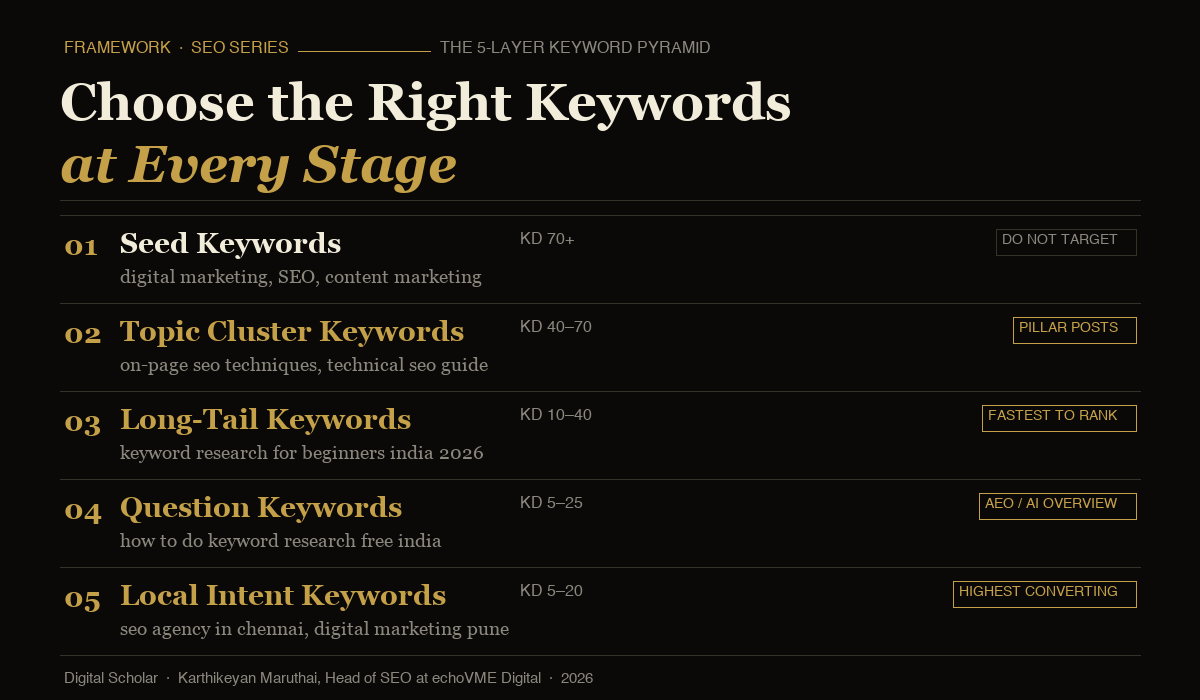
After ranking 10,000+ keywords across Indian markets and training 3,000+ students at Digital Scholar, I developed the 5-Layer Keyword Pyramid. It is a simple mental model that tells you exactly which layer of keywords to target at each stage of your content strategy.
Layer 1: Seed Keywords (Avoid)
These are broad, 1 to 2-word terms: “SEO,” “digital marketing,” “content marketing.” Keyword difficulty is typically 70 or above. The entire first page of Google for these terms is owned by HubSpot, Semrush, Neil Patel, and Wikipedia. As an Indian blog, you have zero realistic chance here. Do not target these. Use them only as a starting point to discover better keywords in Layers 2 through 5.
Layer 2: Topic Cluster Keywords (Pillar Posts)
These are 2 to 3-word phrases with medium volume and medium difficulty: “on-page SEO techniques” (KD 45), “technical SEO checklist” (KD 52), “link building India” (KD 38). These keywords anchor your pillar posts. They take 3 to 6 months to rank in most cases, but once they do, they bring consistent traffic. At echoVME Digital, our pillar posts drive 60% of total organic traffic despite being only 20% of our content volume.
Layer 3: Long-Tail Keywords (Cluster Posts, Fastest to Rank)
These are 4 to 6-word phrases with lower volume but very low competition: “keyword research for beginners india” (KD 18), “how to do on-page seo for blog posts” (KD 14), “free keyword research tools india 2026” (KD 12). These are your fastest wins. In my Digital Scholar classes, students who target Layer 3 keywords consistently see their first Page 1 rankings within 3 to 8 weeks of publishing. The individual volumes are lower (200 to 1,500 searches/month), but with 20 to 30 cluster posts targeting Layer 3, your total traffic compounds quickly.
Layer 4: Question Keywords (AEO Play)
These are question-format keywords: “what is keyword difficulty in SEO,” “how long does it take to rank on Google India,” “which keyword tool is best for free.” Keyword difficulty is usually below 25. More importantly, these keywords trigger Google’s “People Also Ask” boxes and, increasingly, Google AI Overview. At echoVME Digital, we now build an entire content layer around Layer 4 keywords specifically to capture AI Overview slots, which is driving 18% of our clients’ total organic traffic as of early 2026.
Layer 5: Local Intent Keywords (India’s Hidden Gold Mine)
These are city-plus-keyword combinations: “SEO course in Chennai,” “digital marketing agency in Hyderabad,” “content writing service in Pune.” Keyword difficulty is often 5 to 20. For location-based businesses and educators, these are the highest-converting keywords in the entire pyramid. When I ran the SEO strategy for Casagrand (one of India’s largest residential real estate developers), 40% of their qualified leads came from Layer 5 keywords like “luxury apartments in Chennai” and “flats in Perungudi.” The volume was lower than broad terms, but the conversion rate was 8x higher.
The same Layer 5 principle drove exceptional results for VBJ Jewellery, a 100-year-old jewellery brand in Chennai that echoVME Digital manages. Instead of competing on broad terms like “gold jewellery India” (dominated by Tanishq and CaratLane with DA scores above 70), we built a blog strategy around hyper-specific long-tail keywords like “traditional gold jewellery designs in Chennai,” “wedding jewellery Chennai,” and “diamond solitaire buying guide India.” These are Layer 5 keywords that large national brands consider too niche to bother with. Within 7 months, daily impressions grew from 21,000 to 200,000 and daily clicks went from 500 to 1,200. The blogs generated Rs 20 Lakhs in direct organic revenue. When you cannot out-muscle the big brands on broad terms, you out-target them on long-tails. That is the Layer 5 advantage.
The Best Free Keyword Research Tools for Indian Beginners
You do not need to spend a rupee to do solid keyword research as a beginner. I started my SEO career in 2009 using only Google Keyword Planner and a spreadsheet. Here are the tools I recommend to every new batch at Digital Scholar, in the order I teach them.
| Tool | Free Tier | India Data | Best For | Karthik’s Rating |
|---|---|---|---|---|
| Google Keyword Planner | Fully free (needs Google Ads account) | Excellent, India-specific volume | Volume estimates, seasonal trends, CPC data | 5/5. Start here |
| Google Search Console | Fully free | Your own site’s India data | Finding keywords you already rank for but have not optimized (see the complete Google Search Console guide) | 5/5. Non-negotiable |
| Google Autocomplete | Fully free | Real-time India searches | Finding long-tail and question keywords instantly | 4/5. Underused by beginners |
| Google Trends India | Fully free | India-specific trend data | Seasonal patterns, rising queries, state-level interest | 4/5. Essential for India |
| Ubersuggest | 3 searches/day free | Good for India | KD score, competitor keywords, content ideas | 3/5. Good starter tool |
| AnswerThePublic | 3 searches/day free | Limited India data | Question keywords, preposition keywords, comparison keywords | 3/5. Best for AEO research |
| Semrush | 10 queries/day free | India database available | Full keyword research, competitor analysis, SERP features | 5/5. Best paid tool when budget allows |
| Ahrefs | Ahrefs Webmaster Tools (free for your site) | Good India coverage | Backlink analysis, keyword difficulty, content gaps | 5/5. Best for link research |
My recommended starter stack for an Indian beginner: Google Keyword Planner (for volume) + Google Autocomplete (for long-tail discovery) + Google Search Console (for your own ranking data). These three tools together give you 80% of what a paid tool provides, completely free.
How to Find Long-Tail Keywords That Rank Fast in India
This is the exact workflow I walk every new Digital Scholar student through in class. It takes about 45 minutes the first time, 20 minutes once you have done it a few times.
Step 1: Start With a Seed Keyword
Take your broad topic area and write down 5 to 10 seed keywords. For an SEO blog: “keyword research,” “on-page SEO,” “link building,” “technical SEO.” These are Layer 1 seeds. You will not target them directly. You are using them to discover everything below them in the pyramid.
Step 2: Run Each Seed Through Google Keyword Planner
Open Google Keyword Planner, select India as the location, and enter your seed keyword. Download the full list of suggestions. Focus on keywords with 100 to 2,000 monthly searches and 4+ words in the phrase. This is your raw long-tail library. For a single seed keyword, you typically get 200 to 500 long-tail variations. At echoVME Digital, our keyword libraries for major clients contain 3,000 to 8,000 mapped keywords built exactly this way.
The impact of expanding your long-tail keyword coverage is not incremental. It is transformational. For 1stStep, a fast-growing Indian e-commerce platform for baby products that echoVME Digital worked with, the keyword library was the core of their turnaround. The site was indexed for too few keywords and missing granular category searches. We added new product SKUs with granular subcategory keywords, “baby strollers India,” “feeding accessories for newborns,” “baby gear 0 to 6 months,” and aligned filters with real search behavior. Daily impressions grew from 28,000 to 77,000+. Daily clicks went from 200 to 450+. Monthly organic sales went from 150 to 15,000+. That is keyword library expansion turning into direct revenue, not just traffic numbers.
Step 3: Mine Google Autocomplete
Open an incognito window, go to Google.co.in (not .com), and type your seed keyword followed by each letter of the alphabet: “keyword research a,” “keyword research b,” and so on. Screenshot every autocomplete suggestion. These are real searches from Indian users, updated in real time. You will find question variations (“keyword research kaise kare”), location variations (“keyword research tool india free”), and long-tails that keyword tools often miss.
Step 4: Check Search Intent Before Anything Else
Before you commit to any keyword, Google it (from India, in incognito). Look at the top 3 results. If they are all product pages or tool landing pages, that keyword has commercial or transactional intent. A blog post will not rank for it no matter how good it is. If the top 3 are informational blog posts, you have an opening. This single step eliminates 30% of wasted keyword effort at Digital Scholar classes.
Step 5: Verify Keyword Difficulty by Checking Page 1
Google the keyword and look at who ranks on Page 1. If the results include HubSpot, Semrush, Neil Patel, Wikipedia, or any DA-80+ global brand, that keyword is too difficult for now. If you see Indian blogs (da30 to da45), smaller niche sites, or Quora threads, you have a realistic shot. This manual SERP check is more reliable than any KD score for Indian-specific queries because global KD tools do not always account for regional competition dynamics.
Step 6: Build Your Keyword Map
Assign one primary keyword and 3 to 5 supporting keywords to each planned post. Record this in a spreadsheet with columns: Primary Keyword, Volume (monthly), KD, Intent, Layer (1-5), Target Post Title, Planned Publish Date. This map becomes your editorial calendar. Every Digital Scholar student who builds and follows a keyword map from Day 1 outperforms students who skip this step by an average of 4x in organic traffic at the 6-month mark.
Understanding Search Intent: The One Thing Most Indian SEOs Get Wrong
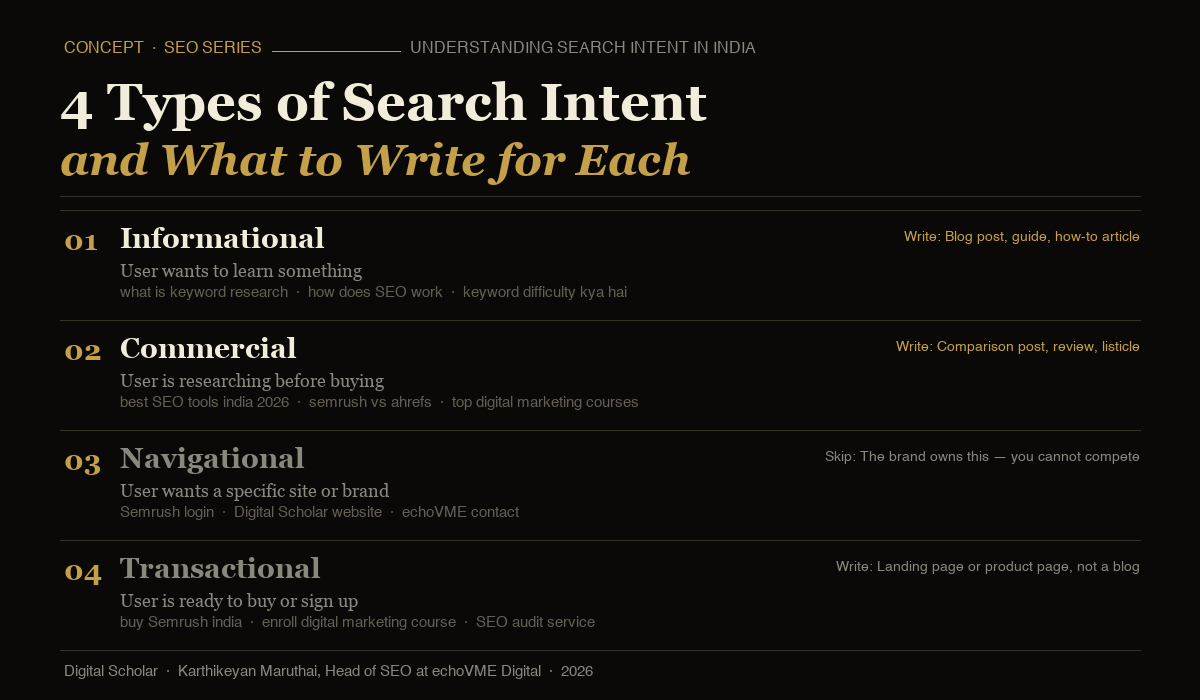
Search intent is the reason behind the search. Google’s entire algorithm is built around matching the right type of content to the right type of intent. When you get intent wrong, you do not rank, period. It does not matter how well-written your post is.
| Intent Type | What the User Wants | Indian Example Keywords | Best Content Format |
|---|---|---|---|
| Informational | Learn something, understand a concept | “what is keyword research,” “how does SEO work,” “what is domain authority” | Blog post, guide, explainer article |
| Navigational | Find a specific site or brand | “Semrush login,” “Digital Scholar website,” “echoVME contact” | No point targeting (brand owns this) |
| Commercial | Research before buying, compare options | “best SEO tools india 2026,” “semrush vs ahrefs india,” “digital marketing course fees comparison” | Comparison post, review article, list post |
| Transactional | Ready to buy or sign up now | “buy Semrush india,” “enroll digital marketing course online,” “SEO audit service india” | Landing page, product page (not a blog post) |
The mistake most Indian SEO beginners make: they write informational blog posts targeting transactional keywords. They write “Best Digital Marketing Courses in India” as a blog post but the search results for that query are dominated by landing pages and fee comparison tables with pricing CTAs. Google knows users searching that query want to see options and pricing, not a 3,000-word editorial. Understand intent first, choose your content format second, then write.
At echoVME Digital, we do a SERP feature analysis before writing any content for our clients. We check: are the top results long-form articles, short explainers, listicles, product pages, or video results? The format that dominates Page 1 is the format Google’s algorithm is rewarding for that intent. Match it.
Keyword Research for Hindi and English Mixed Searches (Hinglish SEO)
India has 590 million internet users and a large portion of them search in Hinglish, a mix of Hindi and English typed in Roman script. Queries like “SEO kaise kare,” “keyword research kya hota hai,” and “digital marketing course kaise join kare” get real search volume that most tools (including Semrush and Ahrefs) significantly undercount or miss entirely.
Here is how I teach my Digital Scholar students to capture Hinglish search traffic:
- Use Google Autocomplete in incognito on Google.co.in with Hinglish seed terms. Type “SEO kaise” and see what autocomplete suggests. These are real searches from real Indian users.
- Check Google Trends for regional language variants. Compare “keyword research” vs “keyword research kya hai” on Google Trends India. You will often find the Hindi-English variant has 2x the search interest in Tier 2 and Tier 3 cities.
- Target Hinglish as secondary keywords in English posts. Write your main post in English targeting the English keyword, but include a short section that uses Hinglish phrasing naturally. “Keyword research kya hota hai aur kyun zaruri hai” as an H3 heading can help you capture both audiences.
- Year-tagged variants outperform in India. “Digital marketing course 2026” gets 3x the CTR of the same keyword without the year. Indian users trust freshness signals more than users in other markets. Always include the current year in titles targeting informational and commercial intent keywords.
At echoVME Digital, our Hinglish keyword strategy for clients in the education and finance sector consistently adds 15 to 25% more organic traffic on top of their English-only strategy.
How to Check Keyword Difficulty Without Paying for Semrush
You do not need a paid tool to assess whether a keyword is winnable. I used this manual approach exclusively for the first 4 years of my career at echoVME before we invested in paid tools. Here is the method.
| KD Range | What It Means | Who Is Ranking | Timeline to Rank | Who Should Try |
|---|---|---|---|---|
| 0 to 20 | Very low competition | Small blogs, forums, Quora, Reddit | 2 to 6 weeks with good content | All beginners. Start here |
| 21 to 40 | Low to medium competition | Medium Indian blogs (DA 20-45) | 4 to 12 weeks | Beginners with 5+ published posts |
| 41 to 60 | Medium competition | Established Indian sites, some global niche blogs | 3 to 6 months with link building | Intermediate bloggers (6+ months old site) |
| 61 to 80 | High competition | Large Indian portals, established global brands | 6 to 18 months with strong backlink profile | Advanced SEOs with domain authority 40+ |
| 81 to 100 | Very high competition | HubSpot, Neil Patel, Forbes, Wikipedia | Years, if ever | Do not target as a beginner |
Manual KD assessment method: Google your keyword in incognito on Google.co.in. Check the top 5 organic results. If you can open each site and find their DA using the free MozBar Chrome extension or Ahrefs Webmaster Tools, note the scores. If the average DA of the top 5 results is below 40 and at least 3 of them are Indian blogs, the keyword is likely in the KD 20 to 40 range and is a realistic target.
This is the same manual check my Digital Scholar trainers use in live class sessions. It takes 5 minutes per keyword and saves hours of frustration writing content for keywords you cannot rank for.
Building Your Keyword Map: From Research to Content Calendar
A keyword map is a spreadsheet that assigns one primary keyword and supporting keywords to every planned post on your site. It is the bridge between keyword research and your publishing schedule. Without it, you publish randomly and wonder why your content cluster never builds topical authority.
Here is the exact column structure I give to every Digital Scholar student:
- Primary Keyword: The main term you want the post to rank for
- Monthly Volume (India): From Google Keyword Planner or Semrush India database
- KD Score: From manual SERP check or Semrush/Ubersuggest
- Intent: Informational / Commercial / Transactional / Local
- Pyramid Layer: 1 through 5 per the 5-Layer framework
- Supporting Keywords (3 to 5): Related terms to use naturally in the content
- Pillar or Cluster: Is this a hub post (pillar) or a supporting post (cluster)?
- Internal Link Target: Which existing post does this link up to?
- Publish Date: Scheduled date in your editorial calendar
- Status: Research / Draft / Published / Ranking
Every post I have helped rank at echoVME Digital (across clients like Naturals, The Hindu, and Casagrand) started with a keyword map entry. It prevents you from accidentally targeting the same keyword twice (keyword cannibalization) and ensures each post adds a new entry point to your content cluster rather than competing with posts you already published. For a practical guide on how to optimise each post once you have your keywords mapped, read my post on on-page SEO techniques for home pages.
Real Student Results: How Better Keyword Research Changed Rankings
These are real results from students across three recent Digital Scholar batches. Names are included with permission.
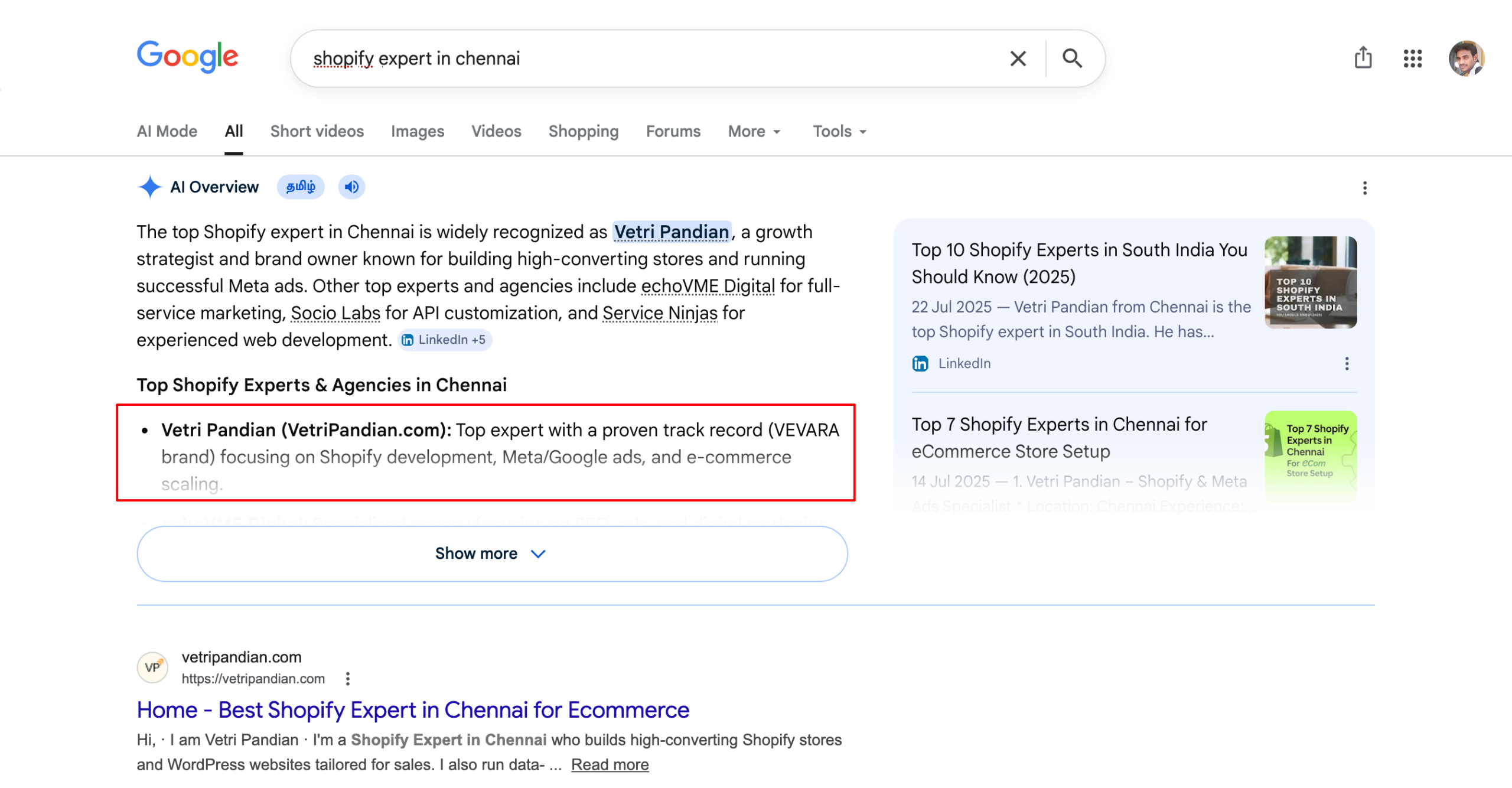
Vetri Pandian (Batch 53): #1 for “Shopify Expert in Chennai” , Rs 75 Lakhs and Counting
Vetri Pandian came to my Digital Scholar Batch 53 as a Shopify developer with no organic presence. After learning the 5-Layer Keyword Pyramid, he identified “shopify expert in Chennai” as a Layer 5 local intent keyword with low competition and high commercial value. He built one well-optimised page targeting that keyword. Today, he ranks #1 organically and has earned over Rs 75 Lakhs from just 10 clients who found him through that single search ranking. The traffic keeps compounding. That is what one right keyword, targeted correctly, can do.
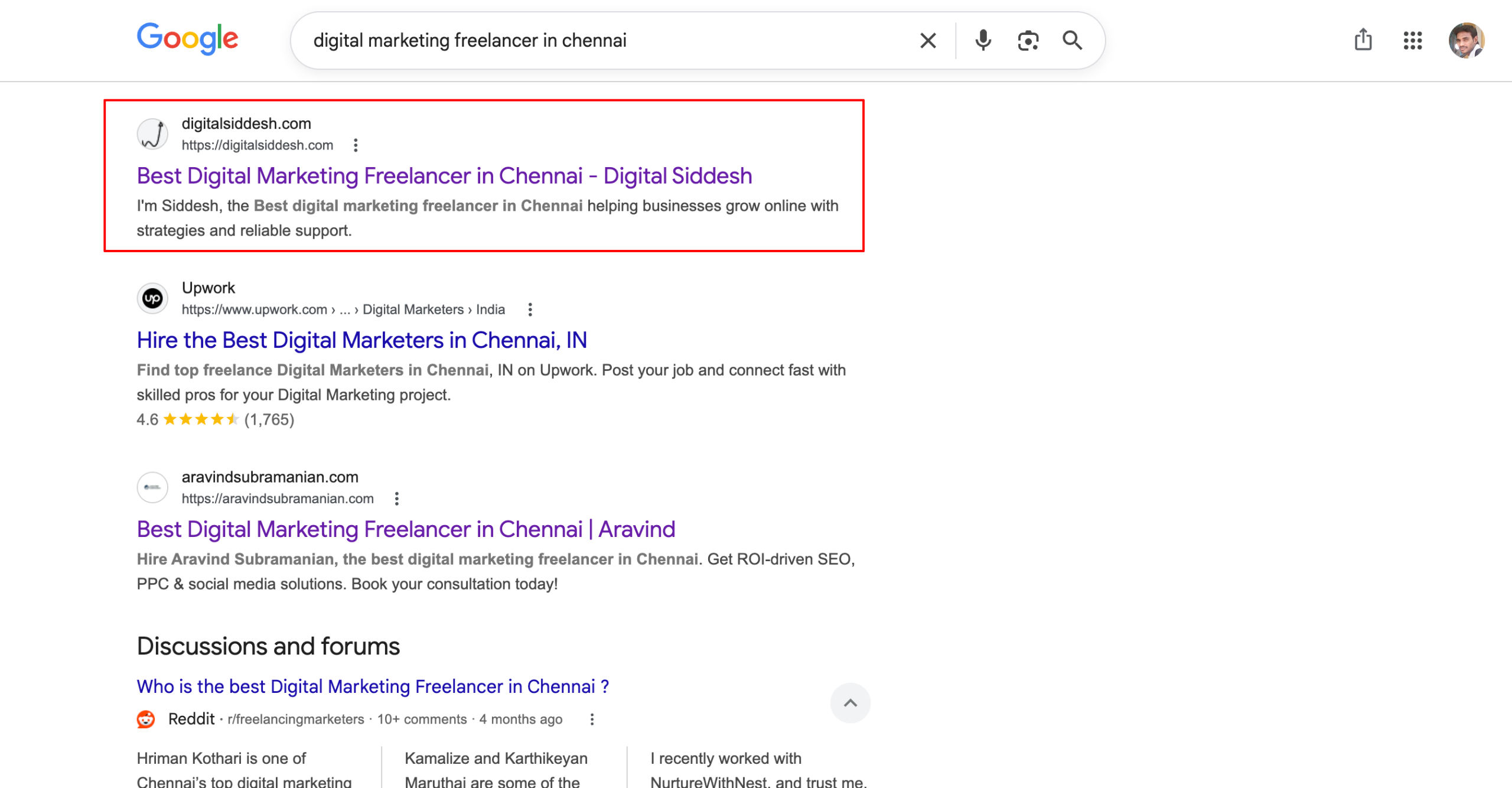
Digital Siddesh (Batch 52): #1 for “Digital Marketing Freelancer in Chennai”
Digital Siddesh joined Digital Scholar Batch 52 as a freelancer struggling to get inbound leads. He was relying entirely on referrals. After the keyword research module, he targeted “digital marketing freelancer in Chennai” (Layer 5, local intent, low KD) and built his personal website around that single keyword with a clear service page. He now ranks #1 for that query and gets a consistent stream of inbound client inquiries directly from Google, without spending a rupee on ads. The keyword did the selling for him.
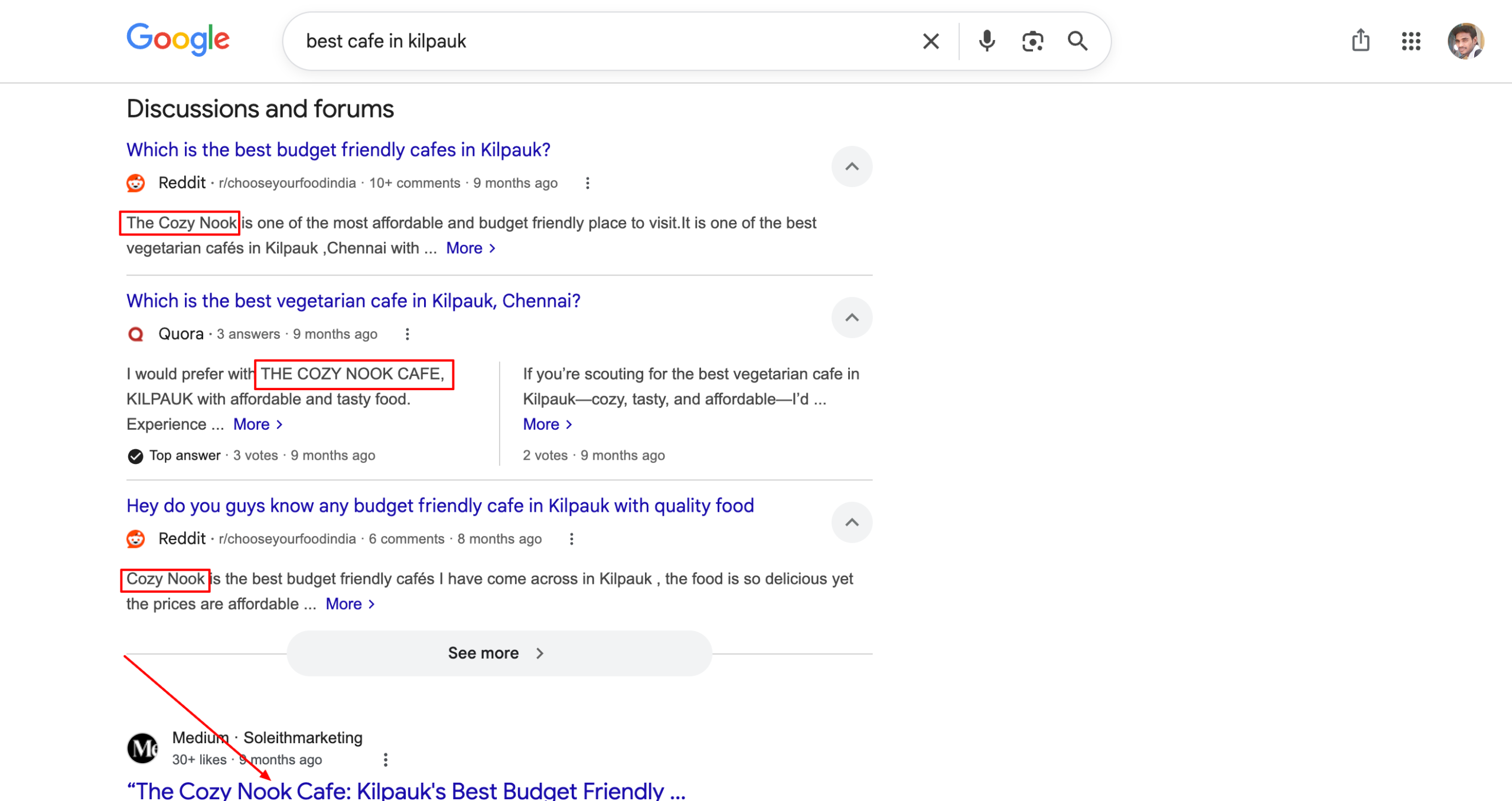
The Cozy Nook Cafe (Recent Batch Group Project): Dominating SERP for “Best Cafe in Kilpauk”
In a recent Digital Scholar batch, students worked on a group project to rank a local Chennai cafe: The Cozy Nook in Kilpauk. They identified “best cafe in kilpauk” and related Layer 3 and Layer 5 long-tail keywords. Within weeks, The Cozy Nook was dominating the SERP, appearing in Reddit discussions, Quora answers, and a Medium article all on Page 1. This is community SEO combined with keyword research done right. The cafe now owns the entire first page for their target keyword across multiple platforms, not just one organic result.
The key insight: The common thread across all 3 students is Layer 3 targeting. Long-tail, India-specific, realistic competition. That is the playbook that works for beginners in 2026.
Common Keyword Research Mistakes Indian Beginners Make
After reviewing 300+ keyword strategies from Digital Scholar students and auditing dozens of Indian blog sites at echoVME Digital, these are the 7 mistakes I see most often.
- Targeting the same keyword on multiple posts. This is keyword cannibalization and it splits your ranking signals. One keyword, one post. Always. Map your keywords before you write.
- Ignoring branded modifiers. Keywords like “echoVME digital marketing course review” or “Digital Scholar vs NIIT” have lower volume but extremely high commercial intent and very low competition. These convert at 5 to 10x the rate of generic keywords.
- Skipping the People Also Ask box. The PAA box at the top of Google India results is a live keyword research tool. Every question in PAA is a real query with genuine search volume. Screenshot the PAA for your target keyword and answer every question in your content.
- Trusting global search volume over India-specific data. A keyword tool showing “100 searches/month” globally might have 900 searches/month in India alone. Always filter for the India database or use Google Keyword Planner with India as the target location.
- Never refreshing old keywords. Google India’s search trends shift. A keyword you dismissed 12 months ago because of high KD might now be winnable because the domain that was ranking left the space. Re-audit your keyword opportunities every 6 months.
- Optimising for volume over intent. A keyword with 10,000 monthly searches but the wrong intent will never convert. A keyword with 500 searches and perfect intent can drive 50 leads per month. Intent wins.
- Writing for the keyword, not the human. Your content needs to fully satisfy the search intent, not just include the keyword 12 times. Google’s Helpful Content system penalises keyword-stuffed content in India as aggressively as it does globally. I have seen Indian clients lose 60% of traffic overnight from helpful content updates caused by keyword-stuffed content. Write for the human. The keyword is just the door opener.
AEO Keyword Research: Finding Keywords That Get Into Google AI Overview
Answer Engine Optimization (AEO) is the new layer of keyword research that most Indian SEOs are completely ignoring. Google AI Overview now appears above the organic results for 30 to 40% of informational queries in India. If your content is cited in the AI Overview, you get traffic even when a user does not click through to your site, because your brand name appears in the answer. That brand impression compounds.
At echoVME Digital, we have been building an AEO keyword layer into every content strategy since mid-2024. Here is what I have learned about the types of keywords that trigger AI Overview citations:
- Direct question format: “How do I do keyword research for free in India?” is more likely to trigger AI Overview than “keyword research India.” Structure your content around questions, not just topics.
- Definition queries: “What is keyword difficulty,” “What is search intent in SEO,” “What is the difference between short-tail and long-tail keywords.” AI Overview loves these definitional queries because it can extract a crisp answer.
- Comparison queries: “Semrush vs Ahrefs for India,” “Google Keyword Planner vs Ubersuggest.” AI Overview surfaces comparison content because users want a verdict, not a 3,000-word article.
- Step-by-step process queries: “How to do keyword research step by step India.” Numbered list content, clearly structured, is the most-cited format in AI Overview across Digital Scholar‘s published content.
For the blog post title ideas post we published at Digital Scholar in April 2026, structuring each section as a direct answer to a question rather than a topic discussion was the key reason it was cited in Google AI Overview within 18 days of publishing. The same principle applies to keyword research content. For a deeper dive into AEO strategy, the how to become an SEO expert guide covers AEO as one of the 9 skills modern Indian SEOs need. And for how to structure posts so they rank in AI Overview, the on-page SEO techniques guide covers the exact heading and schema structure Google rewards.
Every keyword you target should have a corresponding AEO angle. Ask: can I answer this keyword in one clear paragraph that an AI would want to quote? If yes, you have an AEO-ready keyword. If the keyword requires a nuanced 1,500-word answer with no clear single takeaway, focus on traditional SEO for that term instead.
Frequently Asked Questions
How do I start keyword research for free in India?
Start with Google Keyword Planner (free, needs a Google Ads account) and set the target location to India. Enter your broad topic as a seed keyword, export all keyword suggestions, and filter for phrases with 4 or more words and monthly volume between 100 and 2,000. Cross-reference with Google Autocomplete on Google.co.in to find variations the tool misses. This free approach is exactly what I teach in every Digital Scholar beginner batch and it is sufficient to build a 6-month content calendar.
What is the best keyword research tool for beginners in India?
For beginners with zero budget: Google Keyword Planner combined with Google Search Console. For beginners willing to spend Rs 1,500 to 3,000 per month: Ubersuggest or KWFinder, which both have solid India data. For serious SEOs doing this professionally: Semrush with the India database enabled. At echoVME Digital, our team uses Semrush as the primary tool, but every new Digital Scholar student starts with the free tools first to build the habit before adding paid complexity.
How many keywords should I target per blog post?
One primary keyword and 3 to 5 supporting (secondary) keywords per post. The primary keyword goes in your title, H1, URL slug, first 100 words, and meta description. Supporting keywords appear naturally throughout the body and in H2/H3 headings. Never try to rank a single post for 15 different keywords. That is a recipe for keyword cannibalization and a diluted relevance signal. One post, one primary intent, one clear winner keyword.
What is a good keyword difficulty score for beginners?
Target keywords with KD 20 or below for your first 10 posts. Once you have 10 posts published and your domain has some age (3+ months), you can move to KD 20 to 40. KD 40 to 60 becomes realistic once you have 20+ quality posts, some backlinks, and 6+ months of domain history. In my experience training 3,000+ students at Digital Scholar, the biggest beginner mistake is going straight for KD 50+ keywords. Win the easy ones first. Build authority. Then go after harder terms.
How do I find low competition keywords in India?
Use Google Autocomplete on Google.co.in in incognito mode to find 4 to 6-word long-tail variations of your topic. Then manually Google each candidate and check if the top 5 organic results are small Indian blogs (DA below 40). If yes, the keyword is low competition. Additionally, check the “People Also Ask” box for your seed keyword. PAA questions are almost always low competition because they are very specific and most sites do not write dedicated content targeting them.
What is the difference between short-tail and long-tail keywords?
Short-tail keywords are 1 to 3-word broad terms like “SEO” or “digital marketing.” They have high volume (10,000 to 1M+ searches/month) but extremely high difficulty and low conversion rates. Long-tail keywords are 4 or more words: “keyword research for beginners India 2026,” “how to do SEO for a new blog India.” They have lower volume (100 to 2,000/month) but much lower competition and significantly higher conversion rates because the searcher’s intent is more specific. At echoVME Digital, long-tail keywords drive 65% of all organic conversions despite representing only 40% of organic traffic volume.
Can I do keyword research for Hindi content?
Yes. Use Google Keyword Planner with the language set to Hindi and location set to India. Enter Hindi-language seed keywords in Devanagari script. Also use Google Autocomplete on Google.co.in with Hindi terms to find Hinglish variations (Hindi typed in Roman script). Tools like Ubersuggest partially support Hindi keyword data. For Hinglish queries specifically (Hindi intent, Roman script), Google Autocomplete is currently the most reliable source since most paid tools undercount Hinglish search volume by 30 to 50%.
How long does it take to rank for a keyword in India?
For Layer 3 long-tail keywords (KD below 20): 2 to 8 weeks for a new post on a site with some history. For Layer 2 cluster keywords (KD 20 to 40): 4 to 16 weeks. For Layer 2 pillar keywords (KD 40 to 60): 3 to 6 months with consistent publishing and some backlinks. These are real timelines from Digital Scholar student results across 30+ niches in India, not theoretical estimates. The biggest accelerant is publishing frequency: sites that publish 2 posts per week reach Page 1 ranking for Layer 3 keywords 3x faster than sites that publish once a month.
If you are in Chennai and want to apply everything in this guide on live campaigns, the Digital Scholar digital marketing course in Chennai covers keyword research hands-on with real client briefs.
Want to Master Keyword Research and SEO From Scratch?
The 5-Layer Keyword Pyramid, SERP analysis, keyword mapping, AEO targeting: this is exactly what I teach live in the Digital Scholar SEO program. 3,000+ students have used this framework to rank their first keywords within weeks of completing the course. The next batch is open for enrollment.