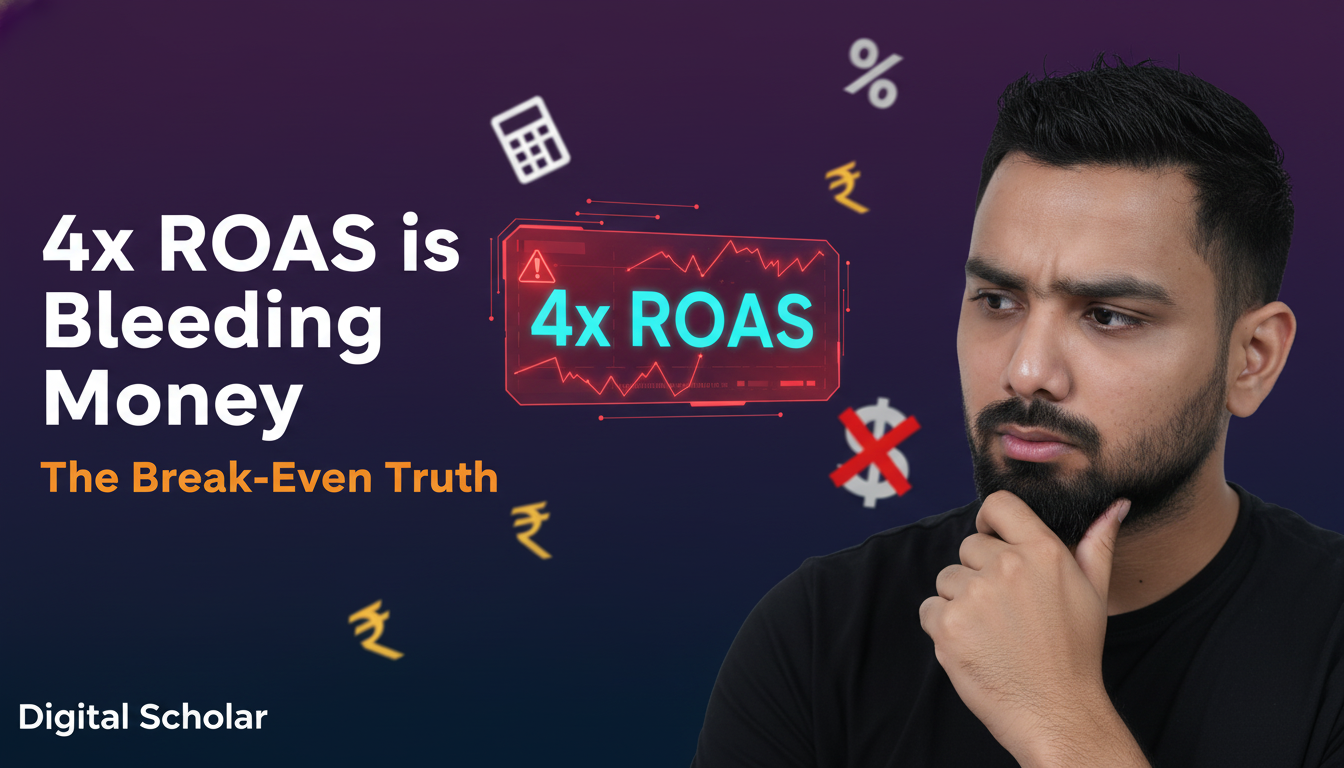

- Your 4x ROAS might be bleeding money. The platform dashboard does not account for COGS, packaging, shipping, payment gateway, GST, or returns. Break-even ROAS via contribution margin is the only number that connects ad spend to actual profitability.
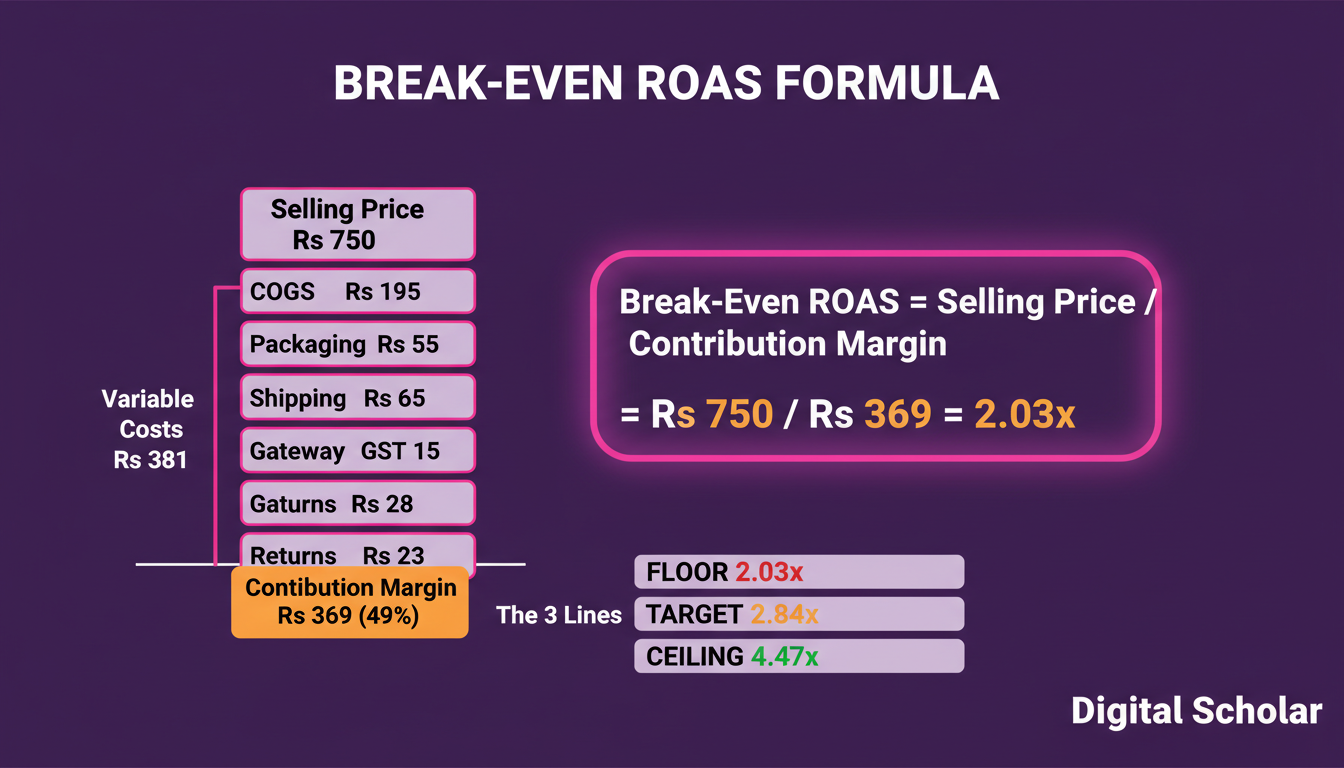
- The formula is 2 steps. Break-Even ROAS = Selling Price / Contribution Margin per unit. Below this number, every order costs you money. Above it, you cover overheads and build profit.
- This post gives you 4 fully worked examples for Indian businesses (premium tea, baby care, SaaS, jewelry), a decision framework called The 3 Lines, and the discount math that shows why a 20% sale can silently destroy your margins. Connects directly to the 8 Levels of Performance Marketing Mastery framework (Level 5: Measurement Mastery).
Free Break-Even ROAS Calculator (Use This Before You Spend Another Rupee)
Skip the math. Punch your numbers into the calculator below and get your break-even ROAS, contribution margin, and The 3 Lines instantly. It works for D2C brands, services, and marketplace sellers. Defaults are set to the baby care example from this post so you can see it work, then replace with your own numbers.
Break-Even ROAS Calculator
Enter your product economics. We will compute your break-even ROAS, contribution margin, and The 3 Lines (Floor, Target, Ceiling) instantly.
Why Your Meta Ads Dashboard Is Lying to You (Structurally)
Your Meta Ads dashboard is lying to you. Not deliberately. Structurally.
It shows a number called ROAS. Return on ad spend. You see 4x and assume you are profitable. But that 4x does not account for the cost of making the product, packaging it, shipping it, processing the payment, handling returns, or paying GST. It only divides revenue by ad spend. The actual money left in your pocket could be Rs 47 per order. Or it could be negative.
When I audit a new client account at echoVME Digital, the first document I ask for is the product-level cost sheet. Not the campaign structure. Not the audience setup. The cost sheet. Because without knowing what it costs to fulfill one order, no amount of campaign optimization will tell you whether the business is actually making money. This is one of the first mastery gates we cover in the Digital Marketing Course in Chennai.
The number that connects ad spend to business profitability is break-even ROAS. And the only reliable way to arrive at it is through contribution margin. This post gives you the formula, 4 fully worked examples for Indian businesses, a decision framework I call The 3 Lines, and the discount math that shows why a festive season sale can silently destroy your margins.
What Is Contribution Margin and Why Should a Performance Marketer Care?
Contribution margin is the money left from a single sale after subtracting every cost that is directly tied to fulfilling that specific order. Not your office rent. Not your team’s salaries. Not your Slack subscription. Those are fixed costs that exist whether you sell 10 orders or 10,000.
The costs that DO go into the contribution margin calculation are the ones that scale with every order:
- COGS (cost of goods sold): raw materials, manufacturing, or sourcing cost per unit
- Packaging: corrugated box, bubble wrap, branded inserts, tape, labels
- Shipping and logistics: courier fee per shipment (Delhivery, Ecom Express, Xpressbees rates vary by weight and zone)
- Payment gateway: Razorpay charges 2%, CCAvenue charges 1.75% to 2.5%, UPI is cheaper but blended rate matters
- GST outflow: net GST after input credit (varies by slab: 5%, 12%, 18%, 28%)
- Return and RTO reserve: a percentage set aside for products that come back (varies wildly by category)
- Marketplace commission: if selling on Amazon, Flipkart, Myntra, Nykaa (referral fee + closing fee + fulfillment)
Why This Number Is Your Ad Budget Ceiling
Think of contribution margin as the maximum amount you can afford to spend to acquire one customer before that sale becomes unprofitable. If contribution margin is Rs 400 and your CAC is Rs 500, you are losing Rs 100 on every customer you acquire. It does not matter if your dashboard ROAS is 3x or 5x. The order-level economics are underwater. This is exactly the contribution margin question we use as the 80% Eliminator in performance marketing interviews.
The Break-Even ROAS Formula (2 Steps)
Step 1: Build the Cost Stack
List every variable cost per unit. Add them up. Subtract the total from the selling price. What remains is contribution margin.
Contribution Margin = Selling Price – Total Variable Costs per Unit
Step 2: Divide
Break-Even ROAS = Selling Price / Contribution Margin per Unit
That is the entire calculation. Two steps. The difficulty is not the math. The difficulty is getting accurate variable cost data, which requires talking to the operations team, the finance team, and the logistics partner. Most performance marketers have never made those calls. That is where the gap lives.
Example 1: Premium Tea Brand (Rs 750 per box)
A single-origin tea brand sells a 100g box of Assam second flush at Rs 750 through their Shopify store. Small box. Lightweight. Low return rate. Here is the cost stack.
| Line Item | Amount |
|---|---|
| Selling Price | Rs 750 |
| Less: COGS (sourcing + blending + quality testing) | Rs 195 |
| Less: Packaging (printed tin + outer carton) | Rs 55 |
| Less: Shipping (250g slab, prepaid, pan-India avg) | Rs 65 |
| Less: Payment gateway (2% blended) | Rs 15 |
| Less: GST outflow (5% slab, net after credit) | Rs 28 |
| Less: Return reserve (3%, tea has low returns) | Rs 23 |
| TOTAL VARIABLE COSTS | Rs 381 |
| CONTRIBUTION MARGIN | Rs 369 (49.2%) |
| BREAK-EVEN ROAS = 750 / 369 | 2.03x |
What This Number Means in Practice
This brand has a comfortable cushion. At 2x ROAS, they break even on variable costs. At 3x, they have roughly Rs 119 per order available toward fixed costs and profit. At 4x, they are genuinely profitable per order. Tea is a high-margin, low-return category. This is the kind of product that performance marketing was built for.
The Insight Most Tea Brands Miss
Because margins are good, many premium tea brands never calculate this. They assume “we are obviously profitable” and never discover that their subscription box variant (which includes a free sample and a handwritten note) has a contribution margin 40% lower than the standalone box. Running the same ROAS target across both SKUs means the subscription box quietly bleeds while the single box subsidizes it.
Example 2: Organic Baby Care Brand (Rs 2,200 combo pack)
An organic baby care brand sells a combo (shampoo + lotion + rash cream) at Rs 2,200. Baby care has moderate COGS but high trust sensitivity, which means return rates spike if the product does not match expectations.
| Line Item | Amount |
|---|---|
| Selling Price | Rs 2,200 |
| Less: First-purchase coupon (10%) | Rs 220 |
| NET REVENUE AFTER DISCOUNT | Rs 1,980 |
| Less: COGS (ingredients + formulation + testing, 32%) | Rs 634 |
| Less: Packaging (child-safe closure + printed box + inserts) | Rs 110 |
| Less: Shipping (400g combo, prepaid avg) | Rs 85 |
| Less: Payment gateway (2%) | Rs 40 |
| Less: GST outflow (12% slab, net after credit) | Rs 178 |
| Less: Return reserve (10%, higher for combos) | Rs 198 |
| TOTAL VARIABLE COSTS | Rs 1,245 |
| CONTRIBUTION MARGIN | Rs 735 (37.1% of original MRP) |
| BREAK-EVEN ROAS = 2,200 / 735 | 2.99x |
Why the Discount Changes Everything
Without the 10% coupon, this brand’s contribution margin would be Rs 955 and break-even ROAS would be 2.30x. The coupon added Rs 0.69 to the break-even ROAS. That sounds small. But across 5,000 orders a month, the difference between a 2.30x target and a 2.99x target is Rs 11 lakh in additional ad efficiency required.
Example 3: B2B SaaS Tool (Rs 45,000 annual subscription)
A project management SaaS for small teams charges Rs 45,000 per year (billed annually). They acquire customers through Meta lead gen, Google Search, and a 3-person sales team. The math works differently because there is no physical product, no shipping, and the “COGS” is infrastructure cost.
| Line Item | Amount |
|---|---|
| Annual Subscription | Rs 45,000 |
| Less: GST (18%) | Rs 8,100 |
| NET REVENUE | Rs 36,900 |
| Less: Cloud hosting + infra (allocated per user, ~11%) | Rs 4,059 |
| Less: Payment gateway + EMI processing (3%) | Rs 1,107 |
| Less: Onboarding cost (CSM time, avg 2 hrs @ Rs 500/hr) | Rs 1,000 |
| Less: Churn buffer (15% of customers churn before renewal) | Rs 5,535 |
| TOTAL VARIABLE COSTS | Rs 19,801 |
| CONTRIBUTION MARGIN | Rs 17,099 (38.0%) |
| BREAK-EVEN CAC | Rs 17,099 |
SaaS Uses CAC, Not ROAS
In SaaS, you do not measure ROAS the way e-commerce does. You measure CAC (Customer Acquisition Cost) and compare it to contribution margin. If CAC exceeds Rs 17,099, the customer is unprofitable in year one.
The Lead Gen Math
If the sales team converts 6% of leads into customers, and each lead costs Rs 650 from Meta:
- CAC = Rs 650 / 0.06 = Rs 10,833
- Break-even CAC = Rs 17,099
- Headroom per customer = Rs 6,266 toward fixed costs and profit
This is a healthy acquisition. You can afford to scale spend.
But if conversion rate drops to 3% (common when you scale audiences too fast):
- CAC = Rs 650 / 0.03 = Rs 21,667
- Break-even CAC = Rs 17,099
- Loss per customer = Rs 4,568
Every new customer bleeds money. Scale is actively harmful until conversion rate recovers.
Example 4: Fashion Jewelry Brand (Rs 5,500, Website vs Myntra)
A contemporary jewelry brand sells a signature set at Rs 5,500. They sell on both their own website and on Myntra. Jewelry has low COGS relative to price but high return rates on marketplaces (sizing, color mismatch, impulse purchases).
Channel A: Own Website (Shopify)
| Line Item | Amount |
|---|---|
| Selling Price | Rs 5,500 |
| Less: COGS (materials + labor + QC, 22%) | Rs 1,210 |
| Less: Packaging (branded velvet box + security seal) | Rs 180 |
| Less: Shipping (insured, 200g, prepaid) | Rs 110 |
| Less: Payment gateway (2%) | Rs 110 |
| Less: GST outflow (3% on artificial jewelry, net) | Rs 132 |
| Less: Return reserve (7%) | Rs 385 |
| TOTAL VARIABLE COSTS | Rs 2,127 |
| CONTRIBUTION MARGIN | Rs 3,373 (61.3%) |
| BREAK-EVEN ROAS | 1.63x |
Channel B: Myntra
| Line Item | Amount |
|---|---|
| Selling Price | Rs 5,500 |
| Less: COGS (22%) | Rs 1,210 |
| Less: Packaging | Rs 180 |
| Less: Myntra commission (15% on jewelry) | Rs 825 |
| Less: Marketplace logistics (Myntra fulfillment) | Rs 95 |
| Less: GST (3% net) | Rs 132 |
| Less: Return reserve (18%, marketplace returns are 2x higher) | Rs 990 |
| TOTAL VARIABLE COSTS | Rs 3,432 |
| CONTRIBUTION MARGIN | Rs 2,068 (37.6%) |
| BREAK-EVEN ROAS | 2.66x |
Same Ring, Two Realities
On their own website, break-even ROAS is a comfortable 1.63x. On Myntra, it is 2.66x. A campaign running at 2x ROAS is profitable on the website and losing money on Myntra. If the marketing team is tracking blended ROAS across both channels, the profitable channel is masking the bleeding one.
The 3 Lines: A Decision Framework for ROAS Targets
Once you know your break-even ROAS, you need a framework to set your actual targets and decide when to act. At echoVME Digital, we draw 3 lines for every brand we work with. Three numbers. Three triggers. That is it.
| Line | Your Number | What It Means | What To Do |
|---|---|---|---|
| The Floor | Break-even ROAS | Below this, every order costs money | Pause scaling. Diagnose: creative, offer, audience, or product? |
| The Target | Break-even x 1.4 | Covers variable + fixed costs + 15% margin | Operate here. Scale gradually. Test new creatives weekly. |
| The Ceiling | Break-even x 2.2 | Consistently above this means you are not spending enough | Increase budget. You have room to grow and are leaving revenue on the table. |
How to Calculate Your 3 Lines
Take your break-even ROAS from the formula above. Multiply by 1.4 to get your Target. Multiply by 2.2 to get your Ceiling. That is your operating range.
For the tea brand from Example 1 (break-even 2.03x):
- The Floor = 2.03x (at or below this, you bleed)
- The Target = 2.03 x 1.4 = 2.84x (this is where you want to operate)
- The Ceiling = 2.03 x 2.2 = 4.47x (consistently above this, spend more aggressively)
For the baby care brand from Example 2 (break-even 2.99x):
- The Floor = 2.99x
- The Target = 2.99 x 1.4 = 4.19x
- The Ceiling = 2.99 x 2.2 = 6.58x
Why The Ceiling Is a Problem, Not a Celebration
When ROAS sits above your Ceiling for more than 2 consecutive weeks, you are not “crushing it.” You are running a constrained budget that Meta’s algorithm has optimized into a small, warm, highly-converting audience. That audience will fatigue. Your frequency will rise. And when it does, ROAS will crash because you never built the broader funnel.
Brands that operate above their Ceiling for too long grow slowly while their competitor, who operates at Target with more spend, captures the market. High ROAS with low volume is a vanity metric. Moderate ROAS with growing volume is a business.
Why Per-Channel ROAS Is Not Enough: Track Your Blended Number
Break-even ROAS tells you if a single channel is working. But your business does not run on one channel. Meta, Google, email, organic, WhatsApp, influencer, and referral all contribute to revenue. The real question is: across all channels combined, is your total marketing investment returning enough?
How to Calculate Your Blended Break-Even
Total Revenue / Total Marketing Spend = Blended ROAS. Some call this Marketing Efficiency Ratio. Some call it blended ROAS. The label does not matter. The number does.
To find your blended break-even: take your weighted average contribution margin across all products. Divide 1 by that percentage. If weighted contribution margin is 42%, blended break-even = 1 / 0.42 = 2.38x.
Why Platform Numbers Cannot Be Trusted in Isolation
When a customer clicks a Google ad on Monday, sees a Meta retargeting ad on Wednesday, and buys on Friday, both Google and Meta claim that sale. Your Google dashboard shows 5x ROAS. Your Meta dashboard shows 4x ROAS. But you only made one sale. The real return is somewhere around 2.5x when you account for the double-counting.
This is why the smartest founders I work with at echoVME Digital look at one number every Monday morning: total revenue this week, divided by total ad spend this week. That single number tells them if the machine is working or if something broke. Everything else is diagnostic detail underneath.
What Happens to Break-Even ROAS When You Run a 20% Off Sale?
This is the section that makes founders go quiet. Because almost nobody recalculates their break-even ROAS when they run a promotion. They assume a 20% discount reduces profit by 20%. The real number is much worse.
The Baby Care Brand Runs a Diwali Sale at 20% Off
| Line Item | Amount |
|---|---|
| Original MRP | Rs 2,200 |
| Diwali discount (20%) | Rs 440 |
| NET REVENUE | Rs 1,760 |
| Variable costs (COGS, packaging, shipping, gateway, GST, returns remain the same) | Rs 1,245 |
| NEW CONTRIBUTION MARGIN | Rs 515 (23.4% of MRP) |
| NEW BREAK-EVEN ROAS = 2,200 / 515 | 4.27x |
Side by Side
| Metric | Full Price | 20% Off (Diwali) |
|---|---|---|
| Net Revenue per Order | Rs 1,980 | Rs 1,760 |
| Contribution Margin | Rs 735 (37.1%) | Rs 515 (23.4%) |
| Break-Even ROAS | 2.99x | 4.27x |
| Orders needed for Rs 5L total contribution | 680 orders | 971 orders |
A 20% price reduction increased break-even ROAS by 43% (from 2.99x to 4.27x). To generate the same total contribution, the brand needs 43% more orders. Unless the Diwali discount drives 43% more volume at the same CPA, the sale is a net loss.
7 Mistakes That Make Break-Even ROAS Calculations Wrong
- Using factory price instead of landed COGS. COGS should include raw material, manufacturing, inbound freight to your warehouse, and quality testing. The number your manufacturer quotes is not the full picture.
- Ignoring the COD vs prepaid split. In India, COD orders carry a 15% to 30% RTO rate. If 40% of your orders are COD, your return reserve must reflect that. Brands that calculate returns on prepaid-only data understate their true variable costs.
- Using a single company-wide break-even ROAS. Every product and every channel has a different margin. A high-margin hero product subsidizes a low-margin accessory. If you run ads for the accessory using the hero product’s break-even ROAS, you are bleeding without knowing it.
- Forgetting platform commissions on marketplace orders. Amazon takes 8% to 15%. Myntra takes 12% to 20%. Nykaa takes 25% to 40%. These commissions reduce contribution margin by Rs 500 to Rs 2,000 per order for mid-AOV products. They are not optional line items.
- Not recalculating after a price change or cost change. Shipping rates change every quarter. Packaging suppliers negotiate annually. Input costs fluctuate. If you calculated break-even ROAS 6 months ago, it is probably wrong today.
- Treating gateway fees as negligible. At Rs 3,000 AOV and 2% gateway, that is Rs 60 per order. Across 8,000 monthly orders, that is Rs 4.8 lakh per month in gateway fees alone. At scale, this is your 5th or 6th largest cost line.
- Calculating on MRP instead of net realized revenue. If you offer a 10% coupon, your revenue per order is not Rs 2,200. It is Rs 1,980. Always calculate contribution margin on the actual revenue received, not the sticker price.
Want to Master the Math Behind Every Profitable Campaign?
The Digital Scholar Online Digital Marketing Course does not just teach Meta Ads and Google Ads. It teaches the business thinking underneath, including contribution margin, break-even ROAS, CAC payback, and MER. 1,000+ students trained per year. Rs 300+ crore in managed ad spend at echoVME Digital backing every framework we teach.
Explore the ProgramFAQs: Break-Even ROAS and Contribution Margin
What ROAS should I target for my D2C brand?
There is no universal answer. A tea brand with 49% contribution margin can be profitable at 2.5x. A baby care brand with 37% margin needs 3.5x to be safe. Calculate your specific break-even ROAS first, then set your target at 1.3x to 1.5x above that number to account for fixed costs and profit margin.
Is 4x ROAS good?
It depends entirely on your contribution margin percentage. For a jewelry brand with 61% margin, 4x is excellent. For a fashion brand with 23% margin, 4x might still be below break-even. The phrase “good ROAS” is meaningless without the margin underneath.
How do I calculate break-even ROAS for multiple products?
Calculate per product first. Then compute a weighted average based on revenue share. If Product A (break-even 2x) generates 70% of revenue and Product B (break-even 3.5x) generates 30%, your weighted break-even is (0.70 x 2.0) + (0.30 x 3.5) = 2.45x.
Should I calculate different break-even ROAS for Meta and Google?
The break-even ROAS stays the same because it is derived from product costs, not ad costs. What changes is your confidence in the platform-reported number. Google Search tends to report more accurately. Meta over-reports due to view-through attribution. So your actual ROAS on Meta is often 20 to 40% lower than what the dashboard shows.
How does GST affect break-even ROAS in India?
GST reduces your net revenue. A product at Rs 1,200 with 18% GST gives you only Rs 1,017 in revenue (after paying the tax portion). Always calculate contribution margin on the GST-exclusive amount, not MRP. Many brands forget this and over-estimate their margins.
What tools do I need to track break-even ROAS?
A spreadsheet is sufficient for most brands under Rs 25 lakh per month ad spend. For larger operations, Triple Whale (for Shopify), or a custom Looker/Metabase dashboard pulling from your order management system. Full stack breakdown in our performance marketing tools guide. The calculation is simple. The challenge is getting clean, real-time cost data.
How often should I recalculate break-even ROAS?
Quarterly at minimum. Immediately after any change in product pricing, supplier costs, shipping rates, or return policy. During festive season, recalculate for every promotional price point you plan to run.
Does this work for lead generation businesses?
Yes, but you measure break-even CAC instead of break-even ROAS. Contribution margin is revenue minus variable costs per customer. Break-even CAC equals that contribution margin. Then work backward: Break-even CPL = Break-even CAC x lead-to-sale conversion rate.
How do returns affect break-even ROAS?
Returns are worse than lost sales. You pay outbound shipping, reverse shipping, restocking labor, and potentially take a loss on resale. A 15% return rate can reduce effective contribution margin by 25% or more once you include reverse logistics costs.
I run an agency. How do I get this data from clients?
Put it in your onboarding questionnaire. Ask for: product price, COGS per unit, packaging cost, average shipping cost, payment gateway percentage, applicable GST slab, and return rate by category. Most businesses will share this once you explain that without it, you are optimizing blind. If a client refuses, you cannot do your job properly. That is a conversation worth having early. This is one of the first questions we ask in the performance marketing interview process at echoVME too.
The Closing Thought
Your ad dashboard gives you revenue. Your cost sheet gives you truth.
Every brand I have worked with at echoVME Digital that scaled past Rs 10 lakh per month in ad spend without knowing their product-level break-even ROAS eventually hit a wall. Revenue goes up. Cash goes down. The agency says “ROAS looks great.” The P&L says “where did the money go?” The answer is always in the cost stack. It was always there. Nobody did the math.
The formula takes 15 minutes per product. The 3 Lines framework takes 5 minutes to set up. The discount impact model takes another 10 minutes. Total: half an hour of work that separates brands that grow profitably from brands that grow into a cash crisis.
Follow along on Instagram: @rrishijain.