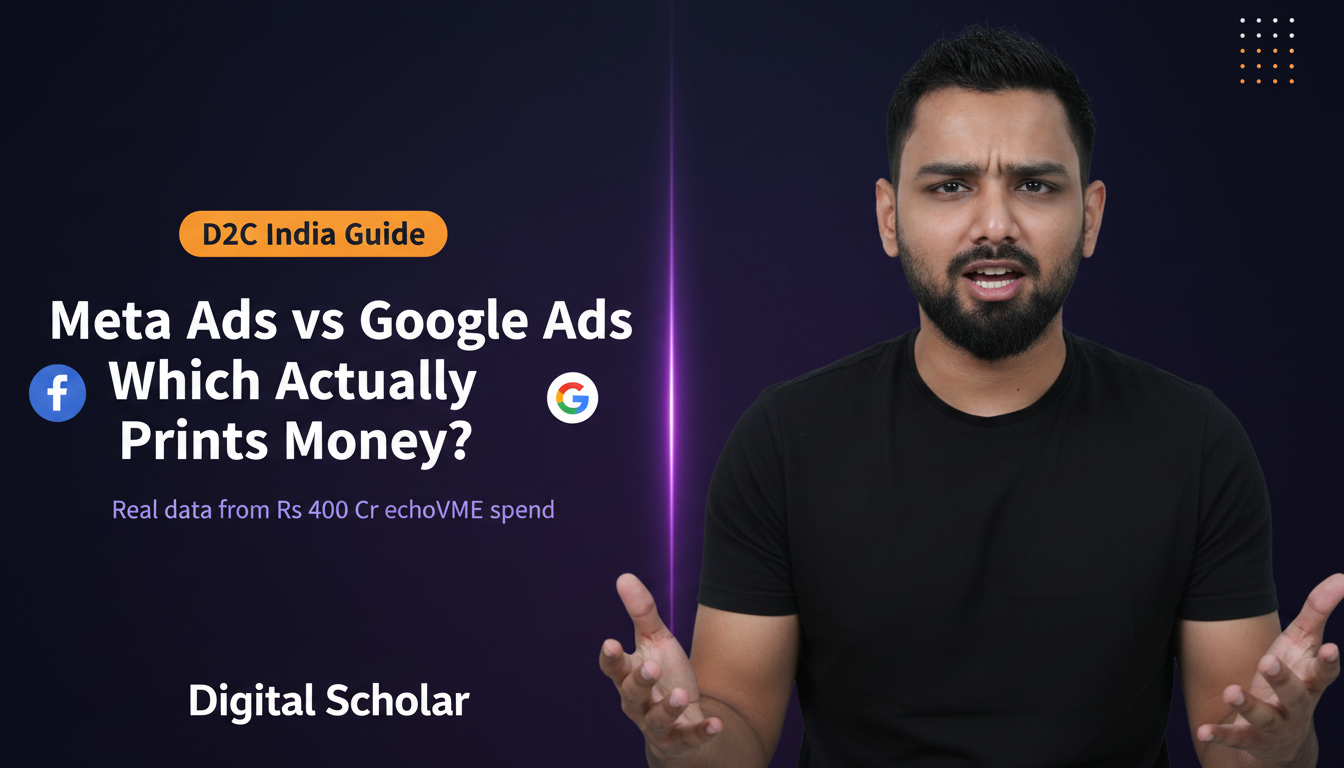

Every Indian D2C founder asks me the same question in the first 10 minutes. “Should my ad budget go on Meta or on Google?” The question is wrong. Meta Ads and Google Ads are not interchangeable checkout machines. They do completely different jobs in a buyer’s journey, and choosing the wrong one for your category can burn Rs 5 to Rs 15 lakh before you figure it out.
At echoVME Digital we have spent Rs 400 crore across both platforms over the last decade, across jewelry, skincare, fashion, SaaS, D2C food, insurance, and education. This post is the decision framework I wish someone had handed me in 2015. It sits as a cluster inside How to Learn Performance Marketing.
In this post you will get the Meta vs Google Fit Matrix (the 2×2 grid we use at echoVME to pick a channel in 30 seconds), a head-to-head comparison across 9 operating metrics, two real client stories with numbers, and the exact budget split we run for a new Indian D2C brand on Day 1.
- TL;DR: Meta Ads vs Google Ads in 30 seconds
- Why listen to me on this
- The real question is not Meta vs Google
- The Meta vs Google Fit Matrix
- Meta vs Google: 9-metric comparison
- What Meta Ads actually wins at
- What Google Ads actually wins at
- Two echoVME stories: jewelry vs SaaS
- How to split your first Rs 5 lakh
- 5 mistakes I see D2C founders make
- FAQs
TL;DR: Meta Ads vs Google Ads in 30 seconds
If your category has existing search demand (insurance, SaaS, a specific supplement), Google Ads beats Meta Ads on first-touch ROAS. If your category is visual and demand has to be created (new-age jewelry, novel skincare, fashion drops), Meta Ads beats Google because you have to make buyers want the product before they can search for it.
- Meta wins for unaided-demand categories, visual products, impulse AOVs (under Rs 3,000), and teams that can refresh creatives weekly.
- Google wins for demand-capture categories, high-consideration products (over Rs 20,000 AOV), B2B and SaaS, and “best [product] in [city]” queries.
- Default split for a new Indian D2C brand: 70% Meta, 20% Google Search on branded + long-tail, 10% Google Shopping or Performance Max.
- Do not run both at full throttle in month one. Attribution collapses. Pick one primary, use the other as the remarketing layer.
- The real bottleneck is creative volume and attribution quality, not the platform.
Who this is for: Indian D2C founders running their first Rs 5 to Rs 50 lakh in paid ads, and in-house performance marketers choosing where to allocate a new quarter.
Why listen to me on this
I run echoVME Digital, a performance marketing agency that has managed Rs 400 crore cumulative spend across 500+ Indian brands since 2015. I also run Digital Scholar, an AI and digital marketing institute that puts 1,000+ students through a 4-month program every year. Meta and Google are not theory for me. They are the two platforms I have personally broken, scaled, and reset for over a decade. This post is based on actual echoVME account histories, not hot takes.
The real question is not Meta vs Google
The real question is: does your buyer already know they want your product? If yes, you need a demand-capture channel. If no, you need a demand-creation channel. Meta is built to create demand. Google Search is built to capture it. Picking the wrong one is a strategic mismatch that no amount of ad copy tweaks can fix.
A yoga mat brand came to us after spending Rs 8 lakh on Google Search for “premium yoga mat”. Zero sales. The ads were not broken. Nobody was searching for “premium yoga mat” in enough volume. Demand had to be built visually on Instagram first. We moved 85% of the budget to Meta. In 60 days, ROAS went from 0.2x to 3.1x.
The key insight: Match your channel to your buyer’s decision state, not to what is trending on LinkedIn. Meta creates the want. Google captures it. Most Indian D2C brands need both, but in very different ratios.
The Meta vs Google Fit Matrix
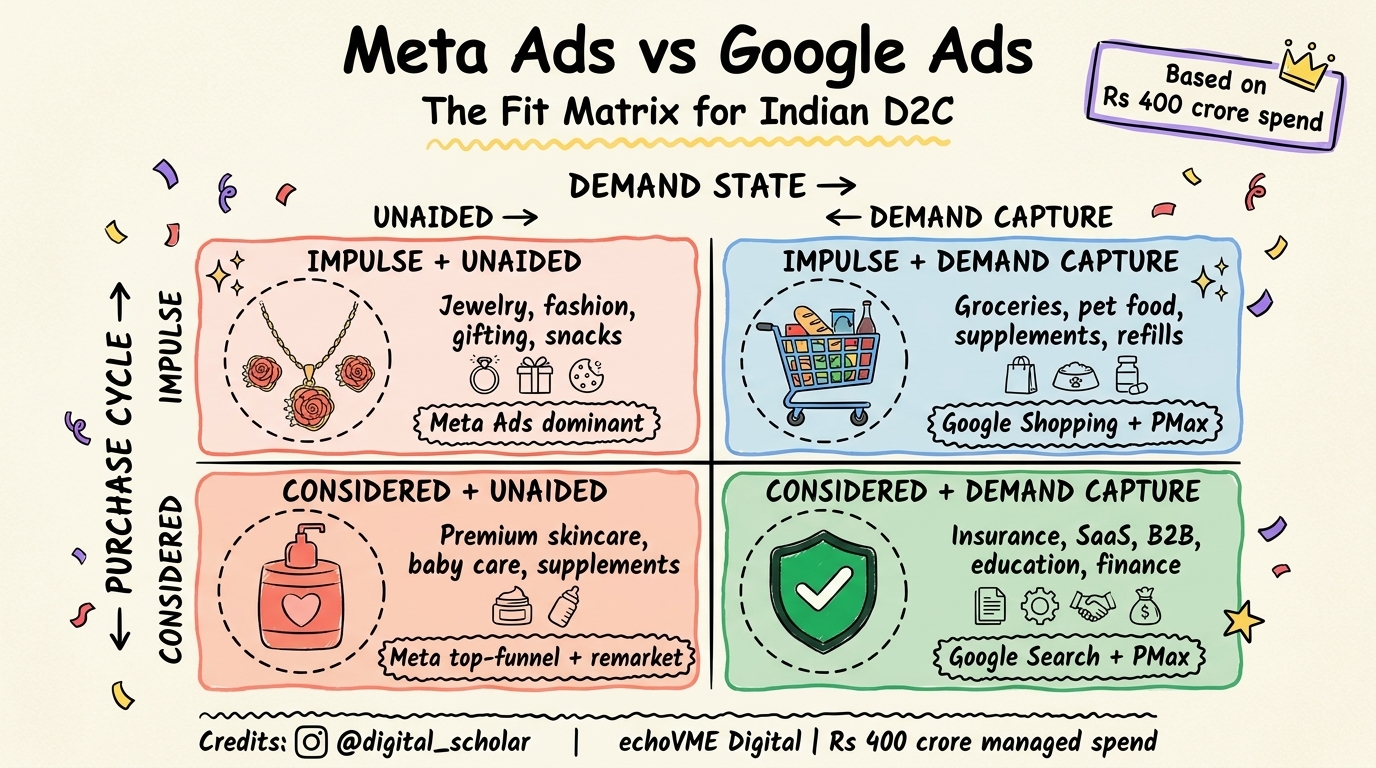
The Fit Matrix is the 2×2 grid we built at echoVME to answer the Meta vs Google question in 30 seconds. Axes are demand state (unaided vs demand capture) and purchase cycle (impulse vs considered). Drop your product into one quadrant, and the answer is right there.
| Quadrant | What it looks like | Primary channel | Example Indian brands |
|---|---|---|---|
| Impulse + Unaided | Buyer did not know this existed 10 seconds ago. Decides under 7 days. AOV under Rs 3,000. | Meta Ads (Reels + carousels) | Snack brands, fast fashion, low-ticket jewelry, gifting, candles |
| Impulse + Demand capture | Buyer knows the category and needs a refill. Decides in 1 to 3 days. | Google Shopping + PMax | Grocery top-ups, pet food, replenishment skincare, supplements |
| Considered + Unaided | Category is new to the buyer. Decision takes 30 to 90 days. AOV Rs 3,000 to Rs 30,000. | Meta top-funnel, remarket on both | Premium skincare, baby care (first baby), new-age supplements |
| Considered + Demand capture | Buyer already searching. Decision 30+ days. High ticket. | Google Search + PMax | Insurance, SaaS, B2B, education, financial services, high-ticket coaching |
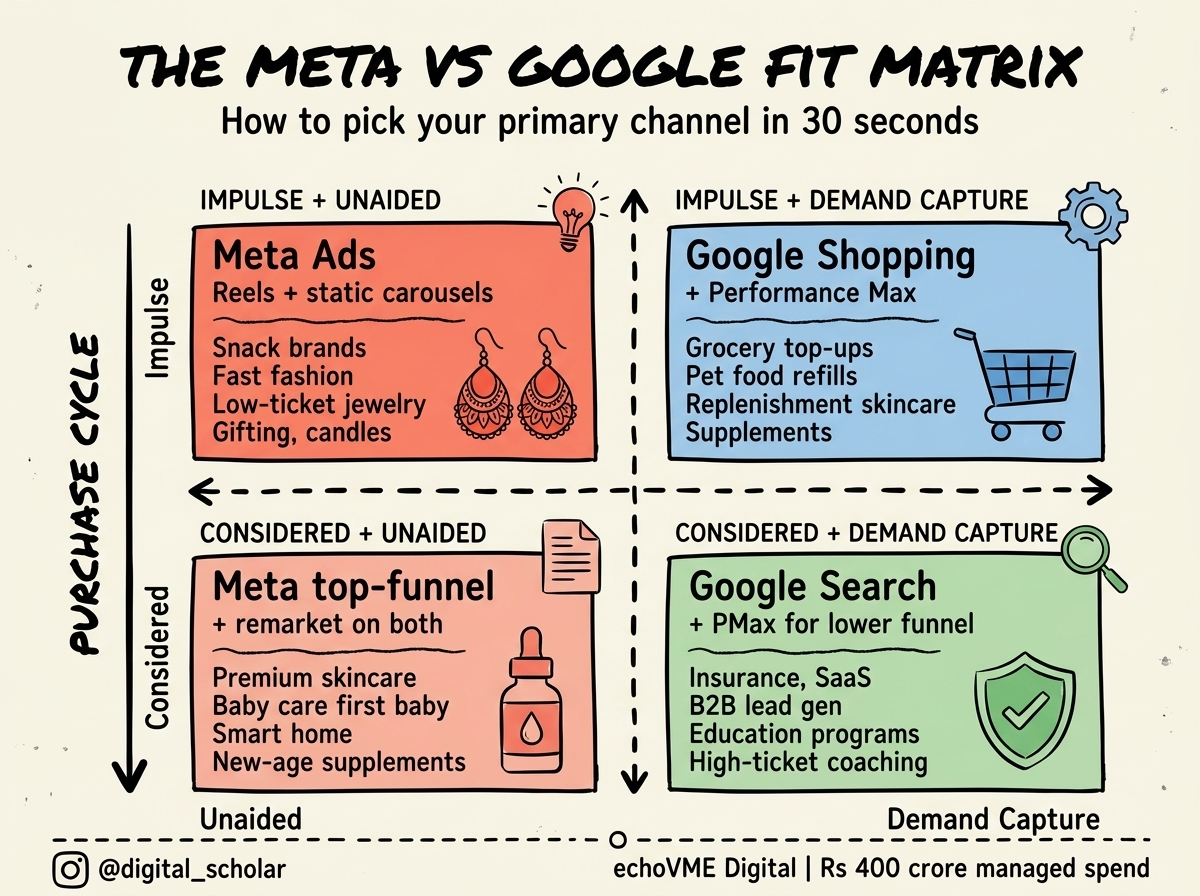
Two rules. First, be brutal about which quadrant you are in. Most founders overestimate unaided demand. If your ICP can type in a search query to find you, you are demand-capture. Second, as you scale past Rs 10 lakh monthly, categories blend quadrants. That is when you layer Google Search for branded and long-tail queries on top of Meta.
Does your brand need demand generation or demand fulfilment?
Choose the channel only after you identify the demand state. Meta is usually stronger when the buyer is not actively searching and the creative must create curiosity. Google is usually stronger when the buyer already knows the problem or product category and is searching for an answer.
I teach this distinction in my Meta Ads sessions at Digital Scholar because “Meta versus Google” is not the first question. The first question is whether demand exists at this moment. If nobody knows the product exists, there may be nothing meaningful to capture in search. If thousands of qualified buyers search for the solution every month, ignoring Google leaves existing intent to a competitor.
| Demand state | What the buyer is doing | First channel to test | Creative or keyword job |
|---|---|---|---|
| Demand must be generated | Not searching because the product, use case, or category is unfamiliar | Meta Ads | Demonstrate the product, create curiosity, and name the persona or problem |
| Demand already exists | Searching for a category, solution, comparison, brand, or local provider | Google Search or Shopping | Match the query, prove fit, and remove purchase friction |
| Mixed demand | Discovers on social, researches on search, then returns through remarketing or branded search | Meta plus Google | Use consistent proof and track blended acquisition, not platform claims in isolation |
A product can move between these states. Digital marketing education required heavier demand generation when the category was unfamiliar. As awareness and search demand grew, the channel mix could include both Meta discovery and Google demand fulfilment. Treat demand state as something to recheck, not a permanent label.
Meta Ads vs Google Ads: 9-metric comparison
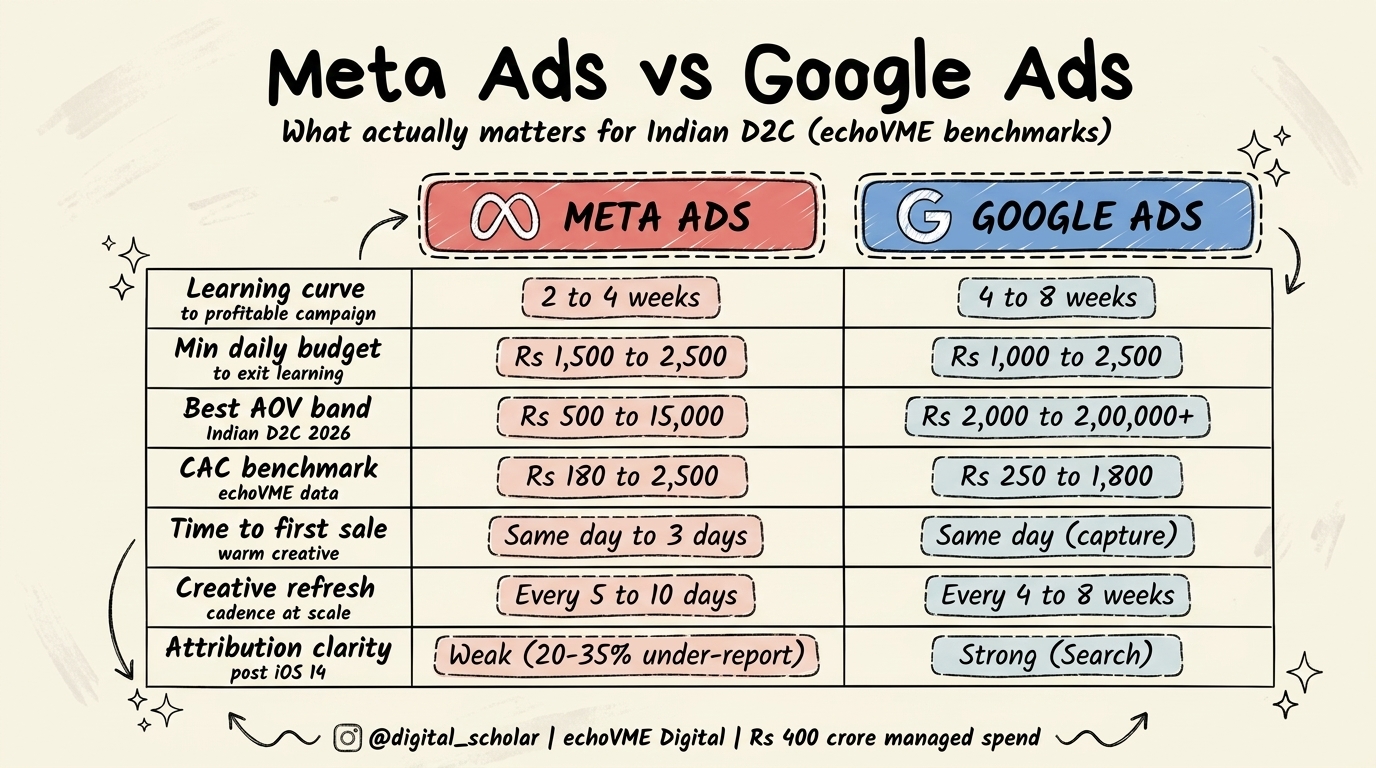
Most comparison posts on the internet measure Meta and Google on surface metrics like “reach” or “targeting options”. Those do not decide your ROAS in month three. Here is what actually matters, based on echoVME data across 500+ brands.
| Metric | Meta Ads | Google Ads |
|---|---|---|
| Learning curve (to first profitable campaign) | 2 to 4 weeks | 4 to 8 weeks (keyword + bid structure) |
| Min daily budget to exit learning | Rs 1,500 to Rs 2,500 / day per campaign | Rs 1,000 to Rs 2,000 Search, Rs 2,500+ PMax |
| Best AOV band | Rs 500 to Rs 5,000, extends to Rs 15,000 with retargeting | Rs 2,000 to Rs 2,00,000+ (no real ceiling) |
| CAC benchmark (Indian D2C, 2026) | Rs 180 to Rs 600 impulse, Rs 800 to Rs 2,500 considered | Rs 250 to Rs 900 Search, Rs 400 to Rs 1,800 PMax |
| Time to first sale | Same day to 3 days | Same day for demand-capture, 2 to 4 weeks for category terms |
| Scalability ceiling | Soft: 5 to 7x daily spend before CAC doubles | Hard: tied to search volume in your category |
| Creative refresh cadence | Every 5 to 10 days at scale. Frequency kills without fresh creative. | Ad copy every 4 to 8 weeks. Visuals every 60 to 90 days. |
| Attribution clarity (post iOS 14) | Weak. 20% to 35% under-reporting vs server-side in echoVME tests. | Strong for Search. Weaker for PMax with automated creatives. |
| Measurement reliability | Needs Conversions API + post-purchase survey | Needs GA4 + Enhanced Conversions |
What Meta Ads actually wins at
Meta wins at four things no other platform matches in India right now: creating unaided demand through short-form video, finding visual-first impulse buyers, letting small brands test 20 creative angles a week for under Rs 50,000, and running the cheapest remarketing inventory on the internet (Stories and Reels placements).
To turn those angles into a repeatable production system, use our Meta Ads creative testing framework. It shows how one persona, ten angles, and three real variations create a 30-ad idea bank without confusing file volume with creative strategy.
A fashion brand launches a new drop on Tuesday. By Friday we have tested 30 static ads and 12 reels. The top creative runs at 5.4x. No other channel compresses the test cycle to four days. Meta Stories retargeting to 180-day website visitors also runs at Rs 80 to Rs 150 CPM, the cheapest remarketing inventory we have access to in India. When founders tell me “Meta is dead”, I ask them about their retargeting setup. 9 times out of 10, there is none.
What Google Ads actually wins at
Google wins at demand capture, branded search conversion, B2B and SaaS lead generation, high-AOV considered purchases, and “near me” geo intent. It also runs the most scalable remarketing network outside Meta thanks to Display and YouTube inventory.
If your brand has any branded search volume, Google branded search is the highest-ROAS campaign you will ever run. Across echoVME accounts, branded search consistently delivers 10x to 40x ROAS. The catch is that volume is capped by how well your demand-creation channel is doing upstream. Branded search is a scoreboard, not a growth lever on its own. For high-ticket considered purchases, a person searching “best term insurance for 30 year old” is 40x more ready to buy than a person watching an insurance reel, and Google CAC almost always beats Meta for those categories once past the learning phase.
Two echoVME stories: jewelry vs SaaS
Two clients, same quarter, opposite platform winners. A mid-ticket jewelry brand (AOV Rs 4,200) hit 4.2x blended ROAS on Meta while Google held at 1.8x. A B2B SaaS (ACV Rs 1.8 lakh) hit 6.1x on Google Search while Meta struggled at 0.9x. Same internal team, same data stack, different Fit Matrix quadrants.
The jewelry brand (Meta-dominant)
Handcrafted pieces, heavy visual storytelling. Buyers did not search for “handcrafted silver earrings Chennai”. They saw a reel, tagged a friend, bought within 4 to 8 days. Meta delivered 4.2x at Rs 6 lakh monthly spend. Google Search was empty because the branded terms did not yet exist. Google Shopping gave 1.8x on a small Rs 80,000 monthly spend, fine but not scalable. The right move: Meta for creation, Google Shopping for the 15% who searched the brand, zero Search on generic category terms.
The B2B SaaS (Google-dominant)
Invoicing SaaS for CAs. Buyers actively searched “best invoicing software for CA” and “GSTR filing software”. Google Search hit 6.1x on MQL value at Rs 3 lakh monthly spend, CAC at Rs 380. Meta reels brought cheap clicks but 0.9x post-sale ROAS because the audience was wrong. We moved Meta from 60% to 15% of budget (pure remarketing), tripled Google Search. Pipeline quality doubled in 90 days.
Evidence note: These are redacted echoVME campaign snapshots, not universal benchmarks. The comparison uses the same-quarter account view described above. Before using these figures for planning, compare the measurement window, attribution setting, spend range, and whether the reported return is platform ROAS, blended revenue, or MQL value.
How to split your first Rs 5 lakh between Meta and Google
For a new Indian D2C brand with a Rs 5 lakh monthly paid budget, a 70% Meta, 20% Google Search, and 10% Shopping or Performance Max split can be a starting hypothesis when the category depends on discovery. It is not a permanent allocation. If search produces stronger contribution margin after enough data, move budget toward search. If branded search rises after Meta spend, evaluate the channels together before crediting Google for demand Meta may have created.
Before any split, calculate your break-even ROAS. Without it, you will chase vanity 4x ROAS numbers that are actually losing money on contribution margin. The break-even math gives you the floor. The Fit Matrix gives you the channel mix. Combine them and budget decisions stop being feelings.
Do not split until you have one clean Meta campaign and one clean Google campaign running with correct attribution. Every tool in your performance marketing tool stack downstream (analytics, attribution, creative testing, bid management) depends on those two feeds being accurate. Measurement first. Scale second.
5 mistakes I see Indian D2C founders make
Across 500 brands at echoVME Digital, the same five mistakes show up when founders pick between Meta and Google. Avoid these and you save Rs 3 to Rs 10 lakh in month-one learning costs.
- Running both platforms at full budget in month one. Attribution collapses. Pick one primary, use the other at 10% to 15% for remarketing. Expand after 60 days.
- Assuming Google is cheaper because CPC is lower. CPC is vanity. CAC is what matters. Google PMax often has lower CPC but higher CAC than a well-run Meta Advantage Plus campaign.
- Underestimating creative refresh on Meta. One viral reel and three statics do not get you past Rs 3 lakh monthly spend. You need 8 to 12 fresh creatives weekly at scale.
- Treating branded search as growth. Branded Google Search is demand capture. If branded volume is growing, your Meta or influencer or PR work is doing the growth job.
- Skipping Conversions API and Enhanced Conversions. Without server-side data, both platforms under-report 20% to 35% of conversions. You are optimizing on garbage.
The key insight: The platform is not the bottleneck. Attribution quality, creative volume, and Fit Matrix alignment are. Fix those three and either platform can scale to 8-figure monthly revenue in India.
Frequently Asked Questions
Which is better for D2C, Meta Ads or Google Ads?
For most early-stage Indian D2C brands (AOV Rs 500 to Rs 5,000, visual product, short decision cycle), Meta wins because the buyer did not wake up searching for you. For high-AOV considered categories like insurance, SaaS, and education, Google wins. Use the Fit Matrix to place your product, then pick.
Is Google Ads more expensive than Meta Ads?
Not on cost-per-click. Meta CPC is usually higher than Google PMax CPC in India. But CPC is not the metric. On CAC, Google is usually cheaper for demand-capture categories and more expensive for demand-creation ones. In echoVME data, Google Search for insurance runs Rs 250 to Rs 500 CAC. Meta for the same category runs Rs 900 to Rs 1,600. For fashion, it flips.
Can I run Meta and Google Ads simultaneously?
Yes, once you have 60 days of clean data on each platform separately. Running both from Day 1 with equal budgets makes attribution impossible. Start with your primary platform (per the Fit Matrix), add the second at 10% to 15% for remarketing, then rebalance after 60 days.
What is the minimum budget for Meta Ads in India?
For a single Meta campaign to exit learning (50 conversions in 7 days), you need roughly Rs 1,500 to Rs 2,500 per day per campaign. Below that, the algorithm never stabilizes. For a proper test-and-scale structure (3 to 5 campaigns), realistic floor is Rs 15,000 to Rs 25,000 per day, about Rs 5 lakh per month.
Should a new D2C brand start with Meta or Google?
Most new Indian D2C brands should start with Meta because they have no branded search volume yet, the product is visual, and Meta is faster to test. Exception: if you are in a mature demand-capture category (insurance, tax, education, niche B2B), start with Google Search.
How do you split budget between Meta and Google?
Default split at echoVME for new D2C brands (under Rs 10 lakh monthly spend): 70% Meta, 20% Google Search, 10% Google Shopping or PMax. For Considered+Demand-capture categories, flip to 20% Meta, 70% Google Search, 10% PMax. Review every 30 days and shift 10% to whichever platform has lower CAC at stable quality.
Meta vs Google is not a technology choice. It is a buyer-psychology choice. Once you know whether your customer is searching or discovering, the channel picks itself. The brands that scale past 8-figure monthly revenue in India run both, in the right ratio, on the right quadrant of the Fit Matrix, with clean attribution. Channel choice is one piece. The full picture is covered across the 8 levels of performance marketing mastery.
Write down your product, your AOV, and your typical buyer decision time. Drop it into the Fit Matrix. If you are in the wrong quadrant for your current channel split, rebalance 10% of next month’s budget toward the right platform and measure for 30 days. The platform is not the lever. The match is.
Want to learn Meta and Google end-to-end?
The Digital Scholar 4-month program teaches Meta Ads, Google Ads, analytics, attribution, and creative testing with live client campaigns. 1,000+ students per year.