- Stop copying tool lists from Twitter threads. A founder spending Rs 80,000 a month on ads does not need Hyros. A CMO spending Rs 1 crore a month cannot survive on a spreadsheet. The right stack depends on your level, not the latest Product Hunt launch.
- This post maps 8 levels of performance marketing maturity to the exact tools that work at each level. Built from Rs 300+ crore in managed ad spend at echoVME Digital across 500+ brands.
- If you are still learning performance marketing, start at Level 1. If your stack matches Level 6 but your spend is Level 3, you are bleeding money on subscriptions. Both mismatches are fixable.
Who this is for: Performance marketers in India at every budget level, from Rs 50K/month founders to Rs 5 crore/month enterprise CMOs. Also useful if you are choosing between performance marketing and digital marketing and want to understand what tools each track requires.
Why Every Performance Marketing Tools List Is Lying to You
Every performance marketing tools list you read is lying to you. Not lying about the tools. Lying about the premise.
They rank Hyros and AdCreative.ai and Windsor.ai and call these the “must-have performance marketing tools for 2026.” A founder spending Rs 80,000 a month on ads reads that list, subscribes to three of them, burns Rs 40,000 in monthly subscriptions, and still cannot figure out why his CPA is broken.
The tool was not the problem. The mismatch was.
A brand spending Rs 1 lakh per month on Meta does not need MMM software. It needs Meta Ads Manager, GA4, and a disciplined spreadsheet. A brand spending Rs 50 lakh per month on Meta cannot run on the same stack. That brand is losing 20 to 30 percent of its spend to bad attribution, creative fatigue, and decisions made without cohort data.
Same companies, different levels, completely different tools.
At echoVME Digital, we have run campaigns across Rs 300+ crore in ad spend over the last decade. One pattern shows up every single time: the brands that plateau are not the ones using bad tools. They are the ones using the wrong tools for their level.
So this post is not a ranked list. It is a ladder. Eight levels of performance marketing maturity. The exact stack that works at each level. The upgrade trigger that tells you when to graduate. And the mistakes we see brands make at every tier, based on what we actually run at the agency. If you are still building your foundation, start with our complete guide to learning performance marketing in 2026.
The 8-Level Performance Marketing Stack Framework
Every performance marketer sits somewhere on this ladder. The level is defined by monthly ad spend, team size, and the complexity of questions the business is asking. Find yours before you read the stack that applies.
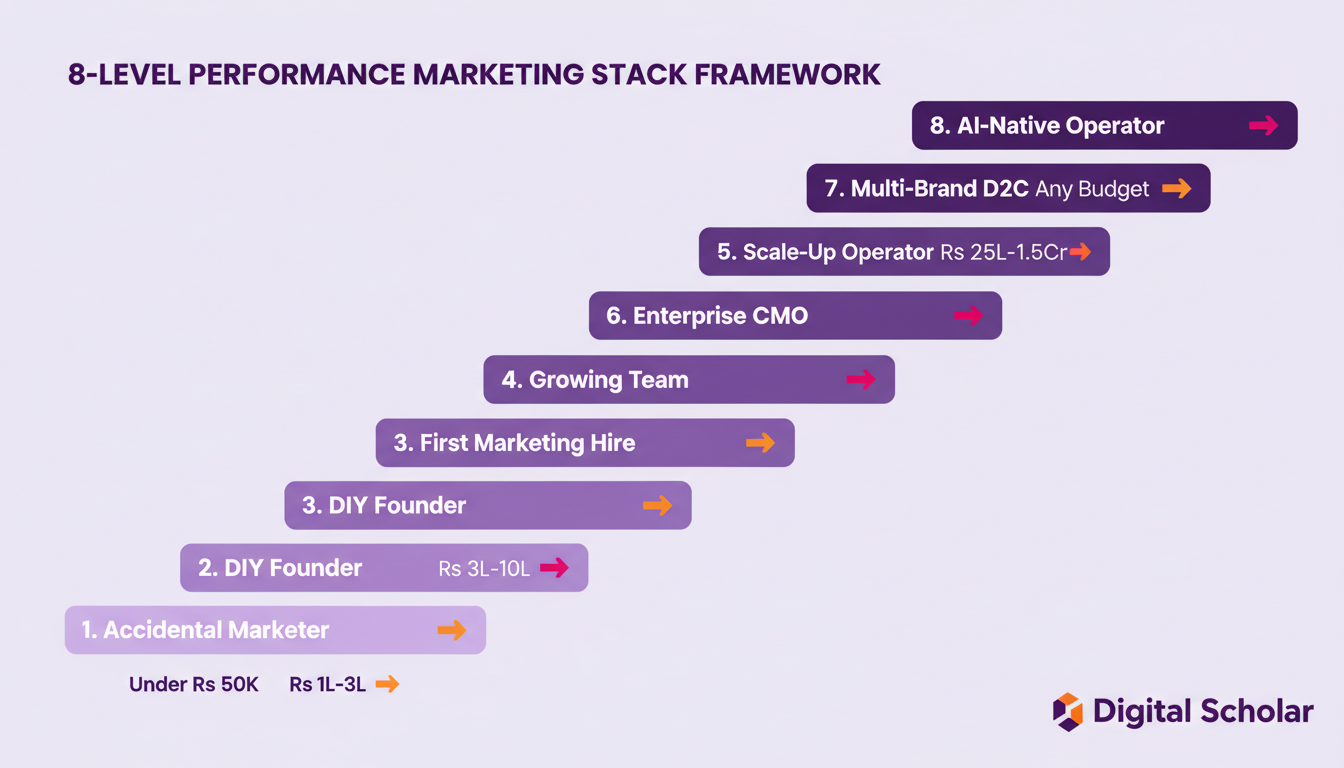
| Level | Profile | Monthly Ad Spend | Core Question |
|---|---|---|---|
| 1 | Accidental Marketer | Under Rs 50K | Is this even working? |
| 2 | DIY Founder | Rs 1L to Rs 3L | What should I do next? |
| 3 | First Marketing Hire | Rs 3L to Rs 10L | How do I scale without breaking CPA? |
| 4 | Growing Team | Rs 10L to Rs 25L | Which channel is actually driving revenue? |
| 5 | Scale-Up Operator | Rs 25L to Rs 50L | How much of my ROAS is real? |
| 6 | Enterprise CMO | Rs 50L to Rs 1.5 crore | Where is budget being wasted at scale? |
| 7 | Multi-Brand D2C Leader | Rs 1.5 crore to Rs 5 crore | How do I model incrementality across brands? |
| 8 | AI-Native Operator | Any budget | How do I run this without adding people? |
Level 1: The Accidental Marketer (Under Rs 50,000 per Month)
Usually a founder or small business owner who has never formally learned performance marketing. They have boosted an Instagram post, run a few Meta ads using the mobile boost button, or paid a cousin’s friend to “handle digital.”
The Stack
- Meta Ads Manager (desktop version, not the boost button)
- Google Ads (only if search intent exists for your product)
- GA4 with a basic install
- Google Tag Manager for pixel firing
- Meta Pixel installed correctly (this is 80 percent of the job at this level)
- One spreadsheet to track spend vs revenue
- WhatsApp Business (for direct response follow-ups)
Nothing automated. Nothing fancy. The goal is signal. Is anyone clicking? Is anyone buying? Can you trace a sale back to a campaign? That is the entire job at Level 1. You do not need AdCreative.ai. You do not need Hyros. You need to learn what a CTR is and why your Meta Pixel keeps firing wrong.
echoVME agency insight: When a small brand onboards with us at echoVME Digital at this stage, we do not build them a stack. We build them a pixel. A correctly installed Meta Pixel with CAPI, GA4 with ecommerce events configured, and one master spreadsheet. That is month 1.
Upgrade trigger: When you can consistently spend Rs 50K a month and see ROAS above 2x for 60 straight days.
Level 2: The DIY Founder (Rs 1 Lakh to Rs 3 Lakh per Month)
The founder has validated that ads work. They are spending with intent. They are personally watching dashboards every morning. The business is running, and they want to grow without hiring yet.
The Stack
- Meta Ads Manager (now running Advantage+ Shopping campaigns)
- Google Ads (Performance Max for e-com, Search for lead gen)
- GA4 with enhanced e-commerce events
- Meta Pixel + Conversion API (server-side, properly deduplicated)
- Google Tag Manager
- Shopify analytics or whichever platform you run on
- Canva Pro for creatives
- A cohort spreadsheet tracking weekly retention
- WhatsApp Business API via Interakt or AiSensy (Rs 2,000 to Rs 5,000 per month)
You stop running single ads and start running campaign structures. Two to four campaigns at a time. Separate creatives for cold and warm audiences. You begin tracking metrics beyond ROAS: CPM, CTR, CPA, AOV, and your first taste of cohort retention.
echoVME agency insight: For brands in this range, the echoVME team runs a fortnightly creative audit using Meta Ads Library and a shared spreadsheet. No paid tool. Just structured observation. A founder who understands why their winning ad won is worth more than 50 AI-generated variations.
Upgrade trigger: You need more than 10 creatives live at once to keep CPA stable, OR you hire your first dedicated performance marketer.
Level 3: The First Marketing Hire (Rs 3 Lakh to Rs 10 Lakh per Month)
The founder has hired a full-time performance marketer or brought on an agency like echoVME Digital. The business is spending seriously. There are two or three sales channels active, and multiple creative formats running simultaneously.
The Stack
- Meta Ads Manager + Google Ads (both at serious scale)
- GA4 with custom dimensions
- Meta CAPI (server-side, properly deduplicated, not the half-broken Shopify plugin version)
- Google Tag Manager with proper container hygiene
- AdCreative.ai or Pencil.ai (Rs 6,000 to Rs 15,000 per month for creative volume)
- ElevenLabs (voiceovers for video ads, Rs 1,700 per month)
- HeyGen or Higgsfield (avatar and UGC-style video at Rs 2,500 to Rs 8,000 per month)
- Claude or ChatGPT (for ad copy at scale)
- Nano Banana Pro (for static creative volume)
- Shopify + one-click checkout (GoKwik, Shiprocket)
- Interakt or WATI (WhatsApp broadcast + automation)
- A weekly reporting cadence in a shared dashboard
Creative volume becomes the bottleneck. You are testing 15 to 30 creatives a week, which means you cannot source them all from a designer anymore. AI-generated creatives enter the stack. Server-side tracking becomes non-negotiable because iOS signal loss starts to visibly distort ROAS.
echoVME agency insight: This is where we see brands fall into the “more tools will solve it” trap. They stack AdCreative.ai, Canva Pro, HeyGen, Descript, Pencil, and a stock video library. Then the marketer spends 3 days a week moving files between tools. The fix is not more tools. It is a documented creative workflow that uses 3 tools well. That is exactly what we teach in the Digital Scholar Digital Marketing Course in Chennai, where students build real creative pipelines, not just a list of subscriptions.
Upgrade trigger: Multiple channels (Meta + Google + YouTube minimum) each running over Rs 1 lakh per month, OR prospecting and retargeting campaigns each performing at scale.
Level 4: The Growing Team (Rs 10 Lakh to Rs 25 Lakh per Month)
A 3 to 5 person marketing team (including agency). Multiple channels active. The CEO is no longer pulling reports. There is a weekly performance review on the calendar. The business is thinking about LTV, not just CPA.
The Stack
- Meta Ads Manager (Advantage+ and Manual campaigns running in parallel)
- Google Ads (PMax + Search + Demand Gen)
- YouTube Ads for awareness and consideration
- GA4 + BigQuery export for custom analysis
- Looker Studio for dashboards
- Meta CAPI with offline conversions uploaded weekly
- AdCreative.ai at serious volume (50+ creatives per month)
- Pencil.ai or Omneky (creative + performance prediction)
- HeyGen or Arcads.ai (UGC-style video at scale)
- ElevenLabs with voice cloning for multilingual ads (Hindi, Tamil, Telugu, Kannada, Bengali)
- Klaviyo or MoEngage for email and push automation
- Interakt or WebEngage for WhatsApp and mobile engagement
- Attribution layer: Triple Whale (for D2C on Shopify) or Northbeam
- Heatmap: Microsoft Clarity (free) or Hotjar
- Survey tool: Typeform for post-purchase feedback
You stop trusting platform-reported ROAS. A 4x ROAS on Meta and a 5x ROAS on Google do not mean you are profitable, because both platforms are double-counting conversions. You install a third-party attribution tool. You start tracking MER (Marketing Efficiency Ratio): total revenue divided by total marketing spend. This one number becomes your source of truth.
echoVME agency insight: At this level we bring in lightweight attribution via Triple Whale for D2C brands and custom GA4 + BigQuery for non-D2C businesses. Hyros or TrackoCity enter the picture only when the brand has a long sales cycle (real estate, B2B SaaS, education) where last-click is actively misleading. For a D2C brand with a 2-day purchase cycle, Triple Whale is enough. This is the same methodology we walk through in the 8 Levels of Performance Marketing Mastery framework at Level 5 (Measurement Mastery).
Upgrade trigger: Monthly spend crosses Rs 25 lakh AND you have 3+ active channels AND platform-reported ROAS is diverging from your actual P&L.
Level 5: The Scale-Up Operator (Rs 25 Lakh to Rs 50 Lakh per Month)
A proper marketing team of 5 to 12 people. A head of growth or CMO. Multiple product lines or SKUs. Retention and CAC payback are boardroom conversations. The founder has stopped asking “are ads working?” and started asking “what is my payback period?”
The Stack (additions to Level 4)
- Attribution: Hyros OR TrackoCity (true multi-touch attribution layer)
- Creative intelligence: Motion.app for creative analytics
- Pre-launch creative testing: Neurons.ai for eye-tracking and attention prediction
- Creative ops: AdCreative.ai at enterprise tier OR in-house prompt library via Claude Skills
- CDP (lightweight): Segment or RudderStack for unified user profiles
- Email + SMS: Klaviyo AI for predictive segments
- Mobile engagement: MoEngage, WebEngage, or CleverTap for push, in-app, and journeys
- Social listening: Brand24 or Meltwater for unprompted mentions
- Customer support: Intercom or Freshdesk (chat data that informs creative angles)
- Landing page testing: Unbounce or Instapage, with Mutiny for personalization
- Warmly (for B2B brands to identify anonymous website visitors)
You move from platform-native reporting to modelled attribution. Hyros and TrackoCity stitch user journeys across first-click, last-click, and view-through touchpoints. You stop treating Google and Meta as separate businesses and start looking at incremental contribution per channel.
Hyros vs TrackoCity: The Real Answer
This is one of the most common questions we get at echoVME Digital. Both tools solve attribution, but they are built for different markets.
Hyros: Originally built for US info-product advertisers (coaches, course creators, high-ticket SaaS). Brilliant at stitching long-form customer journeys across email, ads, and CRM events. Runs Rs 30,000 to Rs 50,000 per month depending on volume. Pick this if you are a SaaS, info-product, coaching, or high-ticket service brand with an LTV over Rs 25,000 and a sales cycle longer than 7 days.
TrackoCity: Built for Indian e-commerce and services with WhatsApp-native attribution, Shiprocket integrations, call-center conversion mapping, and offline event attribution. Runs Rs 15,000 to Rs 40,000 per month depending on volume. Pick this if you are an Indian D2C brand with heavy WhatsApp sales or a service business where leads come in over the phone.
Why Neurons.ai Deserves a Separate Mention
Before you spend Rs 5 lakh on a new creative batch, paste the static ads into Neurons. You get AI-predicted attention scores, clarity scores, and cognitive load scores. Creatives that score below 60 on attention almost never work in production. The tool costs Rs 15,000 to Rs 25,000 per month and saves 5 to 10x that in wasted ad spend per month. This is the most under-rated performance marketing tool we use at echoVME Digital.
echoVME agency insight: At Level 5, we force a “single source of truth” conversation before we approve any new tool. One attribution tool. One primary dashboard. One weekly number. For most D2C brands, this is Triple Whale + MER. For non-D2C businesses, this is Hyros or TrackoCity + CAC:LTV. Everything else is secondary. Understanding the difference between performance marketing and digital marketing becomes critical here, because Level 5 is where pure digital marketing skills hit a ceiling and performance marketing specialization takes over.
Upgrade trigger: Spend crosses Rs 50 lakh OR you are running two distinct brands OR CFO starts asking about incrementality testing.
Level 6: The Enterprise CMO (Rs 50 Lakh to Rs 1.5 Crore per Month)
A brand with real scale. A marketing team of 12 to 40 people. Multiple agencies under management. Category leader or fast challenger. Boardroom expects predictable growth quarter after quarter. Every rupee has to be justified.
The Stack (additions to Level 5)
- CDP (enterprise): Segment, Tealium, mParticle, or a custom CDP on Snowflake
- Data warehouse: BigQuery, Snowflake, or Redshift (non-negotiable at this level)
- Dashboarding: custom Looker, Metabase, or Tableau (built for your business, not templated)
- Pipeline: Windsor.ai or Supermetrics to connect all channels to the warehouse
- MMM (Marketing Mix Modeling): Rockerbox, Measured, or a custom model (often built with an agency partner)
- Incrementality testing: geo holdouts managed via Haus or in-house data science team
- Creative performance: Motion.app + proprietary in-house dashboards
- Personalization: Mutiny for website experiences, Dynamic Yield for e-commerce
- Attribution stack: Hyros or TrackoCity continues, now feeding the warehouse instead of being the final layer
- Forecasting: custom ML models built on historical data
Everything becomes a pipeline. Raw data flows from every channel into a warehouse. Dashboards are custom-built. A CMO at this level does not open Meta Ads Manager. The CMO opens a custom dashboard that already aggregates all channels into one view.
MMM enters the stack because multi-touch attribution starts breaking at this scale. When you are spending Rs 1 crore+ a month across 6 to 8 channels, you cannot rely on user-level tracking alone. You need aggregate models that show you the incremental lift of each channel, regardless of cookies, pixels, or walled gardens.
echoVME agency insight: For brands at this level, echoVME’s job shifts from “running ads” to channel orchestration. We sit in the CMO’s dashboard, not in the ad account. Weekly reviews are about MER trend, channel saturation curves, and where the next Rs 10 lakh of spend should go. We use Claude specifically to analyze weekly exports, flag anomalies, and draft the executive summary before the Monday meeting.
Upgrade trigger: Multiple brands under one P&L, multiple countries, OR marketing team crosses 40 people.
Level 7: The Multi-Brand D2C Leader (Rs 1.5 Crore to Rs 5 Crore per Month)
Holding companies like Honasa, Good Glamm Group, Mamaearth-scale operations, or brands like boAt at their growth peak. Multiple brands under one roof, or one brand with global ambitions. Performance marketing is one of five departments, not the whole business.
The Stack (additions to Level 6)
- Proprietary data infrastructure: Snowflake or BigQuery at scale
- In-house MMM: built by the data science team using Python, R, and causal inference libraries
- Continuous incrementality testing: ongoing geo holdouts and audience holdout programs
- Creative lab: in-house studio + AI creative ops + external production partners
- Attribution: custom-built, not off-the-shelf (though Hyros or Triple Whale may sit as upstream feeds)
- Competitive intelligence: Semrush, Ahrefs, SimilarWeb, Sensor Tower (for app data)
- Retail media: Amazon Ads, Flipkart Ads, quick commerce ads on Zepto, Blinkit, Instamart
- Influencer marketing: Qoruz, Winkl, or in-house tooling for creator management
- Brand measurement: Nielsen, Kantar, or YouGov brand tracks
Everything gets productized. Instead of buying tools, the team builds internal products. A team of 3 to 5 analysts maintains a proprietary dashboard that combines ad spend, revenue, brand search lift, and repeat purchase rates into a single CMO view.
echoVME agency insight: At this level, agencies are specialists, not generalists. The echoVME Digital role in a Level 7 engagement is usually around creative systems, AEO and GEO positioning, or AI integration. The media buying happens in-house. Our value is in bringing outside pattern recognition and specific AI capability that a large in-house team cannot build fast enough on its own.
Upgrade trigger: There is no meaningful upgrade from Level 7. Level 8 is a parallel architecture question, not a scale one.
Level 8: The AI-Native Operator (Any Budget, Architectural Level)
This is not a size level. It is an architecture level. A Level 8 operator has wired AI into the pipeline itself. Tools still exist, but the team is not using them the way other teams use them. Reports are generated by AI, not by analysts. Creative briefs are written by AI based on past performance data. Campaign budgets are adjusted by AI agents based on hourly MER.
The Stack
- Everything from the level matching your actual ad spend (pick your base tier)
- An agent layer: n8n, Zapier AI, Make, or custom agents built on Claude and MCP
- MCP-connected dashboards: your warehouse data queryable in plain English through Claude
- Automated creative pipelines: Nano Banana Pro + HeyGen + ElevenLabs wired together with Claude as the orchestrator
- Automated reporting: Windsor.ai feeds + Claude agents that generate weekly executive summaries
- AEO and GEO visibility tracking: manual audits + tools like Profound or Otterly.ai
- Skill files: documented SOPs written as Claude Skills for repeatable AI execution
- AI creative testing loop: Neurons pre-flight + Meta Advantage+ Creative + post-hoc analysis via Claude
Headcount stops growing linearly with spend. A Level 7 brand at Rs 3 crore per month might have 40 marketers. A Level 8 brand at the same spend might have 12, because the other 28 jobs are now systems running on autopilot.
echoVME agency insight: This is the architecture we teach in the Digital Scholar AI for Marketers masterclass. Everyone in India has AI tools. Almost nobody has AI systems. That gap is the single biggest performance marketing arbitrage available right now.
The Common Mistake at Every Level
It is the same mistake, repeated at every tier.
Level 1 and 2 brands buy Level 5 tools. They read a Twitter thread about Hyros and subscribe before they have proper Meta Pixel tracking. Level 5 brands buy Level 3 tools. They add a fourth creative generator subscription instead of fixing their attribution. Level 7 brands buy Level 8 architecture and forget they still need a functioning Level 6 foundation to feed it.
The tool is not wrong. The tool-for-your-level is wrong.
Before you subscribe to any tool in 2026, ask these four questions:
- What specific decision does this tool help me make?
- Can I make that decision today without this tool, even if it takes more effort?
- At my current spend level, does the cost of this tool exceed 3 percent of my ad budget?
- If this tool vanished tomorrow, would my CPA actually break?
If you cannot answer all four confidently, you do not need the tool yet.
How echoVME Digital Uses This Framework
A quick window into how we actually run this at echoVME Digital.
Every new client goes through a 30-minute audit where we classify them on the 8-Level framework. Based on where they sit, we prescribe a stack. Not the same stack for everyone. Level 3 brands get a Level 3 stack. Level 6 brands get a Level 6 stack.
Once the stack is decided, we freeze it for 90 days. No new tools during that period unless something measurably breaks. This rule exists because we have watched teams destroy their own performance by chasing the tool of the week.
The echoVME Internal Stack
| Function | Tool |
|---|---|
| Client reporting | Windsor.ai into BigQuery into Looker Studio |
| Creative ops | Claude + Nano Banana Pro + HeyGen + ElevenLabs, chained via Claude Skills |
| Attribution (client-side) | Triple Whale for D2C, Hyros or TrackoCity for info-product, real estate, B2B, and education clients |
| Research and briefs | NotebookLM + Claude + Perplexity |
| Meta creative testing | Meta Ads Manager (native) + Neurons (pre-flight) + Claude (post-hoc analysis) |
| Team operations | Notion + Slack + Apify + custom scripts |
Tools change every year. The principles do not.
Ready to Build Your Performance Marketing Stack the Right Way?
The Digital Scholar 4-month program teaches you to build real performance marketing systems, not just subscribe to tools. 1,000+ students trained per year. Rs 300+ crore in managed ad spend behind every framework we teach. Start at your level, build to the next.
Explore the ProgramFAQs: Performance Marketing Tools and Platforms
Should I buy Hyros if I am spending Rs 10 lakh per month?
Only if your sales cycle is longer than 7 days, or your business has heavy offline touchpoints like phone calls or in-person meetings. For a D2C brand at Rs 10 lakh spend, Triple Whale delivers 80 percent of Hyros’s value at 40 percent of the cost.
Is AdCreative.ai worth it?
At Level 3 and above, yes. Below that, no. The tool shines when you are testing 30+ creatives a month. If you are testing 5, the Rs 6,000 subscription is a loss. At Level 4+, you pair it with your own designer. At Level 5+, you often replace it with a custom Claude + Nano Banana workflow.
TrackoCity or Hyros for an Indian D2C brand?
TrackoCity. It is built for Indian workflows: WhatsApp attribution, Shiprocket integration, call-center conversion mapping, offline event tracking. Hyros is stronger for global SaaS, coaching, and info-product businesses. Pick the tool that matches your business model, not the one with more Twitter mentions.
Do I need a CDP at Rs 15 lakh per month?
Probably not. At Level 4, Klaviyo or MoEngage gives you 70 percent of what a lightweight CDP does. A proper CDP (Segment, mParticle) becomes necessary at Level 5 or 6, when you have 3+ active channels and the data stitching starts failing.
What is the one tool every level needs?
A correctly installed Meta Pixel with CAPI, a properly configured GA4, and a spreadsheet you actually look at every week. Everything else is an upgrade on top of this foundation. I have seen Rs 5 crore per month brands with broken pixels. It happens more than you think.
Is Meta Advantage+ Creative worth switching on?
At Level 1 and 2, yes. It generates reasonable creative variations at zero cost. At Level 4+, switch it off. You have a creative team. You do not need Meta making questionable image edits on your ads without your approval.
Which AI tools actually move the needle in 2026?
Claude (research, briefs, analysis), Nano Banana Pro (statics), HeyGen (video avatars), ElevenLabs (voice), Neurons (pre-flight creative testing), and Windsor.ai (data pipelines). That is the short list. The longer list exists, but these six tools cover 90 percent of the AI leverage available to a performance marketing team.
What about Indian mobile engagement tools like MoEngage, WebEngage, CleverTap?
All three are solid. MoEngage is strongest for mid-market Indian D2C. WebEngage is stronger for BFSI and education. CleverTap wins for app-first brands with heavy personalization needs. Pick one, implement it properly, and stay for 2 years. Switching mobile engagement tools is expensive and rarely improves outcomes.
Where does WhatsApp Business API fit?
At every level from 2 upward. Interakt and AiSensy cover Level 2 and 3. WATI scales to Level 4 and 5. For Level 6+, you usually need a hybrid: an engagement tool like WebEngage handles the journeys, and a dedicated API provider like Gupshup handles the volume.
Does Google Analytics 4 actually work in 2026?
Yes, if you configure it properly. GA4 gets more criticism than it deserves because most installs are bad. A well-configured GA4 with BigQuery export, custom dimensions, and server-side events is still the cheapest, most flexible analytics layer for brands up to Level 6.
The Closing Thought
Performance marketing in 2026 is not a tool problem.
Every tool in this post is available to your competitor. Hyros is not hidden. TrackoCity is one form-fill away. AdCreative.ai has a free trial. Claude is Rs 1,700 a month. Meta Ads Manager is free.
The question is not which tool to buy. The question is which level you are at, which stack fits that level, and whether you have the operational discipline to use what you already own before you add anything new.
Follow along on Instagram: @rrishijain.